
Yquem 1811 Returns to Auction
A rare bottle of the legendary 1811 vintage reappears, carrying two centuries of history and market significance
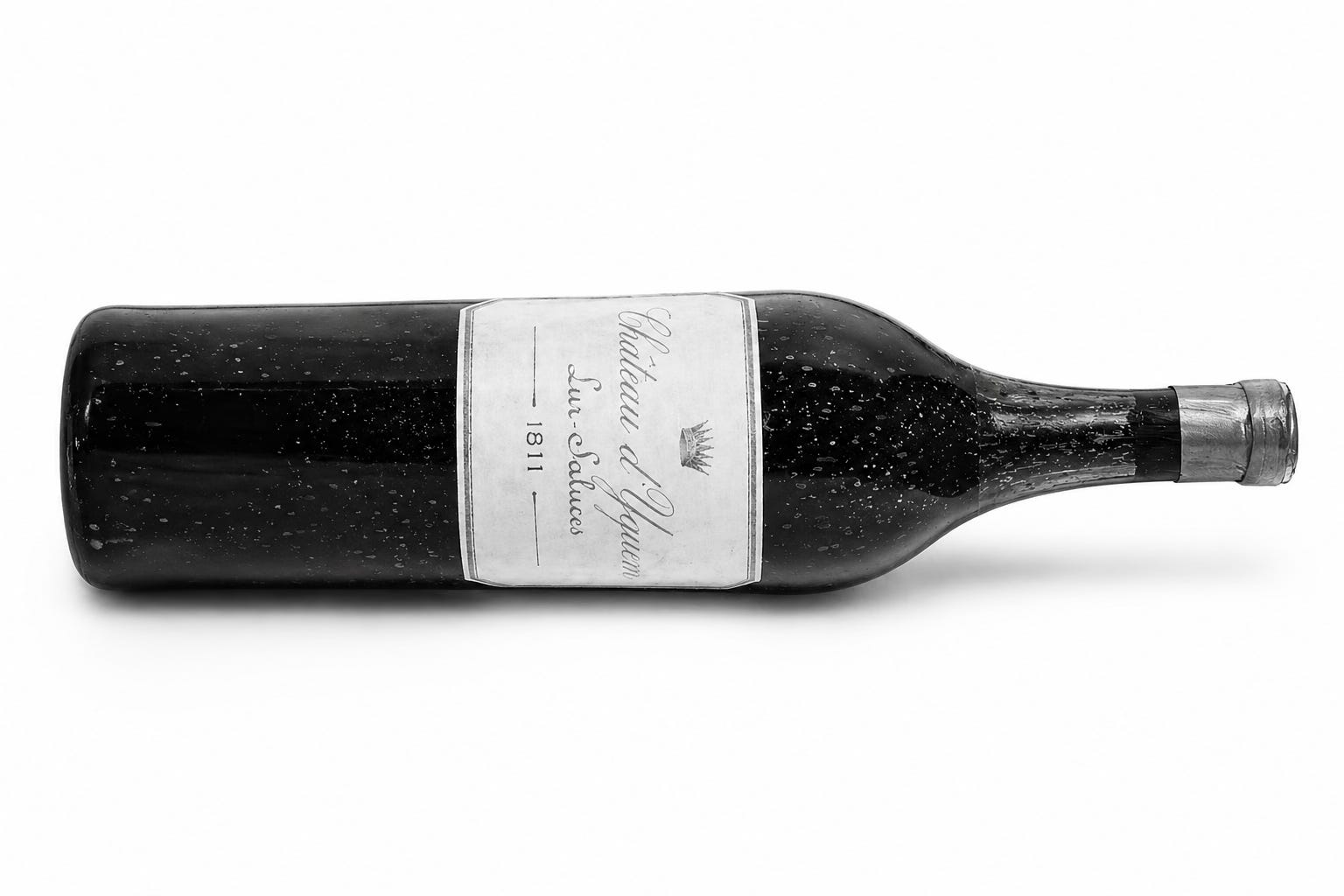
On 31 May, near Montpellier, a bottle of Château d’Yquem 1811 will be presented at auction by Farran Enchères. More than a rare lot, it represents a convergence of viticultural history, market mythology, and the enduring question of what defines value in wine over time.
A Vintage That Transcends Chronology
The 1811 vintage occupies a singular place in the history of wine. Often referred to as the “comet vintage,” it coincided with the passage of a visible celestial event that became, retrospectively, part of its identity. Beyond symbolism, the year was marked by highly favorable climatic conditions, allowing for exceptional grape concentration and balance.
In Sauternes, where the equilibrium between botrytis, sugar, and acidity determines longevity, such conditions proved decisive. Wines from this year have demonstrated an ability to persist far beyond conventional expectations, maintaining structural coherence across centuries.
Château d’Yquem, the only white wine classified as Premier Grand Cru Supérieur in 1855, has long been associated with this capacity for endurance. Today, only a limited number of authenticated bottles from the 1811 vintage are believed to remain—likely no more than a handful.
The last documented tasting, in 1998, described a wine that retained both aromatic complexity and structural precision, suggesting that its longevity was not merely theoretical but fully realized.
A Bottle with Provenance and Market History
The bottle offered at auction carries a trajectory as notable as the vintage itself. Formed from hand-blown glass, it has been inspected and authenticated at the château, ensuring continuity between origin and present condition.
Its more recent history is equally well documented. Formerly part of the collection of Christian Vanneque, a prominent figure in the world of sommellerie, the bottle was acquired in 2011 from The Antique Wine Company for $117,000. At that time, it set a record as the most expensive bottle of white wine ever sold, a status formally recognized by Guinness World Records.
Now re-entering the market, it is presented with a low neck fill level, a time-marked label, and a replaced capsule—features consistent with its age, yet indicative of careful preservation over more than two centuries.
Pricing, Rarity, and Market Dynamics
With a starting price of €60,000, the bottle sits within a category where valuation is shaped less by conventional metrics than by scarcity, provenance, and symbolic capital. Unlike younger collectible wines, where pricing often reflects anticipated evolution, here the value lies in historical continuity and the improbability of replacement.
Two distinct buyer profiles typically emerge in such contexts. The first approaches the bottle as an artifact, preserving it as part of a broader collection of historically significant wines. The second views it as a singular sensory opportunity—an irreproducible experience anchored in time.
The tension between these perspectives contributes to the dynamics of bidding, where the decision to open or to conserve becomes part of the object’s meaning.
A Wine Beyond Its Function
The reappearance of Yquem 1811 at auction invites a broader reflection on the nature of fine wine at its highest level. At this stage, the bottle no longer exists solely as a beverage, but as a document—one that records climatic conditions, technical practice, and the passage of time itself.
Its value cannot be reduced to taste alone, nor entirely to rarity. It resides in the intersection of both, sustained by provenance and reinforced by narrative.
In this sense, the upcoming sale is less about price than about continuity. A bottle produced in the early nineteenth century, still intact and circulating within the contemporary market, offers a rare form of connection—between eras, between practices, and between those who choose to preserve and those who choose to experience.