
The Return of Yquem 1811: A Bottle Beyond Time
One of the rarest surviving bottles of Château d’Yquem returns to auction, carrying over two centuries of wine history
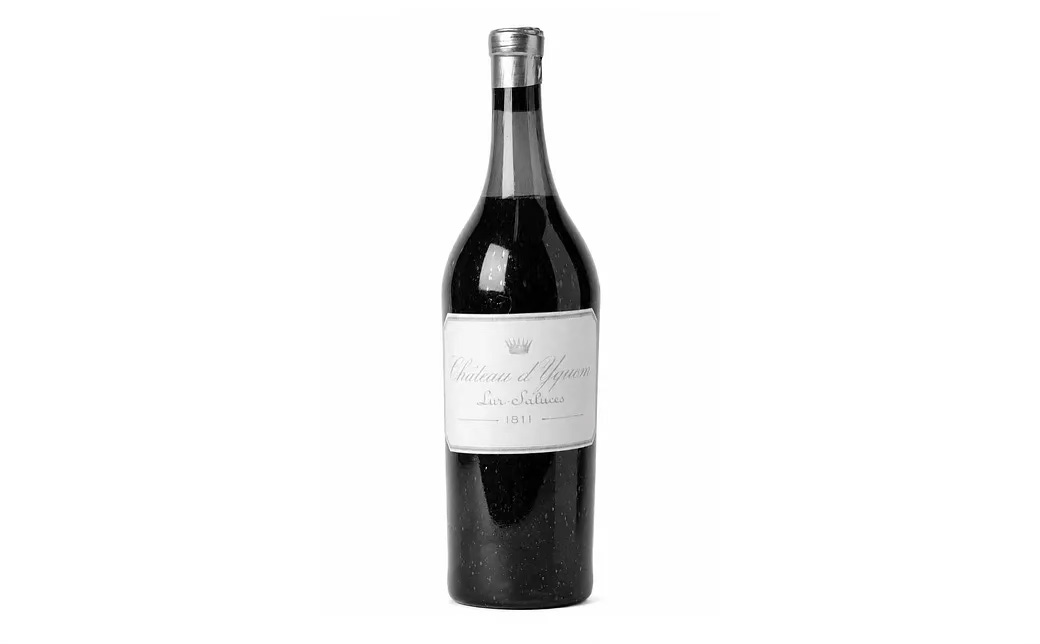
In the world of fine wine, rarity alone does not create significance. True significance emerges when rarity intersects with history, provenance, and enduring cultural relevance. Such is the case with a bottle of Château d’Yquem 1811 scheduled to appear at auction near Montpellier on 31 May.
More than two centuries after its harvest, the bottle stands as a tangible link to one of the most celebrated vintages in the history of European wine. It is also a reminder that certain wines transcend their original purpose, becoming historical artefacts as much as beverages.
For collectors of Bordeaux, students of wine history, and admirers of exceptional provenance, the reappearance of an authenticated Yquem 1811 represents a noteworthy event.
Why the 1811 Vintage Still Captivates Wine Historians
Few vintages occupy such a prominent place in the collective memory of the wine world as 1811.
Often referred to as the “Comet Vintage,” the year coincided with the appearance of the Great Comet of 1811, an astronomical event visible across Europe for many months. Over time, the coincidence between the comet and the exceptional quality of the harvest became part of wine folklore.
Yet the reputation of 1811 rests on more than mythology.
Across several European wine regions, growing conditions proved remarkably favourable. Warm temperatures, a long ripening season, and healthy fruit development produced wines noted for concentration, balance, and extraordinary longevity. The vintage earned acclaim in Bordeaux, Germany, and parts of France long before modern critics and scoring systems existed.
Few wines have carried the reputation of the year more successfully than Château d’Yquem.
Château d’Yquem and the Question of Longevity
Within Bordeaux, Château d’Yquem occupies a unique position.
The estate remains the only wine to have received the designation of Premier Cru Supérieur in the 1855 Bordeaux Classification, a distinction that reflected its exceptional reputation even in the nineteenth century. Located in the heart of Sauternes, Yquem benefits from a singular combination of terroir, microclimate, and viticultural precision that allows the development of noble rot while preserving freshness and structure.
The resulting wines possess an uncommon capacity for ageing.
Unlike many great wines that gradually surrender their vitality over decades, the finest vintages of Yquem often evolve over generations. Their balance of sweetness, acidity, concentration, and extract allows them to remain coherent long after most wines have faded from existence.
The survival of authentic bottles from 1811 is therefore not entirely surprising. What remains remarkable is the quality in which some examples have endured.
One of the World’s Rarest Surviving Bottles
The bottle coming to auction belongs to an exceptionally small group of authenticated survivors.
Specialists estimate that only a handful of genuine examples from the 1811 vintage remain in private collections and institutional holdings. Each bottle is therefore evaluated not merely as wine but as a historical object.
Authentication is particularly important for wines of this age. Provenance, bottle construction, fill level, capsule condition, and château verification all contribute to establishing legitimacy.
This example benefits from a documented history. Produced in a hand-blown bottle and later examined at the château, it underwent scrutiny designed to confirm its authenticity and historical consistency. Such verification is essential in the ultra-rare wine market, where provenance frequently carries as much significance as the wine itself.
The Christian Vanneque Provenance
The bottle’s modern history is closely associated with Christian Vanneque, one of the most recognizable figures in the international wine trade and fine-dining world.
A former sommelier at the legendary Paris institution La Tour d’Argent, Vanneque acquired the bottle in 2011 through the specialist merchant The Antique Wine Company. At the time, the purchase attracted international attention because of the price achieved and the bottle’s exceptional rarity.
The acquisition established the wine as one of the most valuable white wine bottles ever sold, reinforcing the status of Yquem 1811 as a benchmark in the market for museum-grade wines.
Today, that provenance remains an important component of the bottle’s appeal. In the world of collectible wine, documented ownership often adds another layer of historical significance.
Condition and Conservation After More Than Two Centuries
For wines exceeding two hundred years of age, condition becomes a central consideration.
The bottle offered for sale presents a low-neck fill level, a naturally aged label, and a renewed capsule. These features are consistent with a wine that has travelled through generations while remaining identifiable and remarkably intact.
No serious collector expects a bottle of this age to appear in pristine condition. Instead, specialists assess whether the signs of ageing remain compatible with authenticity and careful conservation.
Viewed from this perspective, the survival of the bottle is itself notable. Every surviving nineteenth-century wine represents a triumph of storage, stewardship, and circumstance.
Collecting Versus Tasting
Whenever a wine of this calibre returns to the market, a familiar question emerges: should such a bottle be preserved or opened?
The answer often depends on the buyer.
Some collectors view rare wines as cultural artefacts whose value lies primarily in preservation. Others regard them as living expressions of history, believing their ultimate purpose remains consumption, even after centuries.
Both perspectives coexist within the fine wine world. The tension between collecting and tasting has become part of the identity of rare wine auctions, particularly when bottles achieve a level of scarcity that places them beyond ordinary market categories.
An authenticated Yquem 1811 sits precisely at that intersection.
A Piece of Wine History
The upcoming sale near Montpellier is not simply another auction lot. It is a reminder of wine’s unique ability to connect generations.
Most agricultural products disappear within months of production. Great wine operates on a different timescale. Certain bottles survive political upheavals, technological revolutions, changing tastes, and the passage of centuries.
The continued fascination surrounding Château d’Yquem 1811 reflects more than rarity or monetary value. It reflects the enduring appeal of wines capable of carrying a story across time.
For collectors, historians, and lovers of Bordeaux alike, few bottles illustrate that idea more powerfully than an authentic Yquem from the legendary vintage of 1811.