
Wildfire Smoke Taint in Grapes: How Distance, Wind and Vine Growth Stage Shape the Risk
New French vineyard data shows smoke-taint risk falls sharply with distance from flames, but wind, terrain and ripeness still matter.
As wildfires become an increasingly serious threat to wine regions, one question is becoming critical for growers: how close does a vineyard need to be to a fire before smoke contamination puts the harvest at risk?
Data gathered by France’s Dubernet laboratories is beginning to provide a clearer answer. Based on thousands of analyses carried out following recent fires, the risk of smoke taint appears to be highly concentrated around the actual footprint of a wildfire.
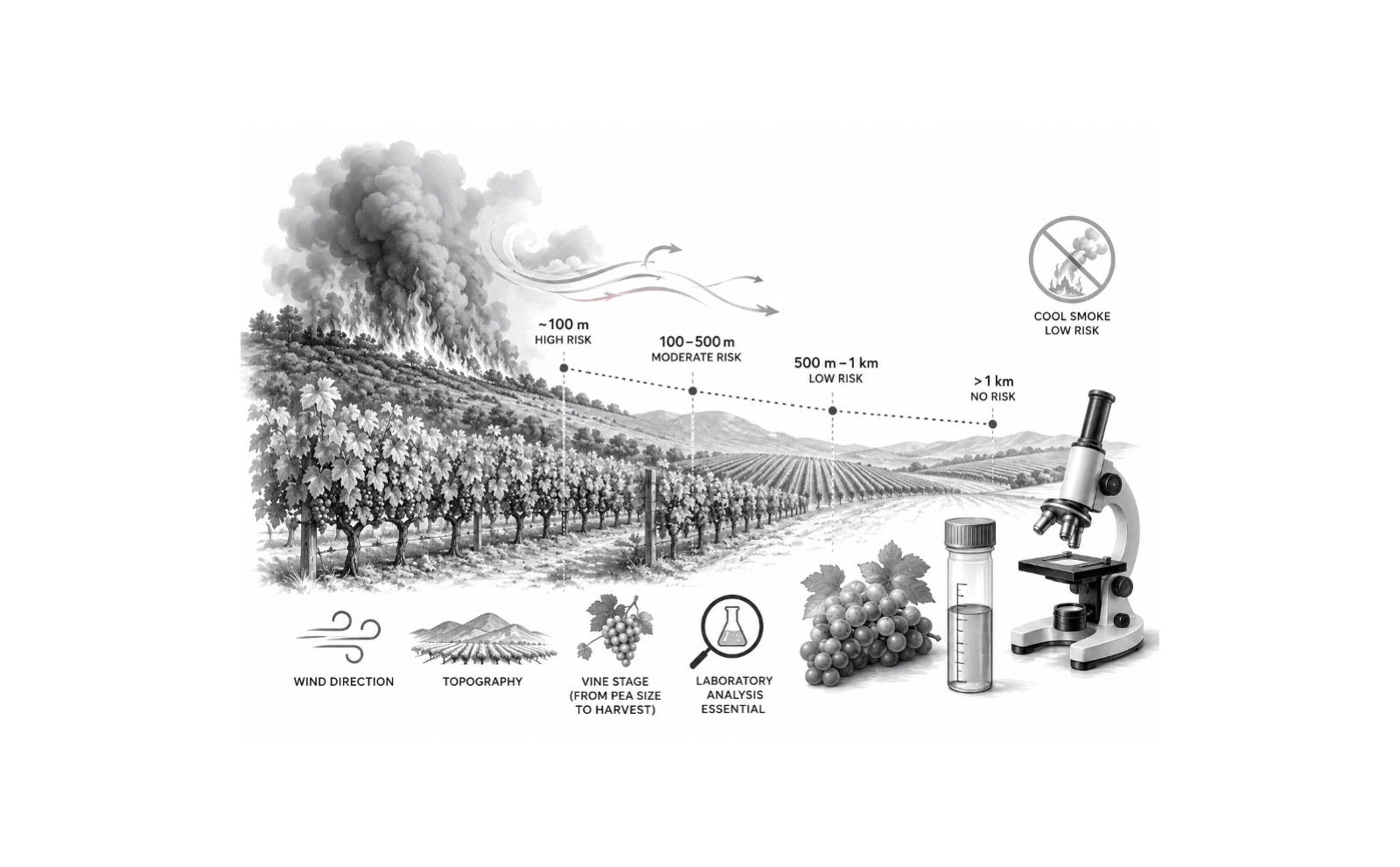
At around 100 metres from the fire front, the danger can be significant. Between 100 and 500 metres, contamination risk falls markedly. Beyond roughly 500 metres—and in many situations beyond one kilometre—analyses generally return to background or very low-risk levels, even when the smoke comes from a so-called megafire.
But distance alone cannot determine whether grapes are safe. Wind direction, vineyard topography, smoke temperature and the vine’s phenological stage can all influence exposure. And because the compounds responsible for smoke taint can be effectively invisible to the senses until winemaking begins, laboratory testing remains essential.
Wildfires raise new questions for French vineyards
With around 87,000 hectares already burned in France in 2026, concern over smoke contamination has moved to a new level for the wine sector.
Wildfires have affected or threatened vineyards across several regions, including the Pyrénées-Orientales, Aude, Gironde, Var and Burgundy, forcing winegrowers to assess not only direct fire damage but also the less visible consequences of smoke exposure.
According to Matthieu Dubernet, head of Laboratoires Dubernet, experience accumulated through the Viti-incendiemonitoring initiative following the Corbières fire has made it possible to establish increasingly useful benchmarks for growers.
Those findings were presented during an August 10 webinar aimed at winegrowers facing wildfire-related risks.
One of the most important conclusions is reassuring: not all smoke carries the same threat to grapes.
Hot wildfire smoke poses a greater smoke-taint risk
Dubernet’s observations distinguish between hot smoke generated close to an active fire and cooler smoke that may travel tens or even hundreds of kilometres.
Hot smoke from a nearby fire is considerably more concerning because it can deposit combustion-derived compounds directly onto grapes.
When woody material burns, lignin breaks down and generates volatile phenols including guaiacols, eugenol and syringol. These compounds and their derivatives are closely associated with the smoky, ashy or medicinal characters that may later emerge in wine.
Cooler smoke transported across long distances, by contrast, does not appear to produce the same level of contamination in most situations.
Dubernet believes, for example, that smoke from a major fire in Gironde would not normally be expected to contaminate grapes in vineyards around the Mediterranean simply because the smoke plume travelled that far.
Nevertheless, the laboratory stresses that assumptions based on distance or smoke movement should ultimately be confirmed through analysis.
How far from a wildfire are grapes at risk of smoke taint?
Perhaps the most useful finding for growers is the relationship between distance from the fire front and smoke-taint risk.
Vincent Bouazza, head of Dubernet’s fine chemistry unit, says the geographic footprint of smoke-related compounds in grapes closely mirrors the actual area affected by the fire.
Thousands of samples analysed by the laboratory in 2025 were classified on a contamination-risk scale from 0 to 4, based on the combined concentration of glycosylated smoke compounds.
Category 3 grapes contained approximately 100 to 200 parts per billion, indicating a very high risk of contamination. Category 4 samples exceeded 200 ppb, representing a critical risk.
Crucially, grapes placed in categories 3 and 4 came from areas directly affected by the fire.
Samples taken between 100 and 500 metres from the wildfire front were classified only in categories 1 or 2.
Beyond about 500 metres, and potentially as far as one kilometre where unfavourable winds push hot smoke toward a vineyard, results generally fell back to categories 0 or 1.
The implication is significant: the size of the wildfire itself does not automatically determine smoke-taint risk. Even a huge fire may have relatively little effect on grapes sufficiently far from its active perimeter.
Why wildfire smoke maps cannot predict wine contamination on their own
Satellite technology can help growers identify where smoke has travelled, but a visible smoke plume does not provide a definitive diagnosis of smoke taint.
The Viti-incendie platform uses smoke mapping based partly on carbon monoxide emissions measured by France’s CNES space agency. These maps can help winegrowers decide which vineyard blocks should be sampled first.
However, Dubernet warns against treating carbon monoxide concentration as a direct proxy for smoke-taint compounds in grapes.
In some cases, laboratory tests have placed grapes in relatively low-risk categories even in vineyard blocks that appeared highly exposed to carbon monoxide. The reverse has also occurred.
Smoke maps are therefore valuable as a sampling tool rather than a substitute for grape analysis.
To assess contamination accurately, laboratories need to measure smoke-derived compounds directly in fruit.
Glycosylated compounds are key to detecting smoke taint in grapes
For grape testing, Dubernet focuses particularly on glycosylated compounds.
When grapevines absorb volatile phenols generated by smoke, the plant can bind these compounds to sugars through glycosylation. This process helps the vine neutralise their phytotoxic effects.
The difficulty for winemakers is that glycosylation can also make the compounds effectively odourless in the grape.
That means tasting berries in the vineyard may provide false reassurance. Grapes can taste apparently normal even when they contain precursors capable of releasing smoky characters later.
The hidden compounds may become perceptible during several stages of a wine’s life.
During alcoholic fermentation, enzymes from yeast can break glycosidic bonds and release volatile smoke compounds. Further release may occur slowly during ageing through acid hydrolysis.
Some compounds can even become perceptible only when the wine is consumed, as enzymes present in saliva release volatile phenols in the mouth.
This delayed expression is one reason why laboratory analysis is so important after a vineyard has experienced significant wildfire smoke exposure.
Baseline vineyard data matters when testing for smoke contamination
Detecting the presence of smoke-associated compounds is only part of the diagnostic process.
Dubernet stresses that test results must be interpreted against reference concentrations found naturally in grapes from unaffected vineyards.
Before the 2025 harvest, the laboratory sampled several grape varieties from healthy vineyard sites that had not been exposed to fires. That work helped establish baseline values against which potentially contaminated fruit could be compared.
The principle is important because the detection of a compound does not necessarily mean that a wine will develop obvious smoke taint. Interpretation depends on concentrations, combinations of compounds and background levels.
For wine samples, testing may also include the measurement of free volatile forms, providing another layer of information once fermentation has begun.
How winegrowers should sample vineyards after a wildfire
The quality of the diagnosis also depends heavily on the way grape samples are collected.
Dubernet recommends approaching smoke-taint sampling in much the same way as a standard grape maturity assessment: the sample needs to represent the fruit that will actually enter the winery.
That means growers should avoid including grapes that have suffered direct heat damage and are unlikely to be harvested.
According to the laboratory’s recommendations, vine rows visibly scorched by heat should be excluded, along with the following five rows, when constructing a representative sample for analysis.
The objective is not simply to find the most contaminated berries in a vineyard. It is to understand the likely contamination level of the grapes destined for vinification.
Wind direction can dramatically change smoke exposure
Two vineyard blocks located at similar distances from a wildfire may experience very different levels of smoke contamination.
Wind direction is one of the main reasons.
A vineyard positioned directly downwind of an active fire is more exposed to hot smoke and combustion compounds than a block situated perpendicular to the prevailing airflow.
This helps explain why distance thresholds should never be interpreted too mechanically.
A vineyard 500 metres from the flames in the direct path of smoke could potentially warrant greater attention than another site at a similar distance but outside the main plume.
Where adverse winds are involved, Dubernet’s observations suggest that precautionary testing may remain appropriate out to approximately one kilometre.
Vineyard topography can protect—or expose—grapes
Terrain also affects how smoke reaches a vineyard.
A ridge, slope or other landscape feature can act as a partial barrier, reducing the amount of hot smoke settling on grapes behind it.
Conversely, local topography may channel smoke into particular vineyard blocks, increasing exposure even when nearby sites are less affected.
For growers assessing wildfire smoke-taint risk, that means a simple radius drawn around the fire perimeter will never tell the whole story.
The most useful assessment combines distance, wind direction, topography and laboratory analysis.
Vines become especially vulnerable after véraison
Timing is another crucial variable.
According to Dubernet, grapevines become sensitive to smoke exposure from around the pea-size berry stage.
The danger then becomes particularly important from approximately seven days after véraison until harvest.
That window is especially relevant for wine regions experiencing wildfires late in summer, when grapes are approaching maturity and harvest may be only weeks away.
A fire occurring during this sensitive period can therefore represent a greater threat to wine quality than a similar smoke event much earlier in the growing season.
For producers facing fires close to harvest, rapid identification of the most exposed vineyard blocks can help determine where testing should be prioritised.
Smoke taint cannot be diagnosed simply by tasting grapes
One of the most dangerous misconceptions surrounding wildfire exposure is that contaminated grapes should smell or taste smoky.
Often, they do not.
Because the grapevine binds many volatile phenols into glycosylated forms, the compounds may lose their obvious aroma before harvest.
That creates a potentially deceptive situation: a grower can taste fruit that seems perfectly clean, only for smoke-related aromas to emerge during fermentation, maturation or even when the finished wine is in the consumer’s mouth.
For that reason, sensory assessment in the vineyard is not enough to rule out contamination when grapes have been exposed to significant hot smoke.
Chemical analysis provides a much stronger basis for decisions about harvesting, vineyard segregation and vinification.
A more precise picture of wildfire risk for the wine industry
The growing body of research offers both reassurance and a warning for wine producers.
The reassuring part is that wildfire smoke does not automatically mean contaminated grapes. A dramatic plume visible across an entire wine region may create widespread concern without producing equally widespread smoke taint.
The highest contamination levels observed by Dubernet remain closely associated with areas directly affected by fire, while risk falls sharply with increasing distance.
At the same time, there is no single universal distance at which growers can stop paying attention.
A vineyard’s position relative to the wind, surrounding relief and the stage of grape development can all alter its exposure. In unfavourable circumstances, testing may still be justified at distances approaching a kilometre from the fire front.
For wineries confronting increasingly frequent summer wildfires, the emerging message is therefore more nuanced than simply “smoke equals smoke taint.”
Proximity to hot smoke matters most. But understanding the real risk requires knowing where the smoke travelled, how the vineyard was exposed, when that exposure occurred—and what is actually present inside the grapes.