
Why Riddling Sparkling Wines Is Becoming More Difficult
Sparkling wine producers face growing riddling challenges as climate change, calcium levels, pectins, Brettanomyces, and blocked malo reshape base wine stability.
For generations, riddling has been treated as one of the quiet certainties of traditional-method sparkling wine. After the second fermentation, the bottle is gradually turned and tilted until the deposit gathers neatly in the neck, ready to be expelled at disgorgement. It looks methodical, almost mechanical. Yet in practice, it is anything but automatic.
Nicolas François, director general of the Champagne Oenotechnical Station, is seeing that reality become more visible. Across Champagne and the crémant-producing regions, producers are asking for sparkling wines that are clearer, cleaner, and finished faster than ever before. Some want riddling completed in less than two days. Trials are even being carried out for one client who hopes to finish the process in a single day.
The ambition is understandable. Modern markets reward visual perfection, speed, and consistency. But riddling is not filtration. It cannot simply be accelerated by command. It is a physical process governed by gravity, the structure of the wine, the behaviour of yeast, and the condition of the deposit. The lees must move, collect, and settle. Nature, François argues, does not always cooperate with the pace now being demanded of it.
The problem is not caused by one factor alone. Climate change, reduced use of winemaking inputs, microbiological instability, and new stylistic choices are converging in the same bottle. The result is that wines are increasingly difficult to riddle, even when producers expect the operation to remain standardized and predictable.
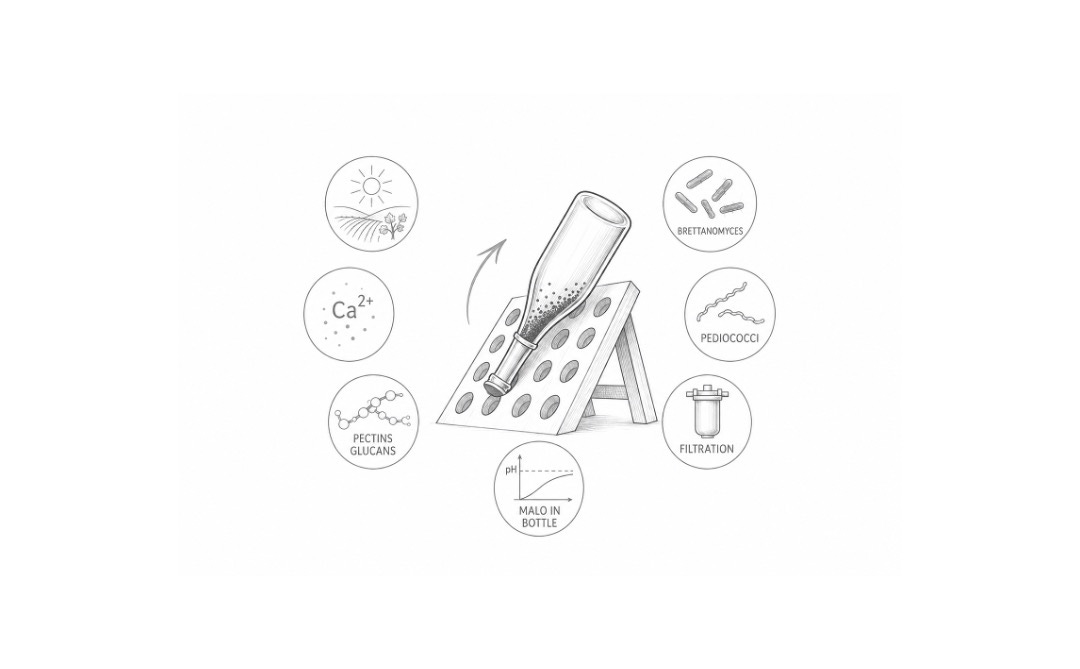
One of the clearest changes concerns calcium. As growing seasons become warmer and vines face more stress, grape skins appear to accumulate more calcium. The berry uses calcium as part of its response to difficult conditions, and vineyard treatments based on calcium are also becoming more common because they help strengthen grape skins. The consequence is that musts are arriving in the cellar with steadily rising calcium levels.
At high concentrations, calcium can create its own stability problems, including calcium precipitations. But its effect on riddling is more subtle. Yeast cells absorb calcium onto their membranes. Because calcium carries a positive charge, it reinforces the positive character of the yeast surface. Glass, by contrast, is negatively charged. The interaction encourages yeast to cling more stubbornly to the inside of the bottle. When that happens, the deposit becomes less willing to slide and collect in the neck, and riddling takes longer.
At the same time, warmer conditions are changing the structure of the musts in other ways. Grape skins are often tougher, and the musts may contain higher levels of pectin-glucan compounds as well as more unstable proteins. These pectin-glucans interfere with the normal sedimentation of the deposit, making it harder for the lees to compact and move cleanly.
Bentonite remains highly effective against this difficulty. In fact, François notes that bentonite can act on pectin-glucans even before it deals with proteins. This means that when a wine treated with bentonite still proves unstable from a protein standpoint, the explanation may be that much of the bentonite’s action has already been taken up by pectin-glucans. These compounds can also be reduced at the must stage through enzyme treatment. Yet this solution runs into another major trend: many winegrowers want to use less bentonite and fewer processing aids.
The industry is therefore caught between competing objectives. Producers want minimal intervention, greater purity, rapid riddling, perfect clarity, and long-term stability. Each goal is defensible. Together, they create tension.
Microbiology adds another layer of difficulty. François is again seeing the development of pediococci, bacteria capable of producing the condition often described as “ropiness” or “grease” after the secondary fermentation. In these cases, the wine can become texturally compromised, and the riddling process is made more troublesome.
He is also observing phenolic off-flavours in some rosé Champagnes and crémants after disgorgement. The likely cause lies in the way colour is sometimes adjusted at the end of production. When red wine is used during the addition of the dosage, it can bring phenolic acids into the final blend. If the red wine is contaminated with Brettanomyces, or if Brettanomyces is already present in the bottled wine, those phenolic acids can be transformed into ethylphenols. The result is the appearance of phenolic aromas and flavours that are unwelcome in finished sparkling wine.
The preventive options are well known. Wines can be filtered, or they can be treated with chitosan, which François describes as an excellent tool for removing Brettanomyces. But here again, the broader issue is not simply one treatment or one organism. It is the growing need to manage base wines with greater precision before tirage, because problems that enter the bottle may become far harder to solve later.
Recent analyses have reinforced this concern. At the beginning of the year, the Champagne Oenotechnical Station examined one hundred Champagne base wines. The findings were striking: 75 percent contained Brettanomyces, in some cases at levels reaching one million cells per millilitre. These organisms do not necessarily produce obvious sensory faults in white wines. Even so, they are not harmless. Brettanomyces can form biofilms that adhere to glass, and those films can further complicate riddling by making deposits stick more readily to the bottle surface.
Malolactic fermentation presents another modern dilemma. More producers now choose to block malolactic fermentation in order to preserve freshness. Stylistically, that choice can make sense, especially as warmer growing conditions push wines toward greater ripeness. But blocking malolactic fermentation requires discipline. If the wine has not completed malolactic fermentation before tirage, all bacteria must be removed beforehand, ideally through sterile filtration.
If bacteria remain in the wine, and if the pH is even slightly elevated, malolactic fermentation may begin in the bottle. Once that happens during the prise de mousse, riddling can become extremely difficult. François suggests that earlier generations may have understood this practical risk very well. Their preference for ensuring malolactic fermentation in tank may not have been driven only by a desire to soften acidity. It may also have been a way to avoid the much greater problem of malolactic activity occurring during bottle fermentation. If acidity is lacking, he argues, it is better to correct it directly than to allow microbiological uncertainty to move into the bottle.
Despite all these complications, François does not describe riddling failure as common. Nearly all wines can ultimately be riddled. The major exception is a wine that suffers a protein break while ageing on lees. In that situation, flakes remain suspended in the wine and cannot be gathered properly into the neck. Outside that specific case, the deposit can generally be collected and the wine clarified. The real issue is time. The wine may be capable of riddling, but not at the speed the producer expects.
That distinction matters. Riddling is often imagined as a fixed mechanical procedure: load the bottles, set the program, collect the sediment, and move on. François rejects that view. Each wine arrives with its own history. Its must composition, treatments, microbial status, malolactic choices, protein stability, calcium level, and colloidal structure all influence how it behaves in bottle. Riddling must therefore be adapted to the wine, not imposed on it as though every batch were identical.
There is also a philosophical question hidden inside the technical one. Traditional-method sparkling wine is not the same as tank-method sparkling wine. A tiny stray yeast cell visible under close inspection is not necessarily a scandal; it is, in a way, evidence of the process that made the wine. If absolute visual perfection is the only objective, François suggests that the tank method followed by filtration before bottling is the more logical route. Traditional method carries with it a living history inside the bottle, and that history cannot always be made invisible.
Still, accepting the nature of the method does not mean ignoring preventable problems. The path forward is clear: musts and wines need to be stabilized against precipitation, protected against microbial development, and prepared intelligently before tirage. Filtration before bottling is strongly advised. If malolactic fermentation has not occurred, sterile filtration is essential. If malolactic fermentation has already taken place, filtration remains useful for removing yeasts and reducing future complications.
The broader message is that riddling problems do not begin at riddling. They are built earlier, in the vineyard, in the must, in the base wine, and in the decisions made before tirage. As climate change alters grape composition and producers pursue lower-input winemaking, the final bottle becomes less forgiving. Faster riddling and flawless clarity are possible only when the wine has been prepared for them.
The bottle may look like the final stage of the process. In reality, by the time it reaches the riddling rack, most of its behaviour has already been decided.