
When does imitation become counterfeiting?
Explore the history of French wine authenticity, from Audibert's 1882 imitation wine manual to the Rudy Kurniawan scandal.
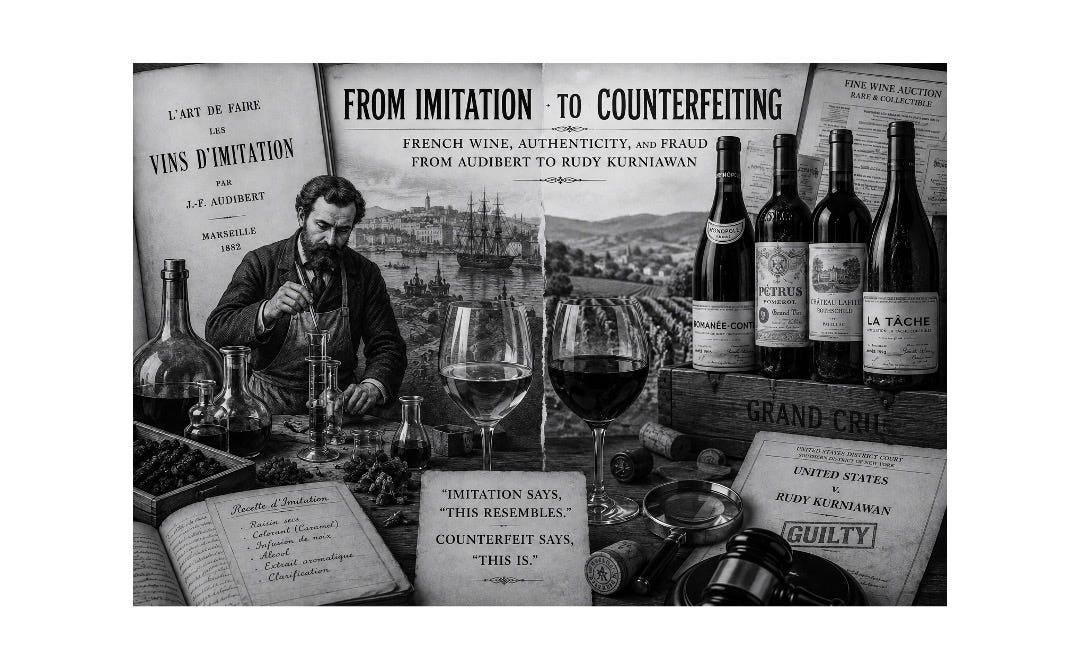
Wine fraud is often imagined as a modern luxury crime: a rare Burgundy bottle, a billionaire collector, a forged label, and a cellar full of secrets. But the imitation of famous wines has a much longer history. Long before Rudy Kurniawan rebottled cheaper wine as grand cru Burgundy and first-growth Bordeaux, nineteenth-century merchants and manufacturers were openly studying how to reproduce the taste, color, strength, sweetness, and aroma of prestigious regional styles. The difference between those two worlds—commercial imitation and criminal counterfeiting—is not merely technical. It is a story about scarcity, regulation, naming, and the changing meaning of authenticity.
French wine’s prestige has long depended on more than fermented grape juice. A famous name—Lafite, Romanée-Conti—carries geography, reputation, scarcity, memory, and price. That is why such names attract imitators. In a legitimate setting, imitation may mean a disclosed substitute: a wine made “in the style of” Bordeaux, Burgundy, or Champagne, intended for consumers who want an affordable resemblance rather than an authentic origin. In a fraudulent setting, imitation becomes counterfeit: the bottle is made to deceive, and the famous name is stolen.
Joseph-François Audibert’s L’Art de faire les vins d’imitation (The Art of Making Imitation Wines), first published in 1882, appears to belong to the first category. Yet it now makes uncomfortable reading precisely because it shows how easily commercial imitation could approach the boundary of fraud.
Audibert was not writing as a romantic vigneron. He was a merchant-technician from Marseille, a port city ideally placed for the import of dried grapes from the eastern Mediterranean. In his earlier work on making wine from raisins, he styled himself as the “creator and promoter” in France of that industry. He explicitly framed raisin wine as a response to shortage: its purpose, he wrote, was to supplement fresh-grape wines at a time when phylloxera had caused scarcity. He also argued that raisin wines could be blended into ordinary wines, used commercially, and serve as a base for imitations of Malaga, Madeira, Jerez, Port, Muscat, and similar styles.
The phylloxera crisis helps explain why such a manual could be both commercially useful and morally ambiguous. In the late nineteenth century, the parasitic vine aphid devastated French vineyards, causing a dramatic fall in production. INAO, France’s national institute for origin and quality, describes the later appellation system as a response to a chain of crises: phylloxera, recovery, imports, overproduction, fraud, and collapsing prices. In that world, imitation was not simply a trick. It was also an answer to a market problem: consumers still wanted wine, merchants still needed stock, and familiar names still sold.
The scale of substitute production was significant. A historical study of wine falsification in France between 1880 and 1905 notes that raisin wine was made by fermenting dried grapes with water, sometimes with added sugar, and that the success of Audibert’s book testified to public and commercial interest in the practice. The same study reports that French imports of dried grapes rose from about 8 million kilograms before phylloxera to 50 million in the early 1880s and 65 million in 1885. In the second half of the 1880s, when French wine production fluctuated between 25 and 30 million hectoliters, raisin and sugar wines represented several million additional hectoliters.
Audibert’s imitation manual should therefore be read as a technical manual for industrial beverage production rather than a vineyard book. Its table of contents and index point to a world of production based on fermentation management, fortification, coloring, clarification, flavoring, botanical infusions, syrups, liqueurs, spirits, and commercial standardization. The index for the 1882 edition includes terms such as caramel, cochineal, colorant, vermouth, Champagne wine, sparkling wines, dried grapes, fermentation, clarification, cognac, rum, kirsch, absinthe, hyssop, rosemary, saffron, citrus zest, coriander, cinnamon, and nutmeg. The later 1896 edition further shows the book’s interest in specific styles, preservation, alcohol treatment, and flavoring materials.
The phrase vins d’imitation did not automatically mean “fake wine” in the modern criminal sense. It meant wines engineered to resemble recognized types. That distinction matters. If a merchant sold a disclosed imitation Madeira as an affordable substitute, the product belonged to the broad nineteenth-century universe of manufactured beverages. If the same beverage was sold as true Madeira, or if an imitation Bordeaux or Burgundy was presented as the real estate wine, the act crossed into fraud. The same liquid could be either a substitute or a deception depending on its label, presentation, and commercial intent.
That tension becomes unmistakable in Chapter IX, Imitation de Crus et Vins célèbres (Imitation of Famous Wine Regions and Wines). The chapter sits exactly on the fault line between style and origin, imitation and fraud. It is historically fascinating because it treats regional identity as something that can be analyzed and reconstructed: body, color, sweetness, acidity, aroma, bitterness, alcoholic strength, and the impression of age. For a modern reader raised on terroir, this is almost shocking. Appellation culture teaches that wine expresses place: soil, climate, grape variety, local practice, vintage, and producer. Audibert’s world suggests the reverse: that a famous wine can be treated as a profile, and that a profile can be assembled in the workshop.
This is why the manual is so valuable for historians of authenticity. It captures a period before modern labeling rules had fully hardened the boundary between origin and style. The French state itself struggled with that boundary. Administrations disagreed over whether raisin wines and artificial wines should be treated like wine for tax purposes or like alcohol mixtures. One study notes that fiscal authorities sometimes taxed as wine any beverage that, by nature, name, and use, took on the character of wine, while customs officials viewed artificial wines—such as raisin wines or watered wines strengthened with alcohol—as alcohol mixtures. The debate was not simply a matter of “market versus state”; it involved taxation, public health, chemistry, consumer protection, and the survival of growers.
By the 1890s, however, the legal atmosphere had changed. As French production recovered, tolerance for artificial wines narrowed. The same historical study describes a movement away from uncertain civil and fiscal approaches and toward more penal treatment of “false wines,” with laws in the 1890s restricting watering, fortification, and the industrial sale of raisin and other artificial wines. INAO’s history places the 1905 law on fraud repression at the beginning of the modern appellation story: it created administrative appellations and allowed the state to delimit areas entitled to an origin name. The first decrees concerned Champagne, Cognac, and Bordeaux, and the 1919 law further protected producers attached to appellations by establishing a collective right in the name.
That legal evolution transformed the status of imitation. In Audibert’s time, the name of a region could still function partly as a style category in commerce. Under appellation law, it increasingly became a protected claim about origin and method. The more law and culture invested in origin, the more profitable counterfeiting became. A famous French bottle no longer represented only a flavor profile; it represented scarcity, estate history, vintage, legal identity, and provenance. The market had moved from imitating taste to imitating trust.
Rudy Kurniawan’s case is the modern mirror image of Audibert’s world. Kurniawan did not publish an industrial manual or advertise economical substitutes. According to the U.S. Department of Justice, he manufactured counterfeit bottles at his home in Arcadia, California, mixed lower-priced wines to mimic rare and expensive wines, poured them into empty bottles of prestigious wines, fitted them with corks and counterfeit labels, and sold them through auctions and direct sales to wealthy collectors. In December 2013 he was found guilty after trial, and in August 2014 he was sentenced to ten years in prison. He was also ordered to forfeit $20 million and pay more than $28 million in restitution.
The Kurniawan scandal shows that the most valuable component of a counterfeit wine is not always the wine. It is the bottle’s story. Old glass, convincing labels, plausible corks, auction catalogues, collector friendships, cellar rumors, and the social confidence of the fine-wine world all helped make the deception possible. In the nineteenth century, Audibert’s recipes aimed to reproduce a sensory resemblance. In the twenty-first century, Kurniawan’s work aimed to reproduce provenance. The palate mattered, but the paperwork and theatre of rarity mattered just as much.
The Kurniawan affair also illustrates why certain French wines remain especially vulnerable to counterfeiting. Burgundy, with its tiny parcels, changing ownership, old négociant bottlings, and scarce grand cru wines, is especially difficult for outsiders to master. Kurniawan’s undoing is often linked to Domaine Ponsot. In 2008, bottles attributed to Domaine Ponsot Clos Saint-Denis from vintages before the domaine had made that wine drew scrutiny, and Laurent Ponsot intervened before the bottles could be sold. The contested bottles included Clos Saint-Denis from 1945 through 1971, although the winery had not started making Clos Saint-Denis until the 1980s. A counterfeit can imitate paper and glass, but it can still fail against institutional memory.
The moral contrast between Audibert and Kurniawan should not be overstated, but neither should it be ignored. Audibert belonged to an age when “wine” itself was being debated. Was wine only fermented fresh grape juice? Could raisin wine count? Could sugar, color, fortification, and botanical flavoring produce a legitimate commercial beverage? Kurniawan operated in a market where the rules were far clearer. By then, no informed collector could reasonably believe that a homemade blend in a reused bottle could honestly become Domaine de la Romanée-Conti, Ponsot, Roumier, Pétrus, Mouton-Rothschild, or Lafite. Modern counterfeiting depends on violating precisely the legal and cultural protections that emerged from earlier crises.
Yet the continuity is revealing. Both the nineteenth-century imitation industry and modern fine-wine fraud begin with the same observation: famous wines have recognizable identities that consumers will pay for. They differ in disclosure. Imitation says, “This resembles.” Counterfeit says, “This is.” The first can belong to industrial food history; the second belongs to deception, theft, and reputational damage.
Today, the fight against wine fraud uses tools Audibert could not have imagined: isotope analysis, trace elements, supply-chain traceability, digital records, specialist authentication, and producer archives. The OIV has emphasized international standards for product definitions, oenological practices, labeling rules, traceability, analytical standards, and authenticity testing, including isotopic signatures and geographic markers. These methods are modern answers to an old problem: how to prove that a wine is what it claims to be.
L’Art de faire les vins d’imitation was first published in 1882. The translation of chapter IX presented after this essay is based on the revised 1896 edition. The chapter is not merely a collection of recipes. It is a remarkable historical document that reveals how nineteenth-century manufacturers analyzed famous wines as sensory profiles that could be reconstructed through blending, fortification, coloring, clarification, and aromatization. Read in that context, it is less a handbook of deception than a window into a world that existed before modern appellation law drew clear boundaries around origin. Audibert shows us how nineteenth-century manufacturers thought about taste, color, aroma, and regional reputation before appellation law drew sharper lines around origin. Kurniawan shows what happens when those lines are crossed in a luxury market built on scarcity and trust.
The history of French wine counterfeiting and imitation is not just a history of fraudsters. It is a history of how wine became authentic: through crisis, imitation, regulation, prosecution, and memory. Famous French wines became famous because they were difficult to reproduce. Their fame, in turn, made people try.
Chapter IX: Imitation of Famous Wine Regions and Wines
We have found that, using wines made from dried grapes, it is possible to imitate almost perfectly nearly all of France’s esteemed wines: Bordeaux, Burgundy, Saint-Georges, wines from the Var, and others. At first glance such a feat appears impossible. Yet nothing could be more natural.
Wine made from dried grapes that has been “Madeira-treated” (maderized), blended with good Portuguese red wines, and then aromatized, comes remarkably close to Bordeaux. Consequently, what has happened? For several years winegrowers and merchants have made extensive use of Portuguese red wine to replace genuine Bordeaux, which is increasingly sought after and in short supply.
To illustrate the situation, I shall cite a characteristic example. Every year, it is said that the Bordeaux district ships, under official excise certificates and as authentic Bordeaux, more than eight hundred times its actual production. After such an example, there can no longer be any doubt concerning the imitation of Bordeaux, and my readers should therefore not hesitate to experiment with these preparations.
Wine tasting plays an essential role in the manufacture of imitation wines. A conscientious producer should always keep at hand a bottle of an excellent example of the wine he intends to reproduce. Only under these conditions can one approach the character of the wine being imitated.
The care given to wines after blending and bouqueting is also of the utmost importance.
General Rules for Blending
Whenever the producer undertakes to imitate a particular wine, he must ruthlessly reject any wine that, after being fined separately, is not perfectly clear. This is verified by examining the wine in a plain crystal glass in a dark room by candlelight.
Once this inspection has been completed, the wines and bouqueting agents are blended with the greatest care.
In general—and I say this as a warning—manufacturers almost always err by adding excessive quantities of aromas and bouquets. A wine can easily be spoiled by over-aromatizing it, but it is never spoiled by making the bouquet so delicate that it is barely perceptible. Moreover, it is well known that an aroma develops only after a certain period of time. A freshly bouqueted wine may appear to contain nothing at all, whereas two months later it will exhale a pleasant aroma that seems entirely natural.
After blending, a light fining is always necessary. Ten grams of Diamond Glue (Colle Diamant) per hectolitre are sufficient. However, this operation remains incomplete unless the wine is vigorously whipped or agitated for a considerable time. I frequently stress this point because the great importance of whipping in marrying wines together—especially wines made from dried grapes—is little appreciated.
When fortifying these wines, only fine-quality spirits should be employed, or better still, well-aged brandy. Otherwise there is a danger that the wines will become undrinkable after some time if poorly rectified grain spirits are used.
Ordinary Bordeaux
White wine from dried grapes (”King of Greece”) ............. 50 litres
Red wine from Roussillon, Spain, Italy, or Portugal ......... 50 litres
Walnut husk infusion ......................................... 1 litre
Florentine iris infusion ..................................... 5 centilitres
Fine with 10 grams of Vinicole Extract per hectolitre. Thorough whipping is necessary to obtain rapid results.
Château Lafite Bordeaux
Aged white wine from dried grapes (”King of Greece”) ........ 25 litres
Well-dried red wine from Roussillon .......................... 70 litres
Walnut husk infusion ......................................... 2 litres
Aroma of the great Bordeaux wines ............................ 5 centilitres
Almond shell infusion ........................................ 2 litres
Proceed as for Ordinary Bordeaux.
Ordinary Burgundy
White wine from dried grapes (”King of Greece”) ............. 40 litres
Red wine from Roussillon or Spain ............................ 50 litres
Alcoholic raspberry juice .................................... 20 centilitres
Walnut husk infusion ......................................... 1 litre
Thyme infusion ............................................... 5 centilitres
Proceed as for Ordinary Bordeaux.
Chambertin Burgundy
White wine from dried grapes (”King of Greece”) ............. 25 litres
Red wine from Roussillon ..................................... 70 litres
Almond shell infusion ........................................ 2 litres
Walnut husk infusion ......................................... 2 litres
Rosemary infusion ............................................ 3 centilitres
Raspberry extract ............................................ 30 centilitres
Proceed as for Ordinary Bordeaux.
To give old wine its golden-yellow colour, use alcoholic caramel at the rate of a few centilitres per hectolitre.
Aged Saint-Georges
Madeirized white wine (”King of Greece”) ..................... 70 litres
Dry red wine ................................................. 20 litres
Raspberry extract ............................................ 50 centilitres
Almond shell infusion ........................................ 1 litre
Walnut husk infusion ......................................... 1 litre
Rosemary infusion ............................................ 2 centilitres
Alcoholic caramel ............................................ 15 centilitres
Proceed as above.
Tavel
White wine (Corinth) ......................................... 80 litres
Red wine ..................................................... 15 litres
Raspberry extract ............................................ 30 centilitres
Walnut husk infusion ......................................... 50 centilitres
Alcoholic caramel infusion ................................... 30 centilitres
Florentine iris infusion ..................................... 30 centilitres
Wine alcohol ................................................. 6 litres
When properly fined, this wine serves wine merchants for blending, giving young wines both the strength and flavour of aged wines. It is added in whatever quantity is considered appropriate to suit the customer’s taste.
Aged Mâcon
Tavel wine ................................................... 50 litres
Red wine ..................................................... 50 litres
Rosemary infusion ............................................ 5 centilitres
Proceed as above.
Southern French Wines
Red wine ..................................................... 70 litres
Tavel wine ................................................... 25 litres
Thyme infusion ............................................... 5 centilitres
Proceed as for Tavel.
White Wines (Sauternes)
Aged dry white wine (”King of Greece”) ....................... 80 litres
Madeira ...................................................... 15 litres
Rum .......................................................... 30 centilitres
Aged Cognac .................................................. 1 litre
Proceed as for the red wines, but double the quantity of Diamond Glue to obtain perfectly clarified white wines. The usual quantity is 50 grams per hectolitre.
Graves
Aged dry white wine (Thyra) ................................. 85 litres
Madeira ...................................................... 10 litres
Kirsch ....................................................... 20 centilitres
Aged Cognac .................................................. 1 litre
Proceed as above.
White Cassis Wine (Provence)
Dry white wine (Corinth) ..................................... 80 litres
Madeira ...................................................... 10 litres
White beechwood infusion ..................................... 1 litre
Cherry infusion .............................................. 30 centilitres
Rosemary infusion ............................................ 3 centilitres
Calamint infusion ............................................ 3 centilitres
Proceed as for the Sauternes white wines.
Written and translated by Wilma Baltus.
© Wilma Baltus. All rights reserved.