
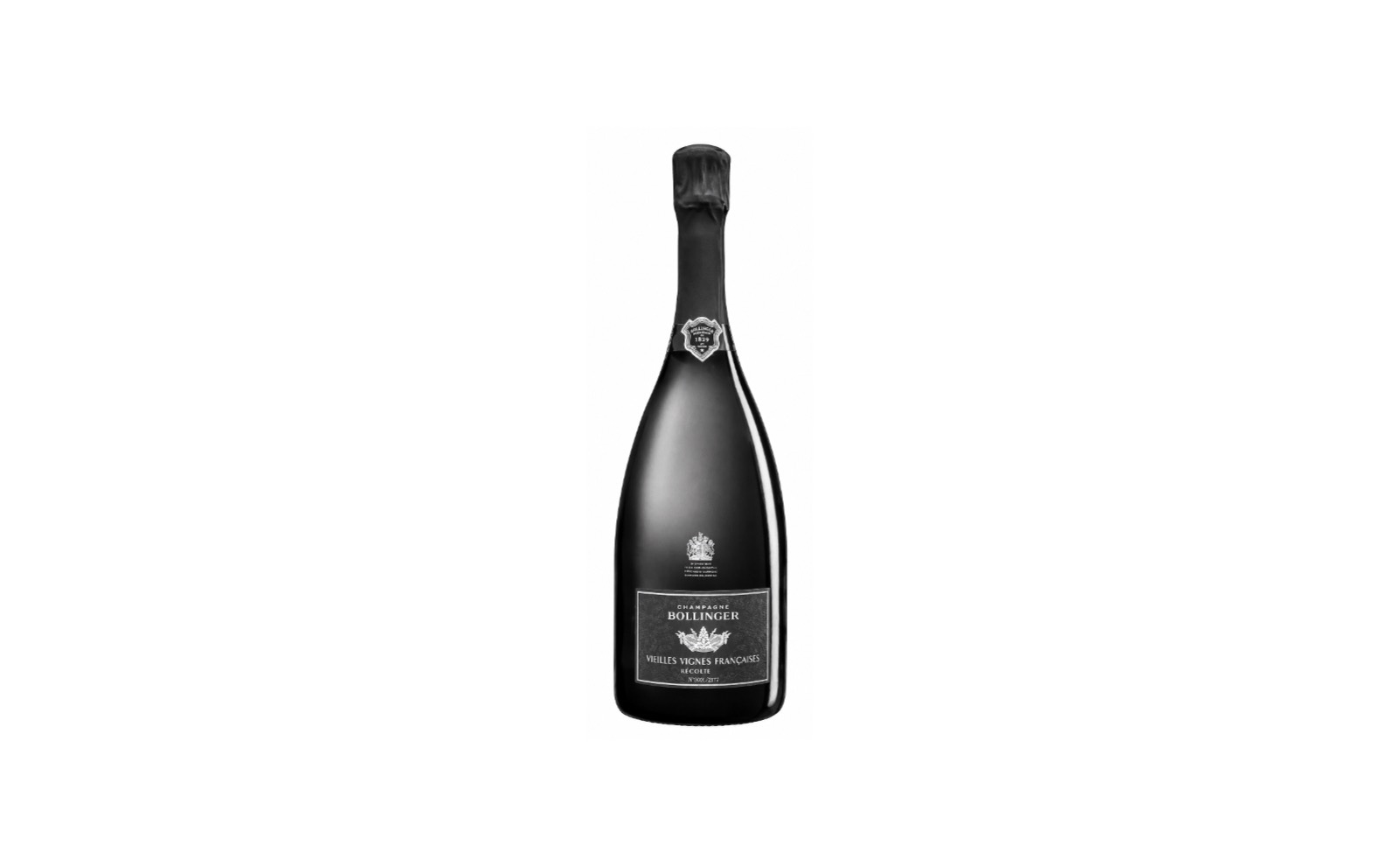
Bollinger’s Vieilles Vignes Françaises is routinely described as a relic of pre-phylloxera Champagne. The reality is more complicated — and considerably more interesting.
The easiest way to misunderstand Bollinger’s Vieilles Vignes Françaises is to ask a seemingly simple question:
How old are the vines?
The wine comes from just two tiny clos in Aÿ, Clos Saint-Jacques and Les Chaudes Terres. Together they amount to only 31 ares, or 0.31 hectare. Both are planted to Pinot Noir. Both are ungrafted. The vines grow en foule, in the dense, irregular arrangement associated with an older form of Champagne viticulture rather than the clean, tractor-friendly rows of the modern vineyard. They are worked by hand, with a draught horse used in the plots, and replacement vines are created through provignage, the old practice of layering a living shoot into the soil until it establishes roots of its own.
Production is minute. The 2016 vintage yielded just 1,736 numbered bottles.
Everything about Vieilles Vignes Françaises encourages mythology.
And the most persistent part of that mythology concerns phylloxera.
Bollinger describes Clos Saint-Jacques and Les Chaudes Terres as vineyards that escaped the insect that devastated European viticulture from the late nineteenth century onwards. The natural inference is seductive: if the plots survived phylloxera, then the vines standing there today must themselves be pre-phylloxera survivors.
That conclusion is much harder to sustain.
A detailed 2026 report by William Kelley states that the present vines were replanted during the 1970s using massal selections from Aÿ, while remaining on their own roots.
At first glance, the two accounts appear contradictory.
They need not be.
They may simply be describing different forms of survival.
And that distinction is where the real story of Vieilles Vignes Françaises begins.
Five different kinds of survival
Wine writing often collapses several different ideas into the phrase “pre-phylloxera vines”.
A vineyard site can be old.
Its method of cultivation can be old.
Its vines can remain ungrafted.
Its genetic material can be propagated from an established local population.
And an individual plant can itself be old enough to pre-date phylloxera.
Those things are related, but they are not interchangeable.
A vineyard does not cease to be historic because its vines have been replanted. Burgundy makes that obvious. No one would argue that a climat loses its historical identity because a parcel has been renewed. The cadastral place, its exposure, soils, boundaries and reputation persist through successive generations of vines.
The same principle applies in Aÿ.
Clos Saint-Jacques and Les Chaudes Terres can preserve a viticultural continuity extending back beyond the phylloxera era without every present vine needing to date from the nineteenth century.
Equally, an ungrafted vine is not necessarily an ancient vine.
That distinction matters because the two ideas are psychologically difficult to separate. Across most European vineyards today, the grape-producing Vitis vinifera plant is grafted onto American-derived rootstock selected in part for resistance to phylloxera. An ungrafted Pinot Noir vine remains on its own roots.
But that tells us something about its root system, not its date of birth.
An ungrafted vine planted in 1975 is still ungrafted.
It can also have been propagated from old local material. It can belong to a diverse massal population rather than a single commercial clone. It may represent a biological inheritance of considerable interest.
None of those things makes it a vine planted in 1875.
So the most useful question to ask about Vieilles Vignes Françaises is not simply whether its present vines are “pre-phylloxera”.
It is this:
What, exactly, has been transmitted?
The importance of lineage
If the present plants were indeed established in the 1970s using massal selections from Aÿ, as Kelley reports, then at least part of the continuity of the vineyard may reside in lineage rather than literal age.
Massal selection is fundamentally different from the idea of preserving one immortal plant.
Instead of propagating a single clone, growers select material from a population of vines judged worthy of reproduction. The resulting vineyard can preserve variation within that population from one generation to the next.
This is not biological immortality.
It is inheritance.
That difference may sound pedantic until one considers how often the identity of an old vineyard is reduced to a planting date. A parcel described as “planted in 1920” sounds immediately more compelling than one planted in 1970.
Yet age alone does not tell us what material was planted, where it came from, how it was propagated or how faithfully a vineyard population has been maintained through time.
At Vieilles Vignes Françaises, those questions may be more illuminating than the number on a birth certificate.
And they become more complicated still because the vineyards are maintained through provignage.
A vineyard without a single birthday
Provignage is one of the keys to understanding why conventional ideas of vine age fit these vineyards so awkwardly.
Rather than removing a failing vine and replacing it with a standard nursery plant, a grower bends a shoot from an existing vine into the soil. Part of the shoot is buried while remaining attached to the parent plant. It develops its own roots and eventually becomes an independent vine.
The new plant is younger.
Yet it is also, in a direct sense, a continuation of the older one.
Practised repeatedly, provignage produces a vineyard population in which generations overlap. Vines die. Others emerge from living neighbours. Renewal happens gradually rather than through the wholesale uprooting and replanting of an entire block.
That makes the familiar shorthand “planted in year X” increasingly inadequate.
A vineyard maintained in this way does not have one simple birthday.
It has a genealogy.
That is the more interesting meaning of old vines at Vieilles Vignes Françaises.
The vineyard begins to resemble a living population rather than a collection of individual antiques.
One might even think of it as a viticultural version of the Ship of Theseus. If individual vines are renewed over time, but the parcel, propagation system, local material and method of cultivation persist, at what point does it stop being the same vineyard?
Perhaps it does not.
Perhaps continuity in a vineyard has never depended on the survival of every individual plant.
What phylloxera changed
The force of that idea becomes clearer when set against what phylloxera did to European viticulture.
The insect did not merely kill vines. It transformed the biological architecture of vineyards.
The practical solution adopted across much of Europe was grafting: European wine varieties were placed onto resistant American rootstocks. The varieties above ground might remain Pinot Noir or Chardonnay, but the root systems beneath them were fundamentally different.
Bollinger’s two Aÿ clos preserve something rare because that transformation did not take place there.
Their Pinot Noir remains ungrafted.
The vines are also planted en foule, rather than in conventional rows. This dense, irregular pattern changes the physical reality of working the vineyard. Machinery designed for straight modern vineyards cannot simply pass through. Bollinger describes manual cultivation and the use of a horse.
Then there is provignage, which determines not only how vines are replaced but how the population renews itself through time.
Taken together, these features describe something more consequential than picturesque old-fashioned vineyard scenery.
They describe a system.
That system is arguably the most convincing sense in which pre-phylloxera Champagne survives at Bollinger.
Not necessarily as an untouched collection of nineteenth-century plants.
As a way of maintaining a vineyard.
The problem with “survivor”
The word survivor is irresistibly powerful in wine.
It suggests catastrophe followed by endurance. A vine stands where others died. Its roots descend through a soil untouched by the compromises imposed after phylloxera. The bottle becomes a liquid connection to a vanished world.
There is nothing wrong with romance in wine.
But romance becomes more compelling when its terms are precise.
If Kelley’s account of 1970s replanting is correct, then the present vines of Vieilles Vignes Françaises should not simply be described as individual nineteenth-century survivors.
That does not diminish Clos Saint-Jacques or Les Chaudes Terres.
It changes the nature of what is remarkable about them.
The sites remain historic.
The vines remain ungrafted.
The cultivation remains exceptional.
The planting system preserves a pre-modern form of vineyard organisation.
Provignage allows successive generations of vines to arise from the existing population.
And, if the reported use of local Aÿ massal material is accurate, the vines may preserve a biological lineage whose significance cannot be reduced to the age of any one plant.
The story becomes less miraculous.
It also becomes more interesting.
Can we taste any of this?
There is a temptation, inevitably, to move from viticultural difference to sensory certainty.
Ungrafted vines are often discussed as if own-rootedness must leave an identifiable signature in the glass: greater purity, different texture, some privileged access to terroir.
That is much harder to demonstrate than to suggest.
Vieilles Vignes Françaises is not an experiment in which one variable can be isolated. Its wines emerge from two tiny sites with unusual planting density and vineyard management, particular vine material and very limited production, all interpreted within Bollinger’s own winemaking.
Whatever distinguishes the wine cannot simply be assigned to the absence of American rootstock.
Nor can old age, provignage, planting density or genetic diversity be tasted separately from one another.
That does not render them irrelevant.
It simply means that wine resists the tidy causality we sometimes want to impose upon it.
The fascination of Vieilles Vignes Françaises is therefore not that it allows us to taste nineteenth-century Champagne untouched by history.
Nothing can do that.
Its importance lies in the survival of something more complicated.
Lineage rather than immortality
Perhaps the greatest mistake is to imagine an old vineyard as a museum.
Museums preserve objects by preventing them from changing.
Vineyards cannot work that way.
They are populations of living plants. They grow, decline and die. They are pruned, propagated and replaced. Even when growers seek continuity, the vineyard itself is constantly changing.
Vieilles Vignes Françaises is compelling because its form of continuity appears to acknowledge that reality.
The two clos do not need every vine to have survived since the nineteenth century in order to retain a meaningful relationship with pre-phylloxera Champagne.
What matters may instead be that a particular kind of viticulture has continued.
The Pinot Noir remains ungrafted.
The vines remain planted en foule.
New plants can still emerge through provignage from vines already living in the parcel.
The vineyards still demand a form of cultivation increasingly alien to the uniform rows surrounding them.
What has survived, then, may not be a collection of immortal plants.
It may be a living lineage.
That is a subtler claim than “pre-phylloxera vines”.
It is also a more remarkable one.
Because the true rarity of Vieilles Vignes Françaises may not be that nothing has changed.
It may be that the vineyard has found a way to change without entirely breaking with what came before.