
There are wine tastings, and there are creation myths.
The Judgment of Paris has become the latter.
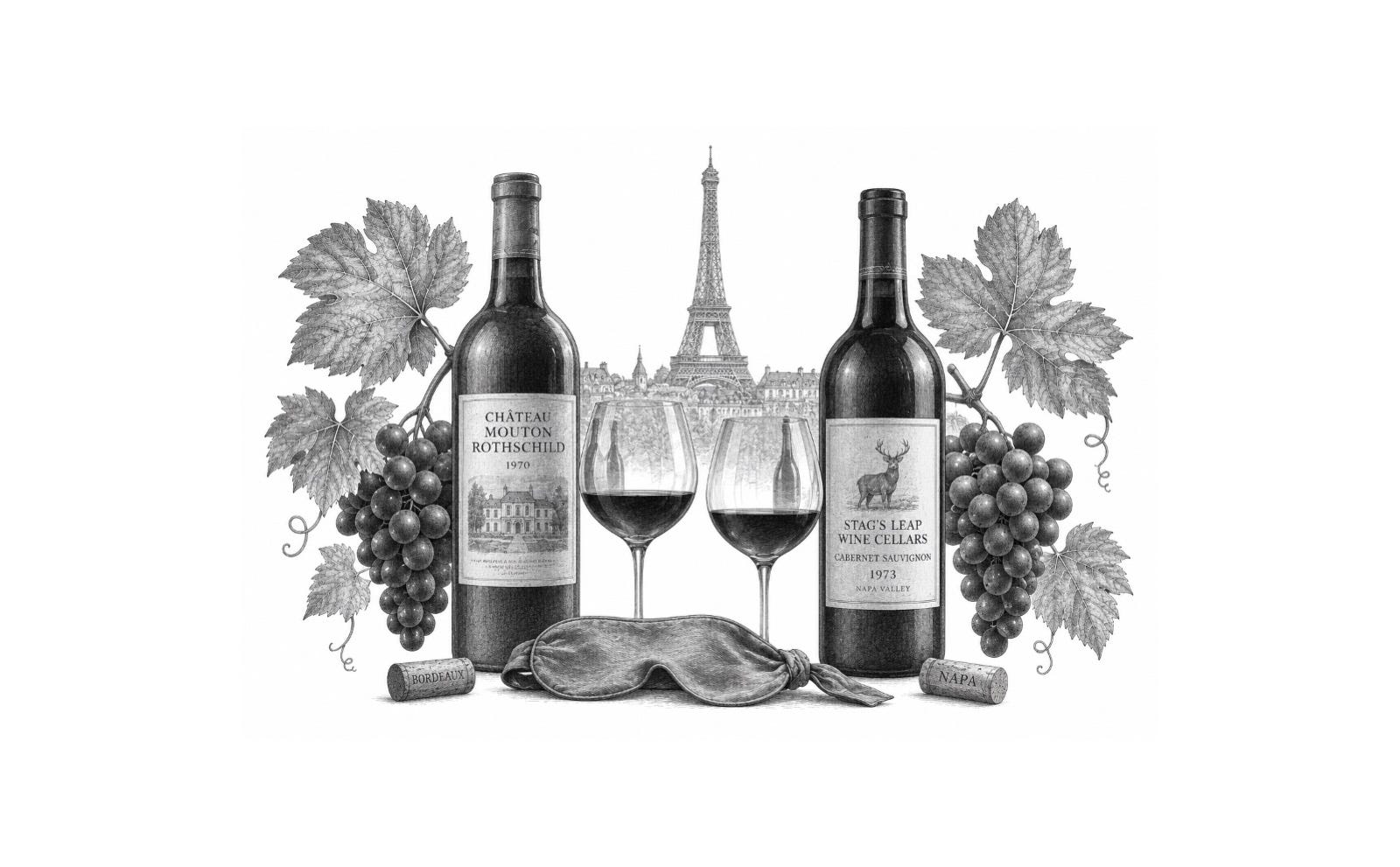
On 24 May 1976, a group of distinguished French wine professionals gathered in Paris to taste a selection of Californian and French wines blind. When the scores were counted, Chateau Montelena’s 1973 Chardonnay had finished ahead of four white Burgundies, while Stag’s Leap Wine Cellars’ 1973 Cabernet Sauvignon had narrowly surpassed a group of Bordeaux that included Mouton Rothschild, Haut-Brion and Montrose.
The result became one of wine’s most durable stories.
France had been beaten. California had arrived. The old order had fallen.
Except that this is not quite what happened.
The more interesting question, fifty years later, is not who won.
It is: what did the Judgment of Paris actually judge?
Literally, it judged twenty wines, tasted on one afternoon by nine French judges and ranked according to one scoring system.
Historically, however, it tested something much larger: whether the standards associated with the greatest French wines could be met beyond France.
The answer was yes.
And that changed wine forever.
France was not merely the opposition
Steven Spurrier, the English wine merchant who organised the tasting, did not originally conceive the event as a national contest.
Together with Patricia Gallagher at the Académie du Vin in Paris, Spurrier wanted to introduce French professionals to a group of Californian wines that were then largely unknown in Europe. Gallagher had returned from California impressed by what she had tasted, and the approaching American Bicentennial provided a convenient occasion to show the wines in Paris.
Spurrier subsequently travelled through California selecting Chardonnays and Cabernet-based reds.
The French wines were added as references.
That distinction matters.
A Californian Chardonnay presented on its own would have given a French professional in 1976 little context. Put it beside Meursault-Charmes, Bâtard-Montrachet or Puligny-Montrachet Les Pucelles, and the comparison immediately became meaningful.
The same applied to Cabernet Sauvignon. Mouton Rothschild, Haut-Brion, Montrose and Léoville Las Cases were not merely opponents. They represented the recognised summit of a tradition against which serious Cabernet-based wine could be measured.
California therefore arrived in Paris not with an entirely new definition of fine wine, but asking to be judged within one that France had spent generations establishing.
The Californian achievement mattered because France was the benchmark.
That is the first thing the mythology tends to obscure.
Twenty wines are not two countries
The tasting contained six Californian Chardonnays and four white Burgundies, followed by six Californian Cabernet-based reds and four Bordeaux.
The French panel was formidable. It included Aubert de Villaine of Domaine de la Romanée-Conti, Pierre Tari of Château Giscours, Jean-Claude Vrinat of Taillevent, Christian Vannequé of La Tour d’Argent and Odette Kahn of La Revue du vin de France.
These were not judges unfamiliar with French wine.
But neither were twenty bottles capable of answering a question as vast as “Who makes better wine: France or America?”
Put the proposition in French terms.
Could four Bordeaux speak for Bordeaux?
Could four Burgundies stand for Burgundy?
Would any serious drinker attempt to determine the superiority of Burgundy over Bordeaux from eight bottles tasted on a single afternoon?
Of course not.
Yet once national flags became attached to the wines, individual bottles somehow became representatives of two viticultural civilisations.
The actual tasting was much narrower.
It judged those wines, from those vintages, under those conditions.
Its historical consequences were far greater than its evidential reach.
Which France was in the glasses?
The French wines themselves also deserve closer attention.
Among the reds, Stag’s Leap faced a formidable group: Château Mouton Rothschild 1970, Château Haut-Brion 1970, Château Montrose 1970 and Château Léoville Las Cases 1971.
There is no need to minimise what Stag’s Leap achieved.
A young Californian Cabernet finishing ahead of three serious Bordeaux from 1970 was extraordinary.
But the white tasting was rather different.
The Burgundies included Roulot Meursault-Charmes 1973, Joseph Drouhin Beaune Clos des Mouches 1973, Ramonet-Prudhon Bâtard-Montrachet 1973 and Domaine Leflaive Puligny-Montrachet Les Pucelles 1972.
These were exceptional producers and important vineyards.
They were not, however, drawn from Burgundy’s most celebrated sequence of vintages.
That observation should not be turned into a counter-myth in which California triumphed only because Burgundy arrived weakened. The Californian wines still performed remarkably.
But lovers of Burgundy, of all people, should resist pretending that producer and vineyard make vintage irrelevant.
The more accurate conclusion is simpler.
The French bottles represented prestigious terroirs and distinguished producers. They did not represent some imaginary perfect expression of “France”.
There is no bottle labelled France.
What does it mean to win a tasting?
The celebrated red victory was also much closer than the legend suggests.
Stag’s Leap Wine Cellars 1973 finished with 127.5 points.
Mouton Rothschild 1970 had 126.
Haut-Brion 1970 had 125.5.
Montrose 1970 had 122.
The immortal victory of Napa over Bordeaux therefore begins with one and a half points separating first from second.
That does not make the result less impressive.
It makes it more precise.
Stag’s Leap did not demolish Bordeaux. It entered the company of several very serious Bordeaux and finished narrowly ahead.
Modern statistical analysis has added another layer of nuance. When the wines are considered collectively rather than simply by whichever bottle finished first, the French reds performed strongly as a group, while Stag’s Leap was the exceptional Californian at the top.
There have also been attempts to recalculate the original preferences using other ranking systems, some of which produce different winners.
None of this means the official result was illegitimate.
Stag’s Leap won according to the method used in Paris.
But it reminds us of something wine drinkers often forget when confronted with numerical rankings:
a tasting does not merely discover a hierarchy. Its method helps produce one.
For a culture increasingly comfortable separating neighbouring wines by fractions of a point, that may be one of Paris’s more useful lessons.
What blind tasting really exposed
Blind tasting was what gave the event its power.
Without labels, the judges could not begin with the knowledge that the wine in front of them came from Meursault, Pauillac or Pessac-Léognan. Producer, appellation, classification and reputation were removed.
The wine had to argue for itself.
Later accounts often relish the moments when French tasters mistook Californian wines for French ones.
The implication is usually that the experts had somehow been exposed.
But there is another interpretation.
Blind tasting exposed something true of every wine culture: expectation affects perception.
A bottle of Haut-Brion does not arrive at the table alone. It brings a château, a place, a history, a classification, previous vintages and the memory of other bottles.
A Puligny-Montrachet is not simply Chardonnay plus a score.
For lovers of French wine, that distinction is fundamental.
The meaning of Burgundy lies precisely in the proposition that origin matters: that one slope differs from another, one village from the next, one climat from the parcel beside it, and one vintage from its predecessor.
Blind tasting is extremely good at asking one question:
What do I think of the liquid in this glass when I know nothing about it?
It cannot answer every question wine asks us.
The irony of Paris is therefore striking.
A tasting designed to remove context produced one of the most context-laden stories in wine history.
The bottles acquired passports
Only one journalist attended the tasting: George Taber of TIME.
His subsequent report contained the phrase that would do more than the final scores to determine how the event was remembered:
“California defeated all Gaul.”
In a few words, the ambiguity disappeared.
Montelena was no longer one Chardonnay and Roulot one Meursault.
Montelena became California.
Roulot became France.
Stag’s Leap became America.
Mouton became the old order.
The bottles had acquired passports.
It made for an irresistible story.
“Several Californian wines performed unexpectedly well against distinguished French references in a small blind tasting” was accurate but unlikely to enter wine folklore.
“California beat France” was perfect.
The French reaction ensured the story had drama. Odette Kahn later recalled the anger that followed the result and the uncomfortable position in which some of the judges found themselves.
There was wounded pride.
But there is little reason, fifty years later, for admirers of French wine to continue fighting that battle.
French wine does not need the Judgment of Paris to be overturned.
It needs the Judgment of Paris to be understood.
What France actually lost
This is where the event becomes historically important.
Before 1976, the belief that the greatest wines were French remained deeply embedded in the international fine-wine establishment.
Bordeaux and Burgundy did not merely occupy the summit of the hierarchy.
To a significant extent, they helped define what that hierarchy was.
The Paris result made the assumption of French exclusivity much harder to sustain.
If unfamiliar Californian wines could sit anonymously beside grands crus and classified growths, and sometimes be preferred by experienced French palates, then greatness could no longer be treated as something available only within France.
That was the revolution.
Not that Burgundy had ceased to be Burgundy.
Not that Bordeaux had been exposed as overrated.
Not that Napa had demonstrated permanent superiority.
France lost exclusivity. It did not lose authority.
Indeed, the global wine world that emerged after Paris continued to reveal the scale of that authority.
Not simply because French grape varieties spread around the planet.
France’s deeper influence lay in an idea of wine itself.
The importance of origin.
The distinction between one place and another.
The conviction that vintage matters.
The belief that soil, exposition, climate, farming, élevage and time can combine to create identities that deserve to be preserved rather than blended away.
Burgundy’s great contribution to wine culture is not Chardonnay.
It is Meursault, Puligny, Chassagne, Corton, Montrachet—and eventually the obsessive distinctions within them.
Bordeaux’s contribution is not merely Cabernet Sauvignon.
It is the proposition that place, blending, estate identity, vintage and ageing can produce wines capable of developing over decades.
The New World borrowed French grapes, certainly.
More importantly, it entered into conversation with French ideas.
The best producers eventually found their own answers.
And that, rather than imitation, is what made the international wine world interesting.
Paris did not diminish Burgundy or Bordeaux
The later history of the wines reinforces the point.
At the thirtieth-anniversary retasting in 2006, the surviving Californian reds performed extraordinarily well, with Ridge Monte Bello 1971 finishing first and Californian wines occupying the leading positions.
For years, one of the easy responses to the 1976 result had been that Californian wine might be attractive in youth but would never possess the longevity of Bordeaux.
The anniversary tasting made that argument difficult to sustain.
Some Californian Cabernets from the early 1970s clearly could age.
Again, Bordeaux did not need to fail for that to be true.
Nor did the result demonstrate that California would always outperform Bordeaux. Subsequent analysis of later vintages has shown no such permanent hierarchy.
And why should there be one?
Wine lovers already accept that a particular vintage can transcend the normal standing of an estate, or that one vineyard can excel in a year when another disappoints.
We grant that complexity instinctively to Burgundy and Bordeaux.
There is no reason not to grant it to Napa.
The significance of 1976 does not depend upon Stag’s Leap being declared world champion for eternity.
It only depended upon a Californian wine being good enough to make the old certainty impossible.
What Paris really changed
Fifty years later, the winning bottles belong as much to cultural history as to wine history.
That seems appropriate.
The Judgment of Paris mattered because it enlarged the fine-wine map.
California acquired legitimacy. Other regions gained confidence. Drinkers and critics became more willing to look beyond inherited hierarchies.
But none of that made French wine less important.
Burgundy did not lose its capacity to produce wines of extraordinary subtlety and emotional force because another country could make fine Chardonnay.
Bordeaux did not lose its ability to create profound, long-lived Cabernet-based wines because Stag’s Leap finished one and a half points ahead of Mouton Rothschild on one afternoon.
What disappeared was something else: the assumption that France possessed a monopoly on greatness.
And perhaps that distinction allows us to understand the Judgment of Paris more clearly today than either its victors or its wounded participants could in 1976.
So what did the Judgment actually judge?
Twenty wines.
Nine official French palates.
A handful of vintages.
One afternoon.
One method of scoring.
That is the literal answer.
Historically, however, Paris judged an idea.
It asked whether the standards embodied by Burgundy and Bordeaux—standards so influential that they had become almost synonymous with fine wine itself—could be met beyond France.
The answer was yes.
That was California’s victory.
But the deeper irony is that California’s triumph did not make France irrelevant.
It confirmed the extraordinary reach of French wine’s influence.
For what the world discovered in Paris was not that Burgundy and Bordeaux had ceased to matter.
It was that their conversation no longer belonged to France alone.