

Vranken Pommery Debt Reduction: A €100 Million Reset
Asset disposals, bank support and tighter stock management define the Champagne group’s route through financial pressure.
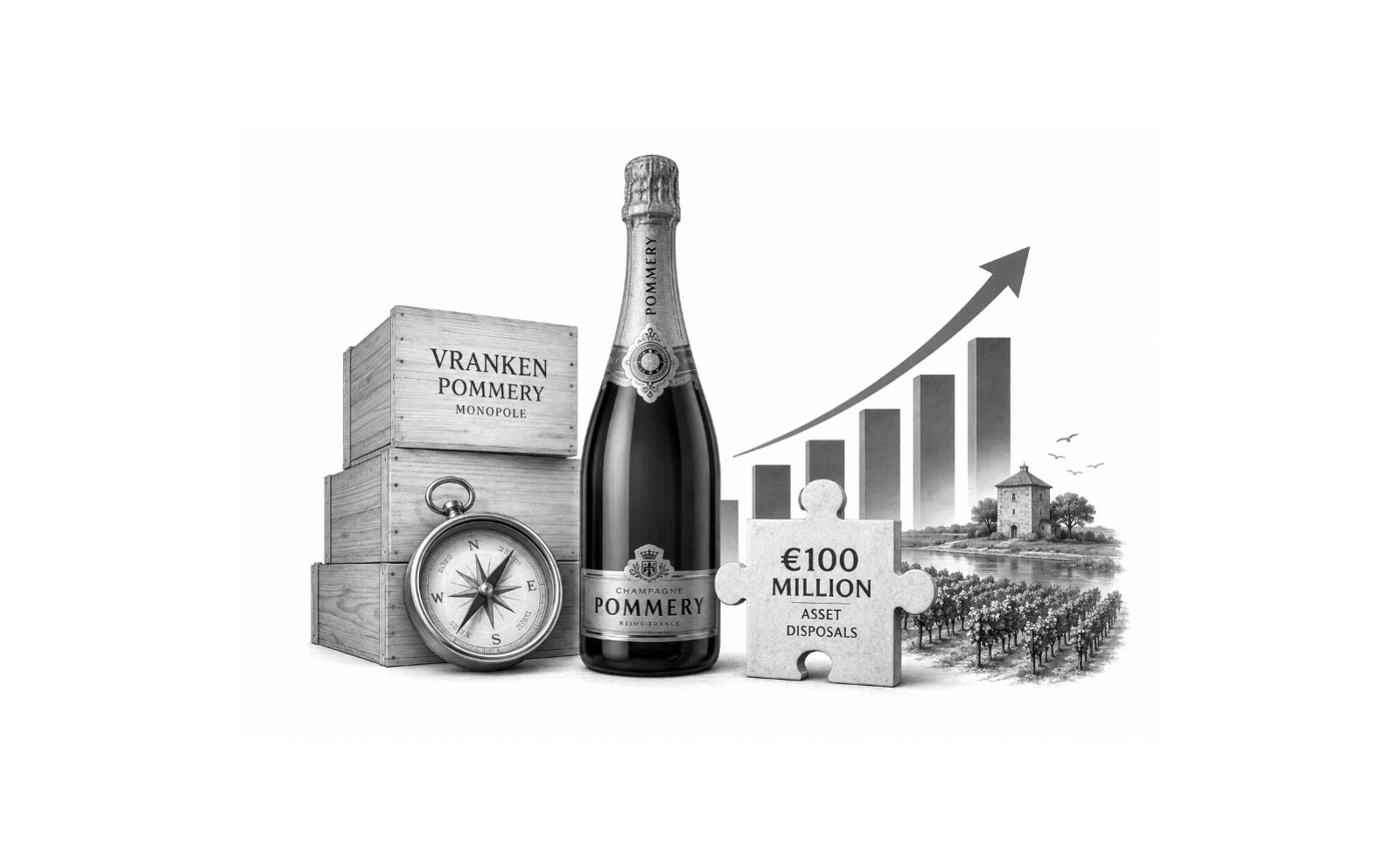
Vranken Pommery is widening its debt-reduction programme, placing as much as €100 million of non-core assets on the table while securing additional breathing room from its lenders. The revised plan follows the conclusion of exclusive negotiations with German sparkling-wine group Henkell Freixenet, which ended without an agreement in early August 2026.
For one of Champagne’s most recognisable groups, the challenge is not simply to raise cash. It is to decide which parts of a broad and geographically diverse wine portfolio remain central to its future.
The group’s holdings extend well beyond Champagne. Alongside houses and brands including Pommery, Vranken, Charles Lafitte and Bissinger, its interests encompass vineyards and wine estates in the Camargue, Provence, Portugal and England. That breadth, once a sign of ambition and diversification, now gives management a range of assets that could be sold as it seeks to strengthen the balance sheet.
Henkell talks end, but the door remains open
Henkell Freixenet had entered exclusive discussions over a potential acquisition of a majority interest in Maison Pommery & Associés. Those negotiations formally expired on 1 August and did not produce a transaction.
Neither side has ruled out returning to the table, but Vranken Pommery is no longer bound by exclusivity. It can now pursue other disposals, consider new investors or explore broader measures to reinforce its equity position.
The end of the talks should therefore be seen less as the end of the process than as a change in its shape. Instead of relying on one large corporate agreement, the group can examine separate transactions across its portfolio.
That approach may offer greater flexibility, although it also requires careful choices. Selling peripheral assets can reduce debt without weakening the Champagne business, but the distinction between “non-strategic” and strategically useful is rarely straightforward in the wine world. Vineyards, brands and production sites often carry long-term value that is not fully reflected in their immediate financial contribution.
Camargue assets move into focus
The most advanced discussions concern assets in the Camargue, where the group owns Grands Domaines du Littoral, including Domaine Royal de Jarras.
Vranken Pommery says it is negotiating with several parties over potential sales in the region. No buyer or final perimeter has been announced, but the Camargue appears to be an early priority within the wider disposal programme.
The group is now targeting €100 million from non-core asset sales, particularly in southern Europe. This is twice the amount announced in May, when management indicated that approximately €50 million of disposals would support negotiations with creditors.
The larger figure reflects the scale of the financial task. Vranken Pommery reported debt of €754 million for 2025, a burden shaped partly by the capital-intensive nature of Champagne. Producers must finance grapes, winemaking and years of cellar ageing long before bottles generate revenue.
For a group with substantial stocks resting in its cellars, liquidity can become strained even when its brands continue to sell.
Bank agreement supports the Vranken Pommery debt reduction plan
A court-approved conciliation agreement with the group’s banks provides financing support until 19 June 2027, with the possibility of an extension into June 2028.
The arrangement covers Vranken Pommery and nine subsidiaries. It follows negotiations triggered by a €50 million payment that fell due in April 2026 and became a catalyst for the group’s financial adaptation plan.
The banking agreement does not remove the underlying debt, but it gives management time to execute asset sales and other restructuring measures without the immediate pressure of a short-term funding interruption.
It also allows the group to approach the 2026 Champagne harvest with financing in place. That point is especially important in a region where harvest-related payments create substantial seasonal demands on cash. The 2026 harvest is expected to begin relatively early, adding urgency to the need for financial stability before the picking season.
Reducing the weight of Champagne stocks
Asset sales form only one part of the Vranken Pommery debt reduction strategy. The group also intends to reduce the capital tied up in wine stocks by €25 million annually between 2027 and 2030.
Inventory management is a delicate subject in Champagne. Mature reserves support consistent house styles and allow producers to release wines only after appropriate ageing. Yet those same bottles represent cash immobilised underground, sometimes for several years.
Reducing stocks too quickly could narrow future blending options or place pressure on supply. A gradual programme, however, may help release working capital while preserving the ageing periods and reserves required by the group’s principal brands.
Management has also referred to a potential capital increase. Taken together, the proposed measures suggest a three-part response: disposing of selected assets, reducing inventory and attracting fresh equity.
A portfolio already in motion
Vranken Pommery began simplifying its business before the current plan was announced. In 2025, it sold the Champagne brand Heidsieck & Co Monopole to Lanson-BCC. The group later reported a net disposal gain of €44.3 million after related costs.
That transaction demonstrated that established Champagne names can generate meaningful proceeds, but the current strategy appears more focused on assets outside the central Champagne portfolio. The emphasis on the Camargue and southern Europe indicates that management wants to protect its core houses where possible.
This distinction matters. Pommery is not simply a financial asset: it is one of Champagne’s historic names, with a significant architectural, cultural and commercial presence in Reims. The strength of such brands will be central to the group’s ability to rebuild confidence among banks, investors, distributors and consumers.
Champagne sales provide a measure of resilience
Despite the financial pressure, the group’s first-half trading figures suggest that its Champagne activity retained momentum.
Revenue for the first six months of 2026 reached €95.7 million on a comparable basis excluding the divested Heidsieck range, an increase of 1% from the previous year. Champagne contributed €83.4 million, rising 4%, supported by higher volumes sold to customers.
Provence and Camargue wines generated €5.8 million, up 2%, while revenue from other wines declined sharply to €6.6 million.
These figures do not resolve the balance-sheet problem, but they help explain why Vranken Pommery is seeking to restructure rather than retreat from Champagne. The core business continues to produce the great majority of group revenue and appears commercially steadier than several of its peripheral activities.
What the restructuring means for Vranken Pommery
The coming months will be defined by execution. Vranken Pommery must identify buyers, agree acceptable valuations and complete disposals without weakening the businesses it intends to retain. At the same time, it must manage the harvest, protect distribution and maintain confidence in its Champagne brands.
For wine lovers, financial restructuring can seem distant from what matters in the glass. Yet ownership, debt and inventory decisions shape how estates farm, age and release their wines. They can determine whether a producer invests patiently or is forced to prioritise short-term cash generation.
Vranken Pommery now has additional time, but not an indefinite reprieve. Its bank agreement carries the group into 2027; its asset programme must turn that time into a more durable financial structure.
The central question is no longer whether the portfolio will change. It is whether the group can emerge leaner while preserving the houses, vineyards and cellar resources on which its reputation in Champagne depends.