
French AOCs are trialling vineyard covers against mildew, heat, frost and hail, testing their effects on wine quality, terroir and vineyard economics. (150 characters)
For generations, the appearance of a French vineyard has been inseparable from the idea of terroir: rows of vines exposed to the weather, shaped by soil, slope, season and the decisions of the grower. Yet as climatic extremes become harder to manage, that familiar picture may be entering a period of cautious change.
Vineyard covers in French AOCs are now at the centre of a broader discussion about how appellation vineyards can protect themselves from mildew, excessive heat, hail and frost without weakening the connection between wine and place. France’s appellation authorities are preparing to examine these systems through a coordinated series of trials, looking not simply at whether they work, but at what their use might mean for wine quality, vineyard economics, labour, the environment and the landscape itself.
The question is more complex than whether a roof or protective fabric can save a crop. For appellation wine, the deeper issue is how far growers can intervene in the vine’s immediate climate while still remaining faithful to the principles on which the AOC system rests.
Why vineyard covers in French AOCs matter now
Protecting vines from the elements is hardly a new ambition. What is changing is the range and sophistication of the tools available.
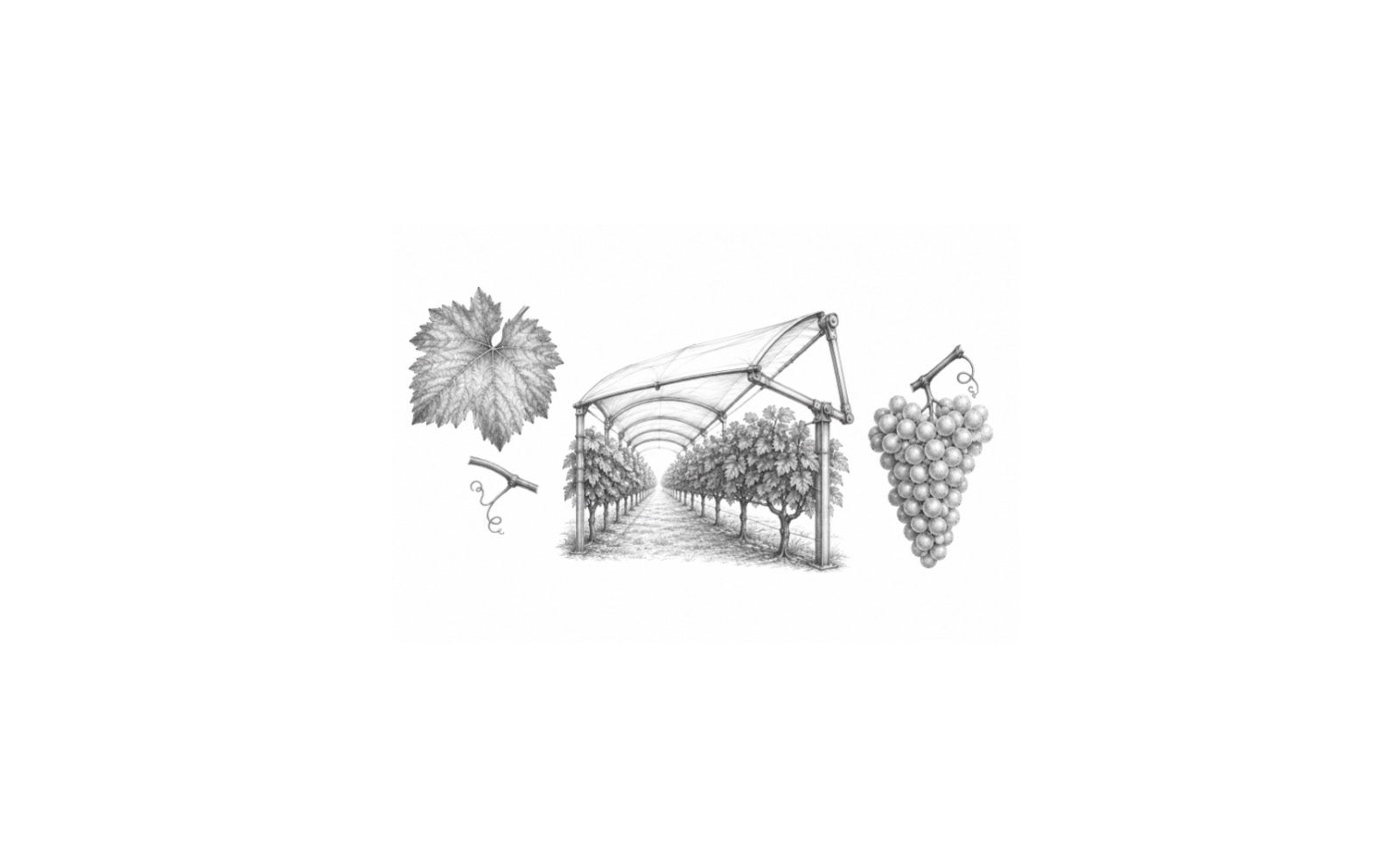
Some systems act rather like retractable umbrellas, shielding rows when rain creates conditions favourable to downy mildew. Others use nets or specialised fabrics designed to moderate heat, reduce sunburn or provide protection from hail and frost. Their common purpose is to soften the most damaging episodes of the growing season rather than isolate the vineyard completely from its environment.
That distinction matters.
French appellation rules have traditionally been wary of equipment that materially alters the vine’s mesoclimate — the highly local atmospheric conditions surrounding the canopy and fruit. Since 2003, vineyard-covering systems have in principle been prohibited in AOP production unless they are being used within an authorised experiment. Anti-hail nets occupy a somewhat different position: since 2018, they may be permitted in appellations whose own specifications do not prohibit them.
The regulatory caution is understandable. An appellation is not merely a geographical label. It represents an agreed relationship between origin, grape growing, human practice and the character of the resulting wine. Any technology capable of changing temperature, humidity, water exposure or light around the vine therefore raises questions that extend far beyond crop protection.
From small trials to a broader AOC experiment
One of the better-known approaches under examination is Viti-Tunnel, a retractable system designed to cover vine rows during periods when rainfall creates a high risk of mildew infection.
Trials have been monitored in Bordeaux since 2019. Early work has suggested that such protection can reduce disease pressure, but much of that research has taken place on very limited sections of vineyards. A handful of rows can demonstrate whether a technology functions; it tells us rather less about how the same technology interacts with everyday viticulture at a meaningful scale.
The next stage is therefore intended to broaden the view.
Around 30 experimental sites could participate across 18 appellations, with trials generally covering between three and ten rows rather than entire vineyards. Bordeaux appellations including Médoc, Saint-Émilion and Pomerol are among those concerned, alongside vineyards in Burgundy and the Loire Valley.
The framework brings together growers, equipment manufacturers, technical organisations responsible for monitoring the trials, and the local bodies that manage and defend individual appellations. Crucially, the same analytical framework is intended to be used across the different sites.
That should make it possible to compare more than simple questions of effectiveness.
Wine quality remains the decisive test
A protective system can perform perfectly from an engineering perspective and still be unsuitable for an appellation vineyard.
If a cover prevents mildew but changes ripening in a way that compromises the identity or sensory quality of the wine, its technical success becomes far less persuasive. The same applies if shading prevents sunburn but alters grape maturity, or if reduced exposure to rainfall creates unintended consequences elsewhere in the vineyard.
For that reason, the trials are expected to pay close attention to the quality and characteristics of the resulting wines.
This is perhaps the most important aspect of the programme. Climate adaptation in prestigious vineyards cannot simply be measured in tonnes of grapes saved. The fruit must still produce wines that meet the expectations of their appellation, both analytically and organoleptically.
In other words, protection is acceptable only if the wine remains convincing.
Vineyard covers and a changing idea of mesoclimate
Behind the practical experiments lies a subtle but significant evolution in French thinking about terroir.
Traditionally, the regulatory question surrounding a new vineyard technique was often whether it altered the vine’s mesoclimate. If the answer was yes, that intervention could appear incompatible with an appellation system founded on the expression of natural conditions.
Climate instability complicates that logic.
A short episode of extreme heat can scorch berries. A violent hailstorm can destroy a crop in minutes. Persistent rain during a sensitive period can create intense disease pressure and increase reliance on plant-protection treatments. In such circumstances, refusing any modification of the vineyard environment may itself have consequences for the expression and even survival of the crop.
The emerging distinction is therefore between changing a vineyard’s climate as a matter of routine and moderating its extremes.
That may prove to be one of the more important conceptual shifts in French viticulture. The objective is not to make Burgundy resemble Bordeaux, nor to engineer identical growing conditions from one vintage to the next. It is to investigate whether temporary, targeted protection can prevent exceptional weather from overwhelming the natural balance of a site.
Economics may determine how widely the technology spreads
Even if the agronomic results are encouraging, vineyard covers are unlikely to become a universal feature of French wine country.
Installation costs, maintenance, durability and additional labour all have to be considered. The vineyards most able to experiment with these systems are, unsurprisingly, often those producing higher-value wines, where the financial consequences of losing part of a crop can be particularly significant.
That does not automatically make the technology economically sensible.
One purpose of the trials is to establish whether these systems can justify their cost in normal vineyard conditions or whether they are likely to remain highly specialised tools for particular sites and appellations.
The answer may vary sharply between regions. A system that appears rational for a valuable, mildew-prone parcel in Bordeaux could make far less sense in another vineyard with different climatic risks, production economics or landscape constraints.
The landscape is part of the appellation too
Few agricultural technologies are judged on appearance as intensely as those introduced into historic French vineyards.
Nets, supports and retractable coverings inevitably alter the visual character of a site, at least when deployed. That is particularly sensitive in regions where the vineyard landscape carries cultural significance alongside its agricultural function.
Concerns have already surfaced in areas such as Burgundy and Sancerre, where the visual identity of vineyard slopes forms part of how the region is perceived by residents, growers and visitors alike.
This is not merely an aesthetic objection. French appellations have long treated place as something larger than soil chemistry or climate statistics. Vineyard architecture, traditional practices and the physical appearance of cultivated landscapes can all contribute to regional identity.
The experiments will therefore examine landscape impact alongside technical performance.
Could covers reduce vineyard treatments?
There is also an environmental dimension.
If temporary rain protection materially lowers the risk of mildew infection, growers may be able to reduce some plant-protection treatments. That possibility is particularly relevant in regions where fungal disease can require repeated interventions during wet seasons.
Yet the environmental calculation cannot stop there.
Any serious assessment must also consider the materials used to manufacture the structures, their durability, installation requirements and eventual replacement. A system that reduces spraying but requires substantial resources of its own needs to be evaluated across its wider life cycle.
Labour is another concern. Covers that must be deployed, retracted, monitored or maintained may change the organisation of vineyard work. Automation could reduce that burden, but it also adds another layer of equipment and investment to what is already a capital-intensive form of agriculture.
The aim of the French trials is therefore unusually broad: technical efficacy is only one part of the equation.
What vineyard covers could mean for French terroir
It would be premature to imagine French vineyards disappearing beneath permanent roofs. That is neither the purpose nor the likely outcome of these experiments.
What is being tested is a more nuanced proposition: whether appellation viticulture can use temporary protective technologies to manage increasingly severe climatic events without severing the relationship between grape, season and place.
The eventual answers may differ from one appellation to another. Some systems may prove too costly. Others may create unacceptable visual effects, fail to deliver sufficient benefits or influence ripening in undesirable ways. Certain technologies, however, could emerge as carefully regulated tools for specific situations.
That is why these experiments matter beyond the individual devices being tested.
French wine has always evolved through a tension between continuity and adaptation. Vineyard practices that appear traditional today are themselves the result of generations of choices, responses and refinements. Climate pressure is now forcing another such discussion.
The challenge for the AOC system is not to choose between technology and terroir as if the two were inevitably opposed. It is to decide which forms of intervention help preserve the distinctive conditions that make an appellation meaningful — and which would alter them too fundamentally.
For vineyard covers in French AOCs, that judgement will ultimately depend on something more demanding than whether the vines remain healthy beneath them. The real test is whether the wines still speak convincingly of where they come from.