
The Report France’s Fine-Wine Market Still Has Not Absorbed
Twenty-five years on, the Berthomeau report still explains France’s luxury wine paradox: prestige without market discipline
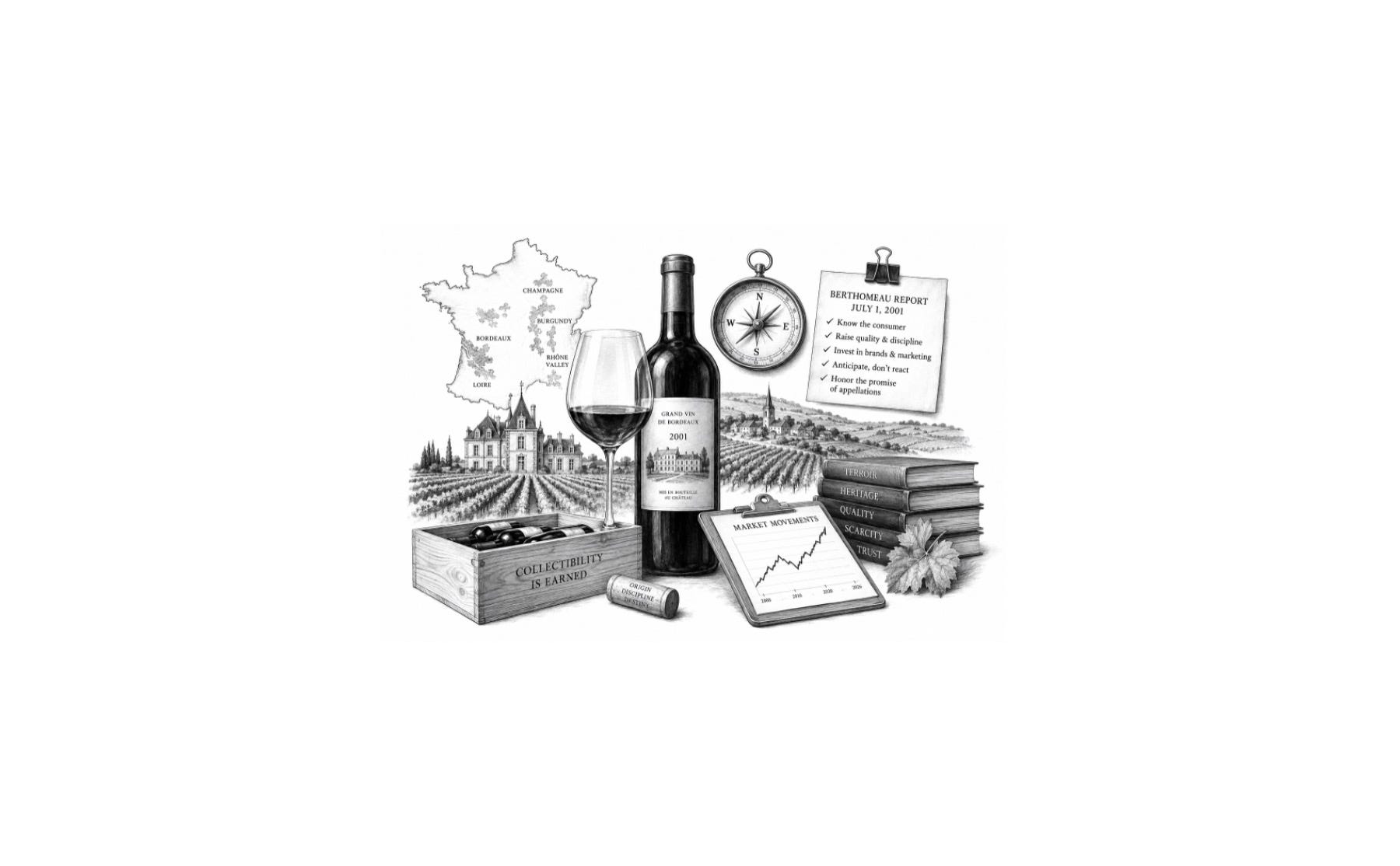
There are reports that age into obscurity, and reports that age into indictment. Jacques Berthomeau’s 2001 study on the future of French wine exports belongs to the second category. Delivered on July 1, 2001, under the title Comment mieux positionner les vins français sur les marchés d’exportation?, it was commissioned by the French agriculture ministry and written at a moment when France could still speak of wine leadership as if it were a natural right. Twenty-five years later, its analysis reads less like a period document than a field manual France never properly opened.
For an intelligence publication focused on collectible wines, historic estates and market movements, the Berthomeau report matters because it sits beneath the surface of today’s fine-wine trade. It is not a tasting note, not a vineyard profile, not an auction bulletin. It is something more structural: a diagnosis of how the world’s most prestigious wine country could preserve symbolic authority while losing commercial clarity.
The central tension was simple. France possessed unrivalled vineyard mythology, regulatory architecture and cultural capital. But Berthomeau argued that these assets had too often become substitutes for strategy. The French wine world had benefited from being the global reference point; it had not always accepted the discipline that such a position required. Prestige, in his reading, was not a shield. It was a promise.
That distinction remains vital for the collectible end of the market. At the summit — first growth Bordeaux, grand cru Burgundy, the great Rhône names, cult Loire and Jura domaines — scarcity, provenance and critical reputation continue to support demand. Historic estates still command liquidity in ways few global assets can match. But the report’s warning was never aimed only at weak producers. It was aimed at the system around them: the habits of interprofessional governance, export complacency, domestic discounting, insufficient brand investment, and a tendency to confuse appellation with market confidence.
Berthomeau’s sharpest point was that French wine could not afford mediocrity under prestigious umbrellas. He warned that under the broad cover of appellations, wines of average or even unworthy quality had been allowed to shelter, weakening the credibility of the entire hierarchy. His charge was not anti-appellation; it was pro-promise. If an appellation signals origin, discipline and typicity, then it must be defended as a market contract, not merely as an administrative label.
This is where the report touches the collectible market most directly. Collectibility depends on belief: belief in origin, belief in custodianship, belief in continuity, belief that the name on the label carries enforceable meaning. When that belief is concentrated in a handful of elite estates, prices can soar even as surrounding regions struggle. But when the broader system is perceived as uneven, the market bifurcates. The best become more collectible; the rest become more vulnerable.
That bifurcation has become one of the defining movements in French wine. The global buyer may still revere France, but reverence has become selective. Capital follows estates with clarity: clear farming philosophy, clear allocation discipline, clear export strategy, clear secondary-market visibility. The weakest producers cannot rely on the halo of national reputation. The middle, once protected by geography and habit, must now justify itself bottle by bottle.
Berthomeau understood that the problem was not simply foreign competition. It was the way France thought about demand. The report criticised an upstream culture in which growers, cooperatives and producers made wine and then waited for brokers, négociants, distributors and retailers to move it. That model, he argued, could not make France strong abroad if entry-level wines were treated carelessly at home.
For collectible estates, this may sound distant. Lafite, Romanée-Conti, Rousseau, Rayas or Yquem do not wait passively for a broker to discover demand. Yet the infrastructure of French wine still matters to them. The export image of France is cumulative. The entry-level consumer who buys a disappointing appellation wine may not later graduate into a serious collector. The emerging-market buyer encountering French wine through discount channels may not internalise the same reverence as a buyer introduced through estate narratives, restaurant education and disciplined distribution.
The report’s most uncomfortable implication is that France’s top wines benefit from the mythology of the whole system, while the whole system often lacks the commercial rigour of its top wines. Historic estates are exceptional precisely because they have solved problems the broader sector has postponed: positioning, scarcity, long-term brand memory, controlled release, technical consistency and credible storytelling.
Berthomeau was particularly alert to the weakness of French wine branding. His example was Mouton Cadet, the Bordeaux brand built by Baron Philippe de Rothschild — an initiative once mocked by parts of the Bordeaux establishment because it placed a great classified-growth name near generic Bordeaux. The episode exposed the cultural gap between France’s estate tradition and the logic of consumer brands.
That gap still shapes the market. Fine wine is not a conventional consumer product, but it is still a product. Provenance may be sacred, yet buyers also need legibility. Burgundy’s rise has shown the power of scarcity allied to producer identity. Champagne’s grandes marques have long understood the power of brand architecture. Bordeaux, for all its classification discipline, has had to work harder to convert historic prestige into emotional relevance for younger collectors. The Rhône, Loire, Alsace, Jura and Savoie each face different versions of the same challenge: how to preserve origin without making origin unintelligible.
The Berthomeau report also anticipated one of the sector’s most consequential demand shifts: the decline of everyday wine consumption in traditional wine countries and the move toward more occasional, qualitative drinking. It noted that in historic wine-consuming countries, consumption was already evolving away from daily use, pushing producers toward more qualitative offers and increasing competition in the mid-market.
This shift is central to the collectible market. When wine is consumed less frequently, each bottle must carry more meaning. Consumers may drink less but spend more selectively. That should favour France. It should favour the Côte d’Or, the Médoc, Pomerol, Champagne, Hermitage, Châteauneuf-du-Pape, Sancerre, Vouvray, Bandol and the emerging canon of micro-domaines. Yet it also punishes complacency. Occasional consumption is not inherited; it is chosen. The occasional drinker compares wine with spirits, travel, restaurants, watches, art, fashion and financial assets. The bottle must earn its place.
This is why Berthomeau’s insistence on the consumer feels so modern. He urged the French trade to understand urban lifestyles, abandon old slogans that pleased producers but made wine look dated, accept new approaches from less mature consumers, and stop applying purely domestic methods to foreign markets.
That language could have been written for the current fine-wine cycle. A new collector in Singapore, Seoul, New York, London, Amsterdam or Dubai does not necessarily inherit the cultural codes of French wine. They may begin with Burgundy because scarcity is obvious, Champagne because the brand codes are clear, or natural wine because the story feels contemporary. They may buy Bordeaux only when price, vintage, critic score and château narrative align. They may see Jura as more exciting than a lesser-known classified growth. They may trust a sommelier, a merchant platform or a data chart more than a regional hierarchy.
For France, the opportunity is immense. No other country has such density of historic estates, classified terroirs and intergenerational wine memory. But Berthomeau’s warning was that memory alone is not a strategy. His report called for moving from speeches, good intentions and miracle solutions to practice aligned with ambition. It argued against merely managing by looking in the rear-view mirror and called instead for anticipation and responsiveness.
The collectible market rewards exactly that combination: heritage with anticipation. The estates best positioned today are those that have not treated history as an excuse for inertia. They invest in farming, cellar precision, distribution control, direct communication, authenticity and release strategy. They know that scarcity without trust becomes speculation, and speculation without trust eventually reverses.
The less glamorous side of Berthomeau’s argument concerned enforcement. He criticised the idea that weak appellation wines should pass scrutiny because excluding them might create economic difficulty for producers. If a failed wine finds buyers only because the appellation gives it cover, the entire system pays the price.
This is a harsh message, but markets are harsher. Collectors, merchants and investors price discipline. They notice when regions police themselves and when they do not. They notice when yields, quality controls and commercial practices support long-term value. They notice when an appellation has too many passengers. Over time, capital moves from broad names to specific names: from region to producer, from producer to parcel, from parcel to vintage, from vintage to bottle condition.
That movement is already visible across France. Burgundy has become hyper-specific. Champagne increasingly trades through grower identity and cuvée hierarchy alongside maison prestige. Bordeaux’s market, once the most systematised in the world, has had to confront price resistance and the limits of automatic en primeur demand. The Rhône’s greatest domaines have benefited from scarcity and global recognition, while broader categories can remain uneven. In the Loire and Jura, the most sought-after wines often come from producers whose reputations travel faster than their appellations.
Berthomeau would likely have recognised this as both a vindication and a warning. The strongest estates have become global micro-brands. The weakest parts of the system have been exposed by falling consumption, climate pressure, geopolitical disruption and retail discounting. The market has done what policy often avoided: it has sorted ruthlessly.
Yet the report was not a call for deregulated surrender. It was a call for rigour. It rejected the lazy choice between old-world protection and new-world branding. Berthomeau understood that France did not need to become Australia, California or Chile. France needed to become more professionally itself.
That remains the strategic question for French fine wine in 2026. How does a country built on terroir compete in a market built on attention? How does an estate founded on lineage speak to buyers formed by data, platforms and global luxury culture? How does an appellation defend collective meaning without diluting elite value? How does France maintain the romance of the cellar while mastering the mechanics of demand?
The answer begins with taking promises seriously. A collectible wine is not merely fermented scarcity. It is a compact between land, reputation and future confidence. The estate promises continuity. The appellation promises meaning. The merchant promises provenance. The market promises liquidity, but only when the previous promises hold.
Berthomeau’s report remains valuable because it saw through the rhetoric. It identified the institutional tendency to commission studies, celebrate dialogue and avoid hard choices. The article revisiting the report notes his frustration with the absence of follow-up, concrete decisions, priorities, feasibility work, arbitration or calendars after earlier strategic studies.
This failure of execution is familiar far beyond wine. Legacy sectors often understand their risks before they act on them. They mistake diagnosis for treatment. They confuse meetings with strategy. They prefer equilibrium among insiders to clarity for the market. Wine is especially prone to this because it wraps economic decisions in cultural language. But bottles move through markets, not memories.
For collectors and investors, the lesson is equally clear. France’s top estates remain among the world’s most compelling wine assets, but the national category is not monolithic. The intelligent buyer must separate structural prestige from estate-level execution. Historic status matters, but it is not sufficient. Classification matters, but it is not destiny. Scarcity matters, but only when demand is real and confidence durable.
The Berthomeau report was eventually treated like many uncomfortable reports: admired by some, resisted by others, and largely buried by the system that had requested it. Later commentary recalled that it challenged the certainties of the French wine sector by pointing to weak cooperation between production and distribution, insufficient investment in brands and communication, and the need to put the consumer at the centre.
That burial may be the most French part of the story. But the market has a way of exhuming old truths. Declining domestic consumption, export competition, climate volatility, generational change and the uneven performance of major categories have all pushed the sector back toward Berthomeau’s central proposition: excellence must be managed, not presumed.
France’s greatest estates understand this already. Their value is not only in old vines, old stones or old classifications. It is in the active maintenance of trust. The next phase of French collectibility will belong to those who combine inheritance with execution — estates that defend origin while speaking fluently to the modern buyer; regions that enforce standards rather than merely invoking them; markets that reward credibility over nostalgia.
Twenty-five years after Berthomeau, France does not need another slogan about terroir. It needs the discipline to make terroir legible, reliable and commercially alive. For the country that still possesses the deepest fine-wine patrimony on earth, that should not be a threat. It should be the work.