
The Long Vintage: How Postwar France Remade Its Wine
How postwar France rebuilt its vineyards, elevated appellations, transformed drinking culture and defended fine wine in a global age.
Golden ages are usually discerned through the softening lens of distance. They belong to eras safely beyond memory, where hardship has faded and achievement has acquired the glow of inevitability. Yet the most persuasive candidate for a golden age of French wine may be much closer to us: the half-century beginning in the early 1960s, when France transformed a vast, uneven and often crisis-prone industry into a smaller, more disciplined culture of origin, quality and international prestige.
This was not a simple ascent. The modern history of French wine is better understood as a succession of withdrawals and advances: vineyards disappeared, consumption collapsed, cafés closed and foreign competitors multiplied. At the same time, appellations expanded, viticulture improved, cooperatives rebuilt forgotten regions, new environmental philosophies emerged and the idea of terroir acquired unprecedented cultural authority.
France did not merely recover from war. It changed what French wine was for.
Reconstruction and the return of ambition
At the end of World War II, France’s vineyards were less physically devastated than might have been expected. The fighting had spared many of the principal wine regions, and the total area under vine had fallen only modestly, from 1.494 million hectares in 1939 to 1.434 million in 1945. But the apparent continuity concealed deep neglect. Labour, fertiliser, pesticides and equipment had all been scarce. Many vineyards had survived rather than flourished.
The immediate vintages offered an almost symbolic consolation. The years 1945, 1946 and 1947 were generally good, and 1947 would come to be regarded as one of the great Bordeaux vintages of the century. Quantity, however, was limited. Nor could quality alone revive export markets. Britain, Belgium and the Netherlands were rebuilding their economies; rationing continued; poverty remained widespread; and France’s late-1940s currency crisis made its wines still harder to sell abroad.
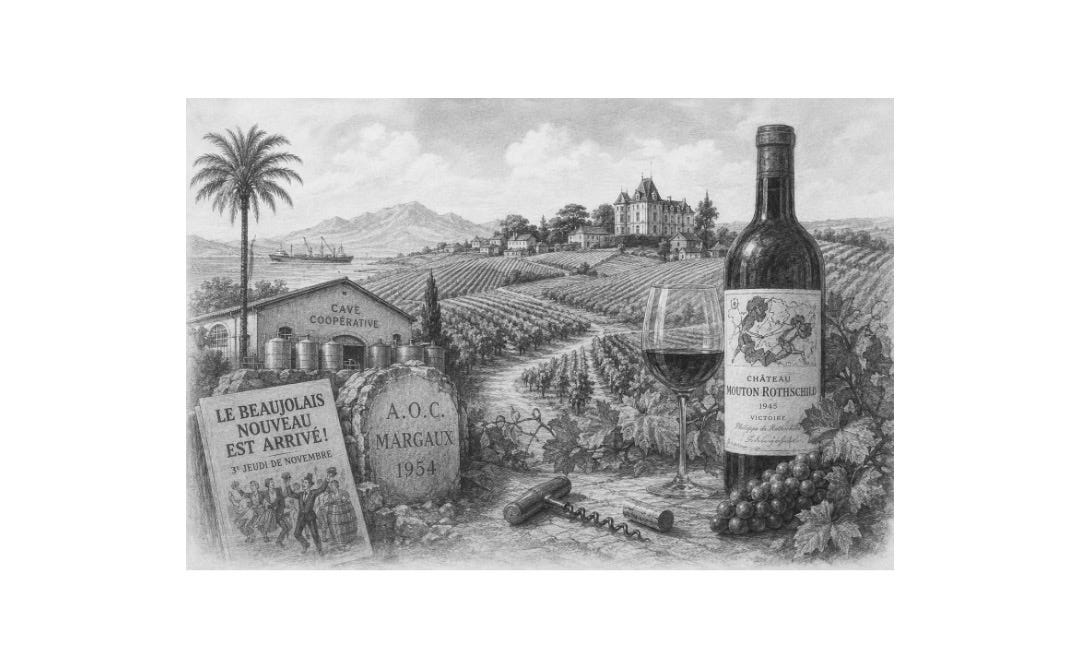
The institutional machinery of origin and reputation nevertheless began turning again. The Institut National des Appellations d’Origine resumed the work that had been interrupted by occupation. New appellations were approved, existing boundaries were adjusted and the postwar geography of fine wine began to take recognisable form. Alsace, Givry and Madiran were among the appellations established in the late 1940s; Margaux received its own appellation in 1954, Côtes de Castillon followed in 1955, and the satellite appellations around Saint-Émilion acquired distinct legal identities.
Classification, too, became a renewed object of attention. Graves announced its classification in 1953, Saint-Émilion in 1955. The sacrosanct 1855 hierarchy remained untouched, despite murmurs of revision, except for the eventual promotion of Château Mouton Rothschild from Second to First Growth in 1973. Baron Philippe de Rothschild’s greater postwar contribution may have been cultural rather than classificatory: beginning with the Victory vintage of 1945, he commissioned an artist to create a label for each vintage of Mouton. Cocteau, Braque, Dalí, Miró, Chagall, Picasso and Warhol would turn the bottle into a meeting place between wine, art and modern patronage.
This was also the period in which France began consciously to restage wine tradition. The Académie du Vin de Bordeaux was established in 1948, followed a year later by the Commanderie du Bontemps de Médoc. Such organisations presented themselves as heirs to an ancient order of wine, complete with robes, ceremonies and banquets. Yet their real significance was modern. They converted heritage into cultural capital and promotion into ritual. France’s postwar wine identity was not simply recovered; it was curated.
The frost that redrew the vineyard
The rebuilding of French viticulture was accelerated by catastrophe. In February 1956, three weeks of exceptional cold swept through the vineyards. Temperatures fell to –25°C in Burgundy and to –23°C near Libourne. In Bordeaux, approximately 45 percent of vines were killed and a further 45 percent damaged. Pomerol was especially badly struck; most of its vines died.
The destruction offered a brutal opportunity. Replanting allowed growers to remove hybrids, eliminate varieties that no longer met appellation requirements and sharpen regional identities. On Bordeaux’s Right Bank, merlot was confirmed as the dominant variety, with cabernet franc occupying a supporting role and cabernet sauvignon restricted to a relatively modest share. The distinction between the merlot-led wines of Saint-Émilion, Pomerol and Fronsac and the cabernet-sauvignon-led wines of the Médoc and Graves became more pronounced.
Elsewhere, a broader varietal reckoning was under way. Baco noir, a disease-resistant hybrid once common in Burgundy, the Loire and Landes, was progressively removed. Aramon, planted across some 150,000 hectares in the late 1950s, began its long retreat from Languedoc. Its prodigious yields could produce wines of remarkable thinness: pale, weak and low in alcohol, they depended heavily on blending for commercial credibility. Aramon was often replaced by carignan, while syrah, grenache and cinsault expanded across Languedoc and the southeast.
The direction of travel was unmistakable. France was exchanging maximum volume for greater concentration, regional suitability and qualitative potential. This did not mean that every vineyard aspired to the status of the Médoc or the Côte d’Or. It meant that an enormous class of wines once accepted as barely drinkable was losing its economic and cultural legitimacy.
Appellation control became more exacting. Compulsory tastings were introduced in certain regions, with wines denied the right to use an appellation name if they failed. When prospective Saint-Émilion grand cru wines were assessed in 1955, a substantial volume was excluded, while many producers withdrew their wines before tasting. The appellation was becoming more than a guarantee of geographical origin. It was being made to function, however imperfectly, as a threshold of competence.
Beaujolais and the invention of arrival
While much of postwar France pursued seriousness through regulation, Beaujolais discovered the commercial power of immediacy.
The region had long sold young wines shortly after fermentation. In 1951, when the INAO attempted to prevent AOC wines from being released before December 15, producers successfully pressed for an exemption. The decision opened the way for what became Beaujolais Nouveau: a bright, fruit-driven gamay intended not for contemplation over decades but for pleasure within weeks.
Its genius lay less in the wine itself than in the transformation of release into occasion. Dates varied at first, before November 15 was adopted in 1967 and the third Thursday of November in 1985. Races carried the new wine towards Paris. The Nicolas chain organised celebrations. The phrase “Le Beaujolais nouveau est arrivé!” made the opening of a bottle feel like the arrival of a season.
By the 1980s, the wine was being flown and shipped across Europe, North America, Australia and Japan for simultaneous release. Production rose from roughly two million bottles annually in the 1950s to more than 30 million bottles of Beaujolais and Beaujolais-Villages Nouveau by 2013.
Professionals have often treated Nouveau with condescension, as though conviviality were an offence against seriousness. Yet its importance cannot be dismissed. It gave Beaujolais a dependable source of income and one of the most recognisable rituals in international wine. The cost was a certain flattening of the region’s image. Morgon, Fleurie and the other crus were frequently obscured by the global fame of their youthful cousin. Beaujolais succeeded so brilliantly in selling one version of itself that it struggled to communicate the rest.
Algeria: the absent partner in the French glass
One of the least romantic but most consequential facts of mid-century French wine was its dependence on Algeria.
For decades, vast quantities of metropolitan French wine—especially pale, low-alcohol wine from Languedoc—were fortified in every sense by blending with darker, stronger Algerian wine. Algeria’s vineyards had expanded during the phylloxera era to compensate for shortages in France, but the relationship long outlived the original emergency. During the 1950s, Algeria produced an average of approximately 1.6 billion litres a year, compared with 5.3 billion in metropolitan France.
Considered independently, Algeria was the fourth-largest wine producer in the world in 1960. Its shipments represented an extraordinary share of international wine movements, though most travelled automatically into the protected metropolitan market. This was not a balanced commercial relationship. Algerian viticulture had been developed to serve French demand, often at the expense of other forms of agriculture.
Independence in 1962 abruptly exposed that dependency. European vineyard owners and workers departed, the Algerian domestic market contracted and access to metropolitan France became politically contested. Although the independence agreement preserved a commercial route for Algerian wine, pressure from French producers led to restrictions. Agreed import volumes were not honoured. Wine became an instrument in a wider trade conflict involving sanctions, oil and the nationalisation of French interests.
The consequences were devastating. Algeria’s wine production, still around 1.3 billion litres annually in the early 1960s, fell by half in the following decade and continued to collapse thereafter. The Soviet Union offered a temporary outlet, purchasing large volumes at much lower prices, but Algeria could not readily reinvent itself as an independent exporter. Its industry had been built for a single privileged market; once that market closed, there was no equivalent destination.
France, meanwhile, lost not only Algeria’s direct contribution to supply but the marketability that blending had conferred on much of its own southern wine. The separation of weak Languedoc wine from robust Algerian material exposed the qualitative fragility of the metropolitan surplus. In that sense, decolonisation became one of the forces pushing France away from anonymous volume and towards more self-sufficient regional styles.
The cooperative revolution
The château and the individual vigneron dominate the iconography of French wine. Yet one of the principal engines of postwar reconstruction was collective.
Hundreds of cooperatives were founded after 1945, bringing France’s total close to a thousand and enrolling more than 200,000 growers. Their greatest concentration was in Languedoc-Roussillon, but they also became important in Bordeaux, Burgundy, Alsace, Champagne and the southern Rhône.
Mechanisation was one reason for their growth. Tractors, improved presses, refurbished concrete vats, stainless-steel tanks and better barrels required capital beyond the reach of many smallholders. Shared facilities allowed growers to modernise without abandoning their land. Cooperatives could also employ professional winemakers and vineyard consultants, offer credit, develop brands, reach distant markets and distil surplus wine that might otherwise have brought no return.
The widespread assumption that cooperative wine must be inferior has always depended on a romantic misunderstanding of scale. A single grower may possess intimacy with a parcel but lack the means to vinify it well. A cooperative may blend across a broad area, yet bring technical competence, hygiene, temperature control and commercial reach to grapes that would otherwise be sold anonymously or poorly handled.
Cahors provides one of the clearest examples. After phylloxera, its historic malbec vineyards had largely been replanted with hybrids. In 1947, the Les Côtes d’Olt cooperative began the patient work of rebuilding the region’s vinous identity, identifying suitable rootstocks, regrafting côt and experimenting with blending varieties. Cahors attained VDQS status in 1951 and full AOC recognition in 1971. Its vineyard area then expanded rapidly, from just over 500 hectares to more than 4,000 by the end of the 1990s.
Similar work helped prepare Buzet, Marsannay, the Hautes-Côtes de Beaune and other regions for appellation recognition. By the late 1990s, cooperatives made approximately half of all French wine and 40 percent of its AOC production. In Champagne, cooperatives not only processed a large share of the crop but created internationally successful marques, including Jacquart and Nicolas Feuillatte.
The cooperative story complicates the cherished opposition between artisanal wine and industrial production. Collective ownership could certainly produce anonymity and mediocrity. It could also preserve small growers, restore historic varieties and provide the technical conditions for a higher standard of wine. The cooperative was not the antithesis of terroir. In many regions, it was the institution that made terroir economically survivable.
Terroir becomes an argument
The postwar rise of appellation wine did more than alter production. It changed the moral language of French wine.
AOC wines were increasingly associated with authenticity, craftsmanship, place and cultural value. Non-AOC wines were disparaged as “industrial,” a term carrying implications far beyond scale. Industrial wine was portrayed as detached from land, tradition and the figure of the vigneron. Appellation wine, by contrast, appeared natural, rooted and legitimate.
Terroir became the organising idea of this hierarchy. Yet terroir itself was neither fixed nor singular. In one formulation, it described the total relationship between place and human practice: soil, climate, exposure, inherited knowledge and the decisions of the grower. In another, it became more narrowly geological, with soil and subsoil treated as the principal determinants of flavour. A third, increasingly international interpretation sought direct sensory correspondences—limestone as minerality, volcanic soils as fire, earth as earthiness.
What mattered was not merely the scientific validity of each claim but the cultural work terroir performed. It allowed French producers to present difference as an inherent property of place rather than a product category. At a moment when Australia, California and other New World regions were becoming commercially formidable, terroir offered France a defence that competitors could not easily reproduce.
The irony was that supposedly timeless wines were being transformed by modern technology. Cultured yeasts, improved filtration, reverse osmosis, micro-oxygenation and other interventions entered French cellars. The language of tradition coexisted with a technological revolution.
Resistance to that revolution generated new schools of thought. Organic growers rejected synthetic fertilisers, pesticides and fungicides. Sustainable viticulture sought a more flexible reduction in chemical use while emphasising water conservation, renewable energy and biodiversity. Biodynamic producers followed principles derived from Rudolf Steiner, treating the vineyard as a living organism and aligning agricultural work with lunar and celestial cycles.
Natural wine pushed the critique further. Its adherents sought to minimise intervention, farm organically or biodynamically, ferment with ambient yeasts and avoid additions, including sulphur in its most rigorous expressions. The Beaujolais négociant and researcher Jules Chauvet became an intellectual reference point, advocating healthy soils, restrained sulphur use and wine as a reflection of place.
These movements differed substantially, and none possessed a monopoly on quality. Their shared importance was philosophical. They reopened the question of what made wine authentic at precisely the moment when technical mastery seemed capable of making wine more stable, polished and reproducible than ever before.
From nourishment to culture
The remaking of French wine cannot be separated from the extraordinary decline in French drinking.
In the late 1930s, annual consumption stood at approximately 170 litres per person. It recovered to around 150 litres in the early 1950s, then began a sustained descent: about 110 litres by the 1970s, 57 litres in the early 2000s and 43 litres by 2014.
These figures describe more than changing taste. Wine had once been integrated into the daily diet, consumed by workers and families as an ordinary source of calories, hydration and sociability. Postwar prosperity gave consumers more choices. Improved tap water, the rapid expansion of bottled water, soft drinks and other beverages displaced wine from the table. Bottled-water consumption rose along a near-inverse curve, from less than 20 litres per person in the 1950s to more than 150 litres in 2006.
The physical and social settings of drinking changed as well. In the 1960s, approximately 200,000 French cafés were licensed to sell wine. By the 1990s, only about 60,000 remained; by 2014, roughly 33,000. Rural depopulation hollowed out the village café, while domestic entertaining increasingly replaced the habitual public drinking of urban workers.
Road-safety laws added further pressure. Penalties for drink-driving became more severe, blood-alcohol limits were progressively reduced and random breath testing was introduced. The Évin Law of 1991 placed strict limits on alcohol advertising, banning it from television and cinemas and preventing drinks companies from sponsoring sporting events.
Yet falling volume did not make wine culturally insignificant. On the contrary, as wine became less habitual, it became more consciously chosen. Television programmes shifted from reports about harvests and machinery towards tasting, oenology, women in wine and the language of appreciation. Consumers who drank less could become more curious about origin, vintage, grape variety and producer.
This is the deeper meaning behind the familiar observation that the French began drinking less but better. In the early 1950s, only around 11 percent of French wine carried an AOC. By the end of the century the share exceeded a quarter, and by 2015 more than half of French production fell within the appellation category. The bottle was ceasing to be an unquestioned daily staple and becoming an object of selection.
Wine moved from nourishment towards culture.
The “French paradox” debate of the late 1980s and 1990s briefly offered a counter-current, with wine—particularly red wine and its resveratrol content—presented in public discussion as a possible explanation for comparatively low rates of heart disease. Whatever the scientific merits and subsequent evolution of that debate, its cultural significance was clear: wine was increasingly defended not as a necessity but as a refined component of a particular way of life.
France meets the wider wine world
Until the 1960s, France’s supremacy in fine wine was largely assumed. Bordeaux, Burgundy and Champagne occupied the summit of international prestige, and their names were so powerful that producers elsewhere routinely appropriated them. “Burgundy” and “Bordeaux” could appear on wines bearing little relation to the French originals; “champagne” became a generic description for sparkling wine in many markets.
The challenge became unmistakable in the 1970s. At the Paris tasting organised by Steven Spurrier in 1976, Californian chardonnays were judged blind against white Burgundies, while Californian cabernet-based wines faced classified-growth Bordeaux. When the scores were averaged, California placed first in both categories.
The Judgment of Paris did not instantly overturn the fine-wine order. Nor did it prove that California had surpassed France in any universal sense. Its importance was psychological. It demonstrated that exceptional wine could be made beyond Europe and that French prestige could no longer be treated as self-evident proof of superiority.
During the 1980s and 1990s, the broader New World wine revolution accelerated. Producers in Australia, California, New Zealand, Chile and elsewhere replanted with vinifera varieties, improved cellar practices and developed clear, varietally labelled wines for export. Their success was particularly strong in Britain, Scandinavia, the Netherlands and Germany—markets open to discovery and less bound by domestic production traditions.
French responses ranged from indignation to collaboration. Many producers denounced the relative freedom enjoyed by New World wineries, which could irrigate, acidify, chaptalise and plant varieties without the intricate restrictions of an AOC. Yet French figures also invested abroad. Baron Philippe de Rothschild and Robert Mondavi established Opus One in Napa Valley. Moët & Chandon developed sparkling-wine interests in Argentina and Australia. Michel Rolland and a group of French partners created Clos de los Siete in Mendoza, while Sancerre producer Henri Bourgeois established Clos Henri in Marlborough.
The exchange worked in both directions. New World producers borrowed the language of terroir and regionality. Some French producers adopted richer, more concentrated styles intended for earlier consumption and the influential American market. Critics accused them of “Parkerising” their wines, a charge suggesting that international approval was eroding regional character.
The anxiety was not simply that France might lose sales. It was that it might lose the authority to define what fine wine should taste like.
Champagne responded to globalisation by defending its name with exceptional determination. Producers challenged Spanish sparkling wines sold as “Spanish champagne,” prevented the use of “Champagne method” outside the region and successfully opposed Yves Saint Laurent’s use of Champagne as the name of a perfume. The appellation became not merely a geographical designation but a form of intellectual and cultural property.
At the turn of the millennium, Champagne demonstrated how effectively scarcity, prestige and global desire could be managed. Fears that supplies would run out before the celebrations of 2000 proved unfounded: the houses had prepared reserves, and a record 327 million bottles were sold in 1999. France’s domestic sales rose relatively modestly; exports to Britain, the United States and Scandinavia surged. The world no longer belonged to French wine, but it still wanted France at the moment of celebration.
A smaller vineyard, a larger idea
French wine law adapted to the new market. The vin de pays category, introduced in the 1970s, created an intermediate tier between anonymous vin de table and tightly controlled AOC wine. It gave producers greater varietal flexibility and, crucially, a regional identity that could be communicated to consumers.
Further reforms arrived in 2010. Vin de table became Vin de France, with grape varieties permitted on labels. Vin de pays became Indication Géographique Protégée, or IGP. AOC became Appellation d’Origine Protégée, or AOP. French appellation wines were also permitted to display grape varieties more prominently, an accommodation to export markets in which consumers were accustomed to choosing chardonnay, merlot or sauvignon blanc rather than decoding a map of communes.
Behind these changes lay the most remarkable structural fact of the postwar period. France’s vineyard shrank from 1.434 million hectares in 1945 to 792,000 hectares in 2014—a reduction of almost half. Much of what disappeared had produced the lowest grades of table wine. The resulting industry was smaller, more efficient and far more heavily weighted towards appellation and geographically identified wines.
To call this a golden age is therefore to acknowledge a paradox. France achieved its modern prestige not by preserving the wine culture it had inherited, but by dismantling a considerable part of it. The ocean of everyday wine receded. Hybrids and high-yielding varieties were uprooted. Algerian blending disappeared. Daily consumption fell. Cafés closed. The peasant vineyard became less common, and the international market less deferential.
In exchange, France fashioned a more exacting idea of wine: one founded on controlled origin, regional distinction, improved viticulture and the cultural value of place. Cooperatives and corporations participated alongside individual growers. Technology advanced while natural-wine movements resisted it. Terroir was invoked as ancient truth even as its meaning was continually rewritten.
The achievement of postwar French wine was not purity, and still less permanence. It was the ability to turn loss into hierarchy, regulation into identity and geography into desire.
France ended the twentieth century with fewer vines and fewer habitual drinkers. But the wines that remained carried more meaning than ever.