

The Long Memory of Romanée-Conti
How monastic land, princely possession, family succession and an exacting sense of place created Burgundy’s most scrutinised domaine.
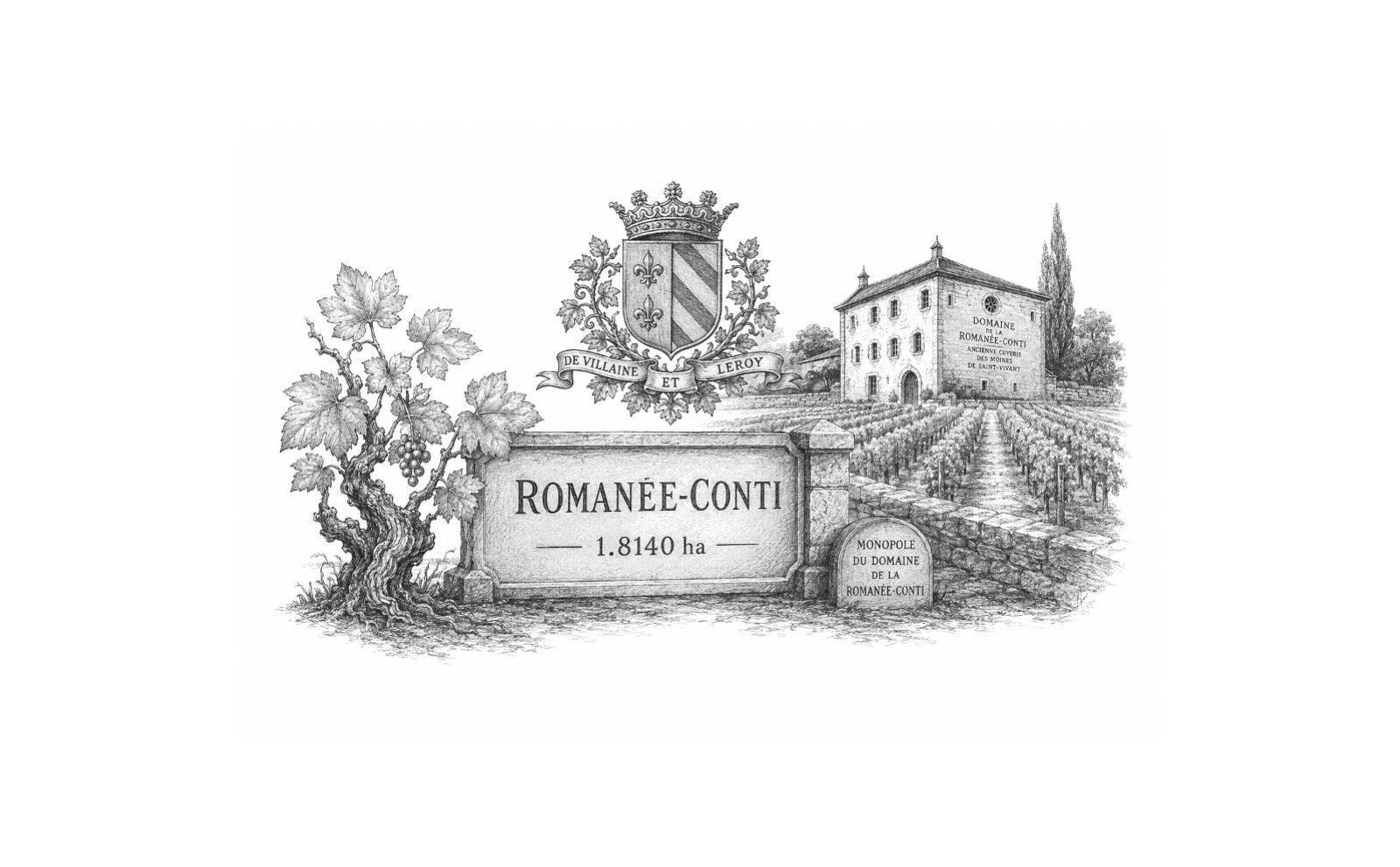
There are famous vineyards, and then there is Romanée-Conti: 1.8140 hectares whose name has come to stand for something much larger than the ground itself. The figure is the Domaine’s own current measurement, precise to four decimal places—a fitting numerical expression of Burgundy’s obsession with the exact parcel. Yet the history behind those hectares resists the neatness of a cadastral plan. It is older than the modern Domaine, older than the appellation, and older even than the name Romanée-Conti.
That distinction matters. Domaine de la Romanée-Conti is often spoken of as though vineyard, estate and company were one continuous entity stretching back into the Middle Ages. They are not. The land has a medieval history; the present family-estate lineage takes shape around Jacques-Marie Duvault-Blochet’s acquisition of Romanée-Conti in 1869; and the Société Civile du Domaine de la Romanée-Conti was constituted only in 1942. To understand DRC properly is therefore to follow three overlapping histories: that of a vineyard, that of a family patrimony and that of an institution.
For collectors, this is more than antiquarian housekeeping. DRC’s prestige rests in part on the sense that the wines emerge from an almost impossibly concentrated continuity of place. The remarkable truth is not that nothing changed, but that the identity of the site survived centuries in which almost everything did.
Before Romanée-Conti: Saint-Vivant and the making of a place
The Domaine’s own chronology places the foundation of the priory of Saint-Vivant around the year 900. The surviving documentation, however, gives us firmer ground slightly later. On 13 November 1131, Hugues II, Duke of Burgundy, transferred land, woods and fields in Flagey and Vosne to Saint-Vivant, in an act preserved by the Archives départementales de la Côte-d’Or under the reference 21 H 58. It is the earliest secure documentary anchor in the historical chain assembled here.
The distinction between tradition and documentary certainty is especially important in Burgundy, where medieval landholding is frequently projected too tidily onto the modern vineyard map. By 1512–1513, a Saint-Vivant terrier records “five journaux” forming part of what would become Romanée-Conti. But the Côte-d’Or archivists themselves caution that the old boundaries cannot be matched exactly to today’s Grand Cru parcels. The continuity is real; the cadastral identity is not provably frozen across five centuries.
That is arguably the more interesting story. Burgundy’s climats were not revealed in a single administrative moment. They accumulated identity through cultivation, ownership, custom, law and repeated acts of distinction. UNESCO’s description of the Burgundian climats makes precisely this broader point: today’s highly delimited parcels emerged historically through the interaction of natural conditions, human cultivation and social institutions, rather than appearing fully formed in the Middle Ages.
By the late 16th century, the site had entered a more recognisable chain of private tenure. In 1584 Saint-Vivant granted the Cros des Cloux—identified by the Domaine as the future Romanée-Conti—in perpetual lease to Claude Cousin. Through inheritance and sale it passed to Germain Danon, Jacques Venot and then the Croonembourg family. In 1651, according to DRC’s chronology, the name La Romanée appears in writing. That matters: Romanée existed as a name before Conti ever entered the story.
The Prince de Conti enters the vineyard
The decisive aristocratic association began in 1760. On 18 July, La Romanée was transferred through Jean-François Joly de Fleury, acting “for himself or a friend to be named”, ultimately for Louis-François de Bourbon, Prince de Conti. Nine years later, an independent boundary record in the Côte-d’Or Archives explicitly describes neighbouring land as adjoining “la Romanée” belonging to the Prince de Conti, confirming the ownership outside the estate’s own narrative.
The episode has attracted the sort of embellishment that follows rare wine through history. A frequently repeated account describes a bidding contest with Madame de Pompadour and assigns an 8,000-livre purchase price. Christie’s has repeated the story, but the estate chronology consulted here confirms the Conti acquisition without itself supplying that price, and no primary documentation establishing the bidding-war narrative was located among the underlying sources. It is safer to leave the legend where it belongs: adjacent to, rather than inside, the verified history.
Conti’s ownership nevertheless altered the vineyard’s identity permanently. After the Prince’s death in 1776, the property passed to his son. Then came the Revolution. Romanée-Conti was confiscated, and on 24 December 1794 it was sold as national property: 40 ouvrées of vines, together with a small building and orchard, for 112,000 livres in assignats. Earlier that year the form Romanée-Conty appears in the Domaine’s chronology; the December sale records use the same association. The evidence therefore supports a careful formulation: the vineyard was La Romanée before Conti, the princely link dates from 1760, and the combined name is documented during the Revolutionary period.
For Burgundy, revolution meant not only regime change but a profound reordering of property. Romanée-Conti’s singularity was not that it escaped confiscation—it did not—but that it escaped the sort of fragmentation that might have dissolved its identity into a patchwork of proprietors. Its history after 1789 is therefore another exercise in continuity through rupture.
From Ouvrard to Duvault-Blochet
In 1819 Julien-Jules Ouvrard acquired Romanée-Conti. During this period the wine was produced at Clos de Vougeot, according to the Domaine’s chronology. An 1834 boundary document adds a tantalising detail: Ouvrard’s manager for Clos de Vougeot and Romanée-Conti appears in the record alongside Jacques-Marie Duvault-Blochet, decades before the latter would own the famous vineyard himself.
That proximity is suggestive because Duvault-Blochet was no arriviste collector assembling a trophy holding. He was an owner-grower, merchant and public figure in the Côte-d’Or, based in Santenay. When he acquired Romanée-Conti on 25 November 1869, at the age of 79, he already possessed vines in Gaudichots, Richebourg, Grands-Échézeaux and Échézeaux. Romanée-Conti did not create his estate from nothing; it became the name-bearing centre of an already substantial Burgundian patrimony.
That point gives 1869 its proper significance. It is not the “founding” of Romanée-Conti, whose history stretches centuries further back. Nor is it the birth of the Société Civile. It is the beginning of the present family-estate lineage.
Duvault-Blochet died in 1874. His properties subsequently passed through his descendants, while Romanée-Conti itself remained undivided between his daughters Claudine-Constance Massin and Henriette Dupuis. The Domaine traces the succession from there into the Chambon and Gaudin de Villaine branches.
For a modern collector accustomed to viewing DRC through the prism of tiny allocations and singular bottles, this family continuity is easy to romanticise. In practice, it depended on legal structures, inheritance, management and the sometimes awkward arithmetic of shared ownership. The Domaine’s durability has never rested on terroir alone. It has also required repeated acts of governance.
The 20th century: institution, appellation and scarcity
The modern legal framework of Romanée-Conti arrived in stages. In 1933 the estate chronology records the acquisition of “La Tâche Joly de Bévy”, a critical enlargement of the Domaine’s holdings, although the concise historical account does not by itself establish every cadastral step leading to the modern 6.062-hectare La Tâche monopole. Three years later, on 11 September 1936, Romanée-Conti entered the French appellation system; subsequent legislation traces the AOC’s regulatory genealogy explicitly back to that decree.
Then, in 1942, came the corporate structure that still defines the Domaine. The Société Civile du Domaine de la Romanée-Conti was constituted on 31 July. According to DRC’s own family history, Jacques Chambon’s shares were acquired by Henri Leroy, joining the Leroy line to the Gaudin de Villaine side of the ownership. From this transaction emerged the two-family architecture that would shape DRC’s management for the remainder of the century and into the next.
Three years later came one of the most celebrated vintages in the Domaine’s history. Christie’s describes 1945 Romanée-Conti as the last vintage made from the vineyard’s old ungrafted, pre-phylloxera vines, with production of approximately 600 bottles. The qualification matters: 600 is not established as an audited exact count. It is nevertheless a startling figure and one reason the vintage occupies a particular place in the mythology of collectible wine.
Scarcity, however, is not a one-vintage phenomenon at Romanée-Conti. The Domaine’s own bottle-count series shows striking variation: 9,627 bottles in 1959, none in 1968, 3,344 in 1979, 7,446 in 1990, 3,151 in 2008 and 4,906 in 2019. The series ends at 2019; the available material does not justify estimating comparable bottle totals for later vintages.
For investors, that variability is worth contemplating. Romanée-Conti’s rarity is not an artificial marketing premise imposed on a stable industrial output. It is inseparable from 1.8140 hectares of agricultural land, vintage conditions and the severe numerical limits of production. The Domaine’s 2021 report, for example, records roughly half the overall Vosne-Romanée crop lost after severe April frost, with Romanée-Conti and Grands-Échézeaux yielding approximately 22–23 hl/ha.
Two families, one Domaine
The post-war decades gradually created the DRC familiar to today’s wine world. Henri de Villaine became co-manager with Henri Leroy after Edmond Gaudin de Villaine’s death in 1950. In 1974, new statutes installed Aubert de Villaine and Lalou Bize-Leroy as co-managers, a partnership that lasted through 1991.
That period coincided with the consolidation of a portfolio whose names read like a map of Burgundy’s most elevated vineyard culture. Montrachet vines were acquired in 1963. Romanée-Saint-Vivant Marey-Monge was leased from 1966 and purchased by the Domaine’s partners in 1988. Romanée-Conti and La Tâche remain the Domaine’s two Grand Cru monopoles, while Richebourg, Grands-Échézeaux, Échézeaux and the later Corton holdings broaden the range without diluting its focus on the top of the Burgundian hierarchy.
The succession after Lalou Bize-Leroy’s departure from co-management in 1992 was more complicated than many abbreviated accounts suggest. Charles Roch succeeded her in January but died that March; his brother Henry-Frédéric Roch then became co-manager alongside Aubert de Villaine and remained in the role until his death in 2018. Perrine Fenal formally succeeded the Roch branch in January 2019. Bertrand de Villaine’s appointment as successor to Aubert was ratified in December 2021, and current 2026 reporting identifies Bertrand de Villaine and Perrine Fenal as co-directors.
The names change, but the logic is consistent: DRC has been preserved not by a single dynasty operating in isolation, but through a negotiated balance between family branches. “Two families, one domaine,” as the estate itself describes the arrangement, is less a slogan than the institutional mechanism through which one of the world’s most valuable viticultural patrimonies has been kept intact.
Expansion without dilution
DRC’s modern history is not simply one of preservation. It has also expanded—cautiously, and through different forms of tenure.
In 2008 the Domaine took Corton Grand Cru vines under lease; Christie’s places the holding at 2.28 hectares across Clos du Roi, Bressandes and Renardes and identifies 2009 as the first DRC harvest. A decade later, on 11 November 2018, the Domaine took charge of 2.91 hectares of Corton-Charlemagne under métayage, or sharecropping.
Those distinctions of ownership, lease and métayage matter for serious students of the Domaine. DRC’s portfolio cannot simply be reduced to a single acreage figure without losing the legal structure beneath it. Christie’s has described the estate as approximately 25 hectares, but the Domaine’s own materials present vineyard-specific holdings and do not, in the pages considered here, supply a single audited total encompassing owned, leased and sharecropped parcels.
The estate has also tied its modern identity consciously back to Burgundy’s deeper history. In 2010 its administrative offices moved into the former harvest building of the monks of Saint-Vivant. Five years later, the Climats of Burgundy were inscribed on UNESCO’s World Heritage List; the Domaine’s chronology notes that Aubert de Villaine chaired the association associated with the successful inscription.
There is a pleasing symmetry here. The institution that now occupies a building associated with Saint-Vivant also became closely involved in securing international recognition for the parcel-based vineyard culture that monastic landholding helped shape.
What DRC’s history actually tells us
Romanée-Conti invites myth because its modern position seems almost mythological. But its verified history is more compelling than the legends.
The vineyard was not “founded” in a single year. Its medieval antecedents belong to Saint-Vivant; firm surviving documentation runs from the 12th century. La Romanée existed as a name before the Prince de Conti acquired it. The Revolution confiscated and sold the vineyard rather than leaving it untouched. Duvault-Blochet’s 1869 purchase established the present family-estate lineage but did not create the site. The Société Civile dates from 1942, while the Romanée-Conti appellation belongs to the regulatory settlement of 1936.
Seen this way, the history of Domaine de la Romanée-Conti is not an unbroken straight line. It is a succession of recoveries and reformulations: ecclesiastical property becomes private property; a vineyard acquires an aristocratic name; confiscation gives way to new ownership; an established Burgundian proprietor makes Romanée-Conti the centre of a family estate; inheritance is converted into a two-family corporate structure; ancient reputation is formalised by appellation law; private stewardship ultimately becomes part of a UNESCO-recognised cultural landscape.
For the collector, this helps explain why DRC is so difficult to reduce to price, score or scarcity. For the investor, it is a reminder that the value attached to Romanée-Conti rests on an unusually dense convergence of physical limitation, historic continuity, institutional durability and cultural recognition. And for the wine professional, its history offers one of Burgundy’s clearest lessons: terroir is never merely geology.
It is geology remembered, delimited, inherited, litigated, cultivated and protected.
Romanée-Conti’s 1.8140 hectares are tiny. Their history is not.