
The Label That Refused to Grow Old
Discover the century-long story of L'Oratoire des Papes, where an iconic label, historic heritage, sustainable viticulture, and exceptional Châteauneuf-du-Pape wines continue to evolve together.
Some wine estates preserve their past by placing it behind glass. L’Oratoire des Papes has done something more difficult: it has allowed the past to keep working.
A century after the birth of both the name and its now-famous label, the Châteauneuf-du-Pape estate presents a rare kind of continuity. The vineyard has grown, ownership has changed, winemaking has evolved, and environmental expectations have transformed the way estates think about their land. Yet the label, with its radiant Art Deco confidence, remains almost untouched. It has not survived because it looks old. It has survived because it still looks alive.
For François Miquel, who now leads the domaine, that tension between inheritance and renewal is not a decorative idea. It is the guiding principle of the house. The wines, like the image on the bottle, are expected to carry memory without becoming trapped by it.
The story begins in 1880, with a wedding gift. Édouard Amouroux received two hectares of vines enclosed within a clos in the commune of Courthézon. Nearby stood an oratory, close to an eighteenth-century chapel dedicated to Saint Mark. The parcel took its name from that small religious landmark, and over time the name would outgrow the plot itself.
It was Édouard’s son, Léonce Amouroux, who gave the estate its commercial identity. He founded Maison Amouroux, registered the name, and protected the label that would become one of the domaine’s most recognizable assets. The design was printed by lithography on stone, a demanding technique that helps explain its crispness and durability. Its historical printer was based in Valréas, but the identity of the original artist remains less certain.
What is clear is the ambition behind the work. The label combines the decorative force of the interwar period with a sharp, almost neo-Gothic line. Its colors were daring for the time, especially the use of red, which gave the design a modern energy rather than a purely traditional appearance. Looking back over the archives, François Miquel sees more than a piece of packaging. He sees evidence of care, intention, and pride.
The label’s power is confirmed by the bottles that still exist. Collectors have found intact examples from 1949 and 1959, while later preserved vintages, including bottles from 1971, are now kept in the wine library at the Prieuré. These surviving bottles show how little the visual identity has needed to change in order to remain current.
The estate’s modern chapter began in 2000, when Maison Ogier, a subsidiary of the Advini group, acquired the property. Under François Miquel’s direction, L’Oratoire des Papes expanded steadily as opportunities arose. Today it covers 38.5 hectares within the Châteauneuf-du-Pape appellation.
The vineyard is planted to the varieties that define the appellation’s character. For the reds, grenache, syrah, cinsault, and mourvèdre are vinified with whole clusters and through co-fermentation. The whites draw on grenache, roussanne, clairette, bourboulenc, piquepoul, and picardan. The approach is not designed to chase fashion, but to express the estate’s own reading of Châteauneuf-du-Pape: rooted, textured, and precise.
That work is overseen technically by Édouard Guerin, who has guided the domaine toward organic certification. The environmental commitment extends beyond certification itself. In partnership with a livestock farmer from a neighboring village, the estate recovers manure from sheep, horses, and cattle, then uses it to produce its own natural compost. The gesture is practical, local, and symbolic: nourishment returns to the soil through a nearby agricultural cycle rather than through an imported solution.
For all this evolution, one thing was never seriously in question. François Miquel did not intend to replace the label.
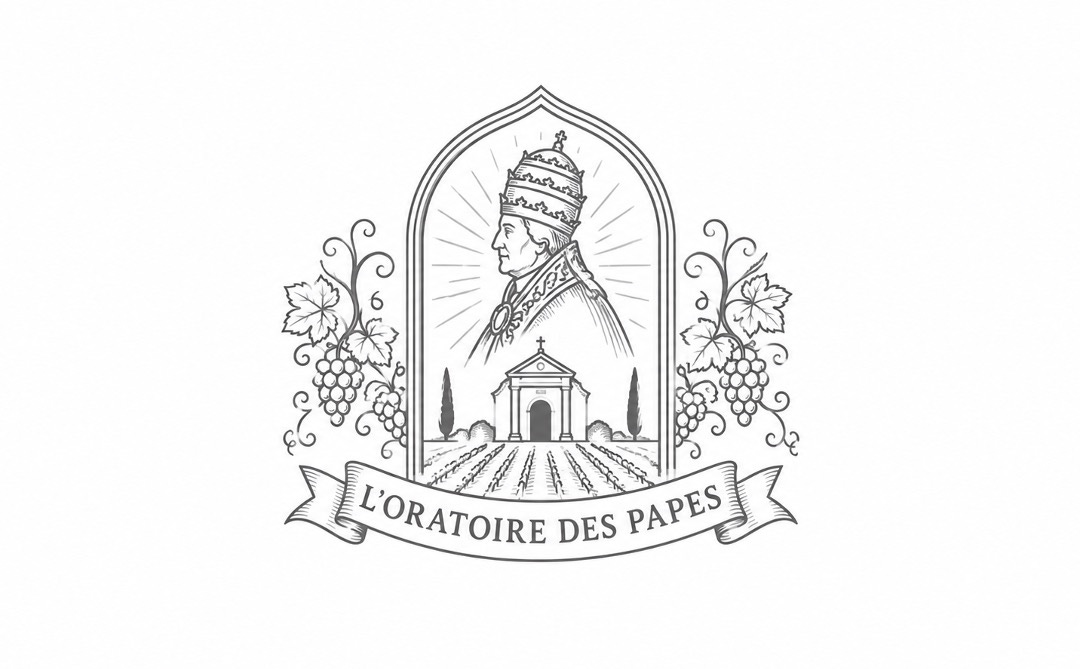
Instead, Maison Ogier chose to deepen the estate’s visual identity. Starting from the traditional armorial Châteauneuf-du-Pape bottle, the house developed its own glass design, incorporating the motif from the original neck band. That element is now screen-printed directly onto the bottle. The result is not a nostalgic replica, but a refined continuation.
The essential symbols remain: Pope Benedict XIII, the oratory, and the name that made the estate recognizable. Around that identity, the range has been clarified. There is L’Oratoire des Papes, and there is Clos de L’Oratoire des Papes, the latter reserved for the estate’s most ambitious wines under the name Les Chorégies. The selection includes two whites and two reds.
The name Les Chorégies opens another door into the estate’s world. It refers to the Chorégies d’Orange, the celebrated opera festival whose history reaches back to 1869. The partnership was created in 2000 by Antoine Leccia, CEO of Advini and a lover of opera. Few cultural settings could be more fitting. The festival takes place in the ancient Roman theatre of Orange, a venue renowned for its monumental backdrop and exceptional acoustics.
Its stage has carried many artistic lives. In its earliest form, the festival was linked to Greek tragedy. In 1903, Sarah Bernhardt performed Phèdre there. Later, opera became its central language. Since the 1930 performance of Gounod’s Mireille, works by composers such as Bizet, Verdi, and Bellini have followed one another before audiences drawn to both music and place. International singers have turned the Roman theatre into one of Europe’s great open-air lyrical stages.
The wines named for Les Chorégies are conceived with that sense of selection and resonance. They come from specific parcels rather than from broad blends. The red is built around century-old grenache, with mourvèdre complanted alongside syrah. The white draws on clairette and bourboulenc. Vinification takes place in 18-hectolitre foudres, with whole clusters, limited intervention, and long macerations. The method seeks depth without heaviness, presence without excess.
In this, the estate’s anniversary is more than a birthday. It is a statement about how tradition can be handled intelligently. L’Oratoire des Papes has not tried to modernize by erasing its visual past, nor has it hidden behind heritage as an excuse for standing still. Its identity is built on a more demanding balance: to keep the parts that still speak clearly, and to change the parts that must serve the future.
To mark the centenary, a special collector’s case will be released from September through selected wine merchants. It will include either a 2024 vintage bottle or a 2025 white, finished with fine-gold screen printing, together with a lithograph by the street artist C215. Production will be limited to 6,000 examples.
The edition brings the story full circle. A label born from lithography returns to print culture through a contemporary artist. A century-old design appears not as a relic, but as a living emblem. And an estate that began with two hectares offered as a wedding gift now stands as a reminder that in wine, continuity is rarely passive. It has to be chosen, protected, and renewed with each generation.