

The History of Wine Taste: Why Fashion Always Returns to the Glass
From resinous amphora wines to pale, low-extraction reds, taste in wine has always followed technology, trade and social desire.
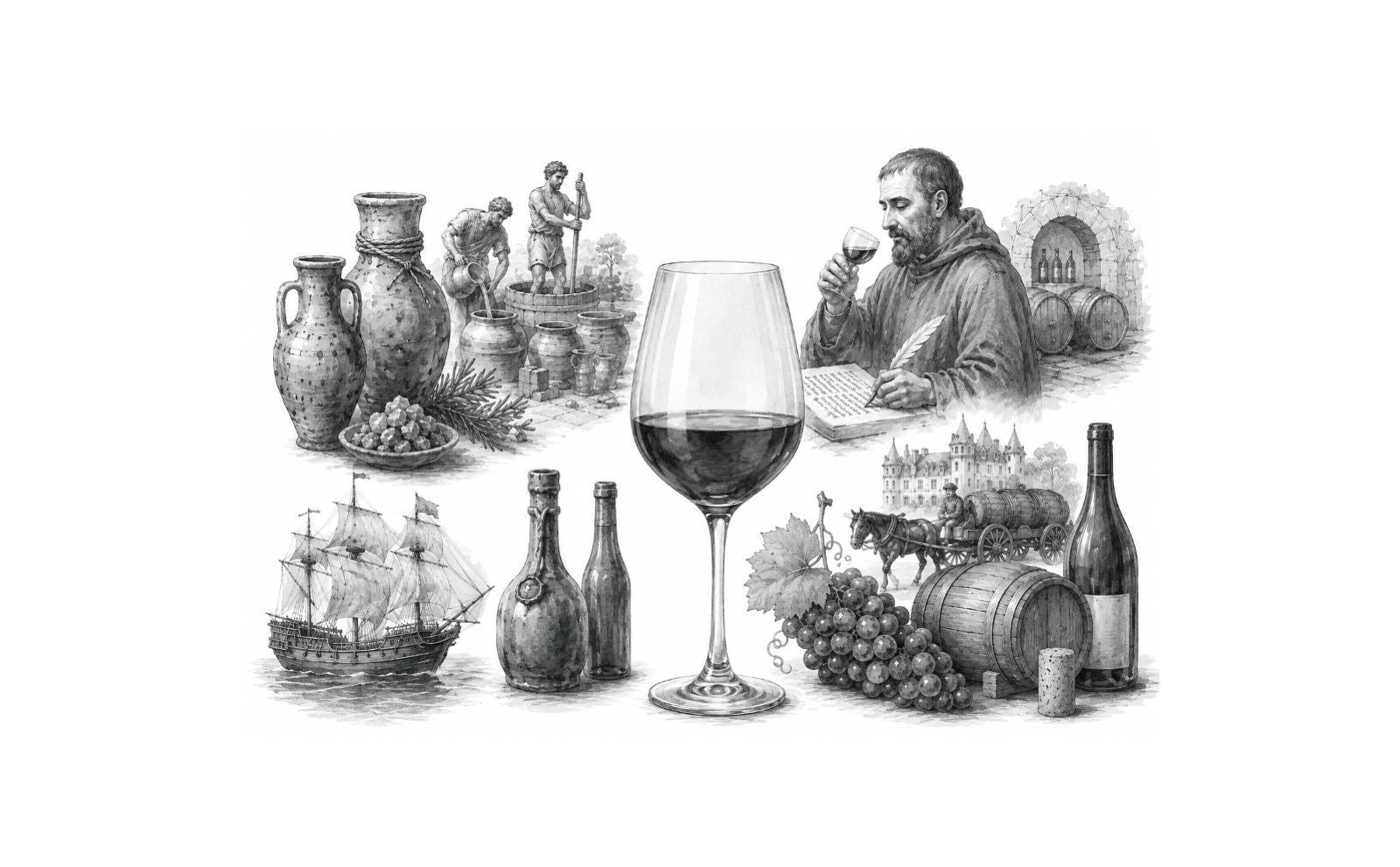
Wine lovers often speak of balance, elegance and authenticity as though these qualities were permanent and universally understood. Yet the history of wine taste suggests something less reassuring—and considerably more interesting. What one generation praises as profound, another may dismiss as heavy. A style once associated with refinement can fall from favour, only to return decades or centuries later under a new name.
Wine does not change in isolation. Its flavours are shaped by vessels, preservation methods, transport routes, medical beliefs, social hierarchies and commercial ambition. What drinkers learn to enjoy is partly determined by what growers and merchants are able to make, preserve and sell.
This does not mean that quality is imaginary. It means that our idea of quality has never been detached from its time. The glass reflects not only vineyard and vintage, but also the expectations of the person holding it.
The History of Wine Taste Begins with Necessity
The earliest wine drinkers did not encounter wine in the polished form familiar today. Ancient producers faced a fundamental problem: fermented grape juice was fragile. Without modern sanitation, temperature control or dependable containers, wine could quickly become unstable.
Preservation therefore influenced flavour from the beginning. Classical agricultural texts describe the use of resin, pitch, salt, seawater, herbs and concentrated grape must. Amphorae and large storage jars could themselves be lined with pitch. These materials were not merely technical aids. They altered aroma, texture and the drinker’s expectations of what wine ought to taste like.
A resinous note that might strike a contemporary taster as unusual could once have suggested soundness and durability. Sweetness from reduced must could conceal roughness, strengthen the wine or help it survive. Practical intervention gradually became part of the accepted sensory landscape.
Traces of this ancient relationship between preservation and flavour remain visible. Greek retsina continues the practice of introducing pine resin during fermentation. In Provence, vin cuit preserves a tradition of using grape must concentrated by heat. Such wines should not be treated as living fossils, but they remind us that techniques often create tastes before drinkers turn those tastes into traditions.
When Age Was Fashionable—and When It Was Not
The belief that a serious wine must improve for decades is comparatively fragile when viewed across the full history of wine.
Roman writers clearly valued mature wines, and some ancient examples were kept for long periods in amphorae. After the decline of the Roman world, however, this culture of extended ageing largely disappeared. For many centuries, even prestigious European wines were generally consumed young.
Medieval drinkers certainly distinguished between ordinary and celebrated origins. Wines could acquire reputations, command higher prices and become associated with courts or powerful households. Yet fame did not necessarily imply longevity. A distinguished wine might still be expected to show its best within the year.
The return of ageworthy wine depended on material change. From the seventeenth century, stronger glass bottles and more reliable closures allowed wine to develop in a protected environment. Ageing then became not only possible but desirable, eventually acquiring moral and aesthetic prestige.
This history complicates the familiar assumption that long life is an essential property of greatness. Cellaring can reveal extraordinary dimensions in Bordeaux, Burgundy, Champagne, the Rhône and many other French wines. But longevity is one expression of quality, not its timeless definition.
The First Language of Tasting
Although professional wine criticism is modern, the attempt to capture wine in words is not.
In late antiquity, the statesman and scholar Cassiodorus described a wine from southern Italy in terms that would sound surprisingly familiar to a present-day reader. He considered its richness, vitality, aromatic force, brightness and persistence. His account even appears to refer to expelling the tasted wine rather than swallowing it.
The vocabulary is separated from modern criticism by many centuries, yet the intention is recognisable: to transform a fleeting sensory impression into language that another person can understand.
Every tasting note performs this difficult conversion. Wine is experienced through smell, taste, touch, memory and expectation; the critic must make those sensations communicable. The resulting language is never entirely objective, but neither is it meaningless. At its best, it gives shape to attention.
Sweet Wine and the Changing Meaning of Luxury
Few categories reveal the instability of taste more clearly than sweet wine.
During the Middle Ages, European thinking about food and drink was influenced by the medical theory of the humours. Wines were classified according to qualities such as hot, cold, dry and moist. Strong, sweet wines were generally considered warming, while thin or sour wines occupied the opposite end of the scale.
These ideas carried social and moral implications. Sweet wines were rare, costly and sometimes treated as restorative. They belonged naturally in princely cellars, at ceremonial tables and among the possessions of educated collectors. Their concentration signalled both material value and sensual intensity.
Muscat was among the great beneficiaries of this culture. Wines from Frontignan, Lunel and other Mediterranean origins travelled widely and enjoyed an enviable reputation. Their unmistakable perfume, now occasionally regarded as excessive, was once part of their distinction.
The modern position is almost reversed. Many naturally sweet and fortified Muscats from Languedoc and Roussillon struggle to attract the attention once granted to them. Consumers who happily accept sweetness in countless foods often describe sweet wine as difficult to place at the table.
This is not simply a change in appetite. It is a change in cultural meaning. Sweetness has moved from rarity to abundance. What once conveyed luxury may now be associated with heaviness or an earlier generation’s drinking habits.
How Old Grapes Acquire New Identities
Decline is not always final. Sometimes a grape returns by changing its stylistic context.
Muscat provides a revealing example. Its intense aromatic signature may seem too obvious in a conventional sweet wine, yet the same grape can appear strikingly different when fermented on its skins. Maceration adds grip, savoury complexity and a more assertive texture, placing the variety within the contemporary world of orange and skin-contact wines.
The technique itself is ancient. Its modern significance lies in the way it allows drinkers to reconsider familiar grapes. Aromatic varieties such as Muscat and Alsace Gewurztraminer can be detached from established expectations and presented through bitterness, tannin and structure rather than perfume alone.
Taste often advances in this circular manner. A forgotten method returns, a neglected grape becomes compelling, and an old style is introduced to a generation convinced it has discovered something entirely new.
Trade and the History of Wine Taste
Terroir is central to French wine, but the style associated with a region has never been determined by soil and climate alone. Markets have always participated in its creation.
Merchants needed wines that could travel, remain stable and appeal to distant customers. Producers, in turn, adapted their methods to the preferences of buyers with economic influence. The resulting styles could eventually appear inseparable from regional identity, even when commerce had played a decisive role in shaping them.
Dutch merchants were particularly important to the Atlantic wine trade in the seventeenth century. Their commercial priorities encouraged technical developments involving preservation, sulphur and distillation. The white wines of western France were not simply sent into an existing market; they were altered by the requirements of that market.
Champagne later offered an especially clear example of production tailored to national preferences. During the nineteenth century, dosage could vary considerably according to destination. Bottlings intended for British customers were made relatively dry, while those prepared for Russia could be dramatically sweeter.
There was no single, universally correct expression of Champagne. There were styles calibrated for different ideas of pleasure.
The Powerful Red and Its Reaction
At the end of the twentieth century and the beginning of the twenty-first, many prestigious red wines pursued concentration. Ripe fruit, extraction, velvety texture and new oak became widely recognised signs of ambition. Bordeaux was closely associated with this movement, although producers responded to it in different ways and with varying enthusiasm.
The influence of powerful critics, particularly Robert Parker, helped give international visibility to this style. Yet it would be simplistic to imagine that one critic imposed it alone. The wines answered a broader appetite for immediate impact, generosity and certainty. Their scale made quality easy to recognise.
Fashion eventually turned. Many contemporary drinkers now seek lighter extraction, brighter acidity, less obvious oak and lower perceived weight. Pale colour, herbal freshness and a certain deliberate austerity can carry the cultural prestige once attached to density.
The reversal is instructive. Neither power nor delicacy is inherently virtuous. A concentrated wine can be harmonious; a light wine can be thin. Trouble begins when a stylistic preference is presented as an absolute standard.
The history of wine taste is full of qualities first elevated into ideals and then hardened into formulas.
The Wines Once Kept at Home
Not every meaningful wine style was created for public approval. Some survived precisely because families continued to make and drink them privately.
The dry oxidative rancios of French Catalonia belong to this intimate history. For a long period, such wines could be treated as domestic curiosities: useful in cooking, served at family occasions or drawn from old barrels that had little place in the modern commercial cellar.
Meanwhile, outward-facing producers often concentrated on wines that seemed easier to explain to urban and international consumers. Familiar grape varieties and techniques borrowed from famous regions promised greater commercial clarity.
Over time, the values were reversed. The oxidative character once viewed as awkward came to represent continuity, local memory and cultural depth. Roussillon’s dry rancios gained formal recognition, while old family barrels on both sides of the Catalan border began to be regarded as a threatened heritage rather than an embarrassment.
The lesson extends beyond rancio. Wine culture is often renewed by styles that survived outside the dominant market: household wines, obscure grapes, unfashionable methods and bottles once considered too local to matter.
Who Decides What Good Wine Tastes Like?
For much of European history, taste moved downwards through society. Courts, aristocratic households and wealthy merchants established models that others followed. Later, exhibitions, competitions, medals and specialist publications helped formalise judgements of quality.
The modern professional critic emerged from this world of classification. Tasting became a distinct occupation, supported by an expanding media culture and, eventually, numerical scoring. Scores offered clarity in an increasingly crowded market. They also implied that wines of different origins and intentions could be arranged along a single scale.
That promise was always questionable. The experience of wine varies with temperature, glassware, food, mood, physical condition, context and the taster’s own history. A score may summarise a judgement, but it cannot remove the person making it.
Earlier wine writers often approached the subject through history, politics, travel and literature as well as sensory description. Figures such as Raymond Dumay, Alec Waugh, Bernard Ginestet, Mario Soldati, Luigi Veronelli and Cyril Ray treated wine as part of civilisation rather than an isolated sequence of aromas.
Their work reminds us that criticism need not become less rigorous when it becomes more expansive. Wine acquires meaning through agriculture, labour, landscape, commerce and memory. A tasting note can illuminate these connections—or reduce the bottle to a number and a list of fruit.
The New Democracy of Opinion
Today, more people publish opinions about wine than at any previous point in its history. Professional critics share the field with sommeliers, merchants, growers, collectors and enthusiastic drinkers. Social media and wine applications have weakened the old boundaries between expert and amateur.
This abundance has clear advantages. More regions, producers and traditions can find an audience. Established orthodoxies are challenged more quickly. Drinkers are exposed to perspectives beyond the small group of publications that once controlled access to critical authority.
The same abundance creates confusion. Visibility can resemble expertise, repetition can resemble consensus, and a fashionable phrase can move through the wine world before anyone pauses to ask what it means.
Perhaps no single voice will again define taste as powerfully as the leading critics of the late twentieth century. That may be healthy. Wine is too diverse to be governed by one palate. Yet a democratic culture of tasting still requires discernment: an awareness of context, a willingness to explain judgement and enough humility to distinguish preference from truth.
What the History of Wine Taste Teaches Us
Every age believes it has stripped away the errors of the one before it. In wine, this confidence deserves suspicion.
Ancient drinkers learned to appreciate flavours created by preservation. Medieval elites prized sweetness and strength. Later generations rediscovered the beauty of mature bottles. International markets encouraged regional wines to become drier, sweeter, stronger or more stable. Critics elevated concentration; their successors celebrated restraint.
None of these preferences appeared from nowhere. Each expressed a particular combination of technical possibility, economic influence and cultural desire.
The most rewarding response is not cynicism, but curiosity. Understanding the history of wine taste makes us more alert to fashion without requiring us to reject it. It allows us to enjoy a fine-boned red, a richly botrytised Sauternes, a skin-macerated Muscat or an oxidative Roussillon wine without forcing them into the same hierarchy.