
The Abbey, the Vineyard, and a Debt Written in Wine
Discover how Burgundy's wine community is funding the restoration of Cîteaux Abbey through a landmark charity auction, preserving centuries of winemaking heritage.
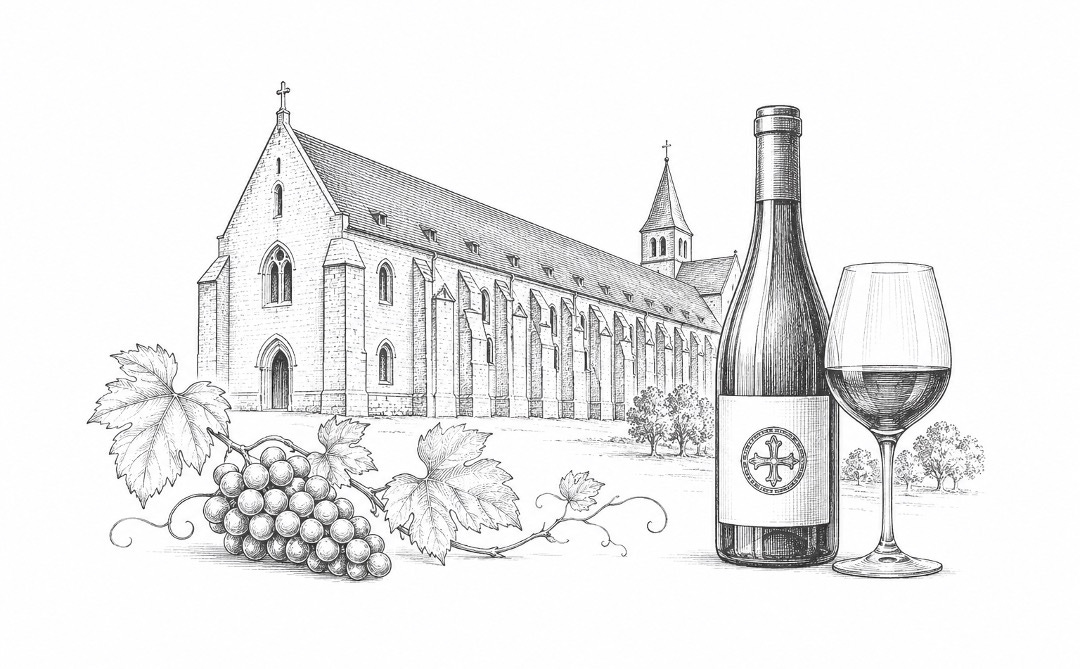
In September 2026, one of Burgundy’s most symbolic stories will return to the place where stone, faith, and vineyard culture have been intertwined for nearly a thousand years. At the Château du Clos de Vougeot, the Confrérie des Chevaliers du Tastevin will host a charity dinner and auction to support the restoration of the definitory of Cîteaux Abbey. The event is not simply another prestigious wine sale. It is a gesture of remembrance, gratitude, and continuity between Burgundy’s wine world and the monastic order that helped shape its identity.
The project has been years in the making. Its roots go back to 2018, when the definitory appeared among the first beneficiaries of France’s heritage lottery. Four years later, in 2022, the Confrérie, working with the Fondation du Patrimoine, organized the first “Clos de Vougeot for Cîteaux Abbey” charity auction. That sale raised €650,000. For the occasion, 24 estates contributed wines to create a special Clos Vougeot Grand Cru bottling: the Cuvée de l’Abbaye de Cîteaux.
The second edition has been conceived on a much broader scale. Rather than returning to the same circle of donors, the organizers wanted to call upon the wider winegrowing community of the Côte-d’Or. The response has exceeded expectations. Around 150 domaines and houses have agreed to take part, turning the auction into a collective offering from Burgundy’s vineyards to one of the great sources of their history.
That enthusiasm is not difficult to understand. Burgundy’s wine culture owes an immense debt to the Cistercians. Their work on land, observation, boundaries, and climate-specific viticulture helped lay the foundations for the region’s understanding of terroir. For many winegrowers, supporting Cîteaux is less an act of charity than an act of return: a way of acknowledging the spiritual, agricultural, and cultural inheritance that still lives in the vineyards today.
The scale of participation is remarkable. According to the organizers, nearly everyone approached agreed to contribute, and additional donations arrived without even being requested. Among producers, the sentiment is widely shared. Jean-Michel Chartron of Domaine Jean Chartron in Puligny-Montrachet sees the initiative as a matter of fairness, since Burgundy’s prosperity as a wine region is inseparable from the legacy of the Cistercian order. Bertrand Dugat of Domaine Claude Dugat in Gevrey-Chambertin expresses the same attachment in more tangible terms: the abbey’s built heritage forms part of the landscape itself, giving history a physical presence among the vineyards.
The auction catalogue promises to attract collectors well beyond Burgundy. Buyers will find wines from 24 grands crus, 19 premiers crus, and 17 village appellations, alongside exceptional formats and rare series. Among the most notable offerings is a six-vintage vertical of Clos de Tart Grand Cru. The vintages represented will range from 1937 to 2025, giving the sale unusual historical depth.
For serious collectors, one detail matters greatly: the lots come directly from the cellars of the donating estates and houses. That “cellar-release” provenance removes much of the uncertainty that can surround older or rare bottles. Condition, storage, and authenticity are central concerns in fine-wine collecting, and this direct route from producer to sale adds considerable confidence.
The catalogue, due to be unveiled in the weeks before the event, will present the full range of Burgundian contributions. It will also extend the story beyond France, with the inclusion of German Pinot Noir from Eberbach Abbey, another house belonging to the same spiritual family. The gesture quietly widens the frame: this is not only about Burgundy, but about the broader Cistercian world and its long relationship with cultivation, discipline, and place.
Wine is not the only gift being offered. Some producers have chosen to contribute experiences as well: private tastings, dinners at estates, and moments of hospitality that allow donors and guests to step inside the living culture of Burgundy. These additions give the sale a more personal dimension. They transform support for a monument into encounters with the people and places shaped by the same inheritance.
The urgency behind this effort lies in the condition of the definitory itself. Built in the seventeenth century, the structure has endured centuries of upheaval, neglect, repurposing, and weather. Its restoration has become one of the major heritage projects of the abbey.
To understand why the building matters, one must begin with its scale. The definitory measures roughly 16 meters by 80 meters, a vast architectural body for a highly specific purpose. It was built by the Cistercian order as the meeting place for the abbots known as definitors. These abbots prepared the decrees submitted each year to the general chapter, the governing assembly of the order.
This system of governance is often overlooked, yet it deserves attention. Long before modern democratic institutions took their familiar form, the Cistercians operated through a structured, deliberative process that distributed authority, debated decisions, and maintained unity across a wide network of monasteries. Later intellectual traditions, especially those shaped by the Enlightenment and the aftermath of the French Revolution, preferred to trace political models back to Antiquity. In doing so, they often neglected the institutional intelligence of medieval religious orders. The definitory stands as evidence of that forgotten administrative sophistication.
Its original purpose came to an end in 1791. During the Revolution, Cîteaux Abbey, its property, and its vast estate of 13,000 hectares were confiscated and sold as national assets. Clos de Vougeot itself formed part of that domain. Many abbey buildings were destroyed, dismantled, or stripped for materials. Roof timbers, stone, and masonry were reused in surrounding construction.
The definitory survived almost by accident. Its brick facing made it less attractive as a source of reusable stone, while neighboring structures were taken apart more readily. Over time, the building passed through different uses, including industrial ones. Survival, however, did not mean preservation. By the twenty-first century, its condition had become serious enough to demand major intervention.
For the Cistercian community, which returned to Cîteaux in 1898, the restoration is more than an architectural campaign. It is a way of reconnecting past, present, and future. Father Abbot Pierre-André Burton has emphasized that restoring such a monument does not mean retreating into the eleventh or seventeenth century. Rather, it means acknowledging continuity: preserving the material witness of the order’s legal, legislative, and spiritual history so that it can remain intelligible to future generations.
The first phase of restoration began in March 2025 and is scheduled to continue into 2026. The repair of the roof and wall alone represents an investment of €8 million. The overall project is estimated at €15 million. Once completed, the restored building will have a new vocation: the transmission and preservation of Cistercian knowledge and history.
The ground floor will be opened to visitors through a guided route presenting nine centuries of Cistercian life. The exhibition will explore the order’s spirituality, its historical development, and the originality of its governing structures. Upstairs, a conservation center will house and protect a unique body of Cistercian documentation, including archives from communities belonging to the order. That center will primarily serve researchers, academics, and specialists interested in Cistercian history. Public opening is planned for 2030.
The September 2026 auction will be conducted by Christie’s, whose international reach is expected to bring the project to collectors across the world. The auction house has also committed to donating part of its proceeds to the restoration, in keeping with its long involvement in charitable causes. Bidding will open online at 12:00 p.m. CEST on September 4, 2026. It will close under the hammer on September 19 during the charity dinner at the Château du Clos de Vougeot. This format allows international buyers to participate remotely through Christie’s platform while preserving the symbolic climax of a live event in Burgundy.
The dinner itself will be one of the evening’s great attractions. Designed and prepared by chef Alexandra Bouvret and her team, it will showcase exceptional wines donated for the occasion. The pairings will include Domaine Jean Chartron’s Chassagne-Montrachet 2023 with the amuse-bouches and Domaine de la Romanée-Conti’s Bâtard-Montrachet 2018 with a course built around the abbey’s cheese. The latter wine is especially rare, since this cuvée from the legendary domaine is not commercially sold.
Seats for the dinner are priced at €500 including tax. For individuals and companies subject to income tax, the effective cost may fall to approximately €350 thanks to the tax receipt issued by the Fondation du Patrimoine for the ongoing fundraising campaign.
What will remain from this mobilization is more than a list of lots, donors, and figures. It will stand as evidence that Burgundy’s vineyards still recognize the order that helped teach them how to read land with patience and precision. The climats of Burgundy, inscribed on the UNESCO World Heritage List in 2015, are often celebrated as masterpieces of terroir. Behind that achievement lies a long discipline of observation, classification, care, and transmission—values deeply connected to Cîteaux.
The restoration of the definitory gives today’s wine world a chance to return something to the source. Through bottles, meals, archives, stonework, and scholarship, a broken thread is being tied again. Until September 19, 2026, collectors, wine lovers, patrons, and admirers of Burgundy’s heritage still have the opportunity to become part of that long story.