
Sauternes 2025: Clarity Within Opulence
A vintage where richness meets precision, redefining balance in Sauternes through freshness, tension, and measured botrytis
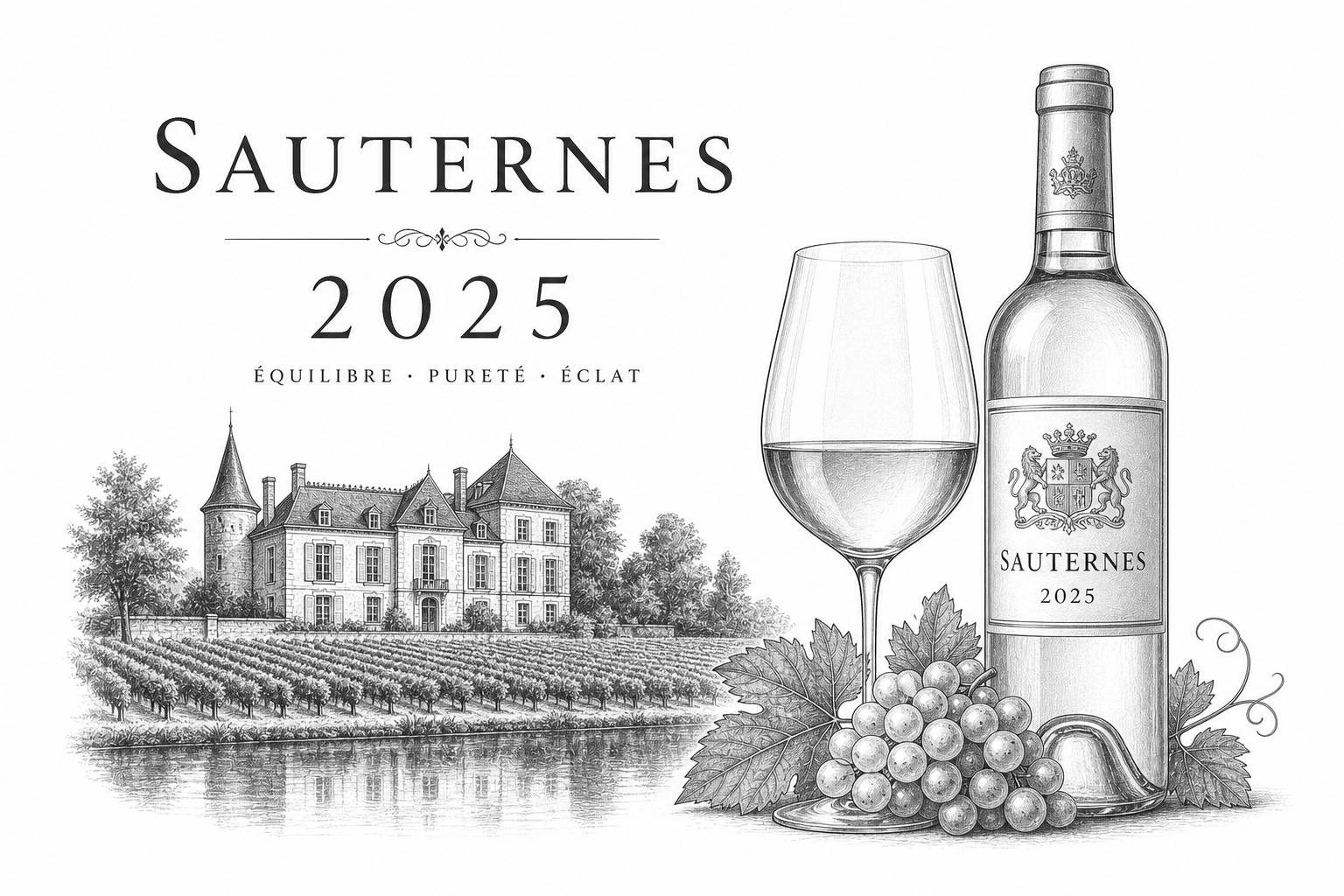
In Sauternes, greatness is often measured by excess—of botrytis, of richness, of time itself. Yet the 2025 vintage suggests a different reading of the appellation’s potential. Here, opulence is neither abandoned nor diminished; it is instead recalibrated, guided by a persistent search for clarity, tension, and precision.
Across the appellation, a remarkable homogeneity emerges. Not in uniformity of style, but in shared intent: to preserve the integrity of fruit within the density of liqueur. The result is a vintage that feels less sculpted by concentration alone and more by articulation—each wine shaped as much by its line as by its volume.
The Architecture of Balance
The defining feature of Sauternes 2025 lies in its equilibrium. Sugars remain substantial, yet rarely overwhelming; acidity, often vivid, provides both structure and lift. This interplay creates wines that move across the palate rather than settling upon it.
At Château Lafaurie-Peyraguey, the liqueur is ample yet disciplined, unfolding progressively and returning, almost unexpectedly, to the freshness of the fruit. The sensation is not of weight, but of controlled expansion.
Similarly, Château Suduiraut demonstrates how density can coexist with tension. Its tactile grain—unusual in sweet wines—introduces a structural dimension that anchors the richness without constraining it. The finish, marked by renewed freshness, reinforces this sense of dynamic balance.
Botrytis Reconsidered
Botrytis remains central, but its expression in 2025 is notably refined. Rather than dominating, it integrates—bringing texture, aromatic complexity, and depth without obscuring varietal clarity.
At Château de Fargues, still in an early and formative stage, the influence of botrytis is pronounced, shaping a dense and layered structure. Yet even here, the promise lies not in sheer concentration, but in the gradual harmonisation of its elements over time.
Elsewhere, estates such as Raymond-Lafon and Rabaud-Promis embrace a more assertive style, where botrytised richness takes the lead. These wines, more monumental in construction, will require extended ageing to fully resolve their internal tensions.
Freshness as a Guiding Principle
If one thread unites the most compelling wines of the vintage, it is the role of freshness—not merely as acidity, but as a sensory counterpoint to sweetness.
Château de Rayne-Vigneau exemplifies this approach, with a profile that privileges energy over breadth. Citrus notes, particularly grapefruit and bergamot, sharpen the contours of the wine, lending it a lifted, almost linear quality.
Château Sigalas-Rabaud and Domaine de l’Alliance further illustrate how acidity can define movement within the wine. Their structures feel agile, their finishes precise, suggesting a style of Sauternes that is increasingly attentive to tension as a form of elegance.
Even in more generous expressions—such as Bastor-Lamontagne or Broustet—the return to fresh fruit in the finish appears as a recurring motif, tempering the natural richness of the appellation.
Texture and Nuance
Beyond structure, the 2025 vintage invites attention to texture. The best wines exhibit a tactile quality that goes beyond viscosity—something closer to a grain, a fine articulation within the liqueur itself.
Doisy-Daëne offers a particularly nuanced interpretation, where the wine evolves through layers of flavour, from ripe fruit to subtle notes of caramelised sugar, vanilla, and spice. The progression feels continuous, almost architectural in its unfolding.
At Caillou and Closiot, texture becomes a medium for expressing both richness and restraint. Their wines vibrate rather than settle, maintaining a sense of movement that prevents any descent into heaviness.
The Diversity of Expression
While the vintage is cohesive, it does not suppress individuality. Differences in terroir and élevage remain clearly legible.
Barsac properties, such as Coutet, emphasise structure and mineral tension, sometimes at the expense of immediate openness. Others, like Guiraud, pursue a more measured and understated expression, where finesse takes precedence over intensity.
In certain wines, élevage remains prominent at this stage, shaping both aroma and texture. Yet the underlying material suggests that time will integrate these elements, revealing greater complexity and cohesion.
A Vintage of Quiet Authority
Sauternes 2025 does not seek to redefine the category through spectacle. Instead, it refines it from within.
The wines possess depth, certainly, but it is a depth that reveals itself gradually. Their strength lies in their ability to reconcile richness with precision, botrytis with clarity, sweetness with movement.
For collectors, this is a vintage that will reward patience. For those attentive to nuance, it already offers a compelling glimpse into a more measured, more articulate future for Sauternes.
In this balance—between opulence and restraint—the identity of the appellation finds renewed definition.