
Saint-Émilion 2025: Precision on Limestone
A composed, mineral-driven vintage shaped by Cabernet Franc and restrained power across Saint-Émilion’s finest terroirs
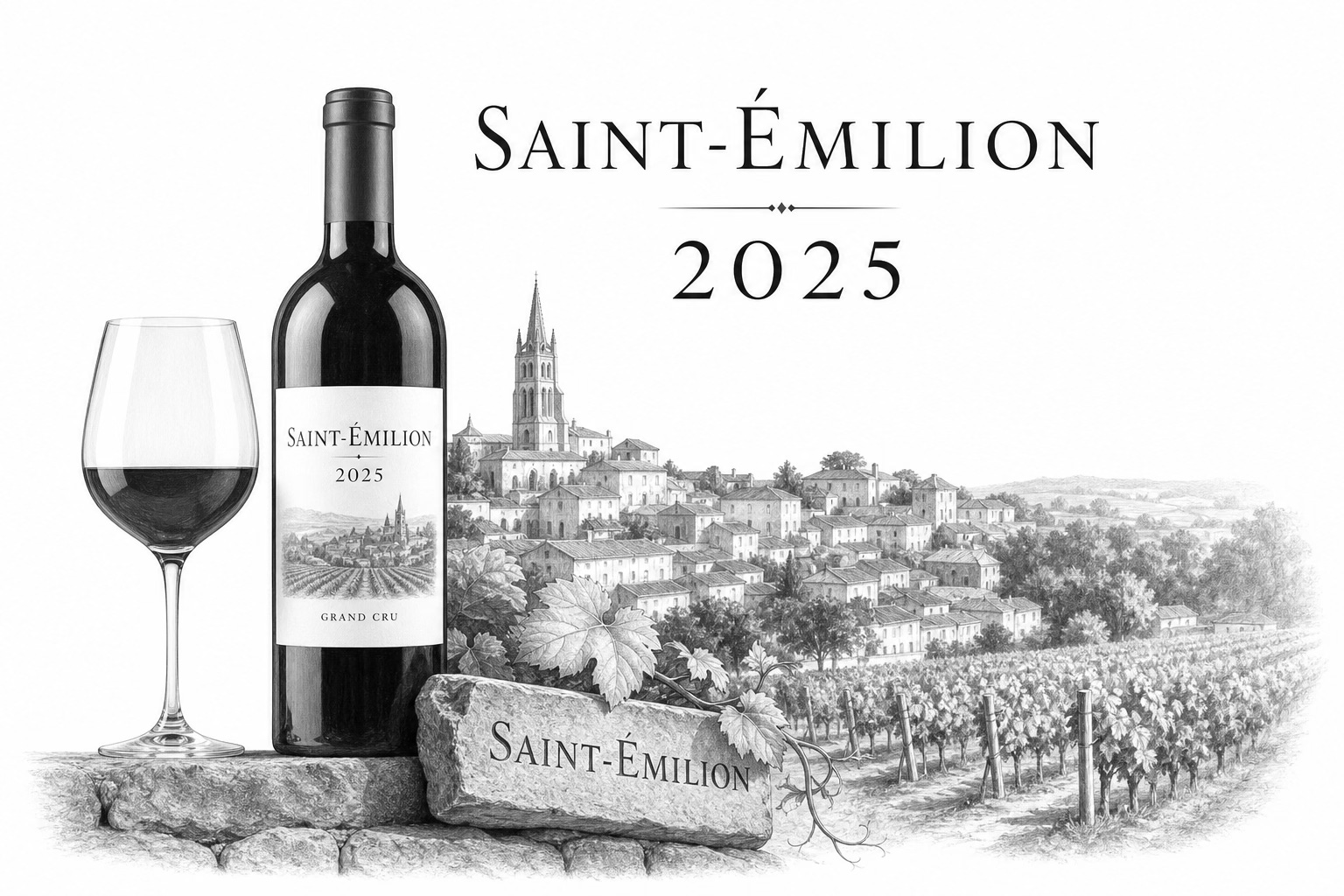
The 2025 en primeur tastings in Saint-Émilion reveal a vintage defined less by sheer power than by composure. Across the appellation, a quiet but unmistakable shift is underway: toward refinement, toward mineral clarity, and toward a rebalancing of the Right Bank’s traditional hierarchy of grape varieties.
The dominant impression is not density, but definition. Wines articulate their origins with unusual clarity, particularly those rooted in the limestone plateau and its fractured extensions. Texture, rather than weight, becomes the principal vehicle of expression.
A Vintage of Measured Energy
Climatically, 2025 might have suggested opulence. Yet the wines resist excess. Alcohol levels remain moderate, often around or just above 13%, allowing structural elements—tannin, acidity, and mineral tension—to emerge with precision.
This equilibrium is especially evident in the mid-palate: a zone of concentration without heaviness. The tannins, consistently described as fine, powdery, or velvety, rarely impose themselves. Instead, they extend the wines, giving shape and length without austerity.
In this sense, 2025 belongs to a lineage of vintages where structure is internal rather than architectural—less about frame, more about flow.
The Ascent of Cabernet Franc
Perhaps the most striking structural evolution lies in the prominence of Cabernet Franc. Frequently exceeding 50% in blends, it shapes not only aromatic profiles but also the tactile identity of the wines.
At estates such as Cheval Blanc, Ausone, or Pavie, high proportions of Cabernet Franc contribute to a style marked by finesse and elongation. The grape introduces floral lift, subtle herbal inflections, and above all a linearity that reinforces the mineral backbone of the terroir.
This is not a stylistic rupture, but a culmination. Cabernet Franc, long integral to Saint-Émilion’s greatest wines, now asserts itself more visibly as a structural axis rather than a supporting element.
Limestone as a Unifying Thread
Across classifications and sectors, the imprint of limestone is unmistakable. Whether on the plateau or along its slopes, the best wines translate their soils into a tactile sensation—chalky, saline, sometimes almost tactile in its austerity.
This mineral signature does not suppress fruit; rather, it disciplines it. Black fruit profiles remain present, yet they are rarely dominant. Instead, they are framed by notes of stone, dried herbs, citrus zest, or even subtle smoky nuances.
In wines such as Canon, Clos Fourtet, or Pavie Macquin, this dialogue between fruit and rock defines the vintage. The result is a form of tension that persists through the finish, often extending into a saline or subtly bitter register.
Texture as Identity
If one were to reduce 2025 to a single sensory characteristic, it would be texture. Not density, not aromatic intensity, but the way the wine moves across the palate.
The finest examples achieve a paradoxical combination: enveloping yet weightless, structured yet fluid. Terms such as “velvety,” “powdery,” and “crystalline” recur across estates, suggesting a shared pursuit of tactile refinement.
Even among lesser-known properties, this attention to texture is evident. Careful extraction, precise élevage, and, in some cases, biodynamic practices contribute to wines that privilege clarity over volume.
Hierarchies Reaffirmed, Nuances Expanded
The leading estates confirm their stature. Cheval Blanc stands out for its balance between concentration and restraint; Ausone for its depth and length; Canon for its articulation of limestone purity; Figeac for its understated harmony.
Yet the interest of the vintage lies equally in its breadth. Numerous crus—Larcis-Ducasse, La Gaffelière, Troplong-Mondot, or Jean Faure—demonstrate a capacity to interpret the vintage with distinct voices, often through variations in soil composition or blending choices.
Second wines, too, reach notable levels of precision, reflecting both the quality of the harvest and the increasing rigor of selection.
A Vintage for the Cellar
The balance achieved in 2025 suggests strong ageing potential, though not necessarily through sheer tannic mass. Instead, longevity will derive from the interplay of acidity, fine tannins, and mineral persistence.
The wines do not seek to impress in their youth. They unfold gradually, often with a reserved aromatic profile that hints at deeper complexity to come. This restraint is not a limitation, but a promise.
Conclusion
Saint-Émilion 2025 does not redefine the appellation; it refines it. It confirms a movement toward precision, toward transparency of terroir, and toward a more nuanced expression of structure.
In this vintage, the limestone speaks clearly, Cabernet Franc finds its full voice, and the notion of balance takes precedence over demonstration. For those attentive to these subtleties, 2025 offers a compelling, quietly profound interpretation of Saint-Émilion.