
Rouge Garance: The Last Vintage of a Wine Born Between Cinema and the Vine
Rouge Garance ends after 30 years, closing a rare Côtes-du-Rhône story shaped by organic wine, Jean-Louis Trintignant, Enki Bilal, and cinema.
Some wine estates disappear quietly. Others leave behind a scent of story, image, and memory. Rouge Garance belongs to the second kind.
For three decades, this 28-hectare organic vineyard in the Côtes-du-Rhône carried more than the identity of a domaine. It carried a bird drawn by Enki Bilal, the shadow of Jean-Louis Trintignant, and the persistence of Bertrand and Claudie Cortellini, who built a wine life from the ground up after leaving the cooperative cellar of Saint-Hilaire-d’Ozilhan in the Gard. In 2026, that story is entering its final chapter.
Claudie Cortellini has confirmed that Rouge Garance will not produce wine this year. The company itself is expected to come to an end before the close of 2026. The decision is not born of bitterness. It is the result of age, exhaustion, economics, climate, and, above all, the absence of a successor willing and able to take the domaine forward.
Bertrand and Claudie Cortellini, now 71 and 67, have spent far longer than a normal working life tending vines, making wine, and defending a distinctive identity in a crowded market. Since 2020, without a family heir to continue the estate, they have looked for buyers. There was interest. Several candidates appeared serious at first. Yet each potential handover eventually failed, for reasons ranging from health problems to financing obstacles. Banks were reluctant. Ambition alone was not enough.
The ending is painful precisely because Rouge Garance was never an anonymous label. It began with friendship, art, and local roots. Jean-Louis Trintignant, who died in 2022, was not a distant celebrity attached to the project for prestige. He was from the region, born in Piolenc, and he brought vineyards into the venture. His involvement helped give the domaine its unusual aura. He supported the Cortellinis not only at the beginning but through years of creation, tasting, and cuvée development.
Even the name carried a cinematic echo. Garance was chosen in homage to the unforgettable character played by Arletty in Marcel Carné’s Les Enfants du Paradis, written by Jacques Prévert. The reference suited a domaine that seemed to stand at the crossroads of wine, film, and imagination.
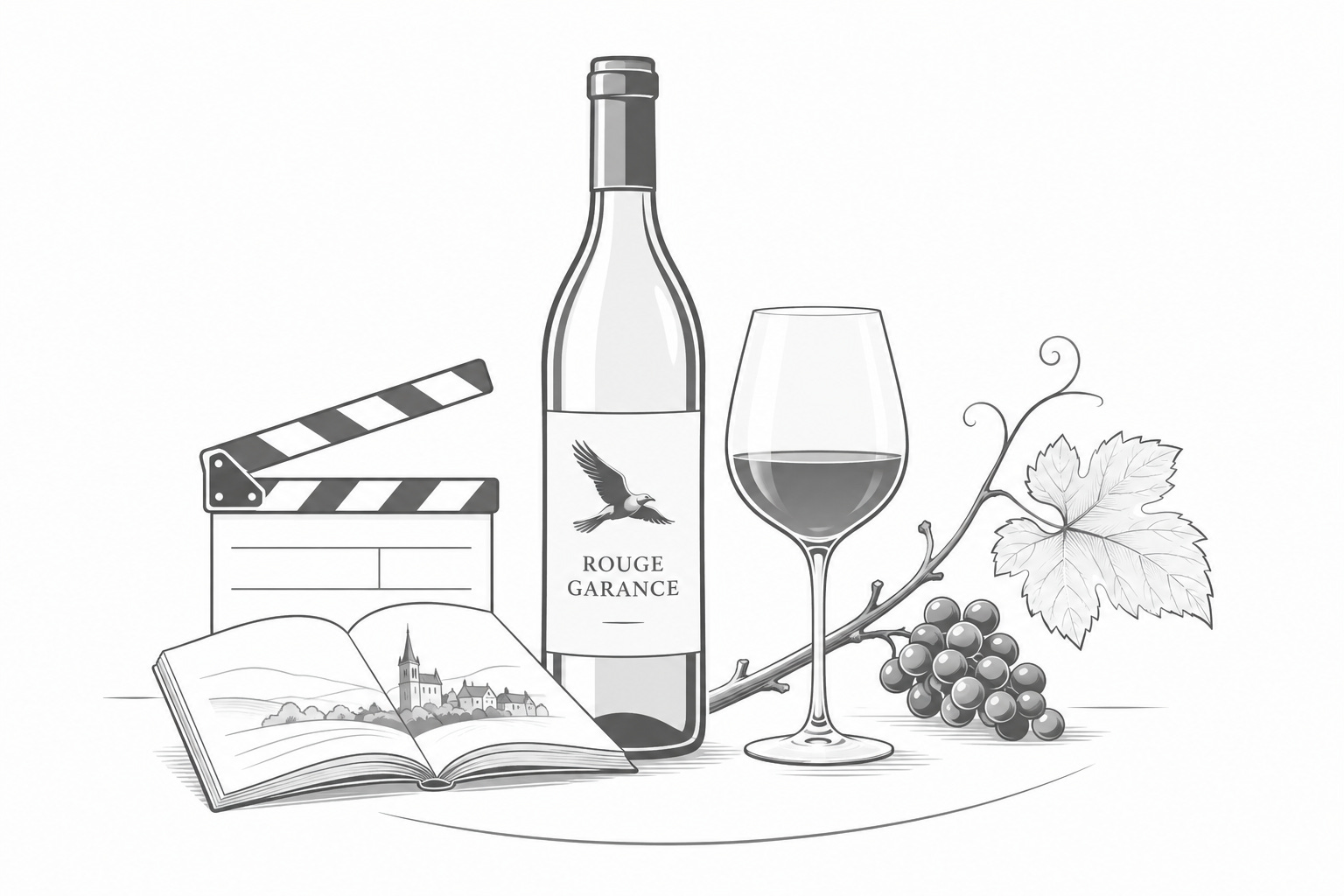
Then came the image that would make the bottles instantly recognizable. In the early days, while Jean-Louis Trintignant was working with Enki Bilal on Tykho Moon, released in 1996, the artist offered to design the label. His bird became the emblem of Rouge Garance. For lovers of graphic novels, that signature mattered. Bilal later gave the domaine another kind of immortality by evoking its flagship cuvée in Quatre?, in a scene set during an airborne dinner in Paris in the imagined year 2027.
The result was a wine estate with a rare triple audience. Wine drinkers came for the bottles. Film enthusiasts came through Trintignant. Comic-book readers recognized Bilal’s mark. Few domaines manage to unite those worlds without it feeling artificial. Rouge Garance did so naturally, because the artistic story was not decoration. It belonged to the estate’s birth.
Yet reputation must still be earned in the glass. Rouge Garance built that reputation through wines known for balance, clarity, and precision. The domaine worked without added sulfites and developed a style that avoided the heaviness sometimes associated with southern Rhône wines. Critics noted the seriousness of the work, its search for continual improvement, and its emphasis on freshness, aroma, and texture rather than rustic force. The wines were Côtes-du-Rhône with a distinct voice: generous but not weighty, expressive without excess.
That kind of identity, however, is demanding to maintain. Claudie Cortellini describes winegrowing as a profession made of several professions at once. A vigneron must know how to farm, how to vinify, and how to sell. Each part requires competence, attention, and stamina. None can be neglected. And even when everything is done well, the weather remains beyond human control.
In recent years, the balance has grown harder. The Covid period disrupted markets. The war in Ukraine and other conflicts deepened economic uncertainty. At the same time, wine consumption has been declining structurally, making the commercial side of the business far more demanding. Selling wine now requires more energy than before, especially for independent estates that must defend their place bottle by bottle, customer by customer, market by market.
For the Cortellinis, that pressure has arrived at the very moment when they should have been able to step back. They are well past retirement age. Continuing would mean not merely maintaining the vineyard, but intensifying the commercial effort. Climate change has added yet another layer of difficulty, altering vineyard work and forcing growers to adapt year after year. The physical and psychological burden has become too heavy.
This is why the end of Rouge Garance should not be mistaken for a failure of quality or affection. The wines were admired. The story was cherished. The name was known. But a domaine cannot survive on admiration alone. It needs hands, capital, resilience, and a future owner prepared to accept the full weight of the craft.
The tragedy is not that Rouge Garance lacked meaning. It may have had too much meaning to pass easily into new hands. To take it over would have meant inheriting vines, a cellar, a clientele, a style, an artistic identity, and the memory of people who gave the domaine its soul. It would also have meant entering a wine economy where romance and reality rarely move at the same pace.
So Rouge Garance reaches its final year with dignity. Its founders are not walking away from an unfinished dream so much as closing a demanding life’s work after giving it everything they had. For thirty years, Bertrand and Claudie Cortellini made a domaine that stood apart: a Côtes-du-Rhône estate shaped by friendship, cinema, drawing, organic viticulture, and an insistence on wines of freshness and precision.
The bird on the label will no longer announce new vintages. But it will remain in the memories of those who understood what Rouge Garance represented: a meeting place between art and agriculture, between the imagined and the cultivated, between the screen, the page, and the vineyard row.