
Rouge Garance: The Final Chapter of a Rhône Estate with a Cinematic Soul
The Côtes-du-Rhône estate shaped by wine, cinema and comics prepares to close after three decades.
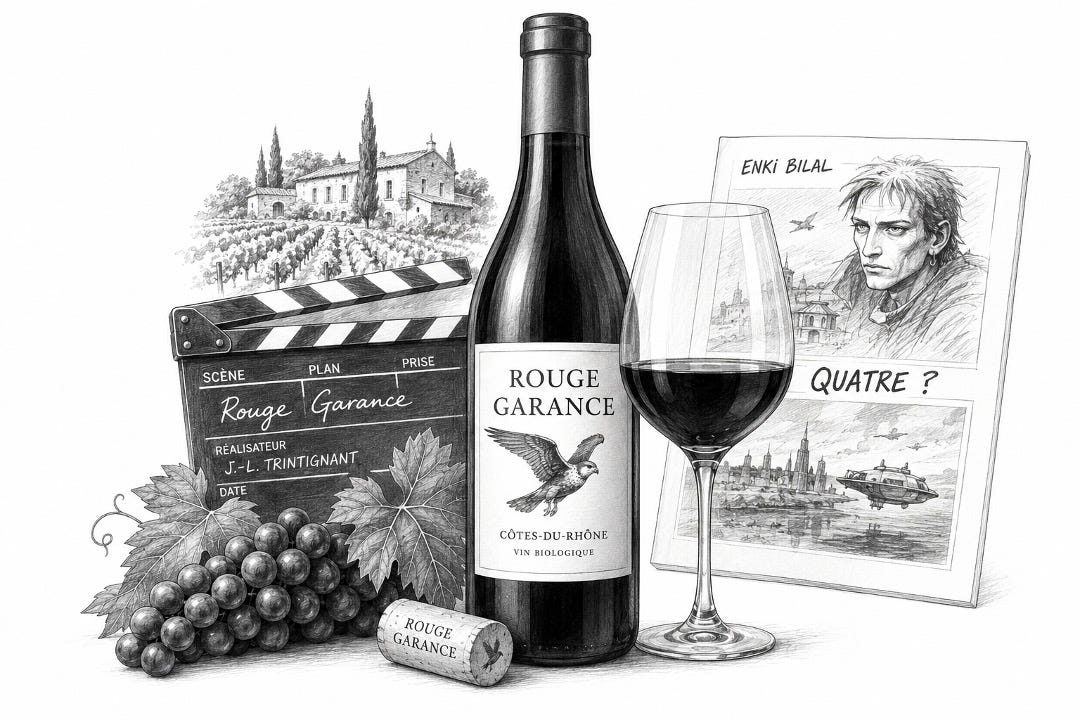
Some wine estates disappear quietly. Others leave behind a story that belongs not only to vineyards and cellars, but also to cinema, drawing, friendship and place. Rouge Garance, the organic Côtes-du-Rhône domaine founded by Bertrand and Claudie Cortellini, belongs firmly to the second category.
After nearly thirty years of work, the estate is preparing to close. There will be no new vinification this year, and the company is expected to come to an end by late 2026. The decision is not theatrical, nor dressed in nostalgia. It is the sober conclusion of a long chapter shaped by craft, persistence and the difficulty of passing on a demanding winegrowing life.
A Côtes-du-Rhône Estate with an Unusual Cultural Signature
Rouge Garance was never just another Rhône label. Based in the Gard, with 28 hectares of certified organic vines in Côtes-du-Rhône, the estate was created by Bertrand and Claudie Cortellini with the support of actor Jean-Louis Trintignant.
Trintignant, born in the region and himself connected to vines, gave the domaine part of its aura. The name Garance evokes the famous character from Marcel Carné’s Les Enfants du Paradis, while the visual identity came through another artistic encounter: Enki Bilal, the celebrated comic-book artist and filmmaker, created the estate’s emblematic bird.
This gave Rouge Garance a rare position in French wine culture. It attracted drinkers who cared about balance and freshness, but also admirers of film and graphic art. The bottle carried more than an appellation; it carried a discreet constellation of references.
The Wines of Rouge Garance
The reputation of Rouge Garance rested on wines that aimed for clarity rather than force. Its Côtes-du-Rhône cuvées were known for avoiding heaviness, favouring aromatic precision, supple texture and a sense of freshness.
The estate also worked without added sulphites, a choice that requires exacting attention in both vineyard and cellar. In the best examples, the result was not a stylistic gesture but a coherent expression of careful farming and disciplined winemaking.
For serious lovers of French wine, Rouge Garance offered a useful reminder: the southern Rhône need not be rustic or excessive. In thoughtful hands, it can speak with warmth, fragrance and restraint.
Why Rouge Garance Is Closing
The end of Rouge Garance is not the result of a single dramatic event. It reflects several pressures familiar across French wine today.
Bertrand and Claudie Cortellini, now beyond retirement age, had been looking for successors since 2020. Several potential buyers showed interest, but none completed the process. The reasons were varied, including financial obstacles and personal circumstances.
At the same time, the wider wine market has become more difficult. Lower wine consumption, economic uncertainty, the aftermath of Covid, international instability and the growing demands of commercial work have made life harder for independent estates. Climate change has added another layer of complexity in the vineyard.
Claudie Cortellini’s assessment is clear: making a distinctive wine now requires expertise in three separate worlds — farming, vinification and selling — while remaining exposed to the unpredictability of weather. That burden is physical, commercial and psychological.
The End of a Domaine, Not of Its Memory
The pieces of Rouge Garance are being dispersed with care. Some vineyard parcels have been sold. Other vines are being removed, with plans to replant trees. The winery buildings are set to become artists’ studios and a home. Equipment, including concrete vats, has been sold to local winegrowers.
There is something quietly fitting in this. An estate born partly through artistic friendship will leave behind spaces for artists. Its tools will continue their usefulness in other cellars. Its name will remain attached to a particular vision of the Rhône: organic, precise, culturally literate and independent.
Rouge Garance in the Story of French Wine
The closing of Rouge Garance reflects more than the fate of one estate. It speaks to the fragility of small and medium-sized domaines, even those with reputation, identity and loyal followers. A beautiful label, a famous connection and critical respect are not always enough to secure succession.
Wine is often romanticised from the outside. From the inside, it is labour, risk, administration, salesmanship, weather, debt, timing and stamina. Rouge Garance reminds us that even poetic wine stories are built on daily work.
Yet its ending should not be read only as loss. For almost thirty years, Bertrand and Claudie Cortellini created wines that carried a distinct voice. They linked Côtes-du-Rhône to cinema and bande dessinée without turning the estate into a gimmick. They made bottles that could be admired for what was in the glass as much as for the story around it.
That is no small legacy.