
Provence Rosé Faces a New Era of Supply Control and Stronger Identity
Provence prepares new tools to protect rosé value, manage supply and defend its identity in a crowded market.
Provence rosé has become one of the most recognisable styles in French wine. Its pale colour, Mediterranean imagery and reputation for freshness have shaped an entire global category. Yet success brings imitation, and popularity does not make a region immune to market pressure.
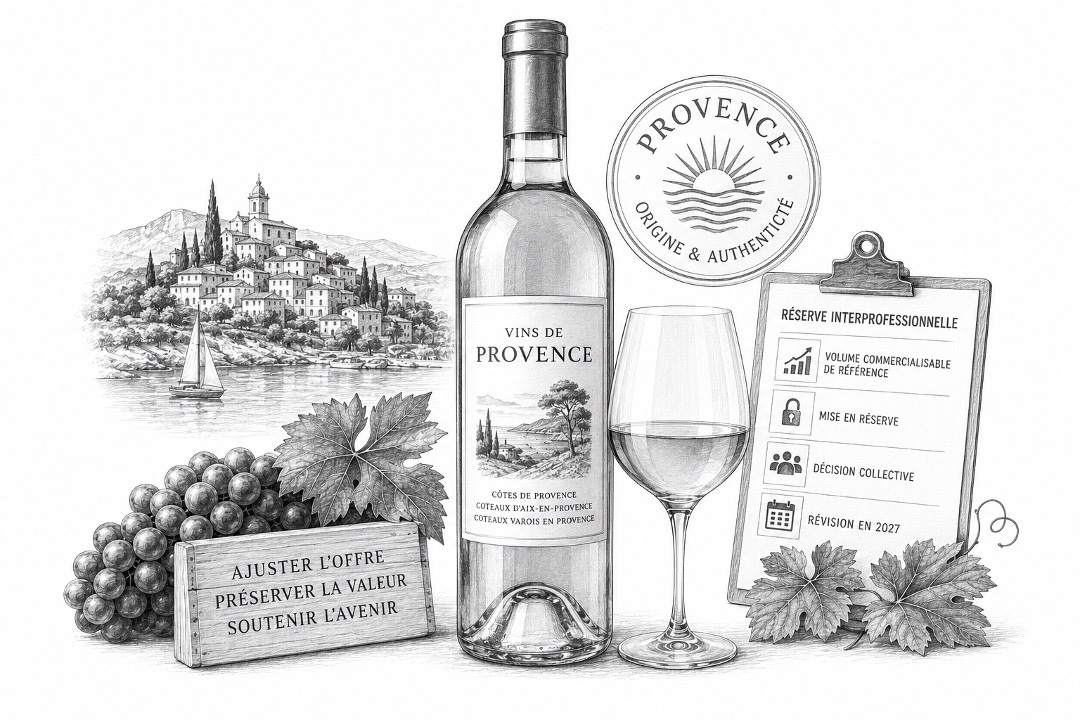
For the 2026 vintage, the Provence wine interprofession is preparing a new mechanism designed to align production more closely with commercial reality. The measure concerns the appellations Côtes de Provence, Coteaux d’Aix-en-Provence and Coteaux Varois en Provence. Rather than imposing a broad reduction in yields across the region, the proposed system would calculate a reference volume for each vinifying operator, based on past sales.
The aim is clear: to avoid a lasting imbalance between supply and demand while protecting the value of Vins de Provence.
A New Reserve System for Provence Rosé
The proposed reserve is built around a “marketable reference volume”. In practical terms, this would be calculated from recent commercial performance, using an average that excludes the highest and lowest years. For bulk wine, this reference would define the amount that can be produced and released commercially. Volumes above that level would be placed in reserve.
For bottled wine, the reference volume would be increased by 5%, allowing room for growth. Any release of reserved wine would be decided collectively. Wines from the 2026 vintage still held in cellars after 31 December 2027 would be destined for distillation.
The measure is expected to be tested on the 2026 vintage, with a review in 2027 before any possible continuation. It still requires ministerial approval.
Why Provence Rosé Needs Regulation
The challenge is not simply one poor season or a temporary slowdown. Provence is trying to prevent a deeper structural imbalance in the rosé market. Wine consumption is under pressure in several countries, while the image of Provence has been widely adopted by producers far beyond the region.
For Provence rosé, this creates a double risk. Too much wine can weaken prices, while visual imitation can blur the consumer’s understanding of origin. A pale bottle with Mediterranean styling may suggest Provence, even when the wine comes from elsewhere.
The new reserve system is therefore both economic and strategic. It is intended to give the appellations more control over supply, preserve value and maintain flexibility for future market or climatic conditions.
A Shared Sign for Vins de Provence
Alongside production management, Provence is also working on a collective recognition mark for bottles from its three main appellations. The idea is to create a clear, immediately visible sign that distinguishes genuine Vins de Provencefrom wines that merely borrow Provençal codes.
This is not a minor detail. In a global rosé market full of pale colours, elegant bottles and sunlit branding, origin can become visually diluted. A shared emblem could help consumers identify authentic AOC Provence wines more easily and reinforce the region’s position at the premium end of the category.
For serious wine lovers, the move also raises a broader question: how does a famous region protect identity without reducing itself to a logo? The success of such a mark will depend on whether it supports, rather than replaces, the deeper values of appellation, terroir and producer reputation.
Beyond Marketing: Protecting a Wine Culture
The planned communication campaign around Provence rosé will include advertising, digital content, wine education, events, tourism and professional visibility. These tools are commercial, but the underlying issue is cultural as well.
Provence has done more than sell rosé. It has defined a contemporary language for it: dry, pale, precise, gastronomic and associated with a certain Mediterranean elegance. That success has helped raise the reputation of rosé wine internationally. But it has also made Provence vulnerable to visual copying and market saturation.
The region now appears to be entering a more defensive phase: not retreating from ambition, but trying to protect the conditions that made its rosés valuable in the first place.
What This Means for French Wine Lovers
For lovers of French wine, the Provence initiative is worth watching. It reflects a tension increasingly visible across France: appellations must balance agricultural production, market demand, climate pressure and brand clarity.
The best Provence rosé is not merely a seasonal drink. It is a serious expression of place, shaped by grape varieties, limestone and schist soils, sea breezes, dry farming conditions and the discipline of growers who understand restraint. Preserving that seriousness requires more than attractive packaging.
If the new reserve system succeeds, it may help stabilise supply without weakening the region’s ambition. If the shared recognition mark is well executed, it could make origin clearer in a crowded rosé landscape.
Provence has helped teach the world how refined rosé can be. Its next challenge is to ensure that the name still means something precise.