

Provence Rosé at a Turning Point
Provence rosé producers introduce a 2026 reserve system and new recognition sign to protect appellation value, manage supply, and strengthen market identity.
For Provence rosé, reputation has always rested on more than pale color and Mediterranean imagery. The region’s strength lies in the delicate balance between desirability, origin, and controlled availability. In 2026, Provence’s wine leadership decided that this balance could no longer be left entirely to the rhythm of harvests and market fluctuations.
On Friday, July 3, the general assembly of the Conseil Interprofessionnel des Vins de Provence, known as the CIVP, approved a new interprofessional reserve for the 2026 vintage. The measure applies to the three Provence appellations: Côtes de Provence, Coteaux d’Aix-en-Provence, and Coteaux Varois en Provence. It had already received support in June from the three relevant defense and management bodies, the ODGs, before moving forward at interprofessional level.
The decision marks a significant change in the way Provence intends to manage supply. Rather than imposing a blanket reduction in yields across the region, as had been done previously and controversially with a reduction of five hectoliters per hectare in 2024, the CIVP has chosen a more individualized system. Nor does the new approach rely on vine-pulling, whether permanent or temporary. Instead, each wine producer’s ability to place wine on the market will be linked to that operator’s own commercial track record.
The concept is new for Provence, although similar logic has already appeared elsewhere in the French wine sector. At its core is what the interprofession describes as a reference marketable volume. Each vinifying operator will be assigned such a volume, and any production exceeding the permitted threshold may be placed into reserve rather than being immediately released onto the market.
The aim is not simply to restrict output. The CIVP presents the system as a tool for aligning available volumes with real commercial capacity. In other words, Provence wants to avoid feeding the market more wine than it can absorb at a healthy value. The region is trying to prevent temporary pressure from becoming a long-term imbalance.
The calculation behind the system is based on past commercial performance. It uses an “Olympic average” drawn from the monthly summary declarations known as DRM. The method removes the strongest and weakest years from the reference period and calculates the average from the remaining three years of commercial activity. This produces a benchmark intended to reflect a producer’s normal market capacity rather than an exceptional peak or trough.
For wine sold in bulk, that Olympic average becomes the operator’s production capacity for the 2026 vintage. Volumes produced beyond that level are placed in reserve. For packaged wine, the system is slightly more flexible: the reference volume is increased by 5 percent, allowing operators some room for growth.
The release of reserved wine will not be decided privately by individual businesses. Any decision to unlock those volumes will be taken collectively. The system also includes a firm deadline: any 2026 wines still held in cellars after December 31, 2027, will have to be sent to distillation. A steering committee will be responsible for dealing with exceptional situations, including business takeovers, new installations, and other cases that do not fit neatly into the standard calculation.
For now, the mechanism is being introduced as a trial for the 2026 vintage. Its performance will be reviewed in 2027 before any decision is made about whether to continue it. The measure must also receive approval through a ministerial decree before it can be fully implemented.
The CIVP frames the reserve as an economic management instrument designed to protect the long-term value of the three appellations. Its stated objectives are to preserve the worth of Provence wines, prevent the emergence of a structural imbalance, and maintain production capacity that can be mobilized when market conditions improve or when climate events disrupt supply.
Éric Pastorino, president of the CIVP, presents the decision as a collective act of protection for the region’s future. In his view, the measure supports the ambition to continue producing world-leading rosés while giving the sector the stability needed to plan ahead. Brice Eymard, the CIVP’s director general, places the decision within the interprofession’s broader responsibility to regulate supply in defense of value. At the same time, he stresses that supply management is only one side of the strategy. Provence also intends to strengthen demand and expand the reach of its collective brand in France and abroad.
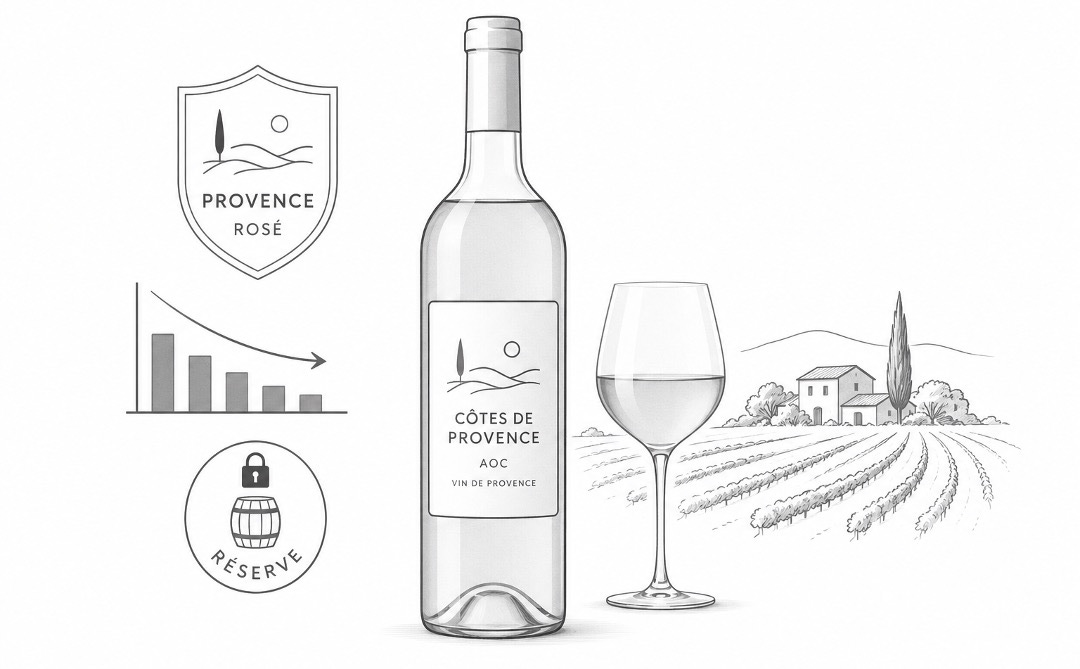
That second ambition is just as important as the reserve itself. Provence is not only trying to manage how much wine enters the market; it is also trying to make sure consumers can recognize what is genuinely Provence. The visual language of the region has become widely imitated. Pale rosé, elegant bottles, soft colors, and sunlit Provençal cues now appear on bottles and bag-in-box wines from many parts of the world. As a result, the CIVP wants to create a distinctive sign that can serve as a clear marker for wines from the three Provence appellations.
The planned sign is intended to function as a shared emblem. It would appear across the appellations and give consumers an immediate point of recognition. The goal is to improve visibility, reinforce the singular identity of Provence wines, and strengthen their association with quality, authenticity, and origin.
Carole Guinchard, the CIVP’s marketing and communications director, sees this as a necessary response to the increasingly crowded rosé category. For her, Provence must reassert both its leadership and its distinctiveness. A common sign on the bottles would become more than a design element; it would be a collective commitment to making the category easier to understand, helping consumers navigate the offer, and clarifying the segmentation of rosé.
The identity project will be supported by a broader marketing and communications program. The CIVP is preparing a more ambitious promotional plan that includes advertising campaigns, a strengthened digital strategy, wine education initiatives, wine tourism development, events, and a presence at major professional gatherings. The interprofession also refers to a national advertising campaign, targeted outdoor visibility in central Paris, and expanded social media activity built around new content formats.
Together, the reserve mechanism and the future recognition sign reveal a two-part strategy. On one side, Provence wants to keep supply aligned with what the market can realistically absorb. On the other, it wants to sharpen the consumer-facing identity of its wines in an international rosé market where Provence-style cues are increasingly used by others.
The 2026 vintage will therefore serve as a test of both discipline and ambition. The production reserve is meant to protect value from within the sector. The shared visual emblem is meant to strengthen recognition from the outside. Both measures point to the same conclusion: Provence does not intend to compete only by producing rosé. It intends to define what Provence rosé means, defend its market position, and preserve the economic foundation of its appellations for the years ahead.