

How to Prevent Premature Oxidation in White Burgundy: What Five Years of Volta Research Reveals
Five years of Volta research reveal practical cellar techniques to curb premature oxidation and extend the life of white Burgundy.
Premature oxidation has haunted producers and collectors of white Burgundy for years. Now, after five years of research, the Volta project is offering Burgundy winemakers a series of practical measures that could help wines retain freshness, stability and ageing potential for longer.
Conducted jointly by the BIVB and Vinventions, the programme focused on a deceptively simple question: what can winemakers do, from harvest through élevage, to reduce the risk of premature oxidation in Burgundy’s white wines?
Its conclusions point not to a single solution, but to a chain of decisions beginning with the grapes and continuing through pressing, sulphur management, juice clarification, fermentation and lees ageing.
One factor stands out above all: the concentration of polyphenols in the must.
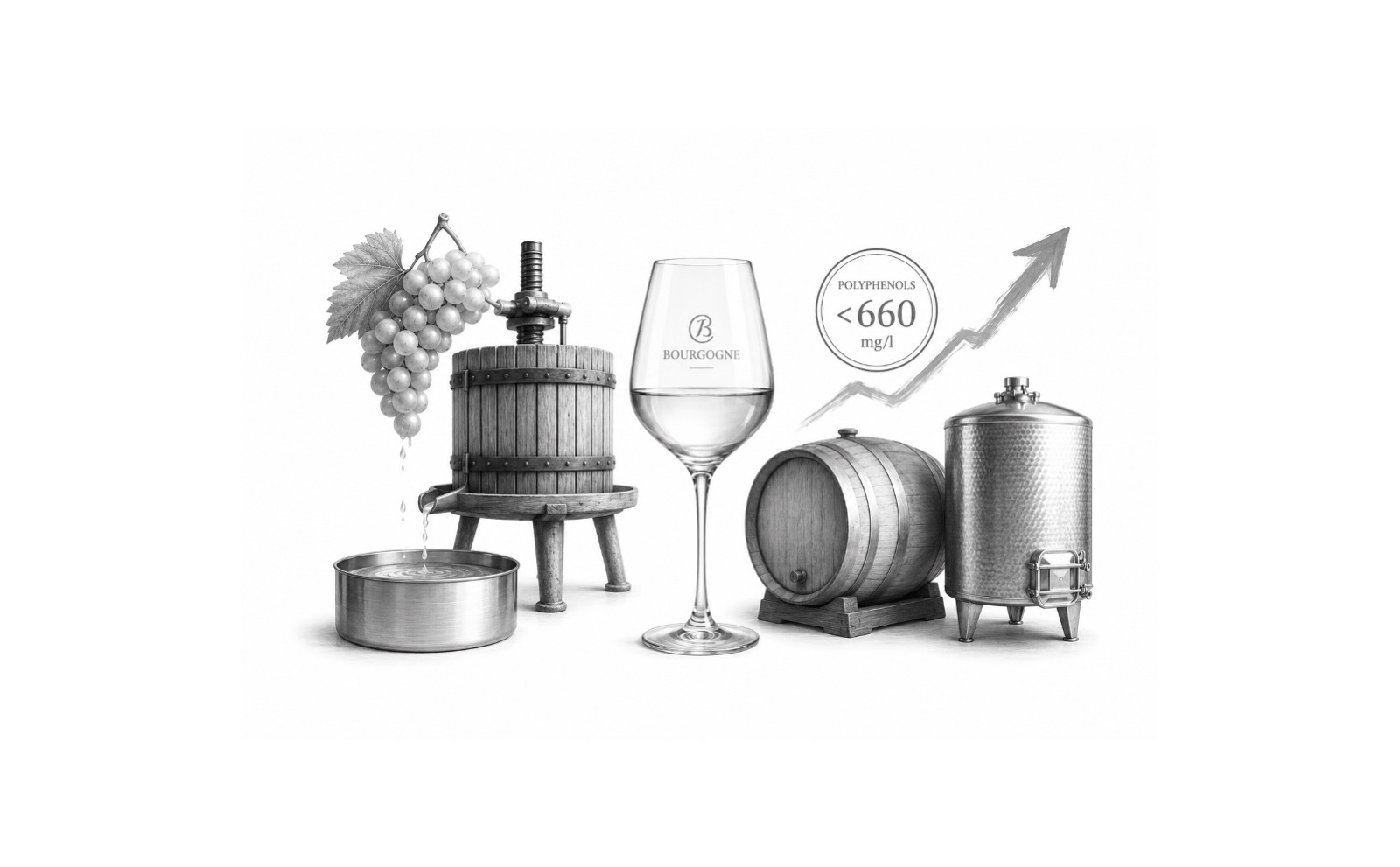
According to the Volta findings, keeping polyphenol levels below 660 mg/l can significantly improve the prospects for a white Burgundy to age successfully. Achieving that target, however, requires winemakers to rethink several long-established cellar practices.
Premature oxidation in white Burgundy starts before fermentation
For Christine Pascal, head of oenology research at Vinventions and leader of the Volta programme, the way grapes and musts are handled before alcoholic fermentation is fundamental.
One of the project’s strongest recommendations concerns sulphur dioxide.
Rather than adding sulphur to grapes while they are still in picking crates or harvest trailers, Volta recommends delaying sulphiting until the juice reaches the receiving tank after pressing.
The reason is polyphenol extraction.
Sulphiting whole grapes too early can encourage greater extraction of polyphenolic compounds. Once present at excessive levels, these compounds can contribute to the wine’s subsequent oxidative vulnerability.
The alternative is to sulphite the juice rather than the grapes, while also separating different press fractions and treating those with high polyphenol concentrations before fermentation begins.
Depending on the juice, Volta identifies oxygen treatment, PVPP or plant proteins as possible tools for removing excess polyphenols.
It is a significant shift in emphasis: instead of trying to protect every fraction of juice from oxygen from the very beginning, producers can use controlled oxidation selectively to eliminate compounds that may create problems later.
The 660 mg/l polyphenol threshold
The Volta project places particular importance on a polyphenol concentration of 660 mg/l.
Once musts move above that figure, additional intervention is recommended.
That makes pressing strategy especially important because the composition of the juice changes as pressure increases.
Guillaume Raphat, an independent consultant and cellar master with Wine Makers in Cheilly-lès-Maranges, considers juice fractionation essential. Free-run juice should be separated from press juice, particularly as pressure rises and more phenolic material is extracted from skins and other grape solids.
Previous practice might have suggested separating fractions after around 1 bar of pressure. Volta’s results indicate that producers may need to act even earlier.
The research suggests that polyphenol concentrations can cross the critical threshold from around 0.8 bar, making this an important point during the pressing cycle.
For white Burgundy producers, that means the press should be viewed not simply as an extraction tool, but as a key instrument for controlling the future oxidation potential of the wine.
Why press juice should be treated differently
Not all juice emerging from the press has the same composition, and the Volta findings reinforce the value of handling fractions separately.
Raphat recommends relatively moderate sulphiting of the clearer free-run juice, typically at around 2 to 3 g/hl of SO2, adjusted according to the sanitary condition of the fruit.
The more phenolic press juice can follow a different route.
Instead of immediately protecting it from oxidation, the juice can be left unsulphited so that its polyphenols oxidise naturally. It can then be clarified with bentonite, subjected to more intensive settling and eventually recombined with the cleaner free-run fractions.
This approach may seem counterintuitive in a discussion about preventing oxidation. But the distinction is crucial.
The objective is not to eliminate oxygen at every stage. It is to manage oxidation in a controlled way before fermentation so that unstable phenolic compounds are removed early, rather than remaining in the wine and potentially contributing to unwanted oxidative evolution years later.
Climate change is making the problem more urgent
For independent Santenay-based oenologist Jan Castaings, premature oxidation is no longer an issue that can be considered only during maturation.
Changing growing conditions have made the subject more pressing.
Higher potential alcohol levels and declining acidity associated with a warmer climate can leave white wines more vulnerable, making protection against oxidation a concern from the moment the grapes are harvested.
Whether a wine is destined for barrel or tank, Castaings argues that the winemaking strategy must begin in the vineyard and at reception.
Whenever possible, he favours hand harvesting followed by cold storage of the grapes at 8–10°C before pressing.
When grapes are machine harvested, inerting the press before loading can provide an additional layer of protection.
After pressing, his recommendation is to wait around two to three hours before adding approximately 2–3 g/hl of SO2 directly to the receiving tank, rather than adding it to juice in the press pan.
The aim is to combine controlled early oxidation with precisely timed protection.
Barrel and tank ageing require different strategies
One of Volta’s clearest messages is that there is no single oxidation-prevention protocol suitable for every vessel.
White wines fermented and matured in barrel behave differently from those raised in tank, and each requires its own approach.
For barrel vinification, Volta suggests that one of the most effective strategies is ageing on the complete lees in new or lightly toasted barrels.
Tank-aged wines require greater attention before fermentation because the protective conditions provided by barrel ageing cannot simply be replicated in stainless steel or other inert vessels.
This distinction has become increasingly relevant in Burgundy.
According to Castaings, producers often keep barrels for an average of around five years. At the same time, adjustable-capacity tanks with floating lids have become popular because they allow winemakers to adapt easily to changing wine volumes.
They are practical, but from an oxidation perspective they demand careful management. Any weakness in the seal or headspace control can increase exposure to oxygen.
The choice between barrel and tank therefore affects decisions from juice settling onwards.
Débourbage: clarification should match the vessel
The settling and clarification of white must — débourbage — is another critical stage identified by the specialists involved.
For wines destined for barrel, Castaings recommends a relatively gentle natural settling period of around 24 to 48 hours at 8–10°C.
Tank wines require a different approach.
Here, the objective is to obtain clean juice more rapidly in order to reduce oxidation risks. An enzymatic settling process at approximately 12–13°C, completed in less than 24 hours, is recommended.
The difference reflects the distinct conditions the wine will encounter during fermentation and maturation.
But clarification does not necessarily mean discarding everything that settles.
The finest lees from the earliest free-run juices — typically cream-beige in colour — can become a valuable resource during fermentation and ageing.
Castaings suggests adding around 4 to 5 litres per barrel, or approximately 2–4% of total volume in tank, before alcoholic fermentation begins.
These fine lees can provide nutrients for yeast while also contributing to the wine’s natural protection.
Lees ageing may be one of the strongest weapons against oxidation
Perhaps the most important tool after fermentation is ageing on lees.
Volta points to an ideal lees-ageing period of approximately six to nine months for improving the longevity of Burgundy whites.
Nicolas Fèvre, consultant oenologist at the Centre œnologique de Bourgogne in Beaune, regards lees as an effective natural defence against oxidation regardless of whether the wine is matured in tank or barrel.
The reason lies partly in glutathione, an antioxidant compound associated with yeast cells.
After fermentation, dead yeast can therefore do more than contribute texture and aromatic complexity. The lees can help protect the wine against oxidative damage.
How they are managed, however, once again depends on the vessel.
Barrel ageing: keep the lees and manage oxygen gently
For barrel-aged white Burgundy, Fèvre suggests that alcoholic fermentation and malolactic fermentation can follow one another without racking in between.
Under the right conditions, the wine can remain on its full lees without creating an excessive risk of reductive aromas.
Regular bâtonnage, approximately once a week, can help.
Stirring the lees keeps them suspended while introducing limited amounts of oxygen through barrel handling, encouraging the kind of controlled micro-oxygenation that can support stable development.
Volta’s recommendation for new or lightly toasted barrels is also significant.
The degree of barrel toasting influences the compounds extracted from oak and may affect the wine’s evolution. The research suggests that lightly toasted barrels combined with full-lees ageing create particularly favourable conditions for longevity.
Tank ageing needs more careful lees management
Applying the same method in tank can be more problematic.
Unlike a barrel, a tank offers very little natural oxygen exchange. Keeping a wine on heavy lees in this environment can therefore increase the danger of reduction.
Fèvre recommends racking at the end of alcoholic fermentation to remove the coarser lees.
The fine lees can subsequently be returned to the wine from the top of the tank before malolactic fermentation.
This allows producers to benefit from the protective properties of fine lees while reducing the risk associated with heavier sediment.
The lesson from Volta is again one of precision: lees are valuable, but their composition and management matter just as much as their presence.
Oxygen management does not end with ageing
Even a carefully protected wine can be compromised late in the production process.
Filtration and bottling are therefore the final pieces of the oxidation puzzle.
Castaings stresses the importance of controlling oxygen pickup during filtration and bottling, when wine is transferred, pumped and exposed to equipment that can introduce dissolved oxygen.
By this stage, the producer may have spent a year or more carefully managing the wine’s oxidative development. Excess oxygen introduced just before closure can undermine much of that work.
For high-quality white Burgundy intended to develop in bottle for years or decades, controlling oxygen at packaging is therefore every bit as important as managing it at pressing.
What Volta means for the future of white Burgundy
The significance of the Volta project lies in the fact that it moves the discussion around premature oxidation in Burgundy from diagnosis towards practical prevention.
Its recommendations span the entire winemaking process: harvest cool and carefully where possible, avoid sulphiting grapes too early, manage pressing fractions precisely, watch polyphenol levels, adapt settling to the eventual ageing vessel, make intelligent use of fine lees and minimise unwanted oxygen during filtration and bottling.
Above all, the research suggests that longevity is determined long before a bottle enters the cellar.
For winemakers, the critical decisions begin at harvest and continue through every transfer, press fraction and ageing choice.
For collectors of white Burgundy, the conclusions may ultimately be even more encouraging. Premature oxidation has often appeared unpredictable, with seemingly similar bottles developing at radically different rates.
Volta’s five years of work suggest that at least part of that uncertainty can be addressed through more precise winemaking.
There may be no single cure for premature oxidation. But Burgundy now has a clearer map of where the risks arise — and, crucially, which cellar practices can help keep its great white wines fresh, expressive and age-worthy for longer.