

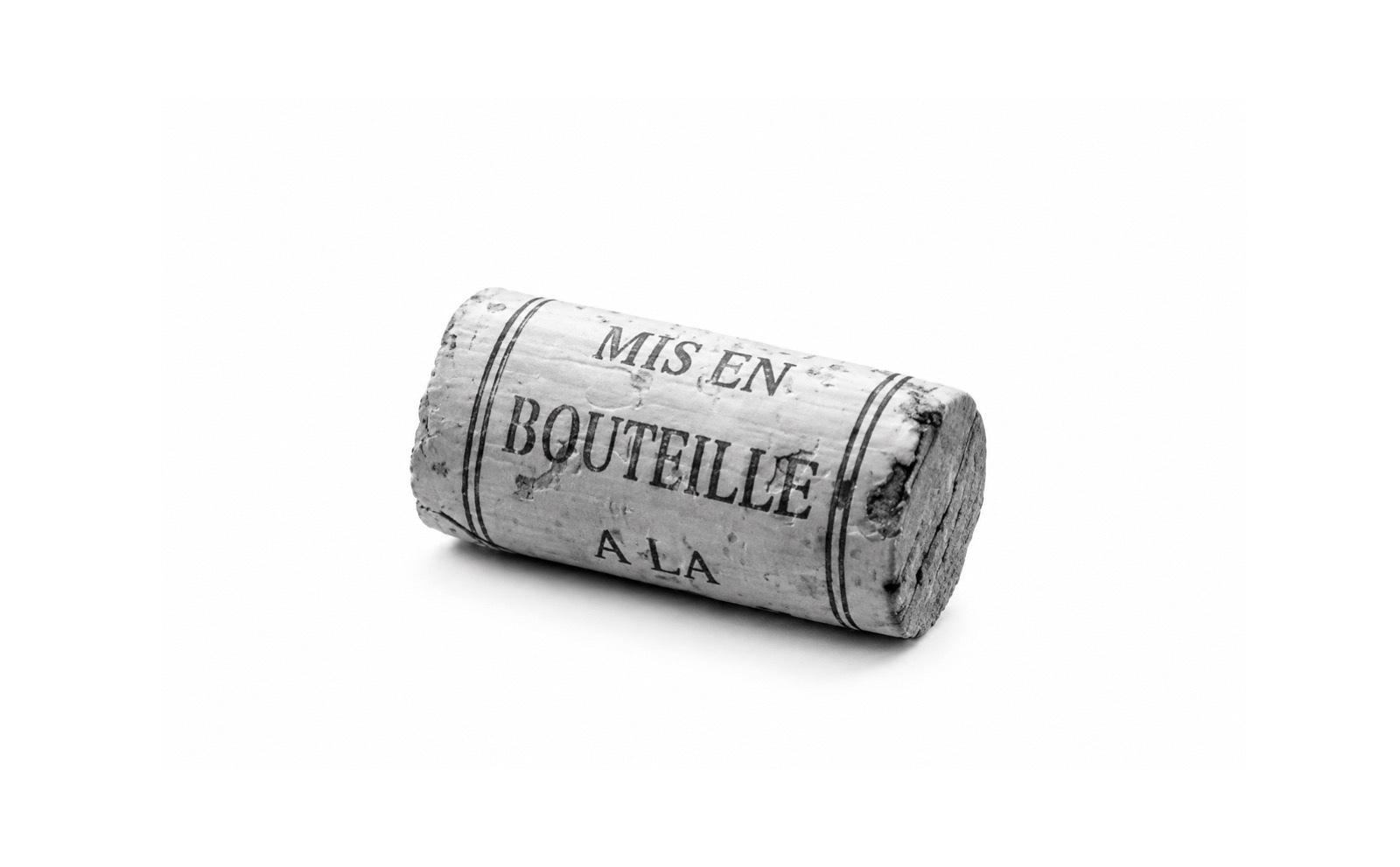
Once a bottle is sealed, wine enters a remarkably active phase of its life. The cork may look inert, but the chemistry behind it is anything but static. Oxygen transfer through cork involves several processes unfolding over months, and some of the oxygen found inside a newly bottled wine does not come from the outside world at all.
Research conducted in Dijon has now provided a more detailed picture of what happens between cork, glass, oxygen and wine after bottling. The findings are particularly relevant to anyone interested in bottle ageing, because they challenge the convenient idea that a cork simply allows a tiny, constant amount of air to pass into a bottle.
Instead, the closure behaves as a changing system. It first releases oxygen already trapped within its structure, then contributes compounds capable of consuming some of that oxygen, while external oxygen gradually begins its own journey into the bottle.
For wine lovers, it is a reminder that maturation under cork is governed by more than time alone.
Oxygen transfer through cork begins inside the stopper
Cork is made up of an enormous number of microscopic cells, many of them containing gas. When a stopper is forced into the neck of a bottle, it is substantially compressed. This creates the first important movement of oxygen.
Some of the gas contained within the cork is displaced during and shortly after bottling. Researchers refer to this early phase as oxygen initial release, or OIR.
It is distinct from the oxygen that subsequently travels from the surrounding atmosphere through the closure system. That longer-term movement is generally described through the oxygen transfer rate, or OTR.
The distinction may sound academic, but it changes how bottle ageing should be understood. An increase in oxygen inside a freshly sealed bottle does not necessarily mean that outside air has already crossed the cork. Part of it may simply have originated within the stopper itself.
And even once the immediate effects of compression have subsided, the cork can continue releasing oxygen.
A miniature bottle reveals a slower process
To separate these different mechanisms, researchers at Institut Agro in Dijon designed an experimental system using small glass tubes that reproduced the geometry of a bottle neck.
They worked with micro-agglomerated cork stoppers of different lengths, from very thin sections to pieces approaching the dimensions of a conventional stopper. Before the main experiment began, the corks were compressed and held in that state for several months, allowing the initial oxygen release caused by bottling pressure to finish.
The expectation might have been that, once this first burst was over, oxygen levels inside the sealed system would remain stable until air from outside began permeating through the closure.
That was not what happened.
Oxygen levels started increasing again.
The source was the cork itself.
Gas remaining within the cork’s cellular structure was moving towards the interior of the experimental bottle because the concentration of oxygen there was lower. It is a basic principle of diffusion: molecules tend to migrate from an area where they are more abundant towards one where they are less abundant.
In other words, the cork continued to give up some of its own oxygen even after the pressure-driven initial release had ended.
Cork is not simply a barrier
This helps explain why oxygen transfer through cork is more complicated than describing a stopper as either highly permeable or tightly sealed.
During the first months after bottling, several mechanisms may be operating simultaneously. Oxygen already present within the cork can move into the bottle, while the eventual ingress of oxygen from the surrounding atmosphere takes place through the closure itself and at the interface where cork meets glass.
The balance also changes with time.
In the experiments, diffusion of oxygen originally contained within the cork continued for months before largely running its course. Only later does oxygen arriving from the external environment become the enduring influence.
That distinction is significant because the two sources behave differently. A thicker piece of cork, for example, contains more cellular material capable of holding oxygen, while also presenting a longer pathway for oxygen attempting to travel from the outside atmosphere towards the wine.
The closure is therefore not a simple open door through which oxygen passes at a fixed rate. Its behaviour changes during the life of the bottle.
The cork can also help consume oxygen
Perhaps the most intriguing part of the research appeared several months into the experiment.
Instead of continuing to rise, oxygen concentrations in the model wine began to fall.
The explanation lies in another property of cork: it contains phenolic compounds. When wine is in contact with the stopper, small quantities of these compounds can be extracted from the surface of the cork into the liquid.
Some then react with dissolved oxygen.
The quantities involved are modest, particularly compared with the much larger pool of phenolic compounds naturally present in real wine. But in the deliberately simplified model wine used for the experiment, the researchers could isolate the effect clearly.
The finding adds another layer to the role of the closure. Cork is not only capable of releasing oxygen and permitting its eventual passage from outside the bottle; substances extracted from it can also participate in reactions that consume oxygen already present.
It is a small chemical exchange, but one that further undermines the idea of the stopper as a passive plug.
What oxygen means for wine ageing
Oxygen occupies an awkward place in wine.
It is neither inherently beneficial nor inherently destructive. What matters is quantity, timing and the wine with which it interacts.
After bottling, oxygen participates in reactions that can influence colour, aroma, tannin structure and the development of a wine over time. Excessive exposure can drive unwanted oxidation. Yet bottle evolution also involves controlled oxidative reactions, alongside many processes that do not depend directly on oxygen.
The closure therefore forms part of a much larger ageing system.
This is especially relevant when considering wines intended for long cellaring. A bottle of white Burgundy destined to mature for a decade and a youthful red intended for relatively early drinking do not necessarily place the same demands on a closure.
But the new research should not be read as a formula for predicting when a particular bottle will reach its peak. The experiments used a model wine and controlled laboratory conditions, rather than following the sensory evolution of finished wines.
They illuminate the mechanism. They do not provide a drinking calendar.
Does a longer cork keep more oxygen out?
The experiments also demonstrate why cork length produces a seemingly contradictory effect.
Longer corks contain more cellular material and therefore potentially more oxygen capable of diffusing out during the early phases. At the same time, they provide a greater physical distance through which atmospheric oxygen must travel during long-term storage.
The researchers found that oxygen transfer from outside became progressively lower as stopper length increased. With the longest cork sections used in the experiment, long-term oxygen ingress was particularly small.
That does not mean that choosing the longest possible cork automatically guarantees better wine ageing. Closure performance depends on far more than length alone, including cork construction, surface treatment, bottleneck geometry and storage conditions.
What the work demonstrates is that the dimensions and structure of the stopper influence different phases of oxygen movement in different ways.
Should wine be stored on its side?
The study also intersects with one of the most persistent questions in wine cellaring: must a cork-sealed bottle lie horizontally?
For generations, conventional wisdom has held that wine should remain in contact with the cork to stop it drying out. The broader question of oxygen transfer, however, appears to be more nuanced.
In an earlier 24-month experiment using micro-agglomerated corks, the Dijon researchers found no difference in oxygen transfer at 20°C between bottles stored upright and those stored horizontally.
That does not settle every question surrounding bottle orientation. The finding concerns a particular type of stopper under defined experimental conditions, and it should not simply be extrapolated to every natural cork, every cellar temperature or every bottle intended for decades of ageing.
It does show, however, that bottle position itself does not necessarily dictate how much oxygen crosses a cork closure.
Temperature may be considerably more important. Previous work by the same research group found that higher storage temperatures could substantially increase oxygen transfer at the interface between cork and glass.
For collectors, that reinforces a familiar principle: stable, moderate cellar conditions matter.
Oxygen transfer through cork is a moving target
Perhaps the most useful conclusion from the Dijon research is that there is no single moment or mechanism that defines how a cork interacts with oxygen.
Immediately after bottling, compression matters. During the following months, oxygen stored within the cork’s cells continues to diffuse. Contact with wine can then extract cork-derived compounds capable of reacting with dissolved oxygen. Over the longer term, atmospheric oxygen continues its slow passage through the closure system.
Each mechanism operates on a different timescale.
That makes the apparently simple act of sealing a bottle surprisingly complex. Beneath the capsule and behind the glass, cork and wine continue to exchange matter long after the bottling line has stopped.
For lovers of mature French wine, this is more than laboratory curiosity. It offers another glimpse into why bottle ageing is so difficult to reduce to rules. The wine we eventually pour has spent years not in complete isolation, but inside a delicately balanced system in which even the stopper has played an active part.