
Muscadet Rethinks Time: Aging as a New Language
From 3 to 24 months, Muscadet proposes a clearer scale of élevage to reveal style, structure, and value to today’s drinker
In the western Loire, where the Atlantic shapes both climate and temperament, Muscadet has long occupied a paradoxical position. Widely planted, widely consumed, yet persistently misunderstood, it has remained one of France’s most elusive appellations—not for lack of quality, but for lack of clarity.
A quiet shift is now underway. Rather than revisiting terroir hierarchies or refining appellation boundaries, producers are turning to something more immediate: time itself. Specifically, the duration of élevage.
From Obscurity to Legibility
For decades, Muscadet has relied on internal codes—communal crus, the notion of “sur lie,” and subtle distinctions in origin—that resonate with professionals but often fail to guide the broader public. On a retail shelf, these cues rarely translate into a clear expectation of style.
The result is inconsistency in perception. Bottles may differ markedly in texture, depth, and aromatic profile, yet appear interchangeable to the untrained eye. In such conditions, choice becomes arbitrary, and value difficult to assess.
The proposed solution is disarmingly simple: indicate the length of aging directly on the label.
A Scale of Time
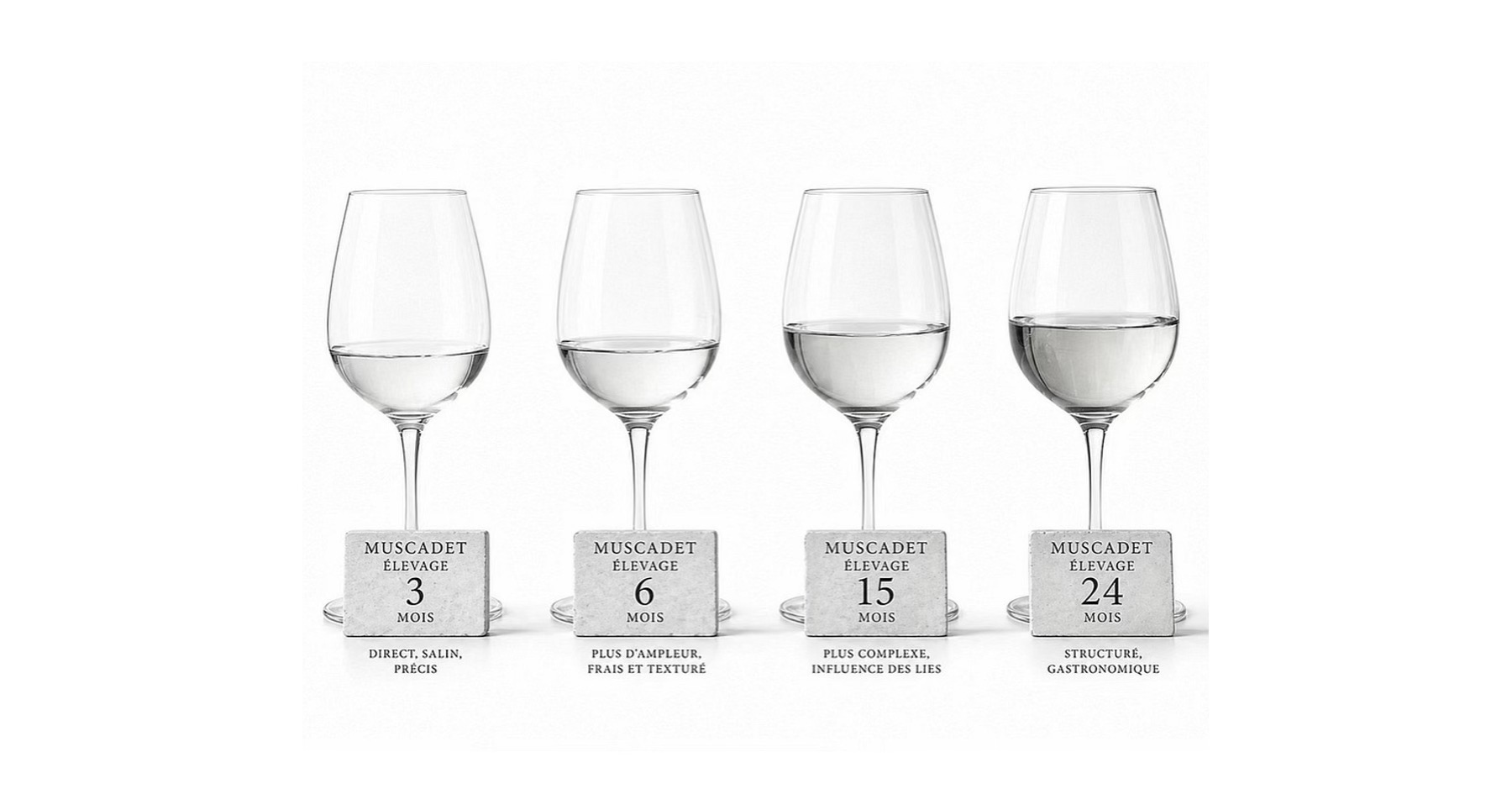
The framework under discussion divides Muscadet into four categories based on élevage: 3, 6, 15, and 24 months. These durations refer to the time the wine spends resting in underground vats, often on its lees.
The logic recalls another French tradition more familiar to consumers: cheese maturation. Just as a Comté expresses itself differently at 12 or 24 months, Muscadet evolves along a similar continuum.
3 months: direct, saline, sharply defined
6 months: slightly broader, retaining freshness with added texture
15 months: layered, with a more pronounced lees influence
24 months: structured, gastronomic, capable of surprising depth
This is not a hierarchy, but a spectrum. Each stage corresponds to a stylistic intention rather than a qualitative judgment.
Pricing and Perception
One of the more pragmatic consequences of this approach lies in pricing transparency. When time becomes visible, cost becomes intelligible. The progression—modest but meaningful—reflects both material and temporal investment.
A shorter élevage implies rapid turnover and immediate expression; longer aging ties up capital and demands patience. By articulating this difference, producers seek to restore coherence between price and expectation.
In doing so, Muscadet addresses a longstanding imbalance: wines that require time have rarely been perceived as such.
A Cultural Adjustment
The initiative remains voluntary. Loire producers, particularly in Muscadet, have traditionally favored independence over prescription. The absence of rigid enforcement reflects this ethos.
Yet early indications suggest a willingness to experiment. A number of estates have already signaled their intention to adopt the system, at least in part. If successful, the model may spread organically, guided less by regulation than by utility.
From Singular to Plural
Perhaps the most telling aspect of this evolution is linguistic. Increasingly, producers speak of “Muscadets” rather than Muscadet—a subtle but deliberate shift.
It acknowledges what has always been true but insufficiently expressed: that the appellation is not monolithic. Its identity is not confined to the archetype of a light, oyster-bound white, but extends into a broader, more nuanced register.
Extended élevage, in particular, reveals a dimension often overlooked. With time, the wines gain weight, complexity, and a capacity to engage with cuisine beyond the maritime canon. They move from accompaniment to participant.
A Measured Transformation
This reorientation does not seek to redefine Muscadet through spectacle or reinvention. It is, rather, an attempt to align what is already there with how it is perceived.
Time, after all, has always been central to wine. What changes here is its visibility.
By placing élevage at the forefront, Muscadet offers a language that is both precise and accessible—one that bridges the gap between producer intention and consumer understanding.
If it succeeds, the effect will be subtle but lasting: a region no longer defined by approximation, but by articulation.