
May-Eliane de Lencquesaing – Bordeaux Grande Dame and Cape Visionary
From Pauillac to Stellenbosch: May-Eliane de Lencquesaing forged a Bordeaux super-second and pioneered Glenelly.
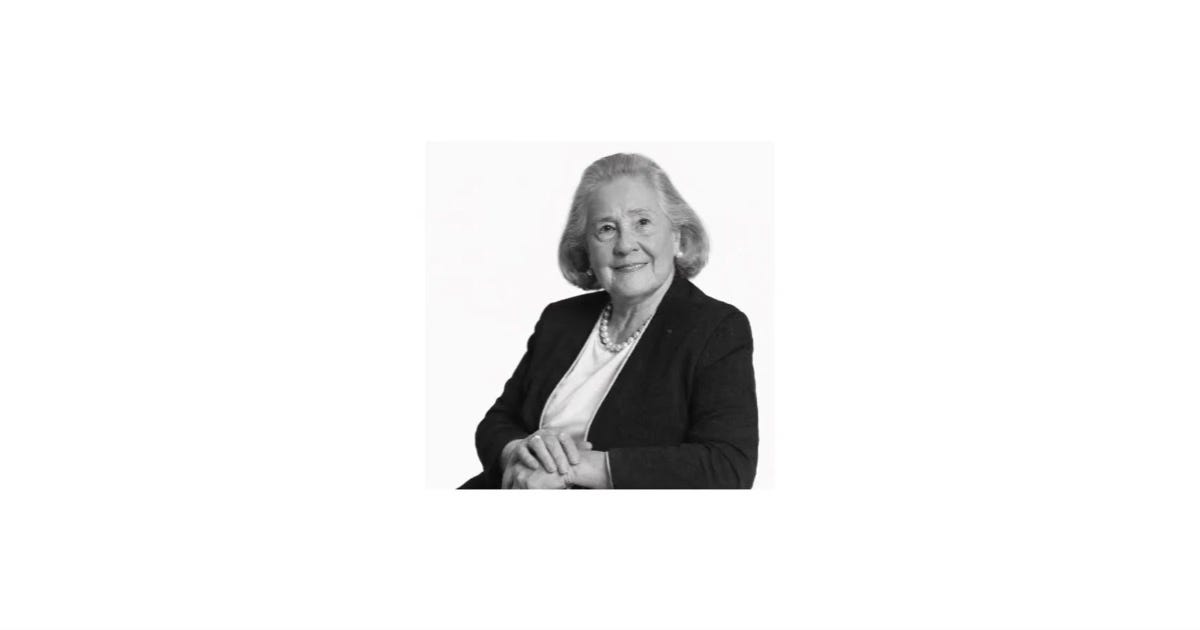
May-Eliane de Lencquesaing was born in 1925 into the storied Miailhe family of Bordeaux, a lineage deeply entwined with the region’s wine trade. Her grandfather had been a négociant (wine broker), and after World War I her father, Édouard Miailhe, along with an uncle, revived the family’s brokerage business and began acquiring wineries at a time when confidence in Bordeaux was low. Among the estates they purchased were some of the Médoc’s finest: Château Palmer in Margaux, Château Ducru-Beaucaillou in Saint-Julien, and Château Pichon Longueville Comtesse de Lalande in Pauillac. Thus, May-Eliane quite literally grew up amid the vineyards. “I grew up among the vines – I learned by listening to my father and uncle,” she later recalled. From childhood, wine was not merely an industry or livelihood in her family – it was a tradition and a calling.
Those early years were not without turmoil. As a teenager during the Second World War, May-Eliane lived at Château Palmer, where her father was a part-owner. The Médoc was under German occupation, yet the young Mademoiselle Miailhe showed remarkable courage and resourcefulness. Tasked with a dangerous secret mission, she would slip away on her bicycle carrying a basket of farm produce to feed Jewish refugees hiding on the estate. Nazi soldiers posted along the roads would stop the local girl and demand to know why she carried so many vegetables, but she deflected their suspicions with girlish charm and laughter – all the while risking her life for those in need. This episode, recounted in vivid detail decades later by May-Eliane, exemplifies the steel beneath her polite refinement. It also foreshadows the blend of tradition, bravery, and service that would characterize her life in wine.
After the war, May-Eliane married Hervé de Lencquesaing, a French Army officer, in 1948. As an army wife she spent years abroad – including a period in the 1950s stationed in Kansas, far from the grands châteaux of Bordeaux. Yet even as she raised a family of four children and moved between postings, her roots in the Médoc’s vineyards remained strong. In those years Bordeaux was recovering from decades of depression and conflict; estates were just starting to prosper again in the mid-20th century. (As she would later wryly note, “we only really started making money in Bordeaux around 1955, so there’s still time,” when comparing the Cape’s still-young wine industry to Bordeaux’s long path to stability) By the 1970s, May-Eliane found herself drawn back into the family wine business – a return that would alter the course of her life and Bordeaux history.
A Château Won by Chance (Pauillac, 1978)
The turning point came in 1978, in a Bordeaux notary’s office, when the Miailhe family’s holdings were being divided among the next generation. In what she later described as a twist of fate, May-Eliane literally won Château Pichon Longueville Comtesse de Lalande by drawing lots. Her father Édouard had passed away in 1959, and an elder brother had managed Pichon Lalande in the 1960s, expanding its vineyards, before disagreements among shareholders led to interim management by outsiders. By the late 1970s, the ownership structure had grown complicated: the Miailhe family owned a majority, but various cousins held stakes and some wished to sell. The 53-year-old May-Eliane – the youngest daughter of Édouard – emerged from the 1978 inheritance lottery with the controlling shares of the estate. She promptly bought out the remaining partners to assume full ownership. In her telling, it was a “happy draw” that sealed her destiny.
Assuming leadership of a Second Growth château in Pauillac would be a formidable task for anyone – and in the 1970s it was still uncommon for a woman to run a top Bordeaux estate. Pichon Longueville Comtesse de Lalande (often shortened to Pichon Comtesse or simply “Pichon Lalande”) is an 1855-classified Deuxième Cru renowned for its elegant wines. It had a unique history of female influence dating back to the 19th century, when Virginie, Comtesse de Lalande, originally inherited and gave her name to the property. Now May-Eliane de Lencquesaing was stepping into the shoes of that formidable comtesse from a century earlier. Some in Bordeaux initially viewed her as an unlikely chatelaine – she was neither a widow taking over by necessity, nor a young heiress content to delegate. Rather, she was a mature woman with an independent will, determined to personally direct the estate’s course. Her military family background even earned her a tongue-in-cheek nickname in the region: “La Générale,” the lady general. The moniker, referencing her husband’s rank as well as her commanding style, hinted at the resolve with which she approached her new role.
May-Eliane’s first vintages in charge quickly vindicated any doubters. The late 1970s were a transitional era for Bordeaux, but Pichon Lalande hit the ground running under her management. The 1978 vintage – the very year she took over – proved excellent in Pauillac, almost a harbinger of good fortune. Then came 1982, a watershed harvest that produced wines of remarkable richness across Bordeaux. At Pichon Lalande, the 1982 vintage that May-Eliane oversaw became a modern legend, noted for its plush, silky power; it was one of the wines that helped define the term “super-second,” garnering extraordinary critical acclaim (including a perfect 100-point score from one American critic). Not to be outdone, the 1983 Pichon Lalande was nearly as lauded, considered one of the highlights of that year’s Medoc wines. By shepherding two back-to-back great vintages in 1982 and 1983, May-Eliane firmly established that the estate’s success was no mere accident of inheritance – it was a result of her steady leadership and exacting standards.
Stewardship of Château Pichon Comtesse (1978–2007)
Over the next three decades, “Madame de Lencquesaing” – as she became respectfully known in wine circles – transformed Château Pichon Comtesse de Lalande into one of Bordeaux’s most consistent and admired performers. She expanded the vineyard holdings significantly, from about 40 hectares in the late 1970s to roughly 75 hectares under vine by the early 2000s. This expansion included acquiring prime adjacent plots (some lying just over the appellation border into St-Julien, which historically had always been part of Pichon Comtesse’s vineyard mosaic). Under her tenure, the estate maintained an unusually high proportion of Merlot in the grand vin blend for a Pauillac – often 30% or more – contributing to a supple, seductive character that set Pichon Lalande apart from its more Cabernet-dominated neighbor and rival across the road, Château Pichon Baron. Indeed, the wines of Pichon Comtesse during those years gained a reputation for a certain finesse and charm sometimes described as a “feminine” interpretation of Pauillac – though May-Eliane herself avoided such clichés, preferring to talk about balance and elegance. Year after year, through variable weather and market ups-and-downs, she delivered wines that upheld the estate’s 1855 classification with pride. By the late 1980s and 1990s, Pichon Lalande was widely regarded as a leading “super-second,” often challenging the First Growths in blind tastings and critical ratings. The consistency was simply indisputable. “Excellence must be achieved every year, not just in the great vintages,” she would say, underscoring her long-term approach over short-term hype.
Madame de Lencquesaing proved to be an adept modernizer as well as a traditionalist. She preserved Pichon’s architectural heritage – the romantic 19th-century château itself and its park – but quietly upgraded the technical facilities and viticulture. In the 1980s, she hired Emile Peynaud, the era’s leading enology consultant, to advise on improving quality, a move that fine-tuned the estate’s winemaking without sacrificing its classic style. She also introduced a second wine, Réserve de la Comtesse, giving the estate more flexibility in selection. (The second wine had debuted in the early 1970s under her family’s ownership, and May-Eliane further developed its role and quality so that by the 1990s it was one of the better regarded second labels in the Médoc.) In the vineyards, she was attentive to detail – conducting replantings when needed and nurturing healthy old vines. If technology or new techniques promised a genuine improvement, she embraced them; if not, she was content to let time-honored methods be. This measured philosophy helped Pichon Lalande navigate the trend-driven 1990s without bending to fads.
Throughout, de Lencquesaing insisted on a certain refinement in the wines to reflect the estate’s legacy. As she once explained, the goal was a Pauillac of depth and structure that could nonetheless “parade in full dress” early in its life – approachable in youth yet capable of decades of aging. It was a tightrope to walk, but one that Pichon’s team mastered under her guidance, producing wines celebrated for their balance of power and polish. By 1994, her contributions were so evident that the British magazine Decanter named May-Eliane de Lencquesaing its “Woman of the Year,” honoring her as an international ambassador of Bordeaux and one of the leading figures in the wine world. It was a rare accolade for a Bordeaux proprietor, and a testament to the respect she had earned among peers and critics alike.
In addition to running her estate, Madame de Lencquesaing took on broader leadership roles in Bordeaux. She served as Grand Chancelier of the Académie du Vin de Bordeaux, an august society dedicated to the region’s wine culture. She also became a fixture at the Union des Grands Crus tastings and other promotional tours, often personally pouring Pichon Lalande for collectors in London, New York, or Tokyo. Indeed, whereas a previous generation of proprietors might have left marketing to agents, May-Eliane embraced the role of globetrotter. “When I was in charge of Pichon, I was travelling a lot to promote the wines,” she has recounted, remembering frequent trips to the United States and beyond. With fluent English and an easy elegance, she became one of the recognizable faces of top Bordeaux in emerging markets during the 1980s and 1990s. Frank J. Prial of The New York Times once profiled her under the headline “She Puts One Of the Great Vineyards On Parade,” capturing how she proudly presented Pichon Lalande to the world. This personal ambassadorship did Bordeaux a great service: at a time when global competition from New World wines was rising, May-Eliane de Lencquesaing personified the grace and commitment behind Bordeaux’s grand vins, helping to win new generations of admirers.
By the early 2000s, having steered Pichon Comtesse successfully for nearly 30 years, May-Eliane faced the question of succession. Her children were grown and pursuing their own lives outside day-to-day winemaking. Rather than see the estate fragmented or risk a decline in its standards, she made a strategic decision. In 2006, at age 81, she agreed to sell a majority stake in Château Pichon Longueville Comtesse de Lalande to the Rouzaud family, owners of Champagne Louis Roederer. It was not a decision made lightly – Pichon Lalande had been in her family since 1925. But Madame de Lencquesaing was ever the pragmatist. “I was eager to ensure the continuing success of the estate in the same philosophy,” she said of the sale. The Rouzauds, an old French wine family known for their stewardship of Roederer and other fine properties, were chosen in part because she trusted they would preserve Pichon’s character and invest in its future. Indeed, after the 2007 transfer, Roederer poured significant resources into modernizing the winery and replanting vineyards (including a state-of-the-art gravity-flow cellar). Madame de Lencquesaing stayed on in an honorary role for a time to help with the transition, working alongside Sylvie Cazes (whom Roederer appointed to manage the château). In essence, May-Eliane staged a graceful hand-off, one that ensured Pichon Lalande would continue to thrive beyond her own tenure. Many observers noted how unusual it was to see a grand proprietress voluntarily relinquish her estate at the height of its fame. But those who knew her understood it was in keeping with her long-term vision and selfless dedication to the wine itself. “One must think of the next generation,” she would say. “After all, we are only temporary guardians of a great château.”
Global Ambassador and Innovator
Even as she concentrated on Pichon Comtesse, May-Eliane de Lencquesaing consistently looked beyond the borders of her appellation – and even of France – in her outlook. She had a cosmopolitan perspective shaped by wartime hardship, international travel, and a recognition that great wine could flourish outside its traditional cradle. Notably, in the 1990s she helped establish an award that bridged Old and New World: the Pichon Lalande Trophy for the Best Blended Red Wine at the International Wine & Spirit Competition in London. That a Bordeaux Second Growth would sponsor a prize celebrating red blends from anywhere in the world (including upstart regions like California, Australia, or South Africa) was unprecedented. It spoke volumes about her character – “instead of putting up barriers she was breaking them down,” as one South African writer observed. The trophy encouraged and recognized wines crafted in the Bordeaux spirit of blending varietals, and over the years it forged connections between May-Eliane and winemakers across the globe. South Africa’s Kanonkop Estate, for example, won the Pichon Trophy three times in the 1990s for its Paul Sauer Bordeaux-style blend, leading to a lasting friendship between Madame de Lencquesaing and Kanonkop’s celebrated vintner Beyers Truter. Through such initiatives, she became both mentor and advocate to vintners far from Pauillac.
Perhaps the most significant relationship born of her globe-trotting was with the late Dr. Anton Rupert, the South African industrialist and philanthropist who had deep interests in wine. They met on the international wine circuit (Dr. Rupert succeeded her as president of the IWSC one year) and discovered a shared passion for art, culture, and wine’s potential to uplift a country. Rupert, a towering figure in South African business and founder of the acclaimed Rupert & Rothschild wine estate, urged May-Eliane to visit the Cape winelands. “He would tell me that there was so much to be done [in South Africa] and that outside investment was badly needed,” she recalls. In 1998, she made her first trip to South Africa, and it left a deep impression. Here was a country emerging from apartheid, with a 350-year wine history that had been isolated from world markets for decades, now eager to modernize and rejoin the global wine community. Ever the student of history, May-Eliane was moved by the Cape’s wine heritage – particularly the legacy of the French Huguenots who brought vine cuttings to the region in the 17th and 18th centuries. “One of the reasons I came here was out of respect for the French Huguenot culture,” she says of her decision to engage with South Africa. “They came here with only their vines and Bibles – nothing else... I have to admire that courage.”
In these global interactions, May-Eliane demonstrated a trait all too rare among top Bordeaux proprietors of her generation: a willingness to learn from and contribute to wine regions outside France. She did not see new world producers as threats, but as partners and protégés. Her worldview was fundamentally collaborative – wine, to her, was a bridge between cultures. This broad perspective amplified her influence beyond the Médoc. It is no exaggeration to say that by the turn of the millennium, May-Eliane de Lencquesaing was as much an international stateswoman of wine as she was a Bordelaise chatelaine. Recognitions followed accordingly. In France she was made a Chevalier of the Legion of Honour in 1996, later promoted to Officier in 2011 for her contributions to French wine and culture. The industry heaped tributes on her: the International Wine Challenge in London gave her a Lifetime Achievement Award in 2017, noting that they could well have given “a few trophies for all of the lifetimes she’s lived”. Ever modest, she often deflected praise by crediting her team or remarking that a great estate like Pichon Comtesse “speaks for itself through its wine.” But there is little doubt that her personal advocacy did much to secure Bordeaux’s place in the late-20th-century fine wine revival.
A New Chapter in the Cape: founding Glenelly
Most people, having sold a renowned château and approaching their 80th birthday, would gracefully retire. May-Eliane de Lencquesaing decidedly did not. Instead, in 2003 – at age 78 – she embarked on arguably the boldest adventure of her life. Following years of conversations with Anton Rupert and careful study, she purchased a 128-hectare fruit farm on the slopes of the Simonsberg Mountain in Stellenbosch, South Africa. Locals were astonished: why would a grand dame of Bordeaux plant her flag in faraway Stellenbosch, in a then relatively undeveloped corner of the wine lands? But to May-Eliane, the reasoning was clear. “I only wanted a small farm,” she says, “but I recognized the potential of the southern slopes of the Simonsberg – the granite soils, the beautiful morning sun, plenty of water... and importantly, no existing vines”. In short, it was virgin terroir with excellent fundamentals, a place where she could apply a lifetime of knowledge from the Médoc to create something new, without having to undo anyone else’s mistakes.
She named the estate Glenelly. The property had a history dating back to 1682 (it was originally granted to a French Huguenot settler, as fate would have it), but it had never been a winery until her arrival. This blank canvas appealed to her deeply. Starting in 2004, Madame de Lencquesaing and her team conducted exhaustive soil studies and climate analyses on the site. She made a bet that Bordeaux grape varieties would thrive in this corner of the Cape, given the slightly cooler microclimate of the Simonsberg’s southern foothills and well-drained granitic soils. Her intuition proved correct. Over several years, Glenelly was transformed: 316 acres of former plum orchards were replanted with about 163 acres of vineyards – predominantly Cabernet Sauvignon, Merlot, Cabernet Franc, Petit Verdot, and a portion of Syrah (an homage to the Rhône, perhaps, or simply a nod to what works well in Stellenbosch alongside Bordeaux cultivars). She also planted a little Chardonnay on the cooler slopes for a white wine component.
From the beginning, May-Eliane approached Glenelly with the same seriousness and long-term vision that she had applied at Pichon Lalande. She recruited top talent: a young winemaker, Luke O’Cuinneagain, who had honed his craft at distinguished cellars like Château Angelus in Bordeaux and Screaming Eagle in Napa, came on board in time for the first harvest of estate grapes in 2007. She engaged the innovative South African vintner Adi Badenhorst as a consultant, adding local know-how to the mix. And she invested in quality infrastructure, constructing a gravity-fed, four-level winery that was completed in 2009 – a facility as technically advanced as any boutique winery in the world. (The design was so environmentally sensitive that Platter’s Wine Guide hailed it as a “victory for environmentalism”.) In short, Glenelly was built to very high standards, reflecting its founder’s unwillingness to cut corners simply because she was in a new context.
The wine style at Glenelly also bears May-Eliane’s imprint. From the flagship “Lady May” (a Cabernet Sauvignon-driven blend named after herself) to the more approachable Estate Reserve and Glass Collection wines, the emphasis is on structure, elegance, and the expression of terroir with a French sensibility. The reds are fermented naturally and see careful use of French oak, aiming – as the estate’s philosophy states – to marry “the power of the French style and the beauty of the South African terroir”. It is essentially the continuation of her Bordeaux ethos, transplanted to new soil. Early on, skeptics wondered if Stellenbosch really needed another Bordeaux-style winery, but over time Glenelly’s wines have earned respect for their quality and authenticity. If anything, they stand as a proof of concept that the Médoc’s grapes and techniques can produce something distinctive in the Cape, without aping Bordeaux outright. By the mid-2010s, Lady May (the wine) was consistently rated among the top South African Bordeaux blends, known for its firm tannins and age-worthiness – very much the kind of wine one might have expected from the woman who oversaw Pichon Lalande ’82.
Culturally, Glenelly allowed Madame de Lencquesaing to express other dimensions of her personality as well. On the estate she built not only a cellar and tasting room, but also a remarkable Glass Museum and art gallery. Over a lifetime, she had amassed an extraordinary collection of antique glass – more than 1,000 pieces dating back to ancient Rome, through Art Nouveau and beyond. She put 500 of the finest pieces on display at Glenelly, illuminated and integrated into the winery building. Visitors can admire glassworks by Salvador Dalí and contemporary master Lino Tagliapietra amid the barrels, a juxtaposition that reflects May-Eliane’s conviction that wine is a form of art. “Glass and wine have a lot in common,” she is fond of saying. “They both come from poor material and poor soils and through man’s talent and genius, they become works of art.” This philosophy – elevating humble nature into culture – is evident in every aspect of Glenelly. Even the range of entry-level wines is named the “Glass Collection” in homage to her dual passions. And at the estate’s Vine Bistro, which serves classic French-inspired cuisine, visitors can dine while overlooking the very vineyards she planted in her late seventies, a living testament to the fruits of patience.
If launching a new wine estate in one’s twilight years sounds quixotic, May-Eliane de Lencquesaing has made it a triumph of continuity. She often frames her South African venture not as a second act, but as a natural extension of her life’s work. “For us, Glenelly is about culture and the appreciation of art, but it’s also about family – we live on the farm, this is our home,” she muses. Indeed, Glenelly has become a multi-generational project. In recent years her grandson Nicolas Bureau moved to Stellenbosch with his young family to take up the mantle on-site. With Nicolas as a director alongside winemaker Luke O’Cuinneagain, the estate remains very much a family affair – just as Pichon Comtesse was under the Miailhes. The difference is that here the family is building something new from the ground up. And true to her long view of history, Madame de Lencquesaing counsels patience. South Africa is still a developing fine-wine region, she notes; Bordeaux itself took centuries to achieve its renown and only became broadly profitable after the mid-20th century. By planting vines whose best years may lie decades ahead, she has effectively passed a baton to the next generation, demonstrating her belief in the Cape’s future. “Madame thinks the future is bright for South Africa,” one profile concluded – and she is helping to make it so.
Legacy and Perspective
As of 2025, May-Eliane de Lencquesaing has reached the extraordinary age of 100, a centenarian with nearly five decades of active wine stewardship behind her. Reflecting on her journey offers perspective not only on one person’s life but on the broader changes in the wine world over the past century. In Bordeaux, she witnessed the region’s post-war nadir, its resurgence in the late 20th century, and the wave of globalization and modernization that swept through the grands crus. She was both a guardian of tradition – upholding the elegance of a classic Pauillac estate – and an agent of change who modernized operations and embraced international outreach. Her tenure at Pichon Longueville Comtesse de Lalande is now regarded as a golden era for the château; under her guidance, a once family-owned “sleeping beauty” was elevated into an exemplar of consistency and excellence. The Rouzaud family, to their credit, continued her work, investing further and steering Pichon to even more technical precision in the years after 2007. Yet connoisseurs still speak of the “May-Eliane era” with particular reverence, recalling the 1982, 1983, 1986, 1989 and other benchmark vintages that carry her indelible stamp. It is telling that when Nicolas Glumineau, the current winemaker at Pichon Comtesse, joined the estate in 2012, he proclaimed his goal was to “rediscover the excellence of the late 1980s” in the wines – essentially, to live up to Madame de Lencquesaing’s legacy.
Beyond Bordeaux, her impact is more subtle but no less significant. In South Africa, she is often called the “Grande Dame of the Cape Winelands”, an honorary title she earned not by longevity alone but by the cultural bridge she built. When she first invested in Stellenbosch, only a handful of foreign vintners (and virtually no Bordelais) had dared to do so. Today, South African wine is in a renaissance, increasingly recognized for quality and distinctiveness. While many factors account for this, the symbolic value of someone of May-Eliane’s stature committing to the Cape cannot be overstated. She brought credibility, attracted attention from global critics, and perhaps most importantly, demonstrated through Glenelly that the Cape could produce wines of classic structure and world-class calibre. In doing so, she subtly encouraged other international wine figures to take South Africa seriously. Her own wines from Glenelly have garnered respect, but in characteristic fashion she measures success not by scores or sales (she pointedly avoids the shallow metrics of “trophy hunting”) but by the establishment of a lasting family legacy on new soil. In her memoir published in 2022, Les Vendanges d’un destin (“The Harvests of a Destiny”), she writes of South Africa as the natural culmination of her life’s harvest – a place where all she learned in Bordeaux about patience, terroir, and culture could be applied to cultivate something for the next generations.
Perhaps the most enduring aspect of May-Eliane de Lencquesaing’s legacy is the lesson that fine wine is not merely about land, but about people – their values, their courage, and their continuity. She often cites an aphorism learned from her father: “Wine is a civilization.” It’s a phrase she has lived by. At Pichon Comtesse, she upheld the civilization of Bordeaux grand cru classé – the idea that a château’s reputation is built over decades of unyielding commitment. At Glenelly, she has sought to contribute to a newer civilization, one where French and South African wine traditions enrich each other. And through her glass art collection and patronage of culture, she reminds us that wine does not stand apart from the broader currents of art and history. “Without art there is no civilisation,” she says simply, implying that a bottle of wine, like a piece of fine glass, is ultimately a cultural artifact reflecting the society that made it.
In an age when wine personalities are sometimes turned into celebrities and luxury brands, May-Eliane de Lencquesaing stands out for her composed, scholarly approach. She never sought the limelight for its own sake – when it came, it was a byproduct of her work. An independent critic or historian assessing her career would likely emphasize her structural impact: how she improved an estate’s vineyards, how she navigated inheritance laws, how she fostered international dialogues. These are exactly the achievements that tend to endure. The medals and titles (and she accumulated many) are but footnotes to a larger narrative of dedication. In Pauillac, a corner of the Médoc bears the imprint of her family’s stewardship dating back to 1925 – and her own from 1978 to 2007 – during which Pichon Comtesse solidified its place among Bordeaux’s elite. In Stellenbosch, a once-ordinary fruit farm is now a thriving wine estate with vineyards that will outlive her, tended by her descendants. Bridging these two worlds is the figure of Madame de Lencquesaing herself, at once a traditional matriarch and a quiet revolutionary.
As Gallico Vinum’s readers well know, the pantheon of French wine has no shortage of legends. What sets May-Eliane de Lencquesaing apart is the scope and multiplicity of her legacy. Few if any individuals can claim to have influenced two great wine regions on different continents, to have been both the conservator of an ancient château and the founder of a new estate overseas – all while maintaining the esteem of peers and the affection of those who worked for her. Visiting her today (whether in Bordeaux or at her home in Switzerland, where she now spends part of her time), one is struck by her intellectual vigor and humility. Her conversation moves easily from reminiscing about past vintages to discussing the latest vintage at Glenelly. She is as likely to mention a piece of music or art as she is a technical detail of pruning – encapsulating the Renaissance balance of a life well lived in wine.
In the end, the story of May-Eliane de Lencquesaing is a reminder that the concept of terroir includes a human element. Pichon Comtesse flourished because an extraordinary person devoted herself to it. Glenelly was born because that same person believed the human and natural terroir of Stellenbosch deserved its chance to shine. Her long-term, structurally minded approach – prioritizing context and consequence over flash – offers a model of leadership in wine that is increasingly rare. As she enters her second century, the influence of “Madame May” continues to resonate. In every glass of Pichon Lalande from the 1980s or a Lady May Cabernet from the 2010s, one can taste not just fruit and earth, but the imprint of her character: refined, steady, and profound. In an industry often obsessed with the new, her life’s work affirms the value of memory and foresight working together. And for that, connoisseurs on both sides of the equator owe May-Eliane de Lencquesaing a debt of gratitude for the lasting gifts of her vision.