
Maison Aÿ Aligns Sustainability and Structure
Multiple certifications reshape vineyard, cellar, and governance at a leading Champagne house
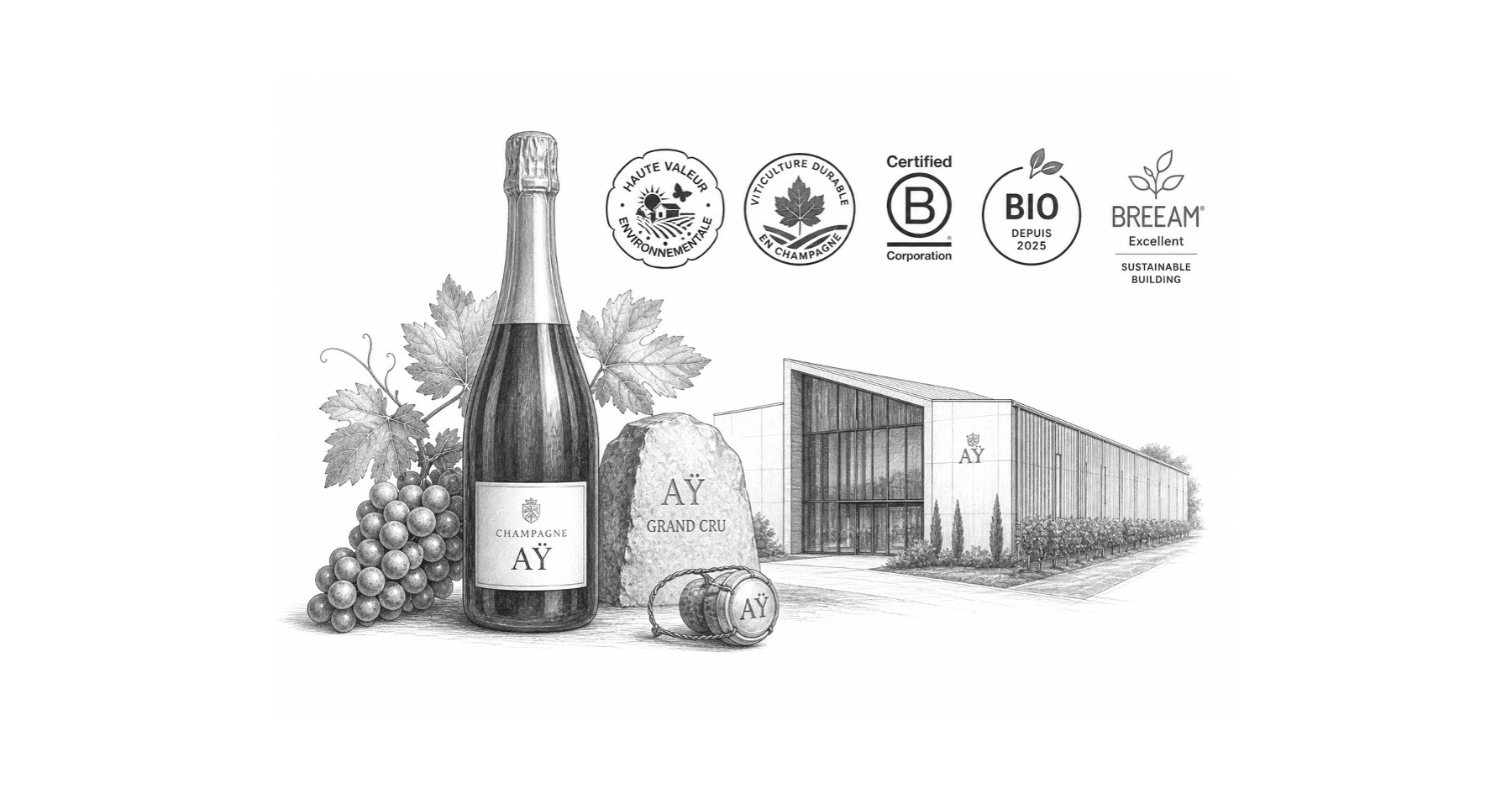
Certification as framework, not ornament
In Aÿ, where the identity of Champagne is closely tied to place, scale, and continuity, one established house has chosen to formalise its environmental and organisational commitments through a dense network of certifications. Rather than treating these as external validations, the estate has integrated them into its operating structure.
The approach is cumulative. The house now holds Haute Valeur Environnementale and Viticulture Durable en Champagne, while also adopting B Corporation standards, which extend evaluation beyond viticulture to include governance, social impact, and management practices. Since 2025, organic certification has been added, further tightening the constraints under which vineyard work is conducted.
Vineyard practices under constraint
The coexistence of these certifications imposes a layered discipline. Organic farming alone already requires a rethinking of treatments, soil management, and risk tolerance, particularly in a northern climate prone to disease pressure. Combined with broader environmental frameworks, it creates a system where decisions must satisfy multiple criteria simultaneously.
This does not simplify vineyard work. It complicates it. Yield management, canopy control, and timing of interventions become more critical, as margins for error narrow. The objective is not solely environmental compliance, but the maintenance of consistency in a region where stylistic expectations remain precise.
Extending sustainability to infrastructure
The recent certification of the estate’s new cellar under the BREEAM standard extends this logic beyond the vineyard. BREEAM assesses the environmental performance of buildings across energy use, materials, water management, and long-term operational impact.
Applying such a framework to a winery introduces a different set of considerations. Temperature control, humidity stability, and logistical efficiency must align with reduced environmental footprint. The cellar is not only a technical space but a controlled environment where precision is essential; integrating sustainability here requires design rather than adjustment.
Governance as part of the equation
The adoption of B Corporation standards signals a broader shift. It brings governance, employee relations, and external impact into the same evaluative field as vineyard and cellar practices. For a Champagne house, where brand identity often rests on heritage, this introduces a more contemporary layer of accountability.
It also suggests that sustainability is being treated as an operational system rather than a narrative. Measurement, reporting, and verification become ongoing processes, not endpoints.
Between continuity and adaptation
Champagne’s structure leaves limited room for abrupt change. The challenge for any house is to integrate new constraints without disrupting stylistic continuity. In this case, the accumulation of certifications indicates a preference for gradual alignment rather than visible transformation.
The wines themselves will remain the ultimate reference point. Certifications can define conditions, but they do not determine outcomes. Their role is indirect: shaping the environment in which decisions are made.
A structured evolution
What emerges from this approach is a form of structured evolution. Vineyard practices, building design, and corporate governance are being aligned within a single framework of accountability.
In a region where consistency is both expectation and constraint, such alignment offers a way to adapt without dislocation. The emphasis is not on signalling change, but on embedding it—quietly, and with a degree of precision that reflects the broader discipline of Champagne itself.