
M. Chapoutier Succession: Fourth Generation Steps Forward
Mathilde and Maxime Chapoutier join the family group’s board as a fourth generation prepares to shape its next chapter.
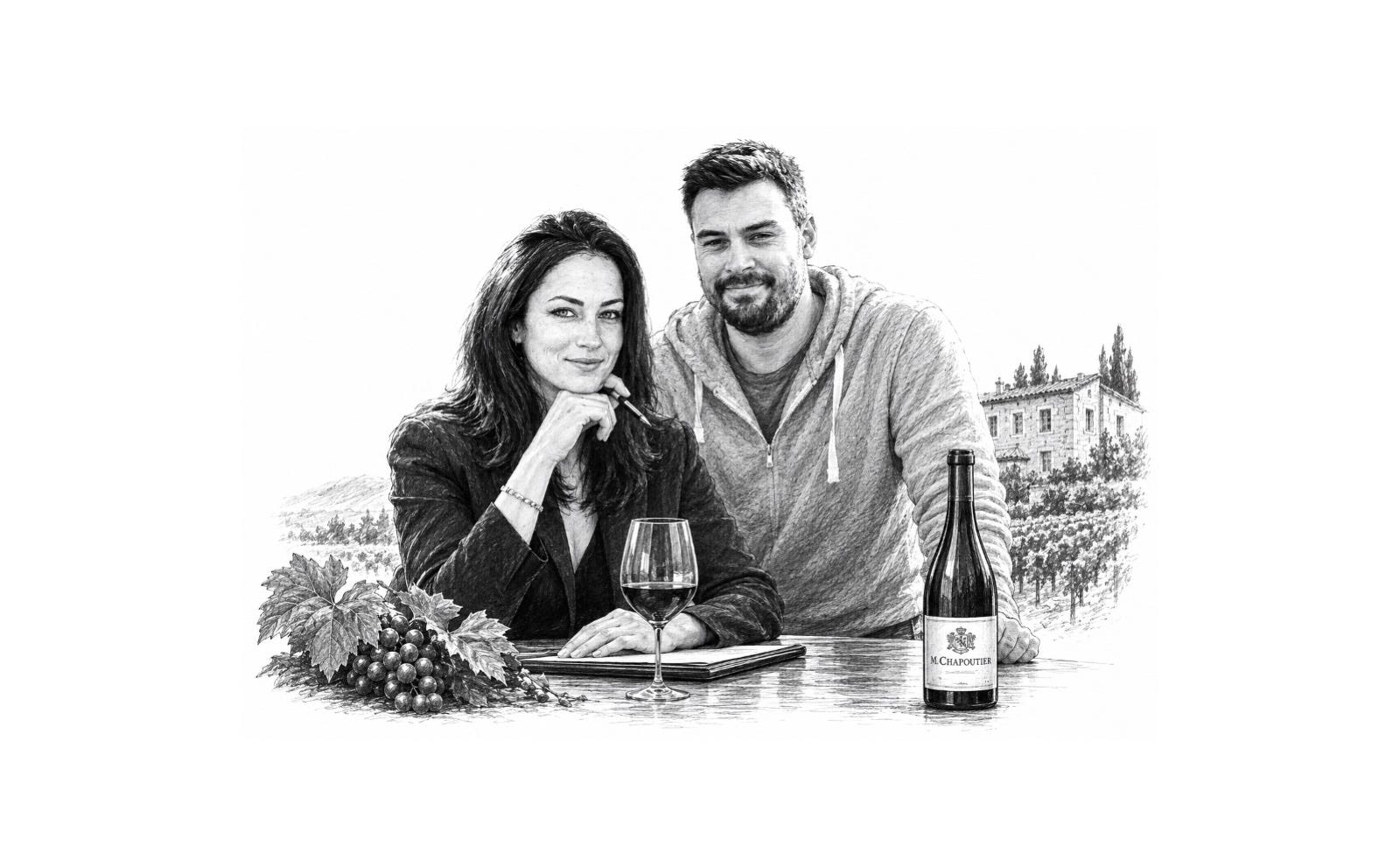
At M. Chapoutier, succession is becoming a matter of governance rather than speculation. Mathilde and Maxime Chapoutier, the children of chairman and chief executive Michel Chapoutier, have joined the board of the family-owned wine group based in Tain-l’Hermitage.
Their appointments give formal expression to a transition that has already been taking place within the business. Mathilde Chapoutier, 35, oversees commercial operations, while her brother Maxime, 33, is responsible for the group’s technical and production activities. Both therefore arrive at board level with established operational roles rather than as distant heirs awaiting their turn.
For one of the Rhône Valley’s most recognisable wine names, the move represents continuity, but not stasis. The fourth generation will help steer a substantial and increasingly international organisation through a period marked by climatic pressure, changing patterns of consumption and the broader challenges confronting the French wine trade.
A Broader Governance Structure
The M. Chapoutier succession is not limited to the promotion of family members. Philippe Al Dahdah, the group’s chief financial and administrative officer, is also taking on the position of deputy chief executive.
His expanded responsibilities bring financial management, organisational development and change management more directly into the leadership structure. The arrangement suggests a deliberate balance: family continuity on one side, professionalised corporate oversight on the other.
That distinction matters for a company of Chapoutier’s scale. In 2024, the group reported sales of 9.6 million bottles and turnover of €76.2 million. It employs approximately 260 people and controls around 450 hectares of vineyards.
Although the house remains inseparable from the northern Rhône, its present identity extends far beyond Hermitage and Crozes-Hermitage. Its vineyard interests include sites in Alsace, Beaujolais, Languedoc, Provence and Roussillon, as well as projects outside France in Australia and Portugal.
The modern Chapoutier business is therefore both a Rhône institution and an international wine group. Passing responsibility to a new generation involves more than preserving a collection of celebrated vineyards. It requires managing a network of estates, markets and commercial relationships whose scale would have been difficult to imagine when the family company took its present name in 1955.
From Family Crisis to International Recognition
Michel Chapoutier assumed control of the company during the 1990s, when its financial position was precarious. Under his direction, the house underwent a profound transformation.
Biodynamic viticulture became central to its identity, adopted well before such methods gained their present visibility across the fine-wine world. At the same time, an ambitious approach in the cellar helped strengthen the reputation of the company’s leading Rhône wines.
International critical acclaim accelerated that rise. A number of perfect scores from the American critic Robert Parker Jr. brought considerable attention to the Chapoutier name, particularly among collectors beyond France. The combination of distinctive vineyard practice, powerful wines and a strong public personality allowed the business to emerge from financial difficulty and become one of the region’s most influential producers and merchants.
Yet the next phase will unfold in a markedly different environment. The market influence once wielded by a small number of critics has diminished. Wine consumption is changing in several established markets, while climate volatility increasingly affects both vineyard decisions and long-term investment.
The skills required to rebuild a struggling house are not necessarily the same as those needed to guide a mature international group. The new governance structure appears designed with that reality in mind.
A New Chapter for M. Chapoutier
Succession in a French wine family is rarely a simple transfer of ownership. Vineyards operate on longer timescales than most businesses, while reputation accumulates over decades and can be damaged far more quickly.
The most convincing generational transitions tend to begin well before titles formally change. In this case, Mathilde and Maxime have already been entrusted with two of the company’s most consequential areas: bringing the wines to market and determining how they are made.
Their respective positions also reflect the dual character of a contemporary wine group. Commercial reach alone is insufficient without viticultural and technical credibility. Equally, excellence in the vineyard and cellar cannot sustain an organisation of this size without clear distribution, financial discipline and sensitivity to changing markets.
Bringing both perspectives into the boardroom gives the fourth generation a platform from which to influence strategy while retaining experienced leadership around them.
There has been no suggestion of an abrupt departure by Michel Chapoutier. Instead, the changes point towards a gradual redistribution of responsibility, allowing institutional knowledge to remain within the company while the next generation gains a larger role in shaping its direction.
A House Built Around a Strong Personality
Michel Chapoutier has long occupied a position that extends beyond his own company. He has chaired the national federation representing French wine merchants since 2014 and has led the network associated with the Vignobles & Découvertes label since 2021.
Earlier roles included the presidency of the Union des Maisons de Vins du Rhône from 2005 to 2014 and of Inter Rhône from 2014 to 2020. He has also supported initiatives involving young sommeliers, charitable harvests and the wider promotion of French wine culture.
His outspoken manner has made him one of the trade’s most visible and occasionally divisive figures. That public presence has often been intertwined with the identity of M. Chapoutier itself.
The challenge for the company is therefore not simply to replace a chief executive. It is to ensure that the strength of an individual personality can be translated into durable structures, shared responsibilities and a clear long-term vision.
The house’s motto, Fac et spera—do and hope—has always implied that optimism must be accompanied by action. The appointments of Mathilde and Maxime Chapoutier suggest that the family is now applying that principle to its own future.
For a business built on vineyards, heritage and a willingness to take risks, the fourth generation’s arrival is less an ending than the opening of another chapter.