
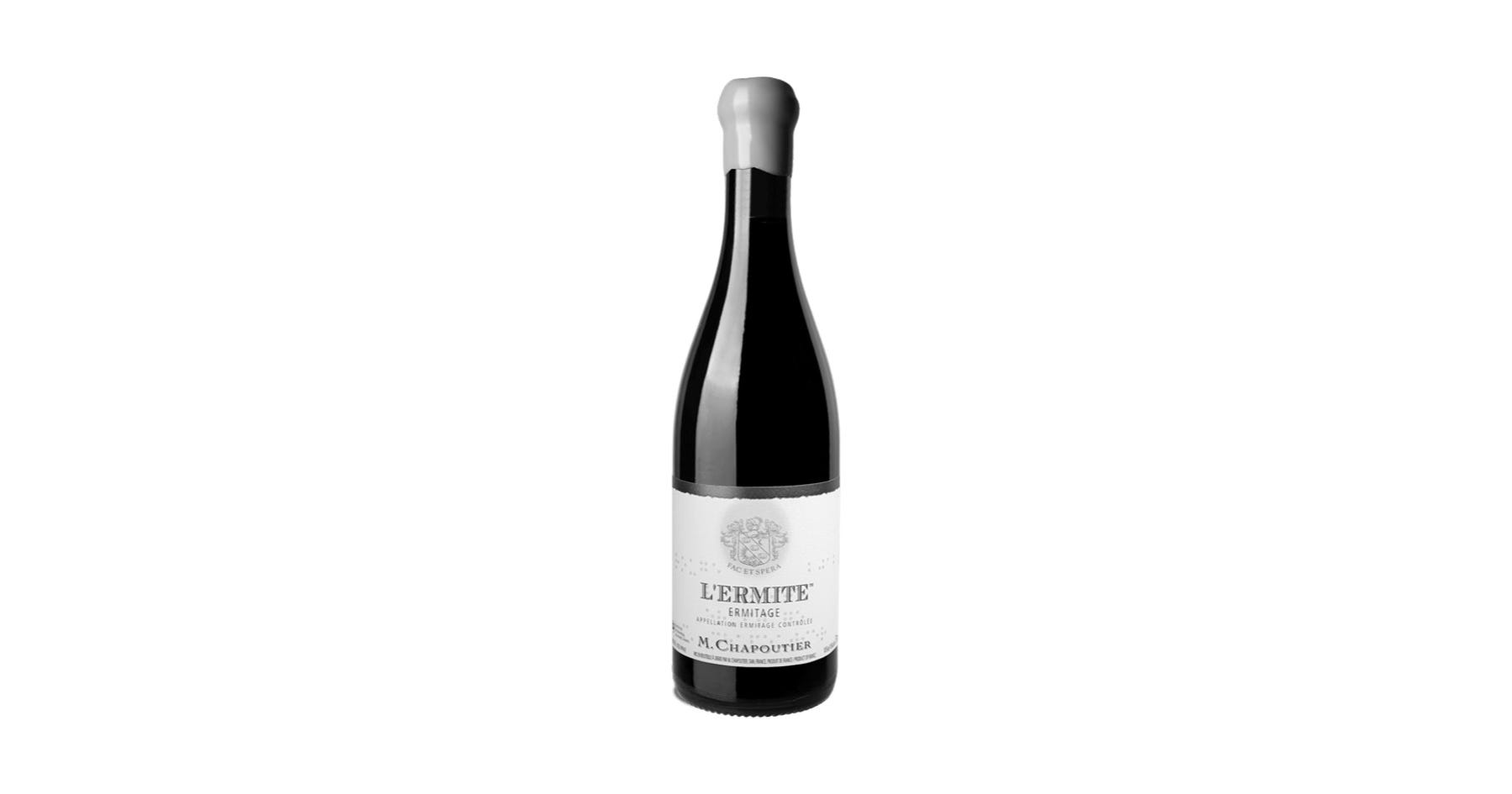
M. Chapoutier: L’Ermite (Blanc)
The most austere and ageworthy white Hermitage, where old-vine Marsanne meets granite precision at the summit of Hermitage.
Place within Hermitage and French fine wine
Within white Hermitage, L’Ermite Blanc sits at the most ascetic, exacting end of the spectrum: not the warmest or most immediately generous expression of Marsanne on the hill, but the one most explicitly framed around altitude, granite, and the upper slopes around the chapel. Under the Hermitage AOC, white wines may be made from Marsanne and Roussanne, and the appellation’s rules explicitly allow the naming of a registered lieu-dit on the label; that legal framework is what permits a wine like L’Ermite Blanc to present itself not merely as Hermitage blanc, but as a specific site within the hill’s internal hierarchy. Hermitage itself has been famous for centuries—first as the “wines of Vienne,” then as the “wines of Saint Christopher’s hill,” and later as the royal wine of Louis XIII—so any grand white Hermitage automatically enters a long historical conversation about French vinous prestige rather than only a modern luxury market one.
What changed under Michel Chapoutier was not the existence of Hermitage’s hierarchy, but its articulation. Public house material and trade commentary link his tenure from 1990 onward to the move toward biodynamics, a more explicit parcel-by-parcel philosophy, and a cellar style intended to sharpen site expression rather than smooth it into an all-purpose “grand vin.” In that context, L’Ermite Blanc became the white apex of Chapoutier’s sélections parcellaires: a wine whose reputation rests not only on scarcity and price, but on the repeated impression among critics that, in the very best vintages, it transcends the normal scale of white Rhône and competes on a broader French fine-wine axis usually reserved for grand white Burgundy, top Châteauneuf Blanc, and the rarest long-lived dry whites.
Its cult following is therefore not accidental. It came from several converging turning points: the 1990s parcel-selection turn at Chapoutier, the powerful international critical reception of the late-1990s and 2000s vintages, the broader rehabilitation of serious white Hermitage as a collector category, and the modern collector’s appetite for wines that are simultaneously microscopic in production, technically distinctive, and stylistically unlike anything else. L’Ermite Blanc fits the broader narrative of French fine wine precisely because it refuses one of its dominant templates: it is neither Bordeaux-like in liquidity nor Burgundian in ease. Its prestige comes from severity converted into grandeur.
Vineyard and terroir
The estate’s own technical sheet places L’Ermite Blanc at the top of Hermitage hill, around the chapel, on an east-facing terrace of very poor granite-derived soils with loess. Matt Walls’s reporting for Decanter adds the key qualitative point that these are effectively the only white vines on the granitic part of Hermitage beyond a tiny outlier elsewhere on the hill, which is one reason the wine behaves so differently from richer white Hermitage drawn from warmer, more mixed or more calcareous sectors. The site is therefore unusual even within Hermitage: high, exposed, nutritionally poor, and geologically severe, with a granitic core that drives tension rather than breadth.
Public trade and critic sources describe the white cuvée as coming from a tiny roughly 0.5-hectare selection of the estate’s oldest Marsanne at the summit, some of it more than a century old. That matters because “L’Ermite” in the broader, cadastral sense is larger than the slice actually feeding the white bottling; the white is best understood as a microscopic old-vine selection inside the lieu-dit rather than an exhaustive white rendering of the whole site. Recent critical notes also mention that the vineyard is spread over different altitudes and must be harvested in multiple passes, which tells you the parcel is not a single homogeneous bench but a fragmented upper-slope environment with materially different ripening tempos.
The Hermitage AOC itself stresses how much the hill’s identity depends on human intervention: terraces, retaining walls, and drainage works built to stabilize unstable granitic sands and evacuate rainwater toward the Rhône. That context is crucial for L’Ermite Blanc. Granitic sands and loess drain quickly, help prevent dilution, and, in cool or balanced years, give the wine its most linear, mineral form. But they can also turn the site into a place of stress. In the 2022 vintage, Decanter’s hill-wide reporting found that granite-based parcels such as Ermite and Les Bessards were actually more liable to ripening blockages in drought than clay-based sectors, finishing materially lower in alcohol than the warmer clay zones; that is exactly the sort of year that reveals both the nobility and the risk of this terroir.
Microclimatically, L’Ermite Blanc is sensitive in both directions. The upper, east-facing position tends to preserve freshness better than warmer sectors such as Le Méal and can yield relatively modest alcohols even in hot years, as Chapoutier’s 2022 Rhône report noted for old-vine Marsanne. At the same time, the estate’s 2020 report shows that the grapes for L’Ermite Blanc were already being picked on 25 August that year, ahead of many reds, illustrating how a drought year can produce startling precocity even on the upper hill. At the summit, “cooler” does not mean “late”; it means the wine’s balance is negotiated through exposure, drainage, vine age, and very small yields rather than simple calendar delay.
Grape material and farming
The wine is 100% Marsanne, even though the Hermitage AOC permits both Marsanne and Roussanne in white Hermitage. That choice is not trivial. Marsanne on Hermitage can be broad, waxy, and almost massive when grown on richer soils, but on granite at elevation it can also become one of France’s most structurally severe white-wine vehicles. Chapoutier’s public material frames L’Ermite Blanc as the estate’s oldest-vine Marsanne selection, while trade references specify some vines at over 100 years old and, in certain notes, pre-phylloxera or ungrafted material. This is not a grape-composition story of blending finesse; it is a vine-material story of old Marsanne under extreme site pressure.
That old material translates directly into scarcity. Publicly documented yields are tiny: K&L quoted 12 hl/ha for the 2013, Richard Hemming MW recorded 25 hl/ha on the 2017 cask sample, and merchant/critic records for vintages such as 2006, 2008, 2009, and 2017 place production in the low hundreds of cases rather than in the thousands. For collectors, this is more important than any abstract prestige claim. L’Ermite Blanc is scarce because the site is tiny, the vines are old, and the viticultural logic is concentration through survival rather than crop volume through vigor.
The farming philosophy is identifiably biodynamic and organic in the published material. The estate’s current and archived pages show Demeter, Biodyvin, and organic certifications on L’Ermite Blanc, and outside reporting consistently ties Chapoutier’s Hermitage work to a biodynamic turn under Michel Chapoutier. That said, public sources are much better on philosophy than on certain technical specifics: I did not find a public matrix of clone numbers, selection-massale protocols, or block-by-block replanting chronology for the white vines. For a professional collector, that absence matters. What the open record supports confidently is old-vine preservation, very low yields, and a farming regime designed to intensify site contrast rather than erase it.
Vinification and élevage
The current estate technical sheet is unusually informative. It describes whole-cluster pressing, moderate sulfur use, light settling, fermentation with indigenous yeasts in half-muids with 25% new wood plus stainless steel vats, and a full year of ageing on lees. That is a revealing combination: the fruit is protected but not aggressively antiseptic; the ferments are not stripped of solids by hard clarification; oak is present, but its modern form is larger-format demi-muids rather than a small-barrel regime designed to stamp flavor; and the year on lees suggests that mouthfeel and reductive protection are integral to the wine’s architecture, not merely decorative élevage choices.
Independent reporting suggests a broader stylistic evolution in Chapoutier’s white-Hermitage cellar over time. Perswijn notes that the white parcel selections are now spontaneously fermented after 24–48 hours of settling, mostly in 600L demi-muids with only 10–20% new oak and partly in stainless steel, then matured for 10–12 months, sometimes with bâtonnage, while retaining a bit more dissolved CO2 for freshness, keeping quality, and “relief.” That same reporting explicitly says there used to be more new oak. In other words, the technical direction of travel has been toward less emphatic oak signature, more textural precision, and a fresher, more protected post-fermentation profile. House commentary on Michel Chapoutier’s reforms lines up with this by describing a move away from large foudres, a shorter and more controlled barrel regime, and unfiltered bottling.
Recent vintage notes make the modern recipe even clearer. Farr’s 2019 and 2022 pages specify a regime of roughly 90% demi-muids and 10% stainless steel, with 25% new wood, while the 2021 note remarks that L’Ermite Blanc “always sees a slightly longer élevage.” This helps explain the wine’s recurring youth profile: it is not merely rich Marsanne raised in oak, but a wine deliberately held in a reductive, leesy, moderately wooded environment long enough to knit extract, salt, and tannin-like dry matter into something more architectural. Exact coopers, forest origin, and toast levels are not public in the sources I reviewed, so any more granular claim than that would be speculation.
Vintage chronicle
The archive is surprisingly uneven before the late 1990s. In open public sources, I could verify a 1992 bottling in a public cellar record and a 1996 bottle in Christie’s archive citing Parker; from 1999 onward, the merchant-and-critic record becomes much denser. The estate’s own archived shop pages then confirm a long sequence of later vintages, and current critical/merchant sources extend the chronology through 2025 in primeur form. For serious collectors, that means the wine’s early history is real but not perfectly transparent online; confidence rises sharply from the late 1990s forward.
The founding phase appears to begin, at minimum, by 1992. Parker’s published early-1990s comments on Chapoutier’s luxury white Hermitage bottlings show the ambition already established: tiny production, old Marsanne, and wines meant for decades rather than years. 1995 is harder to reconstruct from open institutional sources, but it remains visible in collector memory. 1996 is the first clearly documented vintage I could verify in auction literature for L’Ermite with explicit old-vine, high-chapel-parcel context. 1997 and 1998 are harder to document in depth for the blanc specifically from open professional sources, although later surviving bottles and gala references show the broader white-Hermitage pattern of enormous body followed by the possibility of a muted intermediate phase. By 1999 and 2000, the record becomes emphatic: these are already treated as crystalline, site-driven, almost immortal whites.
2001 and 2002 appear in later estate archival listings, but open contemporary commentary is thinner than for the vintages that follow. 2003 belongs to the torrid Rhône year that produced massively endowed, low-acid dry whites whose long-term trajectories observers were already debating. 2004 is one of the great paradoxes of the cuvée: Parker wrote that the single-vineyard Ermitages were then seeing 100% new oak, yet the finest bottles seemed to absorb it almost completely into texture rather than aroma. 2005 reads as a deeper old-vine statement, with notes of extraordinary acidity and some vines around 130 years old. 2006 is one of the canonical L’Ermite Blancs, around 227 cases and described as a modern legend. 2007 remains less cleanly documented in the open record than adjacent years, but stylistically it belongs to the pre-2010 run of very full, very concentrated white Hermitage. 2008, by contrast, was already judged faster-evolving than 2005–07 or 2009 despite the density and a materially larger—but still tiny—production of 445 cases.
2009 and 2010 are benchmark years in the modern legend of the wine. In 2009, Parker wrote of 229 cases from ungrafted Marsanne over 100 years old, a wine so structured and intense that he projected century-scale longevity. In 2010, he emphasized pure granite soils and pre-phylloxera vines, again treating the wine as both a terroir monument and an outlier among dry whites. 2011 is different: denser, more backward, more austere, and therefore in some ways more classically “Ermite.” 2012 and 2013 form an extraordinary pair—both treated as perfect or near-perfect expressions of power married to purity, and both central to the wine’s collector mythology today. 2014 is the cool-vintage exception that the secondary market still treats seriously, suggesting a scarcity-and-precision vintage rather than an opulent one. 2015 is the warm-vintage behemoth that later critics used to define the cuvée’s “liquid rock” phase.
2016 is comparatively harmonious and, for L’Ermite, relatively legible early. 2017 is concentrated but notably more reductive and backward, with Hemming’s cask-sample note recording 25 hl/ha and a wine that clearly needed patience. 2018 is one of the great contradictory vintages: huge fruit, huge extract, huge richness, yet still with the granitic freshness that prevents the wine from collapsing under its own mass. The estate’s own harvest material stressed how the upper heights of Ermitage protected the white fruit in that hot year. 2019 is one of the towering recent vintages, chiseled and structured, with the now-familiar 90% demi-muid/10% stainless regime and a long suggested waiting period. 2020 is monumental again, but less overwhelming than 2018 or 2019—more elegant, more harmonious, less sheerly massive. 2021 is the classical reset: later-bottled, saltier, tighter, more acid-driven, and arguably the most intellectually compelling recent vintage if one values line over amplitude.
2022 shows why this terroir matters in a warming climate. Chapoutier’s Rhône report notes old-vine Marsanne at 13–13.5% with surprisingly preserved acidity, while Decanter’s wider hill analysis observed that granite-based parcels on Ermite and Bessards could even stall compared with riper clay sectors, producing lower alcohol and a more severe shape. That is exactly the profile one wants from L’Ermite Blanc in a hot year: not denial of the sun, but resistance to excess. 2023 already reads in criticism as a classic Ermite—flint, smoke, salt and a mineral core wound tight around generous body, with trade listings around 12.5% alcohol. 2024, from a different sort of year, was harvested in three passes across altitudes and already tastes “classic Ermite” in barrel. 2025 is still preliminary. The estate’s harvest report describes a year of contrasts—water reserves, frostless delay, then severe summer heat—but with balance apparently preserved; the wine is already sold en primeur for 2028 delivery, so for now it belongs to the category of promising future vintage rather than completed history.
Style, identity, and cellaring
The easiest mistake with L’Ermite Blanc is to describe it as an exotic Marsanne because Marsanne is the grape. In reality, its identity is structural first. Public technical and critical descriptions consistently return to salt, smoke, crushed-stone severity, dry extract, granitic “uprightness,” and a paradoxical combination of body with tension. K&L calls it the most structured of Chapoutier’s white Hermitages, and Decanter’s recent notes repeatedly distinguish it from the broader, more immediately solar profiles of De l’Orée and Le Méal. That is the wine’s core identity across vintages: not aromatic flamboyance, but the ability to turn density into line.
This makes it quite different not only from Chapoutier’s own other white Hermitages but also from the blended whole-hill blanc of Domaine Jean-Louis Chave. In recent Decanter notes, Chave’s white Hermitage is described through the softer, more expressive dispositions of Rocoules/Péléat in 2023, while L’Ermite is explicitly rendered as “the essence of granite.” Put differently: Chave Blanc is often about whole-hill synthesis and layering; L’Ermite Blanc is about upper-hill singularity. Within Chapoutier’s trio, De l’Orée tends to be the fleshier alluvial/calcareous voice, Le Méal the richer solar one, and L’Ermite the most stern, saline, aristocratic form of white Hermitage.
In bottle, L’Ermite Blanc often behaves like the finest long-lived white Rhône: youth marked by reduction, oak texture, and tightly wound mass; mid-life by a frequently awkward, apparently mute corridor; full maturity by enormous textural authority without heaviness. Chapoutier’s own archived material claims 30–60 years and, in certain vintages, 50–75 years of life. Parker and Dunnuck repeatedly make 30-, 40-, and 50-year arguments for the strongest years. Parker also explicitly described mature white Hermitage as liable to a “dumb,” oxidative-seeming phase, a warning collectors should treat seriously. The reward is obvious; the risk is equally real. This is not a white wine for casual interval drinking. It is a wine to leave alone for long stretches in a cold, stable cellar and then to open with seriousness.
Market and cultural life
The market case for L’Ermite Blanc begins with scarcity, not momentum. Documented production in some years runs to 227 cases, 229 cases, 231 cases, or 445 cases; that is enough to create rarity, but not enough to create a deep, frictionless secondary market. Current Farr listings show active offers for only a handful of vintages: 2020 at £1,425 per six, 2021 at £1,475, 2022 at £1,720, and 2024 at £1,700, all in bond; its own historical and third-party market references show older examples occupying similar or higher tiers, such as 2009 at £1,985 per six and 2013 at £2,320 in a 2019 “100-point wines” analysis, while a 2000 market example was quoted around HK$24,660 per 12 and 2015 around CAD$5,240 per 12. That is high-value, low-volume trading: serious money, but with strong vintage dispersion and limited turnover rather than broad commodity-like liquidity.
That thinness is visible in sales channels. L’Ermite Blanc appears in elite retail and in high-end auction houses such as Christie’s and Bonhams, but far less continuously than blue-chip Bordeaux first growths, grand cru Burgundy, or even the most liquid Rhône reds. As an investment object, it is therefore better understood as a connoisseur’s scarcity asset than as a highly tradeable benchmark. Price can be excellent; transparency and depth are less so. The principal risks are exactly the ones sophisticated collectors already know: stylistic misunderstanding, the wine’s occasionally monastic youth, the long wait required for true maturity, provenance sensitivity for older bottles, and the possibility that market enthusiasm for ultra-expensive white Rhône remains narrower than for the classic red categories.
Culturally, however, L’Ermite Blanc sits in a much stronger position than its limited liquidity might suggest. Hermitage’s historical prestige is inseparable from French court culture and the old practice of “Hermitagé,” by which Bordeaux producers once advertised the strengthening effect of Hermitage in their wines. Modern L’Ermite Blanc participates in that older symbolic economy of grandeur rather than merely in modern score culture. It appears on luxury wine lists—recently, for example, in the Grand Lisboa Palace’s Don Alfonso list alongside other established icons—and in serious tasting contexts such as Robert Parker’s dinner notes, where the 2000 L’Ermite Blanc was placed in a flight of world-class whites and judged at that level. Gastronomically, the estate’s own pairings for the wine include arctic char and beet preparations, but the structure of the wine points more broadly to the classic high-end white-Hermitage table: lobster, turbot, veal with cream or morels, richly sauced poultry, and, at maturity, truffle-bearing dishes where salt, dry extract, and evolved Marsanne texture matter more than primary fruit.
Conclusion
L’Ermite Blanc is one of the few white wines in France whose stature depends less on analogy than on irreducibility. It is not “the Rhône’s Montrachet,” except in the very loose sense that both can be among the greatest dry whites in the world. It is not even the fullest or most obviously seductive white Hermitage in every year. Its greatness lies elsewhere: in how a tiny, old-vine Marsanne parcel high on Hermitage’s granitic crown can produce a wine of massive body yet stern line, luxurious texture yet almost monastic reserve, and aging potential that is not a marketing slogan but a repeated empirical fact across the best vintages. For the collector or professional who values site over charm and duration over immediate éclat, L’Ermite Blanc is not merely a trophy white Rhône. It is one of the most exacting terroir wines in France.