
Louis Roederer Burgundy Acquisition: A Historic Move into Gevrey-Chambertin
Louis Roederer makes its first move into Burgundy with eight hectares of prized vineyards in Gevrey-Chambertin.
Louis Roederer Enters Burgundy
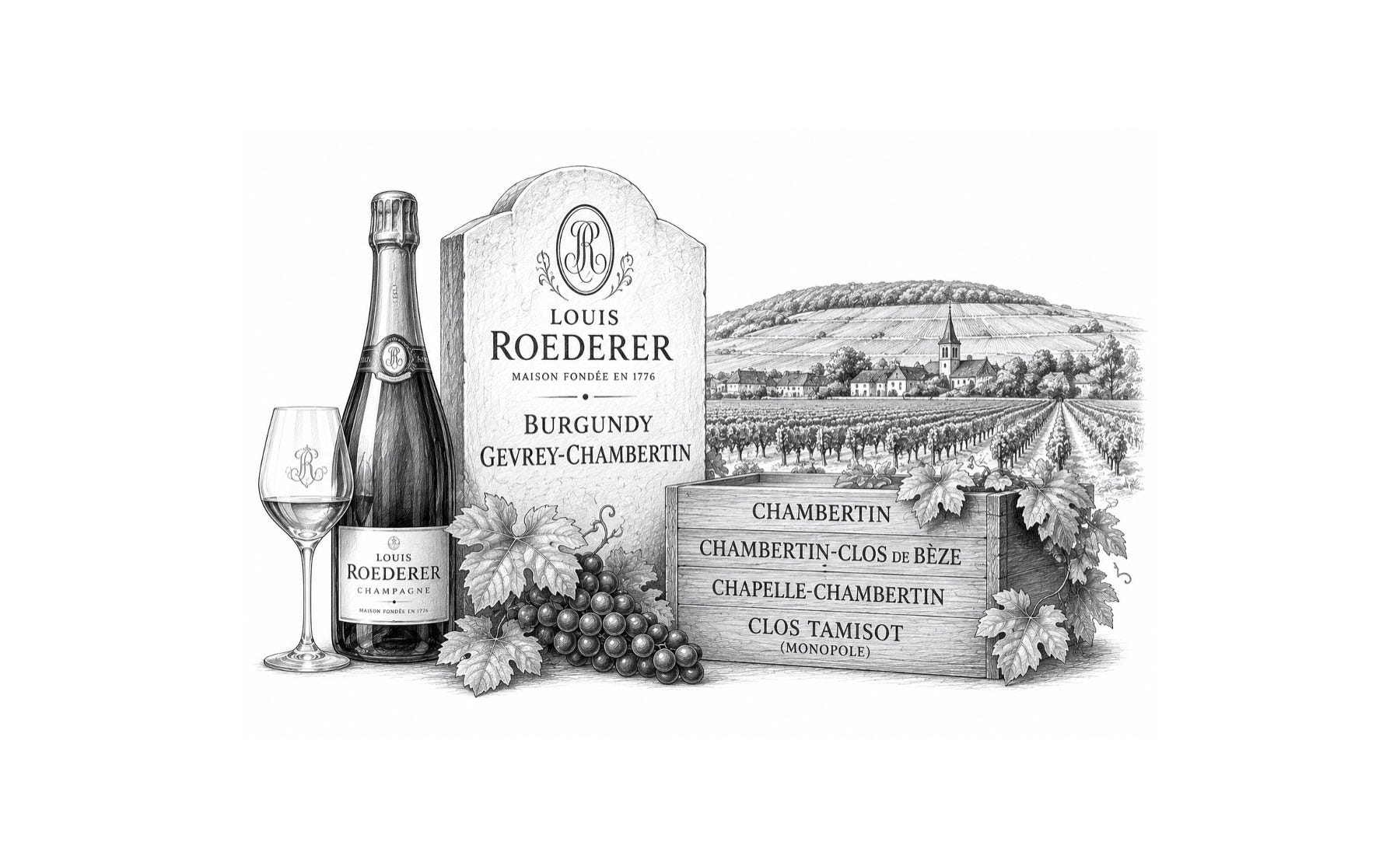
Louis Roederer has crossed one of the most closely watched frontiers in French wine. The historic Champagne house has acquired Pierre Damoy’s eight-hectare estate in Gevrey-Chambertin, giving the Rouzaud family group its first foothold in Burgundy.
Completed after exclusive negotiations announced in April, the Louis Roederer Burgundy acquisition brings together two very different wine cultures. Roederer arrives from Champagne with the resources and patience of a large, family-controlled group. The estate it has purchased is rooted in the intensely fragmented landscape of the Côte de Nuits, where a few rows of vines may carry extraordinary historical, cultural and financial weight.
The vineyards include holdings in Chambertin, Chambertin-Clos de Bèze and Chapelle-Chambertin, three of Gevrey-Chambertin’s most revered grands crus. The acquisition also includes Clos Tamisot, a monopole cultivated under the exclusive control of the estate.
No purchase price has been disclosed. Given the rarity of substantial grand cru holdings in Burgundy, however, the transaction is certain to attract interest well beyond the region.
Eight Hectares of Exceptional Burgundy Vineyards
In most wine regions, an eight-hectare acquisition would be notable without appearing transformative. In the Côte de Nuits, eight hectares containing several grand cru parcels represent an estate of unusual scale and consequence.
Burgundy’s vineyards are famously divided among numerous owners, often through generations of inheritance. Acquiring a coherent group of parcels is therefore difficult, particularly at grand cru level. Opportunities involving this quantity and quality of land rarely reach the open market.
Chambertin and Chambertin-Clos de Bèze stand at the summit of Gevrey-Chambertin’s hierarchy. Their names carry an authority built over centuries, while Chapelle-Chambertin offers another distinctive expression of the same celebrated slope. These are not merely prestigious labels. They are vineyards whose individuality has helped shape the very idea of terroir.
Roederer has also highlighted the estate’s plant material, including a significant proportion of old vines and considerable genetic diversity. Such details matter in Burgundy, where vine age, massal selection and the preservation of individual plant lineages can influence both resilience in the vineyard and complexity in the glass.
The vines themselves may prove as important as the land beneath them.
The Louis Roederer Burgundy Acquisition and a 250-Year Milestone
The timing gives the purchase additional symbolic weight. Louis Roederer is entering Burgundy in the year of its 250th anniversary.
Founded in Reims, the house has long been associated with a distinctive model of Champagne production based on substantial vineyard ownership. That emphasis on controlling its sources offers a natural point of connection with Burgundy, even if the two regions differ sharply in scale, structure and winemaking tradition.
The wider Roederer group is already one of the most diverse family-owned portfolios in fine wine. Its interests include Louis Roederer and Deutz in Champagne; Château de Pez and Château Pichon Longueville Comtesse de Lalande in Bordeaux; Delas Frères in the Rhône Valley; Domaines Ott in Provence; and properties in Portugal and California.
Until now, Burgundy had been the conspicuous absence.
That omission was understandable. The region offers few opportunities to acquire significant vineyard holdings, and prices at the highest level have risen to figures that can be difficult to reconcile with agricultural returns alone. For an established wine group seeking a lasting presence rather than a symbolic parcel, patience would have been essential.
With Pierre Damoy’s estate, Roederer has secured an entry of unusual substance.
Pierre Damoy’s Three Decades in Gevrey-Chambertin
Pierre Damoy took responsibility for the family property in 1992 and has spent more than 30 years tending its vineyards and shaping its wines.
His period at the helm coincided with a profound change in Burgundy’s international standing. During those decades, the region moved from specialist fascination to global obsession. Demand grew, prices accelerated and once-discreet domaines became objects of intense attention among collectors.
Damoy remained comparatively reserved within that increasingly public world. Yet the vineyards under his care were impossible to overlook. Few estates possess such extensive holdings in Gevrey-Chambertin’s grands crus, and fewer still can offer them as a single patrimony.
The sale has been presented not simply as a financial transaction but as a transfer of stewardship. That language is common in fine wine, though here it carries particular relevance. Burgundy vineyards are not easily expanded or recreated. Their value lies in continuity: of ownership, farming, plant material and accumulated knowledge.
For Roederer, the responsibility will be to preserve that continuity while bringing its own standards and resources to the estate.
Why Gevrey-Chambertin Matters
Gevrey-Chambertin is among the largest and most celebrated villages of the Côte de Nuits. Its reputation rests particularly on Pinot Noir, expressed across a broad range of village, premier cru and grand cru sites.
The commune contains nine grands crus, more than any other village in Burgundy. Their character varies according to position, exposure, soil and the work of individual growers, but Gevrey is often associated with wines of depth, structure and longevity.
Such general descriptions should never be treated as rigid formulas. Burgundy resists simplicity, and neighbouring parcels can produce markedly different wines. Even so, the grands crus acquired by Roederer occupy an exceptional place in the region’s imagination.
Chambertin has long been regarded as one of Burgundy’s benchmark vineyards. Chambertin-Clos de Bèze possesses an equally distinguished history, while Chapelle-Chambertin is smaller and less frequently encountered. Together, the holdings give Roederer access to several perspectives on the grand cru landscape of Gevrey.
Clos Tamisot adds another dimension. As a monopole, it allows one estate to shape the vineyard’s identity without the variation created by multiple owners and winemaking approaches.
Champagne Capital Meets Burgundian Scale
Large groups entering Burgundy are often viewed with a mixture of curiosity and caution. The region’s prestige has attracted luxury companies, investors and established wine families, raising questions about land prices, succession and the future of independent domaines.
Roederer is not an outsider to vineyard culture. Its Champagne identity has long been tied to estate-owned vines, detailed farming and long-term family control. That distinguishes it from investors approaching wine primarily as a financial or branding opportunity.
Even so, Burgundy will require a different rhythm.
Champagne houses traditionally work across broad vineyard networks and produce blends assembled from numerous parcels, grape varieties and harvest years. Burgundy, by contrast, places extraordinary emphasis on individual sites and highly specific origins. A single climat is expected to speak with its own voice.
The task will not be to impose a Champagne model on Gevrey-Chambertin. It will be to understand how Roederer’s experience, technical resources and agricultural ambitions can serve vineyards whose identities are already firmly established.
Frédéric Rouzaud, chief executive of the Roederer group, has emphasised continuity and respect for the work of the Damoy family. The real meaning of that commitment will become apparent gradually, through decisions made in the vineyard and cellar.
A Landmark Deal in an Increasingly Expensive Region
The Louis Roederer Burgundy acquisition also draws attention to the extraordinary economics of the region’s finest land.
Grand cru vineyards are both agricultural assets and cultural treasures. Their supply is permanently limited, while demand comes from producers, private investors and international groups. This combination has pushed values to levels rarely seen elsewhere in the wine world.
The full price of the Damoy transaction remains private, making confident estimates inappropriate. What can be said is that an eight-hectare Gevrey-Chambertin estate with substantial grand cru holdings belongs to the rarest category of Burgundy property.
Such sales can reshape more than ownership. They influence expectations about vineyard values, complicate succession for local families and reinforce the gap between land prices and the income generated by wine production.
At the same time, well-capitalised ownership can provide stability. Old vines require careful maintenance, vineyard teams need long-term security and historic estates must invest continuously if they are to preserve their quality.
The question is not simply whether outside capital enters Burgundy, but what it does once it arrives.
What Comes Next for the Former Damoy Estate?
Roederer has not yet provided a detailed account of how the estate’s wines will be named, distributed or positioned within the group. Nor has it announced major changes to the vineyards or cellar.
That restraint is appropriate. The most credible first step in Burgundy is usually observation.
The estate already possesses vineyards of exceptional pedigree, mature plant material and more than three decades of recent continuity under Pierre Damoy. Any evolution should begin with a precise understanding of what is already there.
Roederer’s financial strength may support improvements in farming, equipment and long-term vineyard renewal. Its international distribution network could also bring the wines to a wider audience, although availability is likely to remain naturally limited by the size of the holdings.
For collectors, the earliest vintages under the new ownership will invite close attention. Yet abrupt stylistic judgments would be premature. Vineyards of this calibre reveal changes over years rather than months.
A New Custodian for Rare Burgundian Terroirs
The sale marks a significant moment for both parties.
For Pierre Damoy, it concludes a long period of personal stewardship over one of Gevrey-Chambertin’s most remarkable groups of vineyards. For Louis Roederer, it opens an entirely new chapter in a region that demands humility even from the most accomplished wine houses.
The acquisition is impressive in scale and prestige, but ownership alone does not confer authority in Burgundy. That must be earned through farming, interpretation and consistency across successive vintages.
Roederer now holds eight hectares of land whose names are already larger than any corporate identity. Its achievement will be measured not by the prominence of the purchase, but by how quietly and faithfully those vineyards are allowed to speak.