
L’Oratoire des Papes and the Power of a Wine Label
A century-old Châteauneuf-du-Pape label shows how heritage, design and modern viticulture can still speak fluently today.
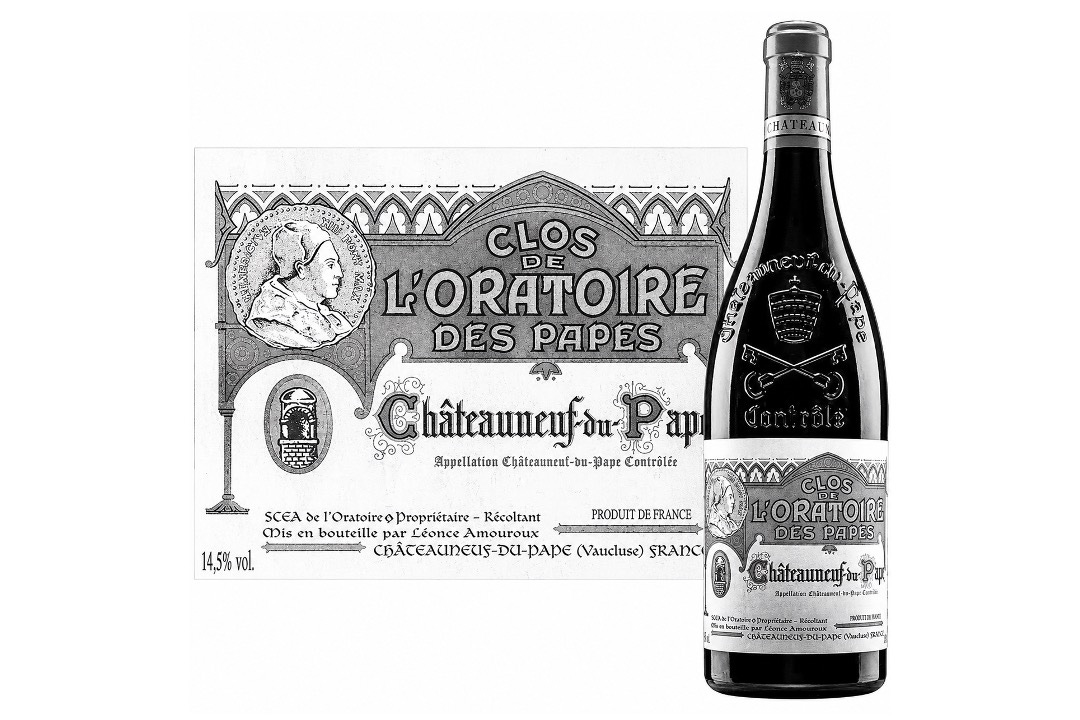
In French wine, labels are rarely mere decoration. At their best, they become a form of memory: a small rectangle of paper capable of holding a place, a family, an ambition and a particular idea of taste. Few examples illustrate this better than L’Oratoire des Papes, the Châteauneuf-du-Pape estate whose celebrated label has now reached its hundredth year with remarkable poise.
The estate has changed hands, grown in size and adapted its vineyard work to the expectations of a new century. The label, by contrast, has hardly moved. That is precisely its charm. Its Art Deco energy, radiant colour and architectural confidence still feel fresh, not because they chase modernity, but because they were conceived with clarity from the beginning.
From a Wedding Gift to a Châteauneuf-du-Pape Estate
The story begins in 1880, when Édouard Amouroux received an unusual wedding present: a two-hectare enclosed parcel in Courthézon, one of the historic communes of Châteauneuf-du-Pape. The site took its name from a nearby oratory, itself close to an eighteenth-century chapel dedicated to Saint Mark.
It was the next generation that gave the domaine its more enduring public face. Léonce Amouroux founded Maison Amouroux and registered both the name and the label of L’Oratoire des Papes. Printed by lithography, the original design brought together several elements that remain central to the estate’s identity: the oratory, Pope Benedict XIII, and a graphic style that balances ecclesiastical reference with the bold confidence of the 1930s.
The result has proved unusually durable. Bottles from vintages such as 1949, 1959 and 1971 have survived with their labels intact, preserved today in the estate’s collection. Their survival is more than archival curiosity. It confirms how strongly the visual identity of L’Oratoire des Papes was established from the start.
L’Oratoire des Papes Today: Continuity Without Stagnation
Since its acquisition in 2000 by Maison Ogier, part of the Advini group, the estate has expanded significantly. Under the direction of François Miquel, L’Oratoire des Papes now covers 38.5 hectares in the Châteauneuf-du-Pape appellation.
The vineyard remains rooted in the varieties that define this southern Rhône cru. For the red wines, Grenache, Syrah, Cinsault and Mourvèdre form the core of the work. Whole-bunch vinification and co-fermentation are used as part of a style that seeks texture and integration rather than heavy-handed extraction. For the white wines, the palette includes Grenache Blanc, Roussanne, Clairette, Bourboulenc, Piquepoul and Picardan, giving the estate a broad range of expression beyond the appellation’s red-wine reputation.
Technical director Édouard Guerin has also guided the domaine toward organic certification. The environmental approach extends beyond certification itself. Through a partnership with a nearby livestock farmer, the estate uses composted natural manure from sheep, horses and cattle, reinforcing a practical link between vineyard, village and surrounding agricultural life.
The Enduring Power of an Art Deco Wine Label
To replace the historic label would have been to misunderstand the estate. Instead, Maison Ogier has chosen to refine rather than erase. The Châteauneuf-du-Pape armorial bottle has been reinterpreted through a custom flacon, incorporating the original neck-band motif as a screen-printed detail.
The essential symbols remain: the oratory, the papal figure, and the name that has given the estate its identity for a century. This is not nostalgia for its own sake. It is a form of visual discipline. At a time when many wine labels compete for attention through novelty, L’Oratoire des Papes shows the quiet force of consistency.
The estate now distinguishes between L’Oratoire des Papes and Clos de L’Oratoire des Papes, the latter reserved for its most ambitious wines, including Les Chorégies. This division allows the house to honour its historic image while giving its finest parcel selections a more precise stage.
Les Chorégies: Châteauneuf-du-Pape with an Operatic Echo
The name Les Chorégies connects the estate to one of Provence’s great cultural institutions: the opera festival held in Orange, whose roots reach back to the nineteenth century. Set within the city’s ancient Roman theatre, the festival has long been associated with drama, voice and resonance.
The partnership behind Les Chorégies was established in 2000, shaped by Antoine Leccia, then head of Advini and a lover of opera. The wines are conceived as parcel selections rather than simple prestige cuvées. In red, they draw on old Grenache, Mourvèdre and Syrah. In white, Clairette and Bourboulenc provide a more luminous register.
The winemaking follows a restrained path: whole bunches, large 18-hectolitre foudres, limited intervention and extended macerations. The aim is not to create a louder Châteauneuf-du-Pape, but a more articulate one—wines with depth, breadth and a sense of controlled movement.
A Centenary Marked in Gold and Ink
For its hundredth anniversary, L’Oratoire des Papes has created a limited collector’s box. It includes either a 2024 red or a 2025 white, presented in a bottle screen-printed with fine gold, alongside a lithograph by the artist C215. Production is limited to 6,000 examples, with distribution through selected wine merchants.
Such a release could easily have become a purely decorative exercise. In this case, it feels more coherent. A domaine whose identity has always depended on the meeting of wine, image and place is celebrating with a bottle and a print: two objects made to be seen, held and remembered.
The Lesson of L’Oratoire des Papes
The appeal of L’Oratoire des Papes lies in a productive tension. The estate respects its history without allowing history to become a museum. Its label remains almost unchanged, yet its viticulture has evolved. Its name evokes papal Châteauneuf-du-Pape, yet its current work is concerned with precision, environmental care and a more contemporary reading of southern Rhône wine.
For lovers of French wine, that balance is worth noting. Heritage is not valuable simply because it is old. It matters when it continues to give shape to the present. A century after its label first appeared, L’Oratoire des Papes still understands that distinction.