
Loïc Pasquet, Archaeologist of Bordeaux Taste
A portrait of Loïc Pasquet, the winemaker behind Liber Pater, who is reviving ancient grape varieties, own-rooted vines, and the distinctive taste of Bordeaux terroir in Landiras.
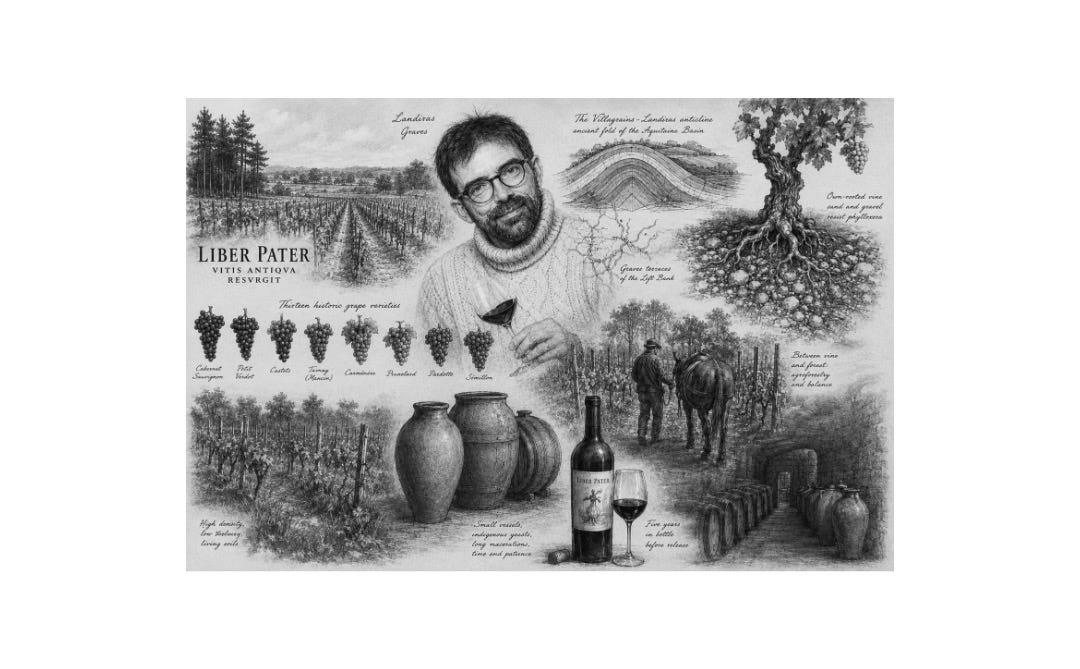
In Landiras, on an unusual Graves terroir, Loïc Pasquet is not simply trying to produce a great wine. With Liber Pater, he is attempting to recover what Bordeaux may have lost by changing its roots, grape varieties, planting densities and, ultimately, its taste. It is a radical, scholarly and sometimes provocative undertaking that forces the region to question its own modernity.
In Bordeaux, the past is often an asset. It takes the form of a classification, a neoclassical façade, a label transformed into a coat of arms, or a history polished enough to serve commercial interests. For Loïc Pasquet, however, the past is neither decoration nor a heritage-based sales argument. It is an accusation, a riddle and a programme of work.
The winemaker behind Liber Pater does not merely ask what pre-phylloxera Bordeaux tasted like. He raises a far more unsettling question: what remains of a wine when its roots, plant material, planting densities, farming methods, yields and tasting criteria are all changed at the same time? When the name, appellation and reputation are preserved, but almost everything that once carried the grape into the glass is altered, is it still the same wine?
Originally from Poitou, Pasquet settled near Landiras in the Graves region in 2006 with an explicitly stated ambition: to recover the taste of Bordeaux’s fine wines from before the phylloxera crisis. From the outset, the project was based on own-rooted vines, historic regional grape varieties and a form of viticulture inspired by agroforestry and permaculture.
The aim, in his view, is not to make a wine that resembles an old Bordeaux. It is to restore the conditions that might allow a place to speak again, without the intermediary of rootstock or the corrective grammar of modern winemaking.
The Past as a Work in Progress
It would be convenient to describe Loïc Pasquet as a traditionalist, but it would also be inadequate. A traditionalist preserves what has been handed down. Pasquet arrived after the break had already occurred. He must rediscover lost practices, reconstruct relationships between grape varieties and soils, relearn how to cultivate own-rooted vines and interpret agronomic principles that are no longer self-evident to contemporary winemakers.
His undertaking therefore has less to do with preservation than with experimental archaeology. Archives, old ampelographic treatises and pre-phylloxera accounts serve as his maps; the vineyard parcel is his laboratory. He proceeds through observation, failure, comparison and repeated attempts.
His lack of formal qualifications in viticulture or oenology, which he openly acknowledges, is presented not as a virtue of ignorance but as freedom from answers that have already been formulated. In his understanding of the profession, the winemaker is less a manufacturer than a “midwife”: someone who intervenes sparingly, but at precisely the right moment, after observing for a very long time.
This demanding approach explains the size of the estate. When Pasquet took possession of it, the vineyard covered approximately seven hectares. The removal of grafted vines, particularly Merlot, gradually reduced the area to slightly under four hectares, before the replanting of ancient varieties began to bring it back towards its original size.
For Pasquet, six or seven hectares already represent a limit. Beyond that, he argues, any individual knowledge of the vines and of the land’s microscopic variations becomes illusory.
The resulting rarity is not pursued as a prestige strategy. It follows from an artisanal conception of excellence: a small area, low yields, a great deal of human presence and direct control over every operation. Here, smallness is not picturesque. It is methodological.
Before the Château, the Place
The choice of Landiras was not accidental. The localities of Barreyre and Pessilla, where Liber Pater is situated, appear in old legal documents and historic editions of the Féret wine guide. At the end of the nineteenth century, several small producers there were still making red and white wines classified among the crus artisans, or “artisan growths.”
This mosaic of modest vineyards confirms that the Villagrains–Landiras anticline was a winegrowing area long before Pasquet reinvested in it. Its near-disappearance after phylloxera may have resulted as much from changes in mixed farming as from the difficulty of adapting grafted vines to the site.
The geology gives the location an almost mythological significance. The anticline is an ancient fold in the Aquitaine Basin whose Cretaceous core was pushed closer to the surface by the uplift of the Pyrenees. Tectonic movements are thought to have played a decisive role in the successive diversions of the proto-Garonne and in the deposition of the gravel that formed the winegrowing terraces of Bordeaux’s Left Bank.
Villagrains–Landiras may therefore be regarded as one of the points of origin of Bordeaux’s great gravel system.
Liber Pater occupies the summit of this structure, in a clearing surrounded by forest. The soils combine quartz sand, small rounded pebbles and acidic humus. In places, there is also a layer of alios—an iron-cemented sandy hardpan—resting on gravel or clay.
Poor in organic matter but rich in mineral components, these soils display major variations in permeability, capillarity and heat conduction over extremely short distances. This heterogeneity lies at the heart of Pasquet’s reasoning: a grape variety should not merely be chosen for an estate. It should be planted precisely where its growing cycle and rooting habits can find their balance.
Water completes this architecture. The water table is close to the surface during winter, before dropping in summer. The gravelly soil rapidly drains rainfall, while the roots can reach deeper layers when drought sets in.
In late summer, the days can be hot and the nights very cool. Wind limits the development of grey rot on the red grapes. In Pasquet’s view, this temperature range allows late-ripening varieties to approach physiological maturity slowly, deep into autumn.
This vision involves a hierarchy of places. Not all soils are interchangeable, not all exposures deserve the same grape varieties, and not all territories can claim the ability to produce great wine.
Far removed from the contemporary discourse that often presents terroir as a moral virtue or merely as closeness to nature, Pasquet restores its discriminating dimension: terroir chooses, limits and orders.
The Own-Rooted Vine: Hypothesis and Manifesto
The defining feature of Liber Pater is the presence of sand and gravel at the surface. Pasquet believes that these formations prevent phylloxera from becoming permanently established because the insect’s tunnels collapse in the sand. This conviction allows him to plant Vitis vinifera directly on its own roots.
Here, the own-rooted vine is more than a viticultural choice. It is the philosophical centre of the project.
For Pasquet, rootstock is not a neutral support. It alters vigour, water uptake, rooting depth and the rhythm of the vine’s vegetative cycle. He believes that a grafted vine responds more abruptly to climatic variations, absorbs more water, produces larger berries and may yield a more diluted wine.
By contrast, he describes the development of an own-rooted vine as more fluid, less vulnerable to seasonal shocks and more naturally adapted to a place when it originated there or has been selected there over a long period.
His observations regarding flavour are equally emphatic. He attributes more intense and floral aromas, a softer texture, greater liveliness, lower alcohol levels, more elegant tannins and a clearer savouriness to own-rooted vines.
In his vocabulary, flowers gradually replace fruit, minerality replaces varietal character, and persistence replaces immediate power.
These propositions should not, however, be transformed into scientific certainties through the force of their coherence alone. Historical accounts contain considerable hostility and scepticism towards grafting, and Pasquet’s own observations are strongly argued, but the relationships between rootstock, soil, plant physiology and sensory expression remain extraordinarily complex.
Questions concerning terroir, the constituents of wine and minerality are difficult to isolate and inevitably involve an element of subjectivity.
Pasquet does not claim that all European vineyards could be replanted without rootstock. He acknowledges that, on soils favourable to phylloxera, including certain clay-limestone terrains, grafting remains the only proven form of protection.
His argument is different: where geology makes own-rooted vines possible, why should their study and cultivation be ruled out?
It is within this space, between radical conviction and open-ended experimentation, that Liber Pater becomes truly interesting. The estate cannot by itself prove what Bordeaux tasted like in 1855. It does, however, set in motion once again a question that the agronomic success of rootstock had largely brought to a close.
Recovering the Bordeaux Orchestra
The reconstruction of the French vineyard after phylloxera changed more than its roots. It also simplified its varietal composition. Clonal selection, productivity requirements and production regulations gradually favoured a small number of varieties that were easy to propagate, consistent and compatible with modern practices.
Yet the Bordeaux of the eighteenth and nineteenth centuries possessed a diversity that is almost unimaginable today. A survey conducted in 1784 listed 52 red varieties and 50 white varieties in the Bazas subdelegation alone. Nineteenth-century treatises continued to mention numerous Cabernets, Verdots, Mancins, Carménères, Pardottes, Castets and other varieties that are now marginal or forgotten.
Pasquet selected thirteen of them. The reds include the Cabernets, Petit Verdot, Castets, Tarnay—the name he prefers to Mancin—Saint-Macaire, Carménère, Prunelard and Pardotte. The whites are centred on Sémillon and Sauvignon, complemented by Camaralet Blanc and Lauzet.
The objective is not to create a decorative conservatory. It is to restore the historic function of the Bordeaux blend: expressing the diversity of a place through a plurality of interpreters.
Pasquet does not advocate random mixed planting. Each grape variety is planted in its own block, in the location that suits it according to slope, exposure, moisture and subsoil.
He thus reverses the modern logic according to which rootstock supposedly makes it possible to plant almost any desired variety almost anywhere. In his system, the winemaker does not sovereignly choose the grape variety. He attempts to understand which variety the place itself has chosen.
His musical analogy summarises this conception with considerable elegance: Burgundy, devoted to the dialogue between one principal grape variety and a particular parcel, would be Chopin; Bordeaux and the art of blending would be Mozart.
The image suggests no hierarchy. It distinguishes between two aesthetics: the soloist and the orchestra, variation upon a single voice and the search for harmony among several timbres.
In this orchestra, Merlot is the great absentee. Between 2006 and 2010, Pasquet removed the Merlot vines present on the property. He believes that the variety, which was not widely planted on the Left Bank in the past, ripens too early on his gravel soils and contributes primarily richness and sweetness.
The judgement is deliberately provocative and cannot be extended to the whole of Bordeaux, where the finest expressions of Merlot are indisputable. It nevertheless reveals Pasquet’s refusal to accept that a variety which has become economically and technically dominant must necessarily be appropriate for every soil.
A Vineyard Built Against the Machine
The landscape of Liber Pater is the visible consequence of this philosophy. Planting densities can reach 20,000 vines per hectare, recalling certain practices from before mechanisation.
The vines, derived from local massal selections or material supplied by conservatories, carry few bunches per plant. Production relies on the number of vines rather than on the crop load imposed on each one.
This density effectively excludes the use of a modern straddle tractor. The vines are trained very low, supported by stakes and planted in staggered rows so that light and air can circulate around the vegetation.
When passage through the vineyard is required, a mule replaces the tractor. For Pasquet, the vine should not be adapted to the width and weight of a machine; the method of working should be adapted to the needs of the vine.
The parcels are arranged in blocks separated by joualles, strips of land once devoted to cereals, fodder crops or fruit trees. Hedges and water sources reintroduce ecological continuity.
Agroforestry is therefore not added to the vineyard as a peripheral environmental measure. It reconstructs an agricultural landscape in which vines cease to exist as an isolated monoculture.
The soil is worked as shallowly as possible. Pasquet takes the forest as his model: organic matter remains at the surface, where fungi and earthworms help transform it.
Grass is not treated as a permanent enemy. It is controlled at certain times and then retained during the growing season to protect the life of the soil.
The estate uses neither chemical fertilisers nor artificial inputs in the vineyard. Sulphur and copper are still applied against powdery and downy mildew, together with plant-based preparations, particularly those made from horsetail.
Although Pasquet observes lunar cycles and tides, he avoids claiming the biodynamic label, which he believes has been too readily devalued through overuse.
This form of viticulture is not designed to be spectacular. It is slow, demanding in human labour and profoundly resistant to expansion.
It overturns the conventional promise of agricultural progress: rather than asking how to produce more with fewer people, Pasquet asks how a small area can be better understood by devoting more human presence to it.
In the Cellar: Extending Rather Than Correcting
The grapes are harvested by hand, and yields are approximately 20 hectolitres per hectare. The harvest date is not determined solely by the relationship between sugar and acidity.
Pasquet tastes the berries, chews the seeds, examines the skins and waits for physiological maturity. The grapes are picked early in the morning so that they enter the cellar at a naturally low temperature, without the systematic use of mechanical refrigeration or dry ice.
Vinification is carried out separately by parcel, sometimes on an almost microtopographical scale. Each batch corresponds to a grape variety, an orientation and a particular type of subsoil.
There are no vast stainless-steel tanks. The grapes are placed in barrels or stoneware amphorae, in vessels with a maximum capacity of eight hectolitres. Alcoholic and malolactic fermentations are carried out by indigenous yeasts.
For the reds, maceration lasts approximately two months. Pasquet avoids pump-overs, which he believes would expose the wine to excessively forceful contact with oxygen.
Instead, he gently punches down the cap in the amphorae or rolls the barrels. Extraction is not conceived as a pursuit of colour or power, but as the slow infusion of what the small berries and their thick skins can release without harshness.
The wines are then matured for several years in new barrels or amphorae, on their fine lees and with little racking. Pasquet seeks the wine’s natural protection and the gradual integration of its tannins rather than oxygen exposure intended to accelerate its development.
The whites, dominated by Sémillon and complemented by Sauvignon, Lauzet and Camaralet, are also fermented in barrels or amphorae and remain on their lees for an extended period. No chaptalisation is practised.
The overall approach is old-fashioned in its underlying economy—small volumes, manual harvesting, indigenous yeasts and lengthy maturation—but it is not a folkloric reconstruction.
The clearest proof lies in the closure. Pasquet rejects natural cork because of its variations in permeability and the risk of contamination, choosing instead an ArdeaSeal technical closure.
The gesture is revealing: the man who replants forgotten grape varieties on their own roots does not hesitate to adopt a contemporary material when he believes it will preserve the wine more faithfully.
Liber Pater is therefore not a museum of the nineteenth century. It represents a selective modernity. Pasquet rejects technology when it transforms or standardises; he accepts it when it safeguards the transmission of the flavour he seeks.
A Wine Rescued from Immediacy
Not every vintage becomes Liber Pater. When the material is not considered exceptional, the estate’s principal cuvée is not produced.
Since 2008, lots that fail to reach the required standard have gone into Denarius, the estate’s second wine. From 2015 onwards, the age of the plantings made it possible to incorporate all thirteen grape varieties into the composition of Liber Pater.
Bottling is performed by hand in a specially designed bottle, with the label for each vintage entrusted to the artist Gérard Puvis. The wine is released only after five years in bottle, in addition to its lengthy maturation beforehand.
The aim is to break with the instant judgement of the en primeur system and with the idea that a great Bordeaux should be immediately understandable.
Time is not an abstract value here. It contributes to the form of the wine.
Pasquet believes that the most obvious varietal aromas, such as those of Sauvignon, dominate during the early years and then fade, allowing the depth of Sémillon to emerge.
In the reds, the darkest-coloured and latest-ripening varieties are not intended to create a youthful display, but to construct an architecture that will gradually unfold.
This position runs counter to much of contemporary wine consumption, in which wine is frequently assessed within months of its birth and then sought for its immediate fruit.
Pasquet reintroduces a less comfortable idea: some wines are not difficult to understand in their youth because they are defective, but because they have not yet become themselves.
What Flavour Is He Really Seeking?
Pasquet’s vocabulary reveals a sensory ideal, although no description can replace direct experience of the wines.
The colour should retain blue and purple nuances in its youth before moving towards garnet and then orange. The bouquet evokes violet, hyacinth, crushed rose, raspberry and almond.
The body is defined by sap, tension, creaminess and a flowing, undulating length. This vocabulary is deliberately opposed to that of opulence, vanilla, demonstrative oak, sweetness and alcohol.
On the Villagrains–Landiras anticline, Pasquet expects both reds and whites to combine flowers, spices and a fresh finish. The recurring terms are pedigree, elegance, savouriness, verticality and aromatic persistence.
These are not descriptors of a soft or insubstantial wine. The substance is present, but it must never come to a standstill beneath its own weight.
Geo-sensory tasting is the logical extension of this aesthetic. It gives priority to mouthfeel, consistency, suppleness, liveliness, savouriness, length and digestibility rather than to the accumulation of aromatic comparisons.
The nose is not denied, but it ceases to be the supreme judge. The wine is tasted as matter in motion, capable of making the mouth water and of revealing an origin more clearly than a grape variety.
The Fruitfulness of a Heresy
Loïc Pasquet is a man of forceful arguments. His views on Merlot, grafting, the INAO, clonal selection and interventionist winemaking do not seek consensus.
At times, he himself simplifies the very things he accuses the system of having oversimplified. Contemporary Bordeaux viticulture cannot be reduced to a flavourless industry, just as every wine made from grafted vines cannot be condemned as an unfaithful translation of the soil.
The INAO and post-war regulations did not merely standardise production. They also fought fraud, false claims of origin and practices that were sometimes dangerous.
Research institutions and conservatories have likewise played an essential role in preserving genetic resources, historic varieties and viticultural knowledge.
Yet judging Pasquet solely by his rhetorical excesses would miss the essential point.
Liber Pater’s strength lies in making visible again decisions that modernity had turned into assumptions: why graft when the soil might make grafting unnecessary? Why plant the same variety on different types of land? Why reduce dozens of grape varieties to a few familiar names? Why adapt the vine to the machine? Why confuse technical consistency with identity? Why decide a wine’s potential before it has even begun to age?
The name Liber Pater summarises this ambition. In Roman mythology, Liber is associated with vines, wine and fertility and, through his identification with Dionysus, with a form of liberation.
Pasquet also sees it as the image of a second birth: that of an ancient winegrowing site and of grape varieties that history had almost erased.
Can the taste of the period before phylloxera truly be recovered? Probably not in the sense of an exact reproduction. The climate has changed, as have the landscapes, cellars, vessels, expectations and palates. No wine can carry us intact back through time.
Yet Liber Pater may achieve something more valuable than reconstruction. It demonstrates that the past can be used not to repeat, but to reopen the future.
It restores to Bordeaux a memory based not on the prestige of brands or the permanence of classifications, but on the diversity of roots, grape varieties, soils and practices.
Pasquet contrasts the living silence of a vineyard filled with insects, birds and grasses with the dead silence of soil emptied by chemicals.
“A joyfully silent vine will make a living wine,” he says.
The sentence might seem almost too beautiful. Yet it contains the whole of his undertaking: listening to a place for long enough that the wine, at last, no longer needs to speak loudly.
Copyright © Wilma Baltus. All rights reserved.