

Why Lafleur Is Leaving the Pomerol AOC for Vin de France
Lafleur’s move to Vin de France reveals how climate pressure is testing the limits of even Bordeaux’s most prestigious appellations.
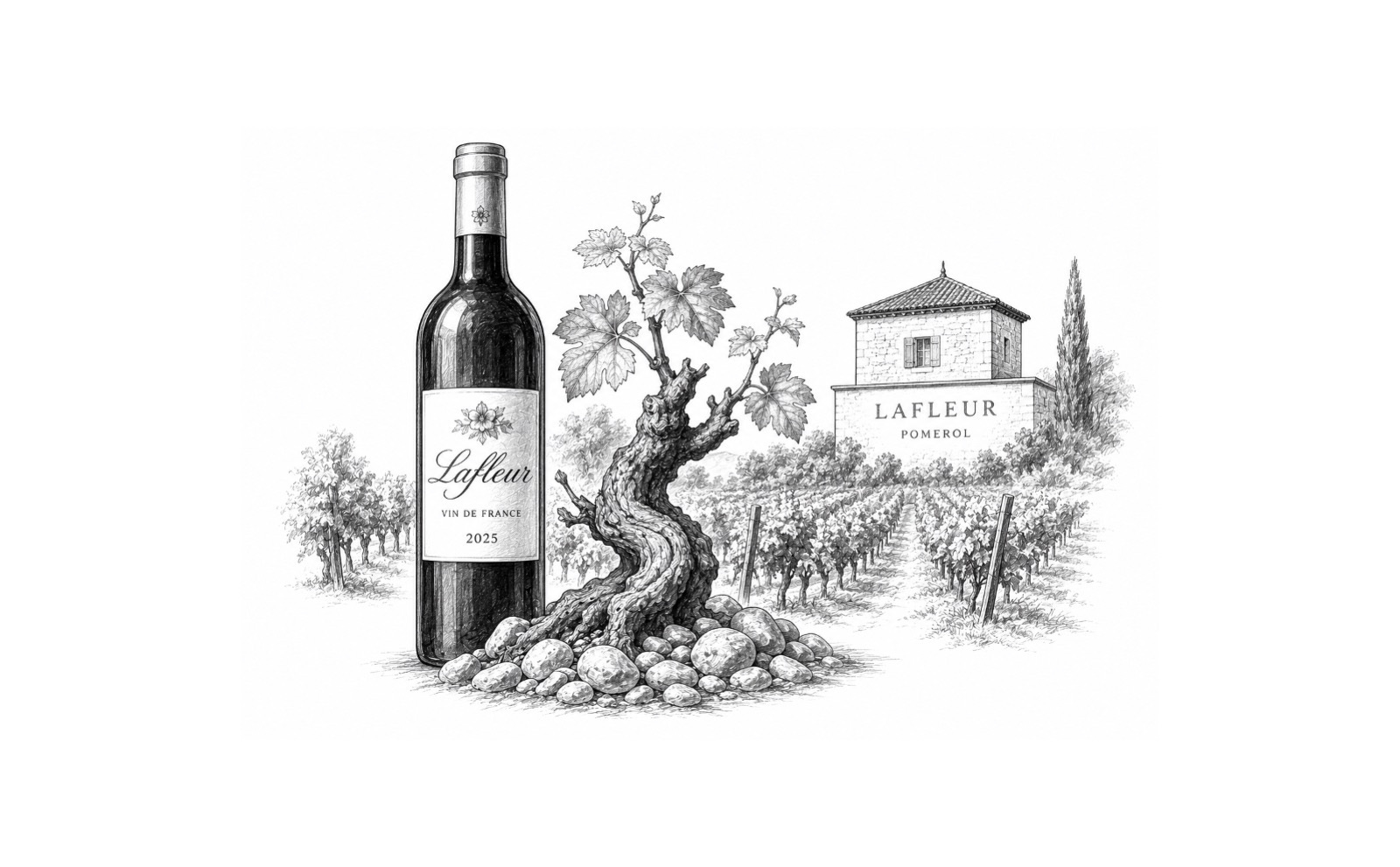
Lafleur is leaving the Pomerol AOC at a moment that might otherwise have invited celebration. In 2025, the Guinaudeau family marked four decades since Jacques and Sylvie Guinaudeau assumed responsibility for this small, revered property on Bordeaux’s Right Bank. Yet the anniversary also became the dividing line between two eras.
From the 2025 vintage onwards, Lafleur and the family’s other wines are set to appear as Vin de France rather than under their established appellations. The decision is not a rejection of Pomerol’s terroir, nor an attempt to distance the estate from its history. It arises from a more practical concern: the belief that the climate is changing faster than appellation regulations can accommodate.
For a property whose reputation rests so firmly on place, relinquishing the name of that place is a striking act. It also raises a larger question for French wine. When the methods considered necessary to preserve a vineyard’s identity fall outside the rules designed to protect that identity, which should take precedence?
A Family History Rooted Beyond Pomerol
The Guinaudeau story did not begin among the celebrated gravel and clay soils of Pomerol. Its deeper roots lie at Grand-Village in Mouillac, within the Fronsadais countryside, where a mixed farm had combined livestock, cereals and vines since the seventeenth century.
By the end of the 1970s, the property required renewal. Following the death of Jacques Guinaudeau’s father, Jean, responsibility eventually passed to Jacques, the youngest of five children. He was joined by Sylvie Graille, whom he had met while studying agricultural management and who came to Bordeaux for the harvest before making the region her home.
Together they rebuilt Grand-Village gradually. They improved the wines, restored buildings, re-established a working team and developed direct sales. Viticulture became increasingly important as they recognised the potential of the estate’s clay-limestone soils.
Pomerol, however, was already part of the family landscape.
The property now known as Lafleur entered the Guinaudeau family line in 1872, when it was acquired by Henri Greloud, Jacques’s great-great-grandfather. Greloud preserved the vineyard through the phylloxera era, improved drainage and maintained a significant proportion of Cabernet Franc—traditionally known in the region as Bouchet—alongside Merlot.
During the decades after the Second World War, Lafleur was tended by Henri Greloud’s descendants, the sisters Thérèse and Marie Robin. After Thérèse’s death, Marie asked Jacques Guinaudeau to take over the property under a lease. Jacques and Sylvie arrived in 1985 to find a vineyard in need of attention, but also one possessing an unusual combination of gravel and clay within the heart of Pomerol.
Learning Lafleur One Vintage at a Time
Lafleur’s present stature can make its development appear inevitable. The reality was less straightforward.
The Guinaudeaus encountered difficult years almost immediately. The challenging 1987 vintage led to the creation of Les Pensées, drawn from a more clay-dominant section of the property. The strong sequence of 1988, 1989 and 1990 was followed by the far less generous conditions of the early 1990s.
These vintages reinforced a principle that would guide the family’s work: a distinguished terroir offers possibilities, not guarantees.
During the late 1990s, the team began an extensive study of Lafleur’s 4.5 hectares. Soil pits were used to examine changes in gravel, clay and subsoil across a vineyard whose modest surface area conceals considerable geological variation. The goal was not to impose a single method on the property but to understand how each part of it behaved.
A decisive moment arrived after Marie Robin’s death in 2001. The Guinaudeaus purchased Lafleur the following year, accepting substantial financial exposure in return for the freedom to determine its future.
Their son Baptiste subsequently joined the estate with his partner, Julie. Both brought formal viticultural training, experience beyond Bordeaux and a willingness to question inherited assumptions. Under the two generations, Lafleur became not simply a property to maintain but a continuing research project.
Why Lafleur Is Leaving the Pomerol AOC
The decision to leave the Pomerol AOC emerged from more than a single hot vintage.
By the early 2010s, the Guinaudeaus had become increasingly concerned about the effects of repeated heat and drought on their vineyards. Their fear was not merely that vines would produce less fruit. Prolonged water stress could alter the balance of the wines themselves, diminishing the freshness, aromatic definition and tannin texture that the family regarded as central to Lafleur.
The vintages of 2019 and 2022 intensified those concerns. The estate produced wines it considered successful, but only while navigating severe periods of hydric stress. To the family, these seasons appeared less like isolated challenges than previews of conditions likely to recur.
They concluded that preparing Lafleur for future extremes would require greater freedom in several areas of vineyard management. Planting density, the use of shade and precisely controlled irrigation all formed part of the discussion. Some of the measures they wished to consider were incompatible with the existing rules of the appellation.
During the summer of 2025, the family announced that Lafleur would leave the Pomerol AOC. The decision was extended across the wider range, moving the Guinaudeau wines outside their respective appellations and into the Vin de France category.
This was not an impulsive withdrawal. It followed years of research into soils, plant material and the vineyard’s response to heat. The family appears to have decided that retaining the name Pomerol was less important than retaining the character they believed Pomerol’s terroir should produce.
Rebuilding Resilience Through the Vine
One of Lafleur’s most important responses to climate change has centred on its own genetic inheritance.
Rather than relying solely on commercially available plant material, the estate undertook a large-scale programme of massal selection. Around 8,000 individual vines were assessed before the selection was narrowed to 54. Many were descended from old Bouchet vines planted during the 1930s.
The resulting material is preserved in an ampelographic collection at Grand-Village. Its purpose is practical as well as historical. Older vine populations may contain genetic diversity that can help future plantings respond more successfully to heat, drought and disease.
This work reflects a broader distinction in the estate’s philosophy. Climate adaptation is not treated simply as a question of irrigation or technological intervention. It also involves root systems, plant genetics, planting choices and the relationship between a vine and a particular soil.
The same thinking informed two wines developed beyond Lafleur itself. Les Perrières explores Bouchet grown on limestone, while Les Champs Libres examines Sauvignon cultivated on clay soils, using selections drawn from Sancerre and Sauternes. Both are conceived around the expression of a site rather than the expectations attached to a conventional regional style.
Precision Irrigation, Not Routine Watering
Irrigation is among the most sensitive subjects in French viticulture. Its critics fear that regular watering can encourage higher yields, weaken the connection between vines and seasonal conditions, or place further pressure on limited water resources.
The Guinaudeaus’ approach is framed differently. Their objective is not to remove every sign of drought, but to intervene selectively when water stress threatens to halt the vine’s physiological activity.
The family has developed its own water supply rather than drawing on the public network. One source comes from a deep domestic borehole within the Lafleur vineyard. The larger reserve is associated with a 14-hectare parcel of low-lying land beside the Dordogne, where more than 1,000 cubic metres can be collected in relation to the tide.
Application is highly targeted. A specially designed straddle tractor places measured amounts of water beneath individual vines rather than distributing it broadly across the surface. The intention is to help plants pass through the most severe dry periods while avoiding excessive vigour or indiscriminate use.
Whether such methods will become more widely accepted within Bordeaux’s appellations remains uncertain. At Lafleur, however, the family considers them necessary to safeguard continuity of style under increasingly volatile conditions.
What Is Lost—and Preserved—Outside the Appellation
The Pomerol name carries immense cultural and commercial value. For many buyers, it provides an immediate geographical reference and a degree of confidence about origin. Lafleur’s departure therefore entails a genuine sacrifice, even for a wine whose individual identity is exceptionally strong.
Vin de France offers considerably more freedom, but it cannot communicate terroir in the same formal way as an appellation. The label category may identify the wine’s country, grape varieties and vintage under the applicable rules, yet it does not replace the geographical promise contained in the word Pomerol.
Lafleur is better placed than most estates to withstand that loss. Its name is recognised independently of the appellation, and the Guinaudeaus have spent years developing a tightly controlled international distribution network. Rather than relying exclusively on the traditional Bordeaux marketplace, they work with a group of ambassadors in numerous countries, enabling closer oversight of distribution and stronger relationships with intermediaries and clients.
Even so, the decision should not be mistaken for a simple exercise in brand confidence. It is a choice between two kinds of legitimacy: the collective authority of an appellation and the estate’s conviction that it must act independently to protect its vineyard.
Lafleur, Pomerol and the Future of Appellation Rules
France’s appellation system was created to defend origin, identity and shared standards. Its strength lies in collective discipline: producers agree to work within defined geographical and technical boundaries so that a regional name retains meaning.
Climate change complicates that compact.
Rules written for an earlier climatic pattern may become increasingly difficult to reconcile with hotter, drier seasons. Yet changing them too quickly could also weaken the identity they were intended to preserve. Every proposed adaptation must therefore negotiate between flexibility and coherence.
Lafleur’s response is unusually decisive because the estate has chosen not to wait for that negotiation to be resolved. It has placed responsibility for the wine’s future above the security of the appellation name.
That path will not be available to every producer. Few estates possess Lafleur’s international reputation, limited production or direct control over distribution. For less established properties, losing an appellation could mean losing the principal marker by which buyers understand and value the wine.
Nevertheless, Lafleur’s move gives the debate greater urgency. When one of Pomerol’s most admired estates concludes that the rules no longer provide sufficient room for adaptation, the issue can no longer be dismissed as theoretical.
A Return to the Wider Farm
The family’s plans extend beyond the vineyards of Pomerol.
At Grand-Village, the Guinaudeaus intend to reintroduce elements of mixed farming, beginning with horses. This revival is not presented as nostalgia for a rural past. It reconnects the property with the agricultural diversity that defined it long before wine became its dominant activity.
The estate has also developed a team of 28 people drawn from varied backgrounds. Whatever their eventual role, each member is expected to spend an extended period working in the vineyard. The principle is clear: decisions about wine should remain anchored in direct knowledge of the vines.
That culture of shared observation may prove as important as any technical measure. Climate adaptation is unlikely to be solved by a single variety, machine or vineyard practice. It will require continuous attention, experimentation and a willingness to revise established methods.
A Bordeaux Identity Beyond the Label
Lafleur’s departure from the Pomerol AOC does not make the wine less connected to Pomerol. Its soils, vines and history remain exactly where they were. What changes is the legal language through which that origin is communicated.
The paradox is difficult to ignore. The Guinaudeaus are relinquishing an appellation in order, as they see it, to preserve the qualities that made the appellation meaningful in the first place.
Their decision may eventually prove visionary, overly cautious or simply specific to Lafleur’s circumstances. It is too early to know. What it already demonstrates is that the relationship between terroir and regulation is entering a more unsettled period.
French wine has always depended on continuity, but continuity should not be confused with immobility. At Lafleur, loyalty to place now means accepting the risks of a different classification—and trusting that the identity of a vineyard can remain legible even when the familiar words disappear from the label.