

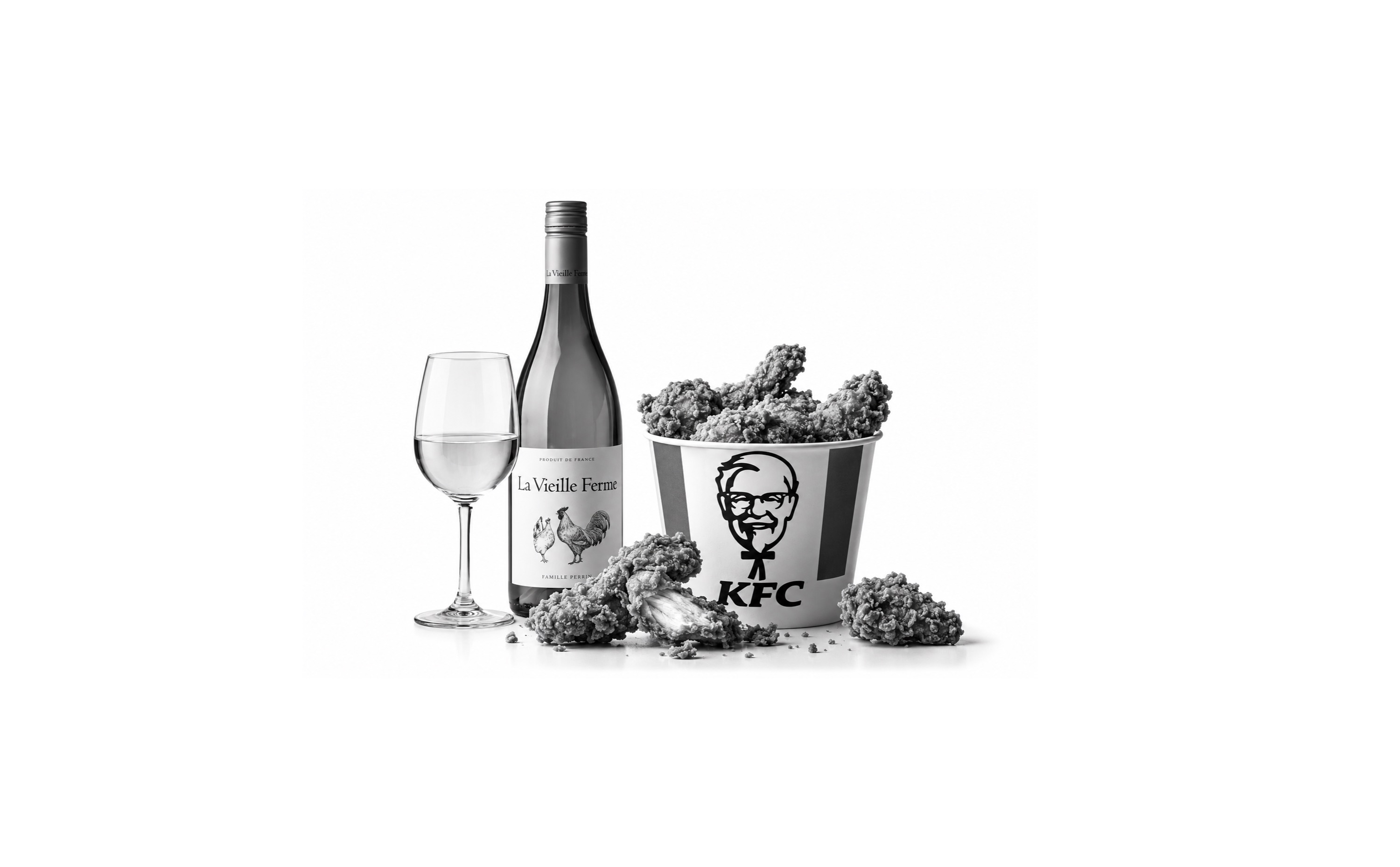
Fine wine and fast food rarely appear in the same conversation. Yet in London, French wine producer La Vieille Ferme and American fried chicken giant KFC brought the two together in a collaboration that challenged familiar ideas about what belongs in a wine glass—and what deserves a place beside it.
For four days in late August, a temporary wine bar called Coq au Vin took over Kachette Annex in Shoreditch, one of East London’s most creative neighbourhoods. Rather than the customary cheese boards or carefully composed restaurant dishes, visitors encountered a menu built around KFC chicken, each preparation matched with wines from La Vieille Ferme.
The unlikely partnership was more than a playful culinary experiment. It also offered a glimpse of how French wine is finding new relevance among younger consumers, often far removed from the traditions that have shaped wine appreciation for generations.
Fried Chicken and French Wine: An Unexpectedly Logical Pairing
At first glance, the combination seems deliberately provocative. Fried chicken belongs to the world of casual eating, while French wine still carries associations with elaborate dinners, established rituals and a certain degree of ceremony.
But from a gastronomic perspective, the distance between the two is smaller than it appears.
The richness of fried chicken, its crisp coating and its characteristic saltiness create interesting possibilities for wine pairing. Fresh acidity can counterbalance the fat, while a sparkling wine brings an additional sense of lightness through its bubbles. Rosé, meanwhile, can offer a versatile middle ground between freshness and fruit.
The London pop-up explored these possibilities through several combinations. Popcorn chicken was served with sparkling rosé, chicken wings accompanied red wine, and KFC’s original recipe tenders were paired with either white wine or rosé.
Not every pairing needs to follow the conventions of classical French gastronomy to make sense. Sometimes, the essential question is simply whether the wine and food complement one another.
That idea was at the heart of the experiment.
La Vieille Ferme: A French Wine with an Unusual Following
The choice of La Vieille Ferme was hardly accidental.
Created in 1970 by the Perrin family, the brand has established an international presence through approachable wines rooted in the winemaking traditions of southern France. The family is also associated with Château de Beaucastel, one of the celebrated estates of Châteauneuf-du-Pape, and the rosé brand Miraval.
Within this wider portfolio, La Vieille Ferme occupies a different position. Its appeal rests less on prestige or rarity than on familiarity, consistency and an uncomplicated relationship with everyday drinking.
In Britain, that identity has acquired an unexpected cultural dimension.
The brand has become widely known on social media as “Chicken Wine”, a nickname inspired by the poultry illustrated on its labels. What began as an informal alternative to a French name has evolved into a recognisable identity among British wine drinkers.
The association with KFC therefore had a certain logic. Both brands already shared a visual connection with chickens, and La Vieille Ferme’s popularity among younger consumers provided a natural starting point for an unconventional collaboration.
It was an opportunity to bring an established French wine into a setting where many visitors might not ordinarily think of ordering a glass.
What the KFC Collaboration Reveals About Wine Culture
Beyond the novelty of the menu, the event reflected a broader shift in how wine is discovered and enjoyed.
For previous generations, an interest in wine often developed through family traditions, restaurant experiences, specialist publications or recommendations from established critics. These influences remain important, particularly for those seeking a deeper understanding of regions, grape varieties and producers.
Yet they no longer define the only route into wine.
Social media has introduced a different form of discovery, one in which labels, informal recommendations and shared experiences can influence purchasing decisions as much as conventional wine expertise.
La Vieille Ferme’s popularity in Britain illustrates that change. A brand with more than half a century of history has found renewed visibility through a nickname and an online audience that may have little connection to traditional wine culture.
The Coq au Vin pop-up turned that digital enthusiasm into a physical experience. According to the organisers, tickets sold out in less than a week, with thousands of visitors attending over the four-day event.
Such interest does not necessarily mean that fried chicken and wine will become a permanent fixture of British dining. It does, however, suggest an appetite for experiences that remove some of the formality surrounding wine.
Can Casual Pairings Change the Way We Enjoy French Wine?
There is an important distinction between making wine accessible and making it simplistic.
French wine has an extraordinary depth of history, geography and craftsmanship. Understanding why a particular wine tastes the way it does can be one of the great pleasures of drinking it. None of that knowledge becomes less valuable simply because a bottle is opened alongside something as ordinary as fried chicken.
Indeed, unusual food pairings can encourage curiosity. A refreshing white wine enjoyed with a salty, richly textured dish might prompt someone to think more carefully about acidity. A sparkling rosé could demonstrate how texture and freshness interact with food. An approachable red might become the first step towards discovering the wines of the Rhône Valley.
The value of these experiences lies not in replacing traditional wine education, but in offering another way into it.
There is also a useful reminder here for experienced enthusiasts. The quality of a pairing is not determined by the prestige of the ingredients, nor does every bottle require an elaborate occasion.
A wine can be taken seriously without demanding that the moment itself be solemn.
A Different Future for French Wine?
The meeting between La Vieille Ferme and KFC was undoubtedly designed to attract attention. Its unusual format, playful identity and social media appeal made it an effective promotional exercise.
Nevertheless, the collaboration raises a question that extends beyond marketing: how can French wine remain culturally relevant without losing the characteristics that make it distinctive?
Part of the answer may lie in accepting that consumers increasingly encounter wine on their own terms. Some will begin with a famous appellation, others with a recommendation from a friend, and still others with a bottle whose label has become unexpectedly familiar online.
The path into wine matters less than the curiosity it inspires.
For La Vieille Ferme, the London experiment demonstrated how a long-established French wine brand can participate in contemporary food culture without abandoning its origins.
And for wine lovers, it offered a small but worthwhile reminder: the next memorable food and wine pairing may arrive somewhere entirely unexpected.