
How France Decided What Could Be Called Wine
Phylloxera, chemistry, commerce and law remade the meaning of wine—and helped forge modern ideas of authenticity, origin and terroir in France.
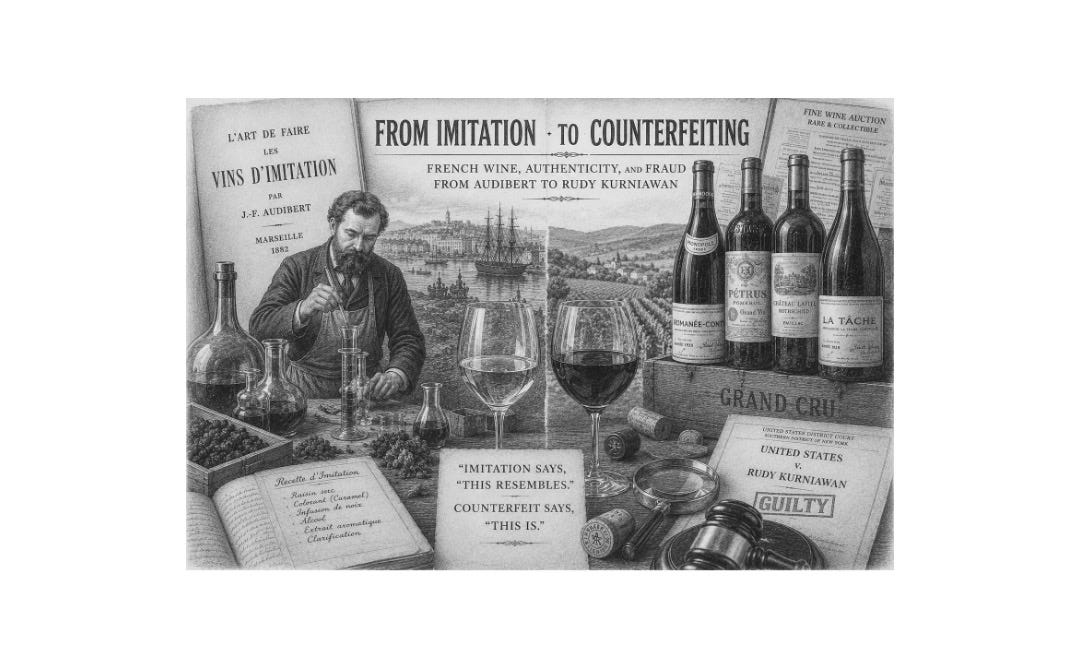
At the end of the 19th century, the most unsettling question in French wine was not whether a wine was fine, sound, or pleasurable. It was whether the liquid in the glass had the right to be called wine at all.
A cask might contain fermented grape material, yet not fresh grapes. Its contents might have been stretched with water, strengthened with alcohol, darkened with colourants, stabilised with plaster-derived sulphates, or coaxed into fermentation by adding sugar to exhausted marc. Such a drink could be cheap, wholesome, intoxicating, commercially useful—and still, depending on who was speaking, be condemned as a counterfeit.
This ambiguity lies at the heart of Alessandro Stanziani’s study of wine falsification in France between 1880 and 1905. His subject is not simply a gallery of ingenious frauds. It is the historical construction of the boundary between “true” and “false” wine: a boundary negotiated among growers, merchants, chemists, doctors, civil servants, legislators, and consumers.
The deeper significance of the controversy is that falsification did not arise against an already settled definition of wine. Rather, the definition familiar to us today emerged from the struggle over falsification. Questions of health, competition, taxation, consumer information, and agricultural identity became entangled in an argument over what wine was—and what it ought to be.
A crisis measured in hectolitres
Many of the techniques that scandalised fin-de-siècle France were not inventions of the industrial age. Fortification, sugaring, and colouring had ancient precedents and had become increasingly common during the 18th century. What changed in the final quarter of the 19th was their scale, their technical sophistication, and the economic pressure behind them. Advances in chemistry and agronomy made it possible to modify wine with a precision and in quantities previously unknown.
The immediate catalyst was phylloxera. French wine production had reached 84.5 million hectolitres in 1875. By 1880, it had fallen to about 30 million; in 1889, it touched a low of 23.4 million. This collapse coincided with expanding towns, growing mass consumption, and a widening gap between demand and legitimate supply. Production would eventually recover and stabilise at around 60 million hectolitres during the Belle Époque, but the intervening decades shattered established commercial relationships and opened the market to substitutes.
Scarcity did more than increase prices. It liberated the technical imagination.
The simplest response was mouillage: the addition of water to wine. In Paris during the early 1880s, official octroi records indicated annual consumption of slightly less than five million hectolitres. Once watering was taken into account, one contemporary estimate placed the real quantity nearer six million. The operation deceived the buyer, but it also defrauded the state, particularly when highly alcoholic wine was transported into the city, taxed, and then diluted before retail sale.
Water alone was not necessarily a danger to health. The greater risk came from what followed it. To restore the diluted liquid’s appearance and strength, merchants or retailers might add vegetable colourants, coal-tar derivatives, alcohol, or other chemicals. Detection was difficult, especially when foreign wine, French wine, water, and colouring substances were combined only after the cask had passed through the fiscal barrier.
More ambiguous was plâtrage. The practice had long been used in the warmer vineyards of southern France, Spain, and Italy to protect wines against spoilage. In regions lacking good cellars, or where sudden temperature changes threatened unstable musts, treatment with plaster and the resulting sulphates could be understood as a method of preservation.
During the 1880s, however, the purpose began to change. Plâtrage was increasingly used to accelerate vinification and give wine greater brilliance, colour, and apparent solidity—the effects that older practice had obtained through ageing and repeated racking. The same cellar operation could therefore represent prudent husbandry in one setting and commercial falsification in another. Its meaning depended less on the substance itself than on the intention, dosage, market, and conception of quality attached to it.
Sugaring occupied an equally porous frontier. Water sweetened with sugar could be poured over marc to produce a second fermentation, while weak first-press wines could be enriched to raise their alcoholic strength. The practice spread rapidly in the 1880s, when the phylloxera and mildew crises coincided with falling sugar prices. Sugar manufacturers wanted new outlets; wine producers wanted volume. Once improved methods made the resulting drink more palatable, annual production of second-cuvée sugar wines averaged approximately 1.4 million hectolitres between 1885 and 1890.
The most striking alternative dispensed with fresh grapes altogether.
Wine without the vineyard
Making wine from dried grapes was disarmingly straightforward. A commonly described recipe called for 100kg of dried fruit to be mixed with 400 litres of water at around 20°C. Fermentation began quickly and continued for six to eight days, sometimes assisted by a little sugar. The resulting drink generally contained between 7 and 10 percent alcohol, although its low tannin content made it unsuitable for long keeping.
What appeared to be an improvised answer to phylloxera soon developed into a substantial industry. French imports of dried grapes rose from roughly eight million kilograms before the crisis to 50 million in the early 1880s and 65 million in 1885. Much of the fruit came from Turkey and Greece, with Corinth grapes particularly valued for vinification.
The geography of production was revealing. In the Seine department, dried-grape wine was made in large establishments serving the expanding Parisian market. In the Hérault, production was likewise concentrated in industrial-scale facilities, while in the Gironde it was more often undertaken by small merchants and growers. “Artificial” wine was therefore not the monopoly of an alien industrial class standing outside viticulture. It could be made by urban manufacturers, rural producers, négociants, or vineyard owners themselves.
During the second half of the 1880s, when French vineyard production fluctuated between 25 and 30 million hectolitres, dried-grape and sugar wines together represented between five and six million hectolitres. Watering, impossible to calculate nationally, may have added another million hectolitres in Paris alone. For a period, drinks later described as adulterated accounted for somewhere between one fifth and almost one third of the national total.
These were not marginal curiosities hiding in the darker corners of the trade. They were structural responses to a national shortage.
Nor were they necessarily unfit to drink. Dried-grape wine was frequently judged safer than chemically coloured or badly manipulated ordinary wine. The central dispute was therefore not always about toxicity. It was about naming, disclosure, taxation, agricultural competition, and the right to benefit from the prestige attached to the word wine.
A state divided against itself
Such quantities might seem to demand a clear official definition. Instead, they exposed the French administration’s inability to speak with one voice.
In 1883, the Consultative Committee of Public Hygiene distinguished between plâtrage, which it regarded as potentially injurious, and dried-grape wine, which it did not consider more dangerous than wine fermented from fresh grapes. The committee initially favoured disclosure: manufacturers should state the composition of their product or risk prosecution for misleading the buyer.
Yet it drew back from the practical consequences. If French producers were required to identify dried-grape wines while equivalent products entered from Italy or Spain as ordinary wine, domestic industry would be disadvantaged. Public health, consumer information, and protection of national production pointed in different directions. The committee ultimately recommended leaving the manufacture of dried-grape wine free.
The fiscal authorities adopted an even broader conception. For the Contributions indirectes, any beverage that possessed the character, name, and customary use of wine could be taxed as wine, whether it came from fresh grapes, dried grapes, marc, or some other process. Its concern was not ontological purity but efficient revenue collection.
Customs officials reached the opposite conclusion. Artificial wines, watered wines restored with alcohol, and similar mixtures could be treated as spirits, subject to the duties imposed on alcohol. Their priority was to prevent foreign alcohol from entering France disguised as wine. The same cask could therefore be “wine” to the domestic tax service and an alcoholic compound to the customs administration.
This was not a simple conflict between the state and the market. There was no singular state, just as there was no uniform market. Customs, tax officials, public-health committees, agricultural authorities, and the Ministry of Justice approached the liquid from different institutional positions. Each produced its own categories of fairness, risk, and efficiency.
The definition of wine shifted according to what the administration wanted to do with it: tax it, admit it across a frontier, protect a grower, prosecute a retailer, or safeguard a consumer.
When the laboratory entered the cellar
Science appeared to offer an escape from this confusion. A chemical analysis, unlike the competing assertions of growers and merchants, promised an objective verdict. But the laboratory did not arrive as a single, disinterested voice.
In 1885, the Ministry of Finance acknowledged that the accepted definition of wine was the fermented juice of fresh grapes containing only the alcohol naturally produced during fermentation. It also conceded that this definition could not be consistently enforced: analytical science had not yet found a reliable means of distinguishing naturally strong wine from weak wine strengthened by added alcohol. Even when experts began identifying certain samples as fortified, officials hesitated to act because the conclusions did not rest on methods regarded as scientifically incontestable.
The plâtrage controversy provided an even clearer illustration. The National School of Agriculture in Montpellier analysed 94 wines and conducted a small consumption experiment involving two groups of ten people. One group drank plastered wines, the other unplastered wines. After a month, the investigators reported no significant difference in health and concluded that plâtrage was not dangerous.
The result supported the position of southern producers for whom the practice was familiar and economically important. Parisian commercial interests then invoked the Montpellier findings in asking that the permitted sulphate level be doubled.
Gironde producers protested, and another commission was convened. Its investigators demonstrated that different analytical methods produced different measurements of tartar-related compounds. They chose the method they believed better suited to the sweet wines of Barsac and Sauternes, thereby protecting the claim that Bordeaux wines generally respected the legal limit while differentiating them from the wines of the Midi.
Science did not simply fail to settle the argument. It entered an argument whose terms were already shaped by regional interests, administrative mandates, sample selection, and rival conceptions of quality. Analytical knowledge became indispensable, but it could not be separated from the institutional question being asked.
A method designed to detect danger did not necessarily answer a question about commercial deception. A test of chemical composition could not, by itself, determine whether an old regional technique had become a fraudulent one.
The law of names
The decisive change came when legislators began to move away from asking whether an imitation was drinkable and towards asking what could legally be sold under the unqualified name of wine.
The law associated with Senator Griffe, debated in 1888 and adopted in 1889, established the principle that no product could be sold under the simple designation vin unless it came from the fermentation of fresh grapes. Drinks made from dried grapes, marc, sugar, or other materials were placed in a separate category.
The final wording was subtler than an outright prohibition. Another fermented drink could still be sold using the word wine, provided that the term was immediately followed by an indication of the materials from which it had been made. A mixture of ordinary wine and an artificial beverage required the same disclosure.
This apparently semantic formula was revolutionary. It converted fresh grapes from one possible raw material into the defining essence of the product. The law did not simply regulate how a beverage was made; it organised a hierarchy of names. Wine stood alone. Its substitutes required qualification.
The legislation also strengthened the movement from civil liability towards criminal responsibility. Earlier jurisprudence had often turned on whether the buyer knew the composition of the drink. A declared falsification might not be prosecutable as fraud. The Griffe law treated certain additions—including glucose, molasses, and colouring materials—as falsification in themselves. Liability could attach to those who made, possessed, or sold the product knowing it to be falsified, regardless of whether the consumer had been informed.
This shift marked the beginning of a distinction that would become fundamental: deception concerning the identity or designation of a product was not quite the same offence as altering its composition. One concerned the words attached to the wine; the other concerned the liquid itself.
The price of authenticity
The triumph of “natural wine” was not socially neutral.
Supporters of regulation sometimes acknowledged that dried-grape wine could provide a useful and relatively wholesome beverage for working people, particularly while genuine wine remained scarce and expensive. The objection was not always to its existence, but to its being sold under a name and at a value that did not belong to it.
Critics of prohibition went further. Consumers with limited incomes, they argued, could not simply replace an inexpensive substitute with good vineyard wine. If deprived of dried-grape beverages, they might turn instead to stronger and more dangerous alcoholic drinks. In this view, the informed consumer was capable of choosing among products of different composition and price; state intervention risked mistaking economic constraint for ignorance.
Behind the legal argument lay two rival conceptions of consumption. In the first, information was sufficient: once buyers knew what a drink contained, they would make rational choices and reward quality. In the second, information alone could not overcome misleading presentation, entrenched habits, price differences, or the unequal bargaining power of producer, retailer, and consumer. Public authority was therefore required not merely to disclose the market but to structure it.
The controversy anticipated a dilemma still familiar in discussions of wine regulation. Should authenticity be protected principally through transparency, leaving the informed buyer free to choose? Or does the integrity of a category require the exclusion of products that resemble it too closely, even when their composition is openly stated?
In late-19th-century France, the second position gradually prevailed.
From the reputation of the merchant to the reputation of the place
Not all wine regions supported the new legislation for the same reason.
The Chamber of Commerce in Mâcon feared that honest merchants would be made responsible for falsifications they had no practical means of detecting. Contemporary analysis could not always establish what had been added or where in the chain it had been added. Special labels separating natural wine, sugar wine, and dried-grape wine might give natural wine an official guarantee, but they could also advertise the extent of French manipulation to foreign buyers and discredit the national trade as a whole.
The Gironde adopted a different view. Its fine wines did not compete directly with the cheapest dried-grape beverages, but Bordeaux growers feared something more corrosive than price competition. Artificial wines were also being made or assembled within the Gironde. They could leave Bordeaux carrying the reputation of the region, even when their composition and methods had little relationship to its established practices.
The danger was collective. If merchants used imported wine, dried grapes, alcohol, and other materials to imitate recognised Gironde styles, the resulting damage would not fall solely on the individual house responsible. It would diminish confidence in Bordeaux as a place of origin.
Here, the argument against falsification moved beyond the reputation of an individual producer or merchant. It attached reputation to a delimited space. A regional name became a common asset that could be harmed by the conduct of any operator allowed to use it.
The appellation d’origine contrôlée did not yet exist. Nevertheless, its grammar was becoming legible: a collective geographical reputation, a defined agricultural raw material, accepted production techniques, and public authority capable of excluding products that threatened the identity of the whole.
Southern growers arrived at the same coalition by a different route. Producers in the Midi had invested in quantity and competed directly in the market for ordinary wine. Once French vineyards recovered and abundant natural wine again became available, dried-grape and industrial wines ceased to be emergency supplements and became unwanted competitors.
By the early 1890s, higher production, lower wine prices, and reduced transport costs made ordinary southern wine increasingly attractive to the large commercial houses that had previously dealt in substitutes. Growers and merchants who had once tolerated artificial wine now found common cause against it. The severe downturn in southern wine prices strengthened demands for its suppression.
Thus, the defence of authenticity united interests that otherwise had little in common: Bordeaux proprietors protecting fine-wine reputation, southern growers defending a mass market, merchants seeking stable categories, public-health reformers concerned about chemical additives, and administrators who wanted rules that could actually be enforced.
Prohibition by taxation
Once this coalition formed, artificial wine was defeated not by a single grand definition but by a succession of legal and fiscal constraints.
The law of July 1894 prohibited watering and fortification. In 1897, industrial dried-grape wine was removed from the fiscal regime applied to wine and subjected instead to the much heavier regime applied to alcohol. Production, circulation, and sale were not merely morally stigmatised; they were made economically unattractive.
The consequences were dramatic. Dried-grape wine had reached approximately 3.1 million hectolitres in 1890. Production then declined sharply, falling to roughly half a million hectolitres by 1894. The 1897 fiscal settlement ensured that the industry would no longer recover.
In 1900, the internal consumption duty on alcohol rose again, further increasing the tax paid on every hectolitre of dried-grape wine. The law of January 1903 confirmed the prohibition of plâtrage and required advance declarations for sugaring, while limiting the permitted quantity. A second measure prohibited the use of glucose in first fermentations and in the preparation of second wines from marc.
By this point, the economic background had been reversed. The phylloxera emergency had been overcome; France’s problem was no longer insufficient supply but overproduction. The same artificial wines that had once filled an urgent shortage now aggravated a surplus.
The general anti-fraud law of 1905 completed the transition. It addressed attempts to deceive buyers about the nature, substantial qualities, composition, species, or origin of merchandise. It also anticipated regulations concerning marks and inscriptions identifying geographical origin and regional appellations.
The accompanying legal reasoning clarified the distinction between two kinds of misconduct. Tromperie concerned the false designation of a product and depended upon bad faith. Falsification concerned an alteration of composition—watering or illegal plastering, for example.
The law was not yet the complete architecture of modern French wine regulation. But its foundations were in place: protected denomination, controlled composition, declared origin, administrative inspection, and the possibility of criminal sanction.
Authenticity as a settlement
It is tempting to read this history as the eventual victory of real wine over counterfeit wine, nature over chemistry, and the vineyard over the factory. That interpretation is too simple.
The techniques under dispute did not possess immutable moral meanings. Plâtrage could be a traditional protection against spoilage before becoming a means of accelerating production and improving appearance. Sugar could compensate for difficult vintages, create a second wine from marc, or support industrial manufacture. Dried-grape wine could be a practical answer to national scarcity, an affordable drink for poorer consumers, or a threat to vineyard prices and regional reputation.
What counted as falsification depended on economic circumstances, declared composition, dosage, intended effect, commercial presentation, and the institutional authority making the judgement.
The modern definition of wine as a natural or agricultural product was therefore not simply discovered in the grape. It was institutionalised through a period of crisis in which phylloxera, urban demand, agrochemistry, unstable commercial networks, and the expanding state disturbed older conventions.
Fine-wine regions helped transform the reputation of individual agents into the reputation of a product associated with a place. Protecting that reputation required the normalisation of certain characteristics and the exclusion of techniques regarded as incompatible with the region’s identity. The state, in turn, was asked to make the collective reputation enforceable.
Mass producers in the Midi wanted exclusion for another reason: industrial substitutes destabilised the ordinary-wine market and weakened the contractual relationships on which large-scale production depended. Public officials found that standardisation made inspection easier and gave scientific expertise a more coherent role. Consumer protection, agricultural politics, commercial reputation, and administrative convenience converged.
The resulting definition of “true wine” was neither a timeless inheritance nor a purely scientific fact. It was a settlement—one sufficiently powerful to make its historical contingency almost invisible.
That may be the most resonant lesson of the period. Authenticity in wine is not the absence of human intervention. Every wine is the result of choices, techniques, and conventions. Authenticity begins when a society decides which interventions belong to wine’s legitimate tradition, which must be disclosed, and which place the liquid outside the category altogether.
Modern French wine emerged from that decision. Its moral vocabulary—truth, naturalness, provenance, loyalty, and terroir—was fashioned not only in vineyards and cellars, but in laboratories, customs offices, courtrooms, parliamentary chambers, and the contested marketplace of the fin de siècle.
Copyright © Wilma Baltus. All rights reserved.