

How French Wine Began: From Etruscan Amphoras to Monastic Vineyards
The 1,500-year story of how Greeks, Romans, Celts and monasteries transformed ancient Gaul into the foundations of French wine.
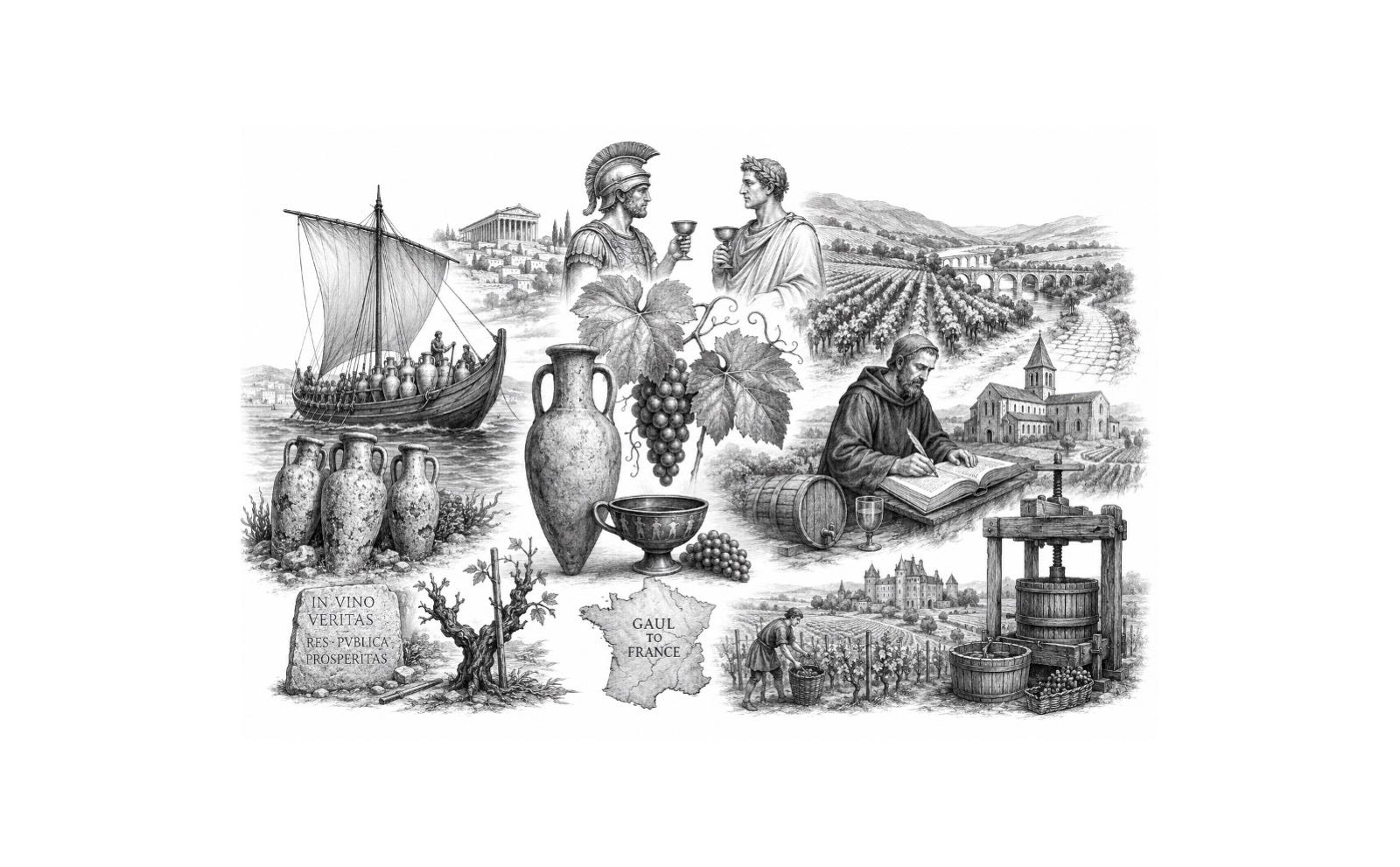
France and wine now seem almost impossible to separate. Bordeaux, Burgundy, Champagne, the Rhône and the Loire are not merely geographical names: they are shorthand for centuries of viticultural prestige. Yet the history of French wine begins with a striking paradox. When wine first arrived on the territory that would one day become France, there was no France — and, as far as the surviving evidence shows, there was no local wine industry either.
Around 2,500 years ago, the Celtic populations of ancient Gaul drank beer made from cereals, along with water and, probably, mead. Wild grapevines grew in parts of the country, but there is no evidence that the Celts were turning those grapes into wine before Mediterranean traders and settlers arrived. French wine, in other words, began as an import.
The transformation that followed was extraordinary. Etruscan merchants brought wine across the Mediterranean. Greek settlers established vineyards around Massalia, modern Marseille. Roman expansion spread viticulture along rivers and trade routes into regions that would later become some of France’s most celebrated appellations. Christianity gave wine an unparalleled ritual importance, while bishops, aristocrats and monasteries helped preserve and extend vineyards after the collapse of the Western Roman Empire.
By around 1000 CE, the essential foundations had been laid. Wine had become an agricultural product, a commercial commodity, a marker of status, a religious symbol and a deeply embedded part of social life. The story of how that happened is, in many ways, the first chapter in the history of France itself.
Before French Wine: A Land of Beer Drinkers
The earliest history of wine in France is not really French at all.
The people living in ancient Gaul before Mediterranean colonization cultivated barley, wheat and other cereals and fermented them into beer. They also made mead from honey. Wine belonged to another cultural world: the Mediterranean civilizations of the Greeks, Etruscans and Romans.
That difference mattered because wine was never merely a drink in the ancient world. For Greek and Roman elites, it was closely associated with civilization, sophistication and social rank. Beer-drinking peoples such as the Celts could therefore be dismissed as culturally inferior.
Such judgments tell us more about Greek and Roman prejudices than about Celtic society, but they had lasting consequences. Wine accompanied trade and colonization. As merchants and settlers moved westward, so did amphoras, vines, drinking rituals and ideas about what wine represented.
The beginning of French wine was therefore not simply an agricultural development. It was a cultural encounter.
The Etruscans Bring Wine to Ancient France
The first known wines to reach the Mediterranean coast of ancient France came not from Greece or Rome, but from Etruria in central Italy — roughly the territory of modern Tuscany.
Etruscan wine production was established by around 800 BCE following contact with the Phoenicians, and by approximately 625 BCE Etruscan merchants were shipping wine to ports along the coast of Gaul.
Archaeology gives this trade remarkable physical immediacy.
A shipwreck near Grand Ribaud Island, east of Toulon, dates from somewhere between 525 and 475 BCE. The vessel sank with roughly 1,000 amphoras in its hold. Together they could have carried around 40,000 litres of wine — roughly equivalent to 50,000 modern 750 ml bottles.
For historians of wine, amphoras are invaluable. Their shapes varied according to place of manufacture, allowing archaeologists to trace trading networks. Many survived underground or underwater long after wooden containers would have decomposed.
Chemical residues inside amphoras found in and around southern France also provide clues about what ancient wine was actually like. Researchers have identified indicators associated with grapes, as well as tree resin and herbs including rosemary, basil and thyme. Ancient wine could therefore be preserved, flavoured or aromatized in ways that would feel distinctly unfamiliar to most modern drinkers.
These ceramic vessels were the dominant containers for transporting wine until wooden barrels increasingly replaced them around the second century CE. Their survival has left an archaeological record of the first great wine trade into what would eventually become France.
Marseille and the Greek Revolution in French Wine
The Etruscan advantage did not last.
Around 600 BCE, Greek settlers from Phocaea in Anatolia founded Massalia, the city we now know as Marseille. It became the most important Mediterranean port in the region — and wine was fundamental to its economy and culture.
The Greeks did not regard wine as an occasional luxury. It was part of everyday life, religious practice and elite sociability. Settlers therefore needed dependable supplies, and Mediterranean trading networks expanded rapidly to meet demand.
The Celtic population soon became part of that market, particularly its wealthier members.
The scale of the trade could be astonishing. One excavated ship carried approximately 10,000 amphoras, potentially containing as much as 400,000 litres of wine — around half a million modern bottles. The source estimates that Greek merchants may have shipped approximately 10 million litres of wine into ancient France every year through Massalia alone.
From the Mediterranean coast, wine travelled inland through commercial networks and along major waterways, particularly the Rhône and Saône.
But the Greeks did something even more significant than importing wine: they planted vines.
By around 525 BCE, amphoras were being manufactured locally in Massalia, compelling evidence that local wine production had developed. Archaeological sites in and around the settlement have also yielded grape seeds.
Farther west, at Lattara near modern Lattes and Montpellier, archaeologists discovered both grape seeds and a limestone pressing platform dating from approximately 425–400 BCE.
By around 500 BCE, wine was therefore being produced on the Mediterranean coast of ancient France. The earliest French vineyards had arrived.
And the geography is striking. Those Mediterranean plantings were the distant predecessors of the enormous Languedoc-Roussillon vineyard landscape that would emerge many centuries later.
Wine Becomes a Symbol of Status
Wine moved inland not simply because people liked its flavour. It also carried enormous symbolic value.
In Greek culture, elite men gathered at the symposium, a ritualized drinking occasion at which wine was normally mixed with water. Conversation, entertainment and drinking games accompanied the wine. How a person drank mattered almost as much as what he drank.
Wine could therefore distinguish rich from poor, Greek from foreigner, and supposedly civilized behaviour from barbarism.
Celtic elites appear to have adopted at least part of this prestige culture.
The spectacular burial of the so-called Vix princess in Burgundy contained one of the most striking pieces of wine equipment ever discovered from antiquity: a monumental Greek bronze krater more than 1.5 metres high and capable of holding over 1,000 litres.
A krater was normally used to mix wine and water, but the Vix example was so enormous that display and symbolism were probably more important than practical use. Alongside pitchers, cups and other luxury objects, it demonstrates the extraordinary prestige imported Mediterranean wine culture had acquired among parts of the Celtic elite.
Long before Burgundy became synonymous with fine wine, wine was already functioning there as a language of wealth and status.
Rome Turns Wine Into an Industry
The Greeks established viticulture in the south. The Romans transformed its scale.
Roman forces crossed the Alps into Gaul in 125 BCE, and Rome soon controlled the Mediterranean coastal territory stretching toward Spain. The province of Narbonensis emerged across much of what is now Provence and Languedoc-Roussillon, with Narbonne as its capital.
Initially, Roman Gaul remained an enormous market for imported Italian wine.
Amphoras from Italy have been found across France: near Narbonne, Toulouse and Nîmes, but also around Bordeaux, the Loire and towns much farther north. Some bear the name of Porcius, a wine merchant associated with Pompeii.
Between approximately 150 and 25 BCE, an estimated 12 million litres of Italian wine were shipped to Gaul each year.
That quantity was far greater than Roman colonists and soldiers alone could have consumed. The implication is clear: the Celtic population had become a substantial market for wine.
Bordeaux was already beginning to reveal the commercial advantages that would define its later history. Italian wine reached Toulouse and travelled down the Garonne toward Bordeaux, while some may then have continued onward to Roman Britain.
Centuries before the famous medieval Bordeaux wine trade with England, the geographical logic behind it was already visible.
From Italian Imports to Wine Made in Gaul
Rome eventually did more than sell wine to Gaul. Roman settlers planted vineyards of their own.
This did not happen without controversy. Roman authorities had reasons to protect Italian agricultural producers from provincial competition, and there were attempts to restrict vine growing outside Italy.
Yet viticulture advanced.
Gaillac, northeast of Toulouse, was probably one of the earliest important Roman-era wine centres. Its location was commercially ideal: the Tarn connected to the Garonne, opening access to Toulouse and Bordeaux.
The Rhône Valley was another early centre. Roman writers referred to vineyards around Vienne, close to areas now associated with Côte-Rôtie and Hermitage.
A dramatic event in Italy then showed just how far Gallic wine had progressed.
When Mount Vesuvius erupted in 79 CE, Pompeii and important vineyards in Campania were devastated. In the resulting shortage, wine from Gaul appears to have travelled in the opposite direction, with Gallic amphoras reaching ports and settlements around Rome.
It may have been one of the first significant export episodes in the history of French wine.
How Roman Vineyards Spread Across France
Viticulture tended to follow the same routes as commerce: roads where necessary, but especially rivers.
Transport was expensive. Vineyards therefore made economic sense near large population centres and navigable waterways.
Bordeaux had vines by the first century CE. By 380, the poet Ausonius could describe the city as already famous for its wine.
Burgundy appears in the surviving record later, but fourth-century references describe vineyards that were already old, suggesting cultivation had begun earlier. Vines were also established around Auxerre in the Yonne Valley.
The Paris region acquired vineyards by the fifth century.
In the Loire, evidence is more complex. Gregory of Tours referred to viticulture around Nantes only in the late sixth century, yet wine presses found near Saumur and Tours have been dated to the first and second centuries.
The result was one of Rome’s greatest contributions to European wine history. By around 500, when Roman power in Gaul had come to an end, wine production had been established in the territories that are today associated with Bordeaux, Burgundy, Champagne, Alsace, the Rhône and the Loire.
The map of French wine had not yet taken its modern form, but many of its defining regions were already cultivating vines.
Ancient Grapes and the Distant Roots of Bordeaux and Rhône Wine
Expanding vineyards northward created a new problem: vines suited to Mediterranean warmth did not necessarily perform well in cooler and wetter regions.
Growers had to find varieties capable of surviving different climates while ripening reliably enough to make acceptable wine.
Roman viticulture included grafting, selection and adaptation. Vineyards may also have contained multiple varieties planted together rather than the neatly separated blocks familiar from modern viticulture.
Two ancient grapes are particularly intriguing.
Biturica and the Bordeaux Connection
Biturica was widely cultivated around Bordeaux and was apparently well adapted to its wet, windy maritime climate.
The source identifies biturica as an ancestor of the carmenet family — the family that includes Cabernet Franc and Cabernet Sauvignon, two varieties fundamental to modern red Bordeaux.
The direct road from ancient biturica to a modern bottle of Médoc is neither simple nor short, but the genetic connection gives Roman Bordeaux a remarkable link with the region’s present identity.
Allobrogica and the Northern Rhône
Allobrogica flourished in the northern Rhône. Roman authors described it as a late-ripening black variety capable of handling cooler conditions and even remaining on the vine after early frost.
Its best-known wine was called picatum, associated with the resin-lined containers in which it was kept.
The precise identity of allobrogica remains uncertain. It may have been related to Mondeuse Noire. Because Mondeuse belongs within Syrah’s lineage, the ancient grape nevertheless forms part of the deeper viticultural history behind the northern Rhône.
Modern Côte-Rôtie and Hermitage therefore occupy landscapes where growers were already confronting questions of grape variety, climate and wine quality in Roman times.
The First Wine Regulations in Gaul
Where wine becomes economically important, regulation rarely remains far behind.
In 92 CE, Emperor Domitian ordered that half the vines in provinces outside Italy be removed and prohibited additional planting. One explanation was concern that too much agricultural land was being diverted from grain. Another is that increasingly successful provincial wines threatened Italian producers.
A further possibility is that vineyards were expanding onto land poorly suited to viticulture, creating low-quality wine that could not support the cost of long-distance trade.
Whatever the motivation, the decree represents an early example of governmental intervention in wine production — a theme that would reappear repeatedly throughout French wine history.
Its practical impact appears to have been limited. Vineyards continued spreading.
Legal conditions became more favourable in the third century. Emperor Caracalla’s edict of 212 extended Roman citizenship to almost all free inhabitants of the empire, opening vineyard ownership to many people who had previously been excluded.
Around 280, Emperor Probus repealed Domitian’s restrictions.
The law had caught up with a process already underway: Gaul was becoming a land of vineyards.
What Did Roman Wine Actually Taste Like?
Anyone imagining a Roman bottle tasting like present-day Bordeaux or Côte-Rôtie should be cautious.
Ancient wine occupied a very different sensory world.
Wine could contain honey, herbs, spices, salt water or resin. Higher-quality examples might be made from grapes that were partially dried before pressing, concentrating sugars, flavour and potential alcohol.
There was also a clear social hierarchy.
Wealthier Romans preferred wines with enough concentration to survive dilution with water. At the opposite end of the spectrum was lora, a weak drink made by adding water to the material left after better wine had been produced.
The source estimates that comparatively strong wines may have reached around 10–12% alcohol by volume, while much ordinary wine was perhaps closer to 7–8%. Lora might have contained only 2–3%.
Wine in Gaul was therefore not one product. It ranged from prestigious elite drink to something far more modest.
And beer did not disappear. It probably remained the most widely consumed alcoholic drink for much of the Celtic population.
The rise of French wine was an addition to an existing drinking culture, not an instant replacement for it.
Christianity Changes the Meaning of Wine
As Roman viticulture expanded, Christianity was spreading through Gaul.
The consequences for wine were profound.
Wine occupied an unusually important place in Christian scripture and ritual. The transformation of water into wine at Cana became Christ’s first miracle in the New Testament, while wine represented the blood of Christ in Communion.
For populations already accustomed to pagan traditions in which wine could have sacred associations — Dionysus in Greece and Bacchus in Rome being obvious examples — Christianity gave wine a new and exceptionally powerful religious identity.
The relationship between Christianity and viticulture developed gradually, but it became one of the most important forces in the continuation of French wine culture after Rome.
Bishops owned vineyards. Cathedrals acquired them. Monasteries planted them. Taxes and rents could be paid in wine. Travellers expected wine when receiving monastic hospitality.
Yet Communion alone cannot explain the scale of church wine production. Medieval Christians received Communion relatively infrequently, and only tiny quantities would have been needed for sacramental purposes.
Church vineyards were also supplying monks, guests, aristocratic visitors and commercial markets.
Wine was sacred — but it was also an everyday economic asset.
Did Monks Save French Wine After Rome?
One of the most persistent stories in wine history is that monks preserved European viticulture while invading “barbarians” destroyed Roman civilization around them.
The evidence presented in the source is considerably more complicated.
Germanic peoples certainly contributed to the political upheavals surrounding the collapse of the Western Roman Empire, but there is little reason to believe they systematically destroyed vineyards.
In some cases, the opposite occurred.
Visigothic laws imposed serious penalties for damaging vines. Vineyard cultivation continued in regions under new rulers. Vikings participated in wine commerce along northern river systems. Vineyards expanded in parts of the Seine, Yonne and Loire valleys.
The largest disruption probably came not from hostility toward wine but from the collapse of the integrated Roman political and commercial system.
When long-distance trade became less secure, wine-producing regions lost parts of their former markets. Bordeaux, for example, endured repeated political upheaval and conquest.
Yet viticulture survived.
In some regions it expanded. In Burgundy, forest was cleared for new vineyards. By the ninth century, greater political stability under the Carolingians helped long-distance trade recover.
The early medieval history of French wine is therefore less a story of destruction and rescue than one of adaptation and continuity.
Monasteries Become Major Wine Producers
That does not mean the monasteries were unimportant. Far from it.
Religious communities offered several advantages to viticulture. Their land was less vulnerable to fragmentation through inheritance, their institutional life could continue for generations, and their written records were more likely to survive.
The Benedictine tradition played an especially important role.
The Rule of Saint Benedict approached wine with a revealing mixture of acceptance and suspicion. Monks were permitted a moderate daily allowance if complete abstinence proved unrealistic. In regions where wine was unavailable, beer could substitute for it.
This tells us something essential about early medieval drinking culture: both beer and wine remained important.
Some monasteries eventually became substantial agricultural enterprises.
In 814, the Benedictine abbey of Saint-Germain-des-Prés near Paris controlled around 20,000 hectares of cultivable land, of which approximately 300 to 400 hectares were planted with vines.
Its directly managed vineyards produced roughly half a million litres annually, while additional wine arrived from tenants as rent and taxation.
Only a portion was needed by the monks and their guests. The rest could enter the market.
The figures also reveal something often obscured by romantic images of medieval monasteries: ordinary tenants themselves were producing and retaining large volumes of wine.
The medieval wine economy extended far beyond monastery walls.
The Church Was Not the Only Vineyard Owner
The survival of monastic records creates a historical trap.
Because monasteries preserved documents more successfully than many secular landowners did, church vineyards are more visible in the historical record. That does not necessarily mean they dominated vineyard ownership.
Aristocrats and other wealthy proprietors also maintained vineyards, both for personal consumption and for sale.
Wine was a fundamental element of hospitality. Serving distinguished guests without it could be almost unthinkable among the elite.
Wills occasionally reveal just how extensive secular vineyard ownership could be. In the sixth or seventh century, the Parisian aristocrat Ementrud distributed vineyard property among churches and numerous private beneficiaries, including an enslaved person whom she freed.
Many similar vineyards may simply have passed from one generation to another without leaving the documentary trail created by monasteries.
This distinction matters. The foundations of French wine were built not by one institution but by a network of growers, landlords, tenants, merchants, clergy and consumers.
Medieval Viticulture Was Surprisingly Resourceful
Monastic estates also demonstrate how little was wasted in vineyard agriculture.
Wine that spoiled could become vinegar. Unripe grapes could be pressed into verjuice, whose sharp acidity made it useful in food preparation. Grape seeds could serve as flavouring or provide oil. Vine leaves could feed cattle, while pruned wood could be burned as fuel.
Some practices described in the source would today fit comfortably under the language of sustainability and circular agriculture.
Medieval growers did not use that terminology, of course. Their incentive was practical economy.
A vineyard was not simply a source of wine. It was an agricultural system whose by-products could be useful throughout a rural household or estate.
Charlemagne, Champagne and a New Era of Stability
From the late eighth century onward, the Carolingian Empire restored a measure of political stability across much of western Europe.
That stability helped wine production and commerce recover.
Charlemagne himself became associated with several traditions in French wine history. He is said to have encouraged vineyard planting and to have given part of the hill of Corton in Burgundy to the abbey of Saulieu — land associated today with Corton-Charlemagne.
He also designated October as the month of the wine harvest in his calendar.
Carolingian regulations addressed winery hygiene and even attempted to influence production methods. One rule reportedly required grapes to be pressed rather than trodden by foot, although foot treading survived for many centuries.
The larger effect of Carolingian government, however, lay less in individual wine rules than in improved security and commercial stability.
Champagne was among the regions to benefit.
Important abbeys were founded there from the seventh century onward, and vineyards expanded around them. These were vineyards for still wine: the sparkling wine that would eventually define Champagne lay far in the future.
A decisive moment in the region’s prestige came in 816, when Charlemagne’s son Louis was crowned at Reims.
As Reims developed into the traditional coronation city of French kings, the wines of Champagne became increasingly associated with royalty and ceremony.
Long before bubbles transformed its identity, Champagne already possessed one of the most powerful marketing advantages in wine: proximity to power.
Wine, Feasting and the Problem of Drunkenness
The spread of vineyards had another consequence: medieval authorities increasingly had to confront excessive drinking.
Wine and beer were central to hospitality, feasting and collective life. Important political and social occasions were accompanied by communal drinking, and heavy alcohol consumption could even be treated as a sign of masculinity.
Church leaders repeatedly condemned the consequences.
Their concern was not necessarily drinking itself. Christianity could hardly reject wine outright when the drink occupied such an important place in scripture and ritual.
The target was excess.
Early medieval penitential manuals prescribed punishments for drunken behaviour, with stricter rules often applied to clergy than to laypeople. Bishops, monks and priests were expected to exercise greater discipline.
Some penalties required offenders to live temporarily on bread and water — a telling punishment in a society where beer and wine could form part of the normal daily diet.
That tension would persist throughout French history: wine celebrated as nourishment, medicine, culture and sociability on the one hand, while excessive consumption attracted moral, religious and eventually medical concern on the other.
By 1000 CE, the Foundations of French Wine Were in Place
The first 1,500 years of French wine history transformed the territory completely.
Around 500 BCE, the earliest known vineyards were clustered around Mediterranean settlements founded or influenced by Greeks. By the end of Roman rule, viticulture had spread into regions that would become Bordeaux, Burgundy, Champagne, Alsace, the Loire and the Rhône.
Wine had moved from imported luxury to local agricultural product.
It had become a traded commodity capable of competing with Italian wine, a symbol of elite status, an object of government regulation, a medicine, a religious substance, a form of rent and taxation, and a daily drink for significant parts of society.
The Roman world established many of the commercial and agricultural structures. Christianity strengthened wine’s cultural significance. Monasteries, bishops, aristocrats and ordinary growers carried vineyard culture through the fragmented centuries that followed Roman rule.
By around 1000 CE, growing political stability and population growth were creating the conditions for another major expansion.
The celebrated French wine culture familiar today was still centuries away. There were no modern appellations, no classified Bordeaux châteaux, no Burgundian grands crus and no sparkling Champagne.
Yet many of the themes that would define them were already present: regional identity, adaptation of grapevines to local conditions, competition between producers, government intervention, long-distance trade, religious patronage, prestige consumption and the persistent belief that wine expressed something larger than the drink itself.
French wine did not spring fully formed from French soil.
It arrived by ship, travelled in amphoras, followed rivers and armies, adapted to new climates, survived political collapse and found a powerful ally in the medieval church.
By the end of the first millennium, the vineyard had become part of the landscape.
The next thousand years would turn it into one of the defining symbols of France.