
Hail Damage in French Vineyards Deepens Fears for the 2026 Harvest
Mid-July storms have scarred vineyards from Beaujolais to Alsace, compounding drought pressure ahead of the 2026 harvest.
Hail Damage in French Vineyards Adds to a Difficult Growing Season
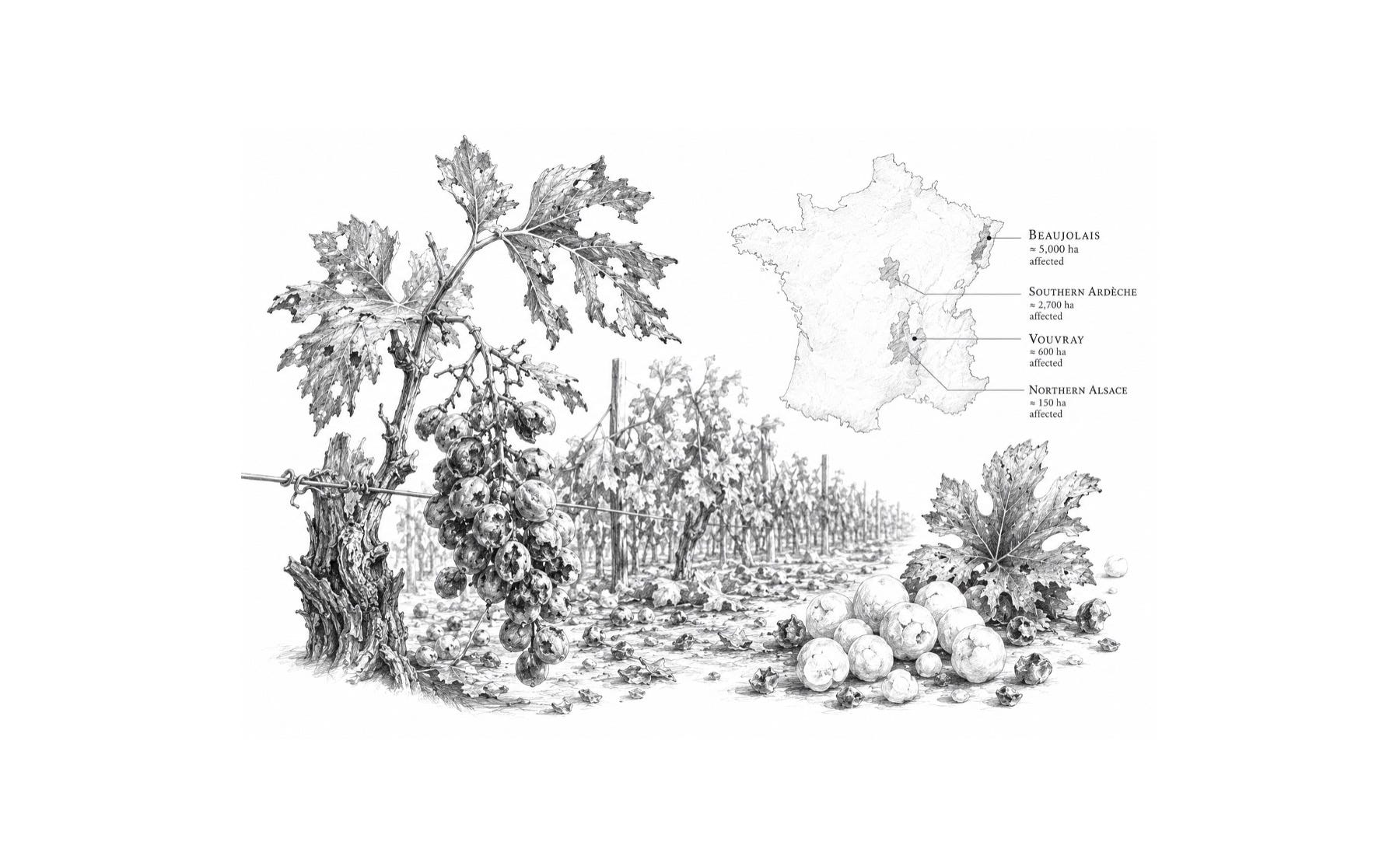
Violent storms in mid-July have left a broken trail across several French wine regions, damaging thousands of hectares only weeks before the 2026 harvest. Beaujolais, southern Ardèche, Vouvray and northern Alsace are among the areas most severely affected, while more isolated outbreaks have also been reported in Bordeaux, Cognac and Burgundy.
The figures are striking, but they reveal only part of the problem. Hail rarely falls evenly across a vineyard. One parcel may emerge with battered leaves and marked berries; another, only a few hundred metres away, can be almost entirely stripped. This unevenness makes early estimates difficult and leaves growers waiting to see how much damaged fruit will survive.
What gives the July storms particular weight is the wider condition of the vintage. Many vineyards were already under pressure from persistent drought and repeated periods of extreme heat. Hail has therefore not created a single, isolated setback. It has reduced crop potential at a moment when vines were already struggling to maintain it.
Beaujolais Bears the Largest Reported Impact
In Beaujolais, around 5,000 hectares are estimated to have been affected by the storm of 15 July. That represents roughly 40% of a vineyard extending over some 12,500 hectares in the Rhône and Saône-et-Loire departments.
The damage is not uniform. Around 4,000 hectares are believed to have suffered losses exceeding 50%, while some traditionally trained bush vines may have lost more than 90% of their potential crop.
Training systems appear to have influenced how individual rows received the hail. Trellised vines could sometimes retain fruit and foliage on the side less exposed to the storm, whereas the open form of traditional gobelet vines offered less shelter.
Even apparently intact bunches may not be safe. Hail can injure the stalk supporting the grapes, causing fruit to dry out or fall later. A vineyard that looks bruised but still productive immediately after a storm may consequently reveal more serious losses over the following days.
For Beaujolais growers, the storm arrived against an already troubling background. Dry soils and intense summer temperatures were reducing berry growth before the hail struck. The eventual yield will therefore depend not only on what the storm destroyed, but also on how the surviving vines respond to continued heat and water stress.
Why Hail Damage in French Vineyards Matters Beyond the Lost Grapes
The immediate concern is naturally the 2026 crop, yet severe hail can also affect the vine’s ability to prepare for the following season.
Leaves provide the energy required to ripen fruit and sustain the plant. Where the canopy has been completely removed, little can be done to restore the current harvest. Where some foliage remains, protecting it becomes essential. The vine still needs functioning leaves to continue ripening its grapes and to build the reserves that support growth when the buds open in spring 2027.
This is why the visual drama of shredded bunches tells only part of the story. The condition of the canopy may be just as important as the number of grapes left on the vine.
The next stages of the season will be decisive. Rain could encourage renewed growth in some parcels, although the value of new leaves will depend on how quickly they develop and how much time remains before harvest. Continued drought, by contrast, would place further strain on vines whose capacity has already been reduced.
Southern Ardèche Confronts Severe but Uneven Losses
The same storm system caused extensive damage in southern Ardèche, where approximately 2,700 hectares—close to half of the region’s vineyard area—are thought to have been affected.
The hardest-hit zone includes sectors around Ruoms and neighbouring communes such as Le Garn, Saint-Remèze, Saint-Thomé, Viviers, Bourg-Saint-Andéol and Valvignères. Some parcels were reportedly devastated, while others sustained damage ranging from relatively limited marking to losses of 70% or more.
Such variation is characteristic of hail. The precise path of the storm, the orientation of the rows and the way the vines are trained can produce very different outcomes within the same village.
The timing is especially painful. With harvest approaching, growers have little opportunity to compensate for the loss of fruit. The remaining grapes must now complete their maturation on vines whose leaves may have been torn or removed.
The consequences also extend beyond the vineyard. In parts of Ardèche, the storm damaged homes, vehicles, agricultural buildings and equipment. For affected winegrowers, this means the financial burden may include repairs as well as a smaller crop.
Vouvray: Heavy Damage Within a Larger Surviving Vineyard
In Vouvray, hail affected around 600 hectares of the appellation’s approximately 2,300 hectares of vines—about one quarter of the total area.
Damage is estimated to range from 20% to 90%, with a particularly severe core of roughly 100 hectares. In the worst parcels, bunches were knocked to the ground and much of the foliage disappeared.
There is, however, an important distinction between this episode and storms occurring earlier in the growing season. By mid-July, the shoots had begun to harden. Although the vines may look dramatically stripped, their more mature structure could make them less vulnerable than young, soft shoots would have been several weeks earlier.
The broader appellation also retains a substantial area of unaffected vineyard. This will not lessen the difficulties faced by individual growers, but it should leave Vouvray with fruit to harvest and wine to supply to the market.
That distinction matters in a vintage marked by highly localised losses. An appellation may remain commercially active even while particular domaines face an extremely small crop.
Northern Alsace Faces Questions Over Ripening and 2027
Around Wissembourg in northern Alsace, more than 150 hectares were damaged within a vineyard area of roughly 200 hectares. Individual losses are reported to range from 20% to complete destruction, with the average reduction in crop potential estimated at 40% to 50%.
For vines that have lost all their leaves, the prospects for the current vintage are bleak. Where part of the canopy has survived, growers will concentrate on preserving it. Those remaining leaves will be needed both for ripening and for building the reserves required for healthy budbreak next spring.
Water shortage complicates the picture. Vines already suffering from hydric stress may find it difficult to replace damaged foliage, particularly without meaningful rainfall. Bunches left on sparsely leafed vines may also struggle to reach full maturity.
It is consequently too early to judge the quality of the surviving crop. The final outcome will depend on rainfall, temperature and the extent to which each vine retains enough functioning leaf area.
A Wider Pattern Across the 2026 French Vintage
Smaller and more localised storms have also been reported in parts of the Cognac region, the Médoc, southern Gironde, the Côtes of Bordeaux and Burgundy, including around Marsannay.
Taken individually, these incidents vary greatly in scale. Together, they add to a sense of mounting fragility across the 2026 French vintage. In many regions, growers are watching crop potential decline under the combined effects of hail, drought and recurrent heat.
For estates already operating with limited financial reserves, another reduced harvest may be particularly difficult. Wine businesses depend on production not merely for the current year’s income, but for the continuity of future releases. A small crop can leave gaps that remain visible long after the damaged season has passed.
The economic effects will also be uneven. A large producer sourcing from several areas may be able to absorb local losses more readily than a small domaine whose holdings lie entirely within the storm’s path.
The True Scale Will Emerge Closer to Harvest
Early estimates provide a necessary overview, but they cannot yet define the final harvest. Some injured berries will fall. Others may dry on the vine. Surviving foliage may recover in certain parcels, while continued heat could reduce yields further even where hail was absent.
By late summer, growers will have a clearer view of what remains. Until then, the 2026 vintage must be understood as a season still in motion.
For lovers of French wine, the events are a reminder that a vintage is shaped not by a single weather report, but by a sequence of pressures. In 2026, mid-July hail has become one of the most visible of those pressures. Its ultimate significance will be measured not only in damaged hectares, but in the resilience of the vines—and of the people who tend them.