

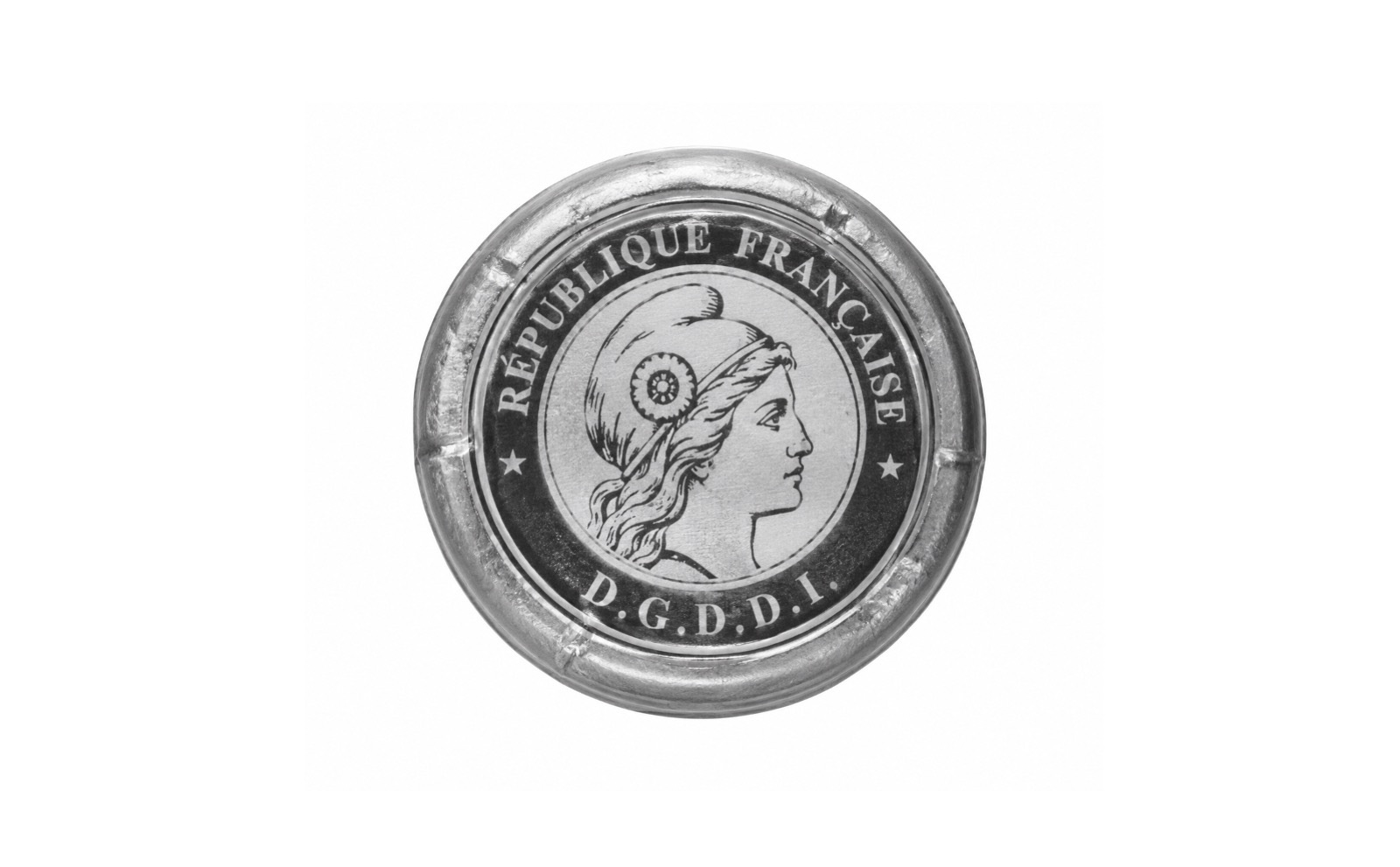
For generations, opening a bottle of French wine has often begun with a small but familiar detail: the capsule bearing Marianne, the emblem used on France’s traditional fiscal marking. Now that symbol can appear somewhere rather different. A new French wine fiscal cork places the required mark directly on the closure, potentially allowing producers to dispense with the familiar capsule altogether.
Developed by Amorim France in partnership with bottle-dressing specialist 2Pack, the system has been approved for use by the French customs authorities. Visually, the change is modest. In practical terms, however, it touches several questions that increasingly matter to producers: packaging, bottling efficiency, material use and the changing expectations surrounding the appearance of a wine bottle.
The cork may remain firmly traditional. The bottle around it is becoming simpler.
From the Marianne Capsule to the French Wine Fiscal Cork
France introduced the capsule représentative de droits, or CRD, in 1960. For decades, its Marianne emblem was one of the most recognisable elements of bottles intended for the French market.
The system also developed a familiar colour language, with different capsule colours historically indicating different categories of wine. For many drinkers, the device became so commonplace that it seemed part of the natural architecture of a French bottle rather than a fiscal instrument.
Its purpose, however, was administrative. The CRD showed that the relevant excise duties had been accounted for and could also serve as documentation for circulation within France.
That framework began to loosen in 2019, when use of the traditional CRD became optional for wine bottles and containers of up to three litres. Producers were no longer obliged to dress every bottle with the familiar fiscal capsule.
The new cork takes that evolution one step further. Instead of placing the fiscal mark on an overcap, the Marianne is applied directly to the closure. The marking is black and can be used for both still and sparkling wines, removing the old visual distinction created by differently coloured capsules.
It is a small change to the eye, but potentially a meaningful one on the bottling line.
Why Remove the Capsule?
Wine packaging contains more components than the casual drinker might notice. Beyond the glass bottle, cork and label, there may be foil, plastic or another material covering the neck.
Each element has to be bought, stored and applied. Depending on the packaging system, fitting an overcap may also require dedicated equipment and an additional stage in the bottling process.
Amorim France argues that transferring the fiscal mark to the cork can eliminate that step entirely. For a producer choosing to bottle without a capsule, there is one fewer packaging material to purchase and manage, and one fewer operation on the line.
The effect is likely to matter most where large volumes are involved. Removing a single stage may sound minor, but repetitive industrial processes are precisely where small simplifications can become significant.
For smaller estates, the attraction may be different. A bottle without a capsule can offer a pared-back appearance while reducing the number of individual components required for packaging.
Either way, the cork is no longer simply performing the mechanical role of sealing the wine. It also carries part of the bottle’s administrative identity.
The Environmental Argument for a Simpler Bottle
The development also reflects a wider debate within French wine about packaging.
Glass remains by far the most substantial component of the conventional wine bottle, but producers are increasingly examining every element surrounding it. Lighter bottles, reduced packaging and fewer decorative materials are becoming familiar subjects across the industry.
Removing the capsule fits naturally into that discussion.
Amorim presents natural cork as particularly well suited to this approach. Cork is harvested from the bark of the cork oak without felling the tree, and the material can be recycled. The company also points to the carbon stored within cork as part of its environmental argument.
Such claims should be distinguished from the broader environmental footprint of a complete bottle of wine, which depends on numerous factors including glass weight, transport, production methods and distribution. A fiscal cork cannot solve those questions by itself.
Its appeal is more straightforward: if a piece of packaging is no longer necessary, avoiding it altogether can be preferable to finding a more elaborate version of it.
That principle may prove more important than any single sustainability claim.
A French Wine Fiscal Cork Without Changing the Ritual
There is another reason the concept may have an easier path into the market than more radical alternatives: it does not ask French consumers to abandon cork.
The French market has historically been cautious about alternative closures, particularly screwcaps for wines positioned in more traditional segments. Cork continues to carry strong associations with wine culture, ageing and the familiar ritual of opening a bottle.
The new system leaves all of that intact.
What disappears is simply the layer above it.
That distinction matters. Wine packaging is surprisingly conservative because consumers read visual details as signals of origin, price and seriousness. Changing the closure itself can alter perceptions immediately. Removing a capsule is a gentler intervention.
Indeed, bottles without neck foils or capsules are already far less unusual than they once were. What might once have appeared unfinished can now look deliberate: clean, restrained and contemporary.
Customs Approval Still Matters
Moving the Marianne onto the cork does not mean dispensing with fiscal controls.
The marking cannot simply be applied by any cork manufacturer. According to Amorim France, the fiscal imprint must be added at a site authorised for that purpose. The company therefore works with 2Pack, where dedicated marking equipment has been installed.
For the bottler, the underlying regulatory obligations remain. The innovation concerns the location and format of the fiscal mark rather than the disappearance of the fiscal system itself.
That is an important distinction because the traditional capsule was never merely decorative. Its familiarity may have softened its bureaucratic origins, but the Marianne belongs to a system governing excise duties and the circulation of alcoholic beverages.
The fiscal cork essentially separates that function from the bottle’s neck dressing.
From Sparkling Wine to Still Wine
Initial interest appears to have been particularly strong among sparkling-wine producers, where bottles without a conventional capsule can make the change visually more noticeable.
The concept is now also moving into still wine.
Amorim France says interest has come from a broad range of operators, including independent estates, merchants and cooperatives. Languedoc producer Gérard Bertrand is among those to have adopted the approach for sparkling wines without an overcap.
Whether this develops into a mainstream format remains to be seen. The traditional capsule still has considerable visual recognition, and producers have spent decades incorporating it into bottle design.
But its regulatory necessity has already diminished. Once an element becomes optional, its continued presence has to justify itself aesthetically, practically or commercially.
Could the Traditional French Wine Capsule Gradually Disappear?
Probably not overnight.
Wine packaging changes slowly, particularly in a country where presentation is closely tied to established codes. Some domaines will continue using capsules because they suit their identity. Others may prefer wax, bare corks or different neck treatments.
The more interesting question is whether the capsule will gradually stop being considered the default.
The French wine fiscal cork offers producers another route: retain natural cork, retain the Marianne where required or desired, but remove an additional layer of packaging.
For the drinker, the difference may amount to little more than seeing the cork before pulling it. For a winery, it can mean one fewer material, one fewer machine operation and a slightly simpler bottle.
French wine has never been shy about tradition, but tradition itself is often made up of practical habits that eventually cease to be necessary. The Marianne may not be disappearing from the bottle.
She may simply be moving closer to the wine.