
French Wine Auctions: A Market in Recalibration
Recent auction data shows sharp Burgundy premiums and divergent Bordeaux pricing in a stabilizing market
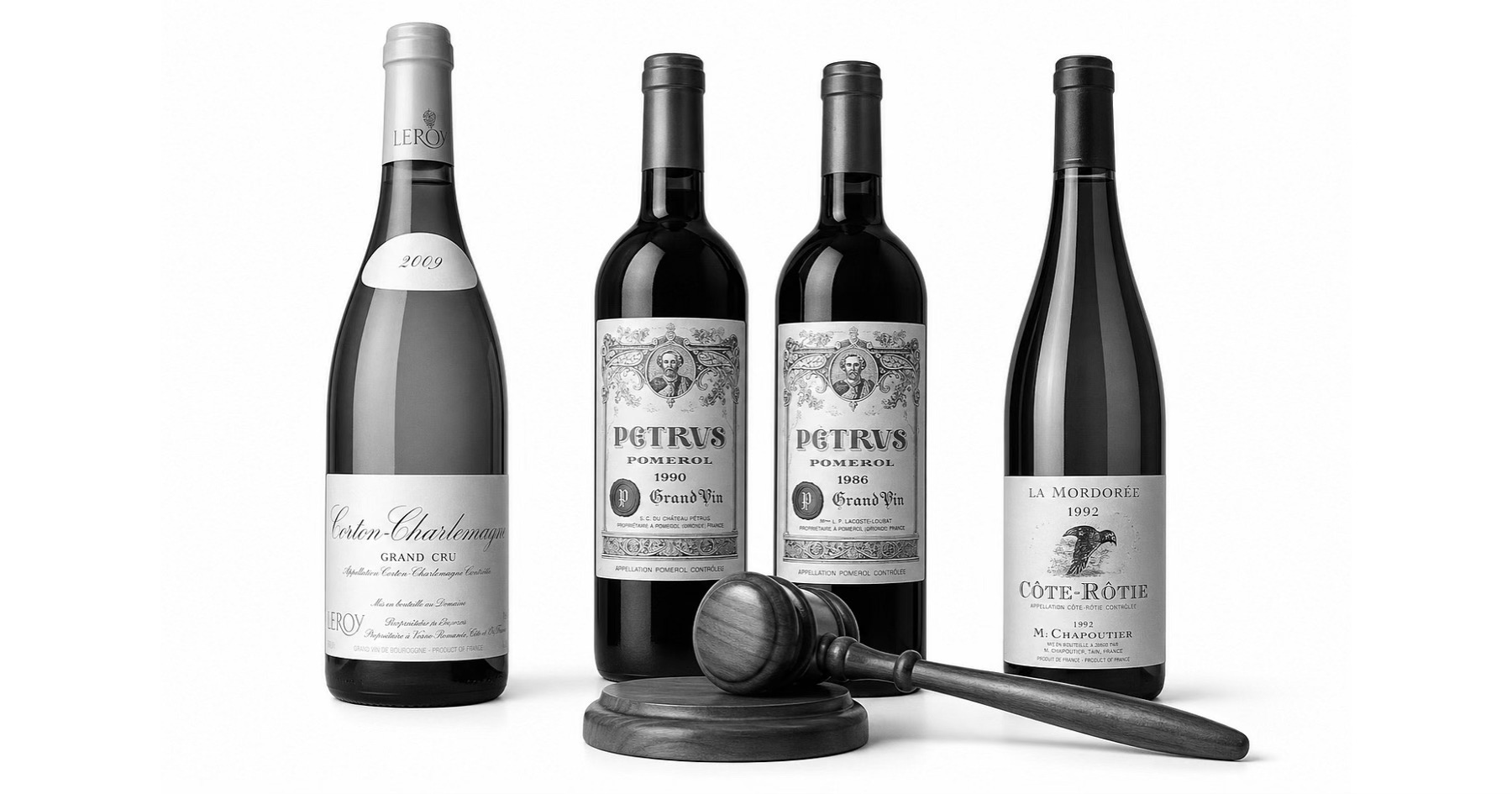
Recent auction results from early 2026 provide a concise dataset for assessing the current state of the French fine wine market. The figures point to a market no longer driven by uniform appreciation, but by selective premiums and precise price alignment, depending on region and producer.
Burgundy: Exceptional Premiums
Corton-Charlemagne Grand Cru 2009, Domaine Leroy
1 bottle, Paris (7 January 2026)
Hammer price: €6,010
iDealwine valuation (28 February 2026): €3,470
Variation: +73%
This +73% result is the most significant deviation in the dataset. It confirms sustained excess demand for elite Burgundy, particularly from Domaine Leroy. The scale of the premium indicates that scarcity and producer reputation continue to override reference pricing.
Bordeaux: Internal Divergence
Pétrus 1990
1 bottle, Paris (29 December 2025)
Hammer price: €2,944
iDealwine valuation: €2,817
Variation: +5%Pétrus 1986
1 bottle, Paris (27 January 2026)
Hammer price: €2,860
iDealwine valuation: €1,728
Variation: +66%
The difference between +5% and +66% within the same château illustrates a fragmented pricing structure. The 1990 trades close to its benchmark, while the 1986 achieves a substantial premium. This suggests that buyers are differentiating at a granular level, likely factoring in rarity, provenance, and perceived market positioning rather than relying solely on vintage hierarchy.
Rhône: Price Efficiency
Côte-Rôtie La Mordorée 1992, M. Chapoutier
6 bottles, Bordeaux (26 January 2026)
Hammer price: €491 total / €82 per bottle
iDealwine valuation: €81 per bottle
Variation: −1%
The Rhône result shows near-perfect alignment with market valuation. A −1% variation indicates a segment where pricing is efficient and expectations are well calibrated. Unlike Burgundy or Bordeaux, there is no evidence of speculative premium or discount.
Quantitative Overview
Across the French wines in this dataset:
2 wines show strong positive deviations (+66% and +73%)
1 wine shows a moderate premium (+5%)
1 wine trades at near parity (−1%)
This distribution highlights a bifurcated market structure:
High-end Burgundy and select Bordeaux vintages generate significant premiums
Other segments, particularly Rhône, remain closely aligned with benchmark pricing
Conclusion: Precision Over Momentum
The current auction data indicates that the French fine wine market is operating with increased precision. Price formation is no longer driven by regional momentum, but by specific attributes at the level of producer and vintage.
Burgundy continues to command the highest premiums, Bordeaux displays internal divergence, and Rhône wines trade with notable stability. The result is a market defined less by trend and more by selective valuation discipline.