
The map of French white wine appellations is not as fixed as it can sometimes appear. Across several regions long associated with red wine, growers are seeking to bring white wines more clearly within the identity of their terroirs. What might look at first like a response to changing consumer preferences is also raising a deeper question: if a white wine is genuinely shaped by a place, should the appellation be able to say so?
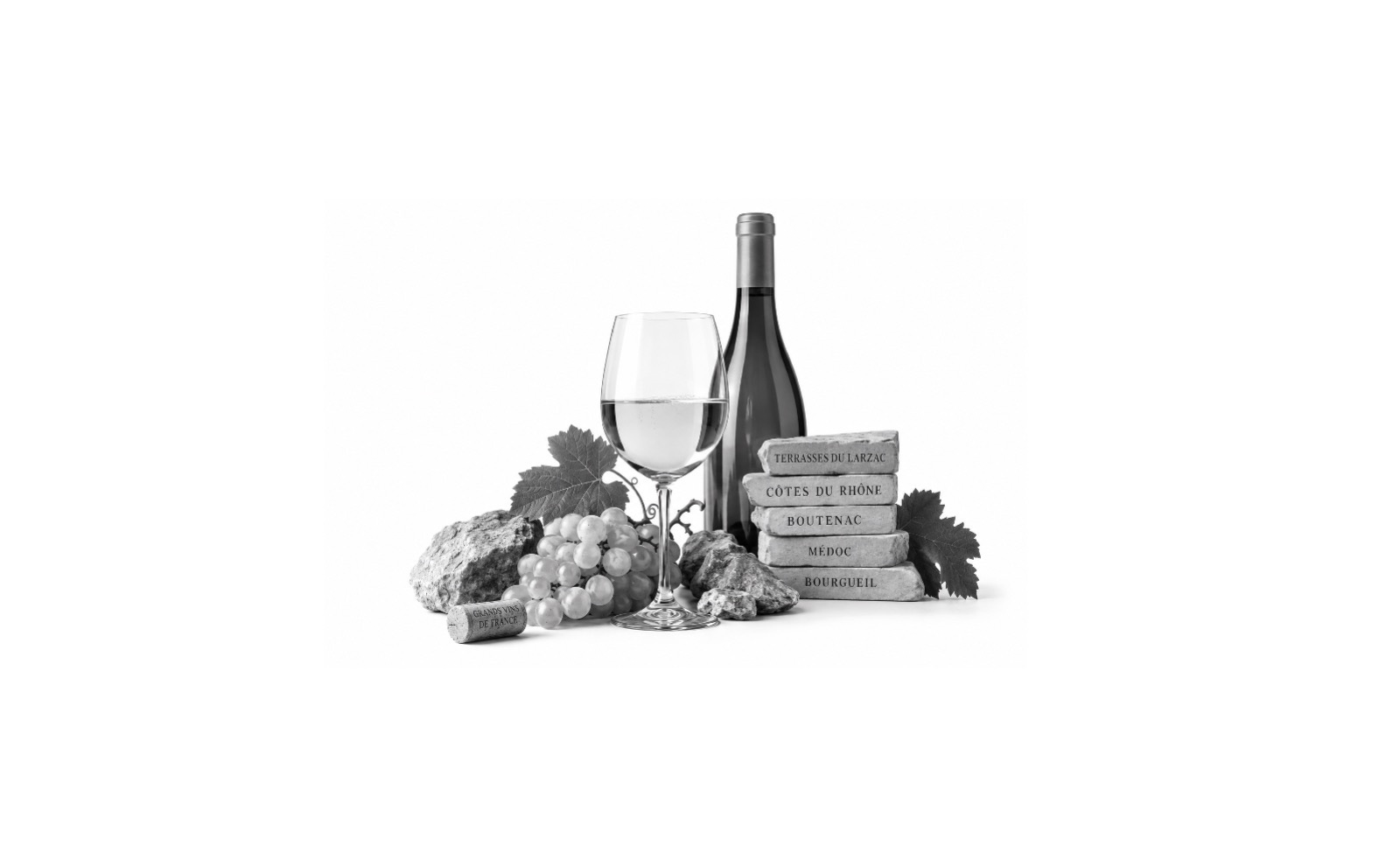
That question is now being asked from the Languedoc to Bordeaux and the Loire. Terrasses du Larzac is preparing to recognise white wines under its own name; the Médoc has already taken that step; Boutenac is considering a similar evolution; and Bourgueil is working towards the return of Chenin to an appellation currently defined entirely by Cabernet Franc.
These initiatives differ in detail, but they share a common idea. Producers do not simply want to make more white wine. They want the appellation itself to reflect what is already happening in their vineyards.
Terrasses du Larzac prepares for white wine
Few Languedoc appellations have built a stronger contemporary identity around red wine than Terrasses du Larzac. Yet the appellation is now preparing to add white wines to its specifications, giving its producers the possibility of presenting them under the same geographical name as their reds.
Regulatory approval has already advanced through the INAO process. Depending on the timing of the final decree, the change is expected to apply from either the 2026 or 2027 vintage.
Five principal varieties have been selected: Grenache Blanc, Rolle, Roussanne, Carignan Blanc and Chenin. Together they form an unusually broad palette, combining varieties deeply associated with Mediterranean France with Chenin, a grape more readily linked in the minds of wine lovers with the Loire.
Initial volumes are expected to remain modest, at roughly 1,500 to 2,000 hectolitres. That scale matters. This is not a wholesale attempt to reinvent Terrasses du Larzac as a white-wine region, but an effort to give existing and future whites a more precise appellation identity.
Many such wines have until now been sold under broader designations such as AOP Languedoc or IGP Saint-Guilhem-le-Désert. Recognition under Terrasses du Larzac would allow growers to connect those wines more directly with the landscape and reputation they have spent years establishing for their reds.
It would also be a mistake to see the change purely as a route to higher prices. Producers already making successful whites under existing classifications have little reason to regard a new appellation as an automatic commercial premium. The more interesting question is one of coherence: whether the geographical name on the label can more accurately describe the wine in the bottle.
The Rhône is moving in a comparable direction. Changes to the specifications of Côtes du Rhône and Côtes du Rhône Villages have also progressed through the INAO approval process, another sign that established appellation frameworks are being reconsidered rather than treated as immutable.
French white wine appellations are becoming more precise
Appellation rules are often discussed as if they exist primarily to preserve tradition. In practice, their more difficult task is to decide which traditions deserve protection and how a region can evolve without losing its identity.
White wine presents an interesting test.
In several predominantly red appellations, growers are already cultivating white varieties and producing wines with a clear local character. Yet those wines may have to appear under a broader regional designation because the more specific appellation does not permit them.
Boutenac, one of the recognised crus of the Corbières, offers a good example. Around 25 to 30 hectares of white varieties are already in production within its area, but the wines are currently declared as AOP Corbières rather than under the Boutenac name.
The local organisation is considering a change that would allow a distinct Boutenac identity for white wine. Carignan Blanc, Grenache Gris and Grenache Blanc are the varieties being considered, with Grenache Blanc already established among the principal white grapes of Corbières.
Here, too, the issue goes beyond colour. Allowing white Boutenac would give growers the opportunity to distinguish wines from a specific cru rather than folding them into the much larger Corbières appellation.
That distinction is central to the logic of France’s appellation system. The narrower the geographical claim, the stronger the expectation that the wine should communicate something recognisable about its origin.
Médoc Blanc moves from idea to reality
In Bordeaux, the Médoc provides the clearest example of a historically red appellation formally embracing white wine.
The change to the Médoc specifications was made official in 2025, and 2026 marked the first year in which wines from the small 2025 harvest reached the market carrying the Médoc name as whites.
Production remains tiny beside the region’s red vineyards. The first vintage amounted to roughly 200,000 bottles from 63 hectares, while red Médoc accounts for around 14,000 hectares.
The contrast in scale is striking, but it also explains why the development is significant. Médoc Blanc is not competing with the region’s reds for dominance. It is creating a defined home for a category that previously sat somewhat awkwardly within the Bordeaux hierarchy.
The initiative itself dates back to 2017 and began as an attempt by growers to express a more specific local identity. White wines from Médoc vineyards could already be sold as AOP Bordeaux, often from familiar Bordeaux white varieties, but producers argued that their wines had a character sufficiently distinct to justify the Médoc name.
That argument touches on one of the most interesting tensions in French wine. Grape variety alone rarely explains identity. Sauvignon grown in one part of Bordeaux need not taste or behave exactly like Sauvignon grown elsewhere, even when the legal classification has historically treated the wines under the same broader banner.
The appearance of Médoc Blanc therefore gives producers another way to make origin visible.
There is an economic dimension as well. A more specific appellation can help a wine stand apart from the large volume of generic Bordeaux Blanc in the market. But the regulatory change is most convincing when it does more than create a stronger label. Its long-term value will depend on whether consumers come to recognise Médoc Blanc as a meaningful style in its own right.
Individual estates are already testing that proposition. Château Lamothe-Bergeron, between Margaux and Saint-Julien, produced its first white under AOP Bordeaux in 2024 before moving to AOP Médoc Blanc with the 2025 vintage. Two hectares are currently devoted to white grapes, predominantly Sauvignon, with further planting planned.
Examples such as this suggest that the category may grow, but from an intentionally small base.
Bourgueil looks to Chenin for its white future
The situation in Bourgueil is different again.
The Loire appellation is presently built around a single permitted grape, Cabernet Franc. Producers are now seeking to reintroduce Chenin, which would give the appellation a white counterpart to its celebrated reds.
The proposal is still working its way through the regulatory process and is expected to require further examination before any change can take effect.
What makes Bourgueil particularly interesting is that the white-wine movement is already visible on the ground. Close to 30 hectares of white grapes are reportedly in production, currently classified as IGP Val de Loire, with additional plantings continuing.
Local projections suggest that the area could eventually approach 100 hectares over the coming decade if producer interest develops as expected.
The proposal is therefore being presented less as the invention of an entirely new category than as an attempt to bring vineyard practice and appellation rules back into alignment.
Consumer enthusiasm for white wine clearly forms part of the context. For estates facing a more difficult market for some red wines, white production can also provide useful diversification. Yet reducing Bourgueil’s interest in Chenin to economics would miss the more compelling part of the story.
Chenin is one of the Loire’s defining white varieties. Giving it a formal place in Bourgueil would create an opportunity to explore how the grape interprets a terroir more commonly understood through Cabernet Franc.
More than a change of colour
The emergence of new French white wine appellations within traditionally red territories does not mean that these regions are abandoning their historical identities. In most cases, the scale of white production is far too small for that.
What is changing is the definition of what an appellation can contain.
For decades, the strongest image of the Médoc has been red Bordeaux; Bourgueil is inseparable from Cabernet Franc; Terrasses du Larzac has earned its reputation through red blends; and Boutenac remains firmly associated with the red wines of the Corbières. None of that disappears because a white category is added.
Instead, these changes suggest a more flexible understanding of tradition. Appellations can preserve what makes a region distinctive while still acknowledging that vineyards, growers and markets do not stand still.
There is an important caution here. Adding a prestigious geographical name to a white wine does not automatically make the wine more interesting, nor should appellation reform become a convenient exercise in chasing demand. The credibility of any new category ultimately depends on whether the wines justify the geographical distinction being claimed for them.
That is why the most persuasive of these projects begin in the vineyard rather than in the marketing department. White grapes are already being grown. Wines are already being made. Producers are asking whether the existing appellation map describes that reality accurately enough.
For wine lovers, the result could be one of the more intriguing developments in contemporary French wine: familiar names appearing in an unfamiliar colour, not as curiosities, but as new interpretations of places we thought we already knew.