
France’s Appellations at a Crossroads
Explore how France’s appellation system is being challenged by climate change, creative winemakers, Vin de France growth, and shifting ideas of terroir.
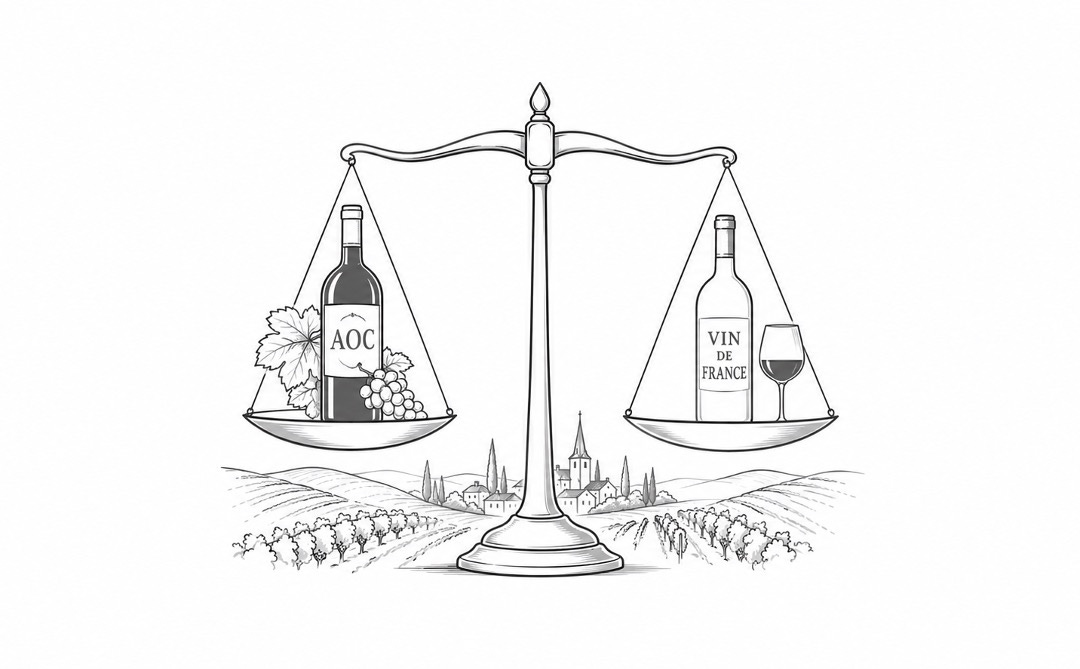
For nearly a century, the names on French wine labels have carried more than geography. Pomerol, Châteauneuf-du-Pape, Montrachet, Sancerre, Saint-Émilion: these words have acted as promises. They have told buyers where a wine comes from, what traditions shaped it, and why one bottle may be worth far more than another. The appellation system gave French wine a language of place, and for decades that language helped the country build one of the most admired vineyard cultures in the world.
Now that same system is being questioned from inside the vineyard.
The debate is not simply about labels. It touches land values, inheritance, climate change, consumer taste, farming freedom, and the very definition of terroir. For some growers, appellations remain the foundation of trust between wine and drinker. For others, they have become too rigid, too slow, too bureaucratic, and sometimes too willing to protect a collective image at the expense of individual expression.
The fault line is easy to caricature: tradition on one side, rebellion on the other. In reality, the divide is more complicated. Many of the growers challenging the system are not rejecting place. Quite the opposite. They often argue that their wines speak more clearly of their soils when they are freed from the official rules designed to represent those soils.
One of the most striking examples came in September 2015. Alexandre Bain, then harvesting his roughly ten hectares in Tracy-sur-Loire, received a phone call that changed the commercial identity of his wines. The approval allowing him to use the Pouilly-Fumé appellation had been withdrawn. Bain was not an heir to an old family estate. He was a newer arrival who had built his domaine in a prestigious part of the Loire Valley, near Sancerre, and had worked to establish a reputation on his own terms.
From the 2015 vintage onward, he had to sell his wines as Vin de France. That meant losing the name Pouilly-Fumé from the label. The bottles could no longer carry the place name that many consumers associated with the region’s limestone-clay soils and smoky sauvignon blanc identity. At most, the label could indicate a postal code and a grape variety. For a grower convinced that his wines were rooted deeply in their terroir, the downgrade felt like a contradiction.
Bain has described the reasons given to him as bewildering, including criticism of details such as grass height between the vineyard rows. Whether other technical factors were involved or not, his story has become part of a larger narrative told by growers who feel trapped in administrative logic that does not always match the realities of vineyard work.
He is not alone. Thierry Michon, another Loire figure, helped bring the Fiefs Vendéens appellation into existence. Years later, he found himself excluded from it after producing parcel-based wines. To him, the system had turned into a machine of complexity: capable of creating recognition, but also capable of punishing the very precision that many modern wine lovers celebrate.
What makes these stories especially revealing is that exclusion from an appellation has not destroyed the reputation of such growers. Their wines continue to find enthusiastic audiences in France and abroad, from fashionable Parisian bistros to Michelin-starred restaurants. That success suggests a shift in the way part of the wine world thinks. AOC status once functioned as a near-essential badge of legitimacy. Today, for some producers and consumers, it is no longer the only sign of seriousness.
Bain’s criticism is direct: appellations helped French wine prosper, and they improved many growers’ lives, but he believes they no longer automatically guarantee quality. That view remains deeply contested.
Philippe Brisebarre, president of the INAO and longtime head of the Vouvray appellation, sees the matter from another angle. To him, a grower who complains after losing appellation status is like someone who builds an impressive house where construction is not allowed, then protests when the rules are enforced. His point is that appellations are collective agreements. A producer may make a beautiful wine, but beauty alone does not grant the right to use a protected name.
Brisebarre also warns against imagining Vin de France as an easy solution. In his view, leaving the appellation system may offer short-term freedom, but it does not necessarily strengthen what is passed on to the next generation. Appellations, he argues, have existed for nearly a century and will likely remain part of French wine for another.
That durability is not only cultural. It is economic. Appellation names influence the price of land, the valuation of estates, the structure of inheritance, and the financial identity of entire regions. When a vineyard belongs to a famous AOC, its name can become a form of capital. Removing or weakening that structure is not a neutral act.
The origins of the appellation system explain why its defenders remain so attached to it. In the 1930s, French wine was still recovering from deep crises, including the devastation left by phylloxera and the damage caused by fraud and poor practices. The first AOCs were designed to restore order and credibility. They linked wine to place, methods, and standards. They reassured consumers that a name on a bottle meant something real.
That mission still matters. But the world around it has changed.
Climate change is forcing growers to reconsider old assumptions about grape varieties, irrigation, yields, ripeness, and vineyard management. Consumers are increasingly curious about natural wines, low-intervention methods, parcel selections, and unconventional labels. Some buyers are less impressed by official categories than by the personality of the grower. At the same time, regions facing declining sales are under pressure to adapt faster than their regulations allow.
The shockwaves are no longer limited to small, independent, anti-establishment producers. In August 2025, Château Lafleur, one of the great names of Pomerol and a neighbor of Petrus, announced that it would leave the Pomerol appellation. In Bordeaux, where tradition remains especially powerful, the decision landed like a thunderclap.
The estate did not frame its departure as a declaration of war. Baptiste Guinaudeau, the owner, presented it as a necessary act to protect the vines and the identity of the wines. His argument was paradoxical but forceful: the wine, he suggested, had never expressed Pomerol more faithfully than it did at the moment it stepped outside the appellation. Lafleur’s bottles, which can sell for around a thousand euros, would henceforth be marketed as Vin de France, giving the estate greater room to follow its own viticultural choices, including on sensitive questions such as irrigation.
For supporters of Vin de France, Lafleur’s move was a powerful symbol. Valérie Pajotin, who leads the Vin de France interprofessional body, described such decisions as acts of courage. She sees many producers turning to VDF for freedom, creativity, or simply the ability to make wines that do not fit neatly inside existing rulebooks. Often, growers do not abandon appellations entirely; they create one or more cuvées outside the system while keeping other wines within it.
The category’s momentum is real. In 2025, Vin de France exports rose by 2% in volume and 3% in value despite a difficult climate marked by falling consumption and geopolitical and economic pressure. Nearly 3,000 structures now produce at least one wine under the Vin de France banner. In certain regions, these wines have brought attention at moments when traditional sales were struggling. The Jura, for example, has benefited from the visibility of celebrated growers who sometimes work outside appellation rules.
But freedom has its shadows.
In Auvergne, a region newly admired by many wine lovers for its volcanic soils and distinctive identity, some appellation defenders worry that the Vin de France category allows confusion. Philippe Goigoux, president of the Côtes d’Auvergne appellation syndicate, points to the role of négociant activity: producers can legally buy grapes from outside their own region and bottle the resulting wine under a creative label. The practice is not necessarily dishonest, but it can be opaque to consumers. A drinker may believe they are discovering the taste of Auvergne when the bottle contains no Auvergne grapes at all.
This complaint goes to the heart of the debate. Appellations may frustrate ambitious growers, but they also protect the link between a wine and its origin. Without that structure, the market can become freer, more inventive, and more responsive. It can also become harder to read.
The INAO insists it is not frozen in the past. According to its defenders, no period has seen as many changes to appellation rulebooks, and the review process has become shorter, even if some files still take many years. The Médoc appellation, for example, has recently been authorized to produce white wine, a significant shift in a region historically defined by red. For Brisebarre, this proves that the system can evolve. He also believes there will always be a certain marketing appeal in standing outside the mainstream.
Bordeaux shows how urgent the question of adaptation has become. Since 2021, the area of vines planted under protected appellation status there has fallen by 20%. Michel-Eric Jacquin, elected in September 2025 to lead the regional AOC, initially wanted to inject far more freedom into the system. At one stage, he proposed that most growers might move outside the appellation. The idea caused such turmoil within the syndicate that it was abandoned.
Jacquin still sees the appellation framework as a world of constraints that can hold back economic recovery. As a grower in Entre-deux-Mers, he would like to experiment with grapes such as syrah or chardonnay, which he considers better suited to climate disruption, even though they are not classic Bordeaux varieties.
That desire illustrates the larger tension facing French wine. Appellations were built to preserve identity. But if the climate changes faster than the rules, preservation can begin to look like immobility. The question is no longer whether tradition matters. It is how tradition can remain useful when the conditions that created it are shifting.
Money also plays its part. Bain argues that some prestigious appellations resist change precisely because their names still sell. Pouilly-Fumé and Sancerre remain commercially strong, so their guardians have less incentive to loosen the framework. In other regions, where the appellation name no longer guarantees demand, attitudes may be more open. Beaujolais, he suggests, has better understood that independent-minded growers can benefit the whole region by renewing its image.
Behind these arguments lies a fear shared by many on different sides of the debate: the fear of standardization. One danger is that strict appellation rules can push producers toward a common style, especially if outside consultants are used to bring wines into line with expectations. Another danger is that excessive freedom can detach labels from place and allow branding to replace origin.
French wine is therefore caught between two risks. Too much rigidity may suffocate creativity and adaptation. Too much looseness may weaken the trust that made French wine famous.
The appellation system is not finished. Nor is it untouchable. Its future will likely depend on whether it can protect origin without smothering individuality, and whether it can adapt to climate, markets, and new forms of craftsmanship without losing the discipline that gave its names value.
Ninety years after the first AOCs appeared, France is not saying farewell to Pomerol, Châteauneuf-du-Pape, or Montrachet. But it is being forced to ask what those names should mean in the next century. The answer will not come from institutions alone, nor from rebels alone. It will come from the vineyard itself, where every bottle must still prove that a place name is more than a word on a label.