

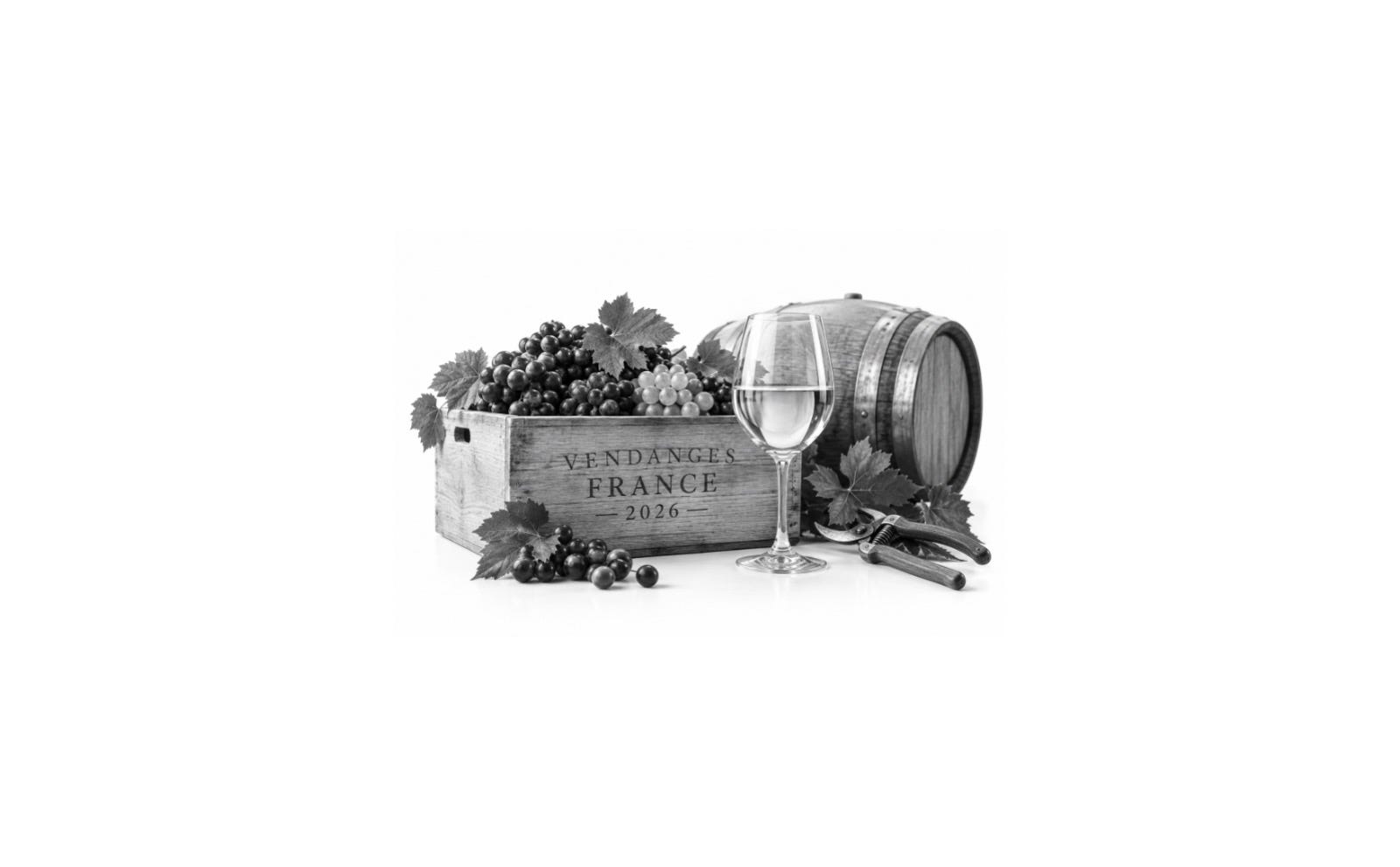
France is heading towards one of its smallest wine crops in decades. Yet the France 2026 wine harvest is proving more complicated than the national headline suggests.
Updated estimates from the French Ministry of Agriculture put production at around 34.9 million hectolitres, a significant upward revision from the 33.8 million hectolitres forecast only a month earlier. The principal reason is Languedoc-Roussillon, where vineyards delivered more fruit than many growers expected during the heat of summer.
On paper, that sounds like welcome news. In practice, it exposes one of the central tensions facing French wine today.
France can produce historically little wine and still find itself worrying about too much wine in the wrong part of the market.
France 2026 wine harvest remains exceptionally small
The national picture is shaped by two forces operating at the same time.
The first is climatic. Frost, hail, heatwaves, drought and fires have all affected production in different regions. Their impact varies enormously from one vineyard to another, but together they have contributed to another difficult growing season.
The second is structural. France simply has fewer productive vineyards than it did a few years ago.
Vineyard area is estimated to have contracted by around 2%, reflecting permanent grubbing-up schemes as well as parcels that are no longer actively cultivated. This shrinking vineyard base means that even when weather conditions are relatively favourable, France now begins each harvest with less theoretical production capacity.
The 34.9 million-hectolitre estimate remains around 14% below the 2021-2025 average of 40.6 million hectolitres.
That is a substantial gap. It confirms that 2026 belongs to the sequence of unusually small French harvests rather than representing a return to the abundant vintages of earlier decades.
Yet national volume alone no longer tells the whole story.
Languedoc-Roussillon changes the 2026 harvest picture
The biggest surprise has come from the Mediterranean south.
A month earlier, production in Languedoc-Roussillon had been estimated at approximately 9.6 million hectolitres. The revised figure is around 10.6 million.
An additional million hectolitres in a single region is enough to alter the national outlook significantly.
Late-summer rainfall appears to have been decisive. After periods of drought and intense heat, those rains helped vines maintain or recover berry weight, limiting some of the losses that had seemed inevitable earlier in the season.
The result is a southern harvest much closer to normal than the summer conditions initially suggested.
This has happened despite another reduction in productive vineyard area. More than 5,000 hectares are estimated to have disappeared from production in Languedoc-Roussillon, representing roughly a 3% decline.
Some vineyards approved for permanent removal were also still capable of producing in 2026 because growers had until the end of the year to complete the grubbing-up process.
The paradox is striking: fewer vines, difficult weather, an exceptionally early vintage—and nevertheless more wine than expected.
An early vintage with highly uneven yields
Anyone looking for a simple description of the 2026 vintage is likely to be disappointed.
Yield variation has been considerable.
Neighbouring vineyards have sometimes reported dramatically different results, with production in one sector potentially twice that of another. Local rainfall, soil water reserves, heat exposure and individual vineyard condition all played a role.
That heterogeneity is increasingly familiar in French viticulture.
A regional harvest figure can suggest relative stability while concealing considerable stress at estate level. One grower may have filled the cellar comfortably; another only a few kilometres away may have harvested a fraction of a normal crop.
The unusually early timing of the 2026 harvest adds another layer to the story. During the summer heatwaves, expectations in parts of southern France were distinctly pessimistic. The final volumes have therefore surprised some growers who had prepared for much smaller crops.
Ordinarily, exceeding an early production forecast might be reason for relief.
The problem is the market waiting for the wine.
Why a bigger Languedoc harvest is not necessarily good news
The French wine economy is no longer governed by the simple assumption that more wine means more revenue.
Consumption has changed. Export markets are uneven. Certain categories face sustained pressure, while producers continue to absorb higher costs for energy, vineyard inputs, labour and equipment.
Against that background, a larger-than-expected harvest in Languedoc-Roussillon risks arriving in a market that was already struggling to absorb existing supply at satisfactory prices.
This is particularly sensitive for bulk wine.
Grower representatives in the Aude have already warned against allowing stronger production to translate automatically into lower prices. Their concern is straightforward: if production costs remain elevated while buyers use additional supply to negotiate prices downwards, higher yields may do little to improve the economic position of growers.
That is one of the defining contradictions of contemporary French wine.
For an individual estate, a healthy crop can be essential. For an entire region facing weak demand, the same additional volume can become a commercial problem.
The France 2026 wine harvest reveals a shift from volume to value
For much of wine history, harvest reports naturally focused on quantity.
How many hectolitres were produced? How did yields compare with the previous vintage? Which regions were up, and which were down?
Those questions still matter, but the France 2026 wine harvest demonstrates why they are no longer sufficient.
The larger issue is now value.
France is gradually reducing its vineyard surface precisely because parts of the industry face a mismatch between what vineyards can produce and what the market is willing to buy at economically sustainable prices.
That makes the situation in Languedoc-Roussillon particularly revealing.
A harvest close to the regional five-year average might once have been considered reassuring. Today, it immediately raises questions about inventories, bulk prices and growers’ negotiating position.
Scarcity at national level does not automatically produce scarcity in every category.
A small Champagne harvest, a constrained Beaujolais crop and a relatively normal volume of southern bulk wine belong to the same French vintage, but they operate in very different markets.
There is no single French wine supply-and-demand equation.
Vineyard removal is changing the meaning of a “normal” crop
The continuing reduction in vineyard area also complicates how harvest statistics should be read.
When vines disappear permanently, past averages become harder to compare with present production. A crop described as “normal” in relation to recent years may have been produced from a significantly smaller vineyard base.
The change is particularly important in southern France, where growers have been offered incentives to remove vineyards as part of efforts to reduce structural oversupply.
This means that future French harvests may increasingly settle at levels that would once have been regarded as unusually low.
Thirty-five million hectolitres can look historically modest when compared with previous decades, yet still generate excess supply within particular segments.
France may therefore be moving towards a wine economy in which smaller national harvests become normal without automatically resolving the industry’s commercial imbalance.
Can the French wine sector protect value?
The debate now moves from the vineyard to the market.
French wine organisations have been working on mechanisms intended to strengthen producers’ negotiating position and encourage a fairer distribution of value throughout the supply chain.
These include frameworks for sustainability agreements involving organic and HVE-certified wines, mechanisms for price guidance, price corridors within interprofessional organisations and stronger producer organisations.
The terminology may sound bureaucratic, but the underlying question is anything but abstract.
Who carries the risk when a harvest is larger than expected?
If growers alone absorb falling bulk prices while their production costs remain high, additional yield can become a liability. If supply can be managed more intelligently and commercial relationships provide greater visibility, a healthy harvest has a better chance of becoming an economic asset.
Such mechanisms remain works in progress. Wine markets are fragmented, contractual relationships differ by region and category, and no regulatory tool can manufacture consumer demand.
But 2026 makes the need for the discussion difficult to ignore.
A small harvest does not guarantee a tight wine market
The most important lesson of the France 2026 wine harvest may be that national scarcity and regional oversupply can coexist.
France is producing far less wine than its recent historical average. Vineyard area is shrinking. Climate events continue to erode potential yields.
And yet some growers are still worried about having too much wine to sell.
That apparent contradiction tells us something fundamental about the state of French wine.
The industry’s challenge is no longer simply to produce enough. In many regions, it is to align production more closely with demand while preserving the economic value required to keep vineyards viable.
Languedoc-Roussillon’s unexpectedly generous 2026 harvest therefore deserves to be read in two ways.
Viticulturally, it is evidence of the vine’s capacity to surprise after an exceptionally difficult summer.
Economically, it is a reminder that a successful harvest is only truly successful when the market can sustain it.
For French wine, the arithmetic of the vintage is becoming increasingly clear: fewer hectares and fewer hectolitres do not necessarily mean fewer problems.