
Fire, Smoke, and the 2026 Vintage: Languedoc-Roussillon Moves Early to Protect Its Wines
Wildfires are already threatening the 2026 Languedoc-Roussillon vintage. Learn how growers are using smoke-taint mapping and vineyard testing to protect wine quality.
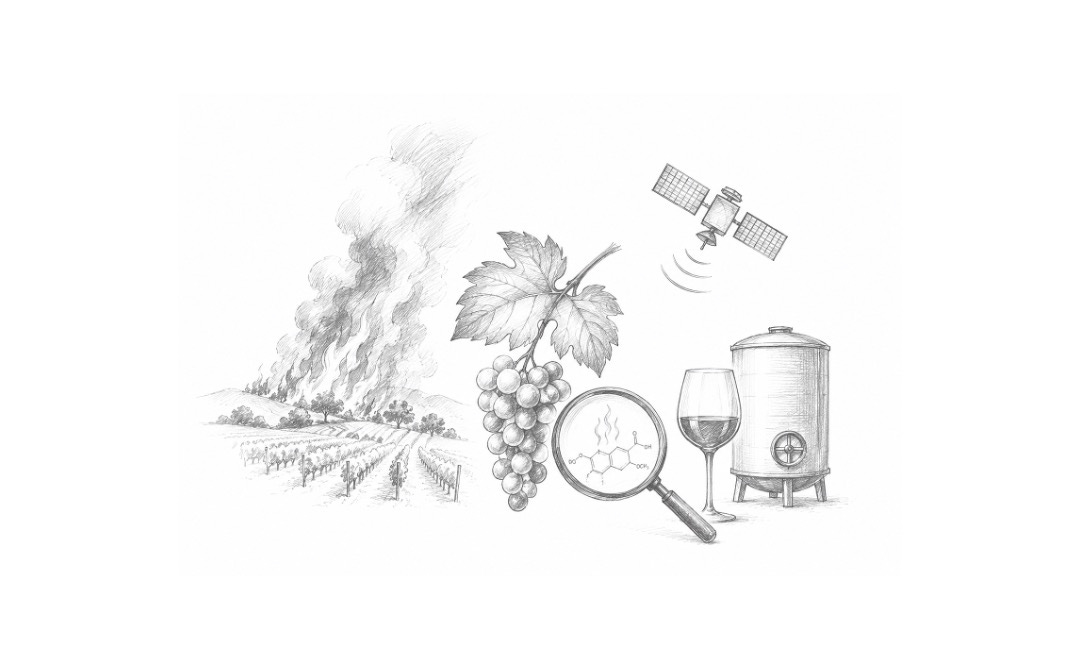
By the first week of July 2026, the fire season had already announced itself with unusual force. Across southern France, flames had consumed more than 11,000 hectares of scrubland, pine forest, and, in some places, vineyard. For the wine regions of Languedoc and Roussillon, the danger no longer lies only in the visible damage left behind by fire. Even vines spared by the flames may carry a quieter threat: grapes exposed to lingering smoke can later give wines an unwanted smoky character.
That risk has prompted InterSud to bring back viti-incendie.fr, the digital platform created the previous year to help winegrowers identify which vineyard blocks should be tested. The goal is practical and urgent: detect smoke-affected fruit early enough to keep it separate from healthy grapes, especially before harvest volumes disappear into large winery tanks.
The scale of the 2026 fires is already alarming. Nicolas Dutour, oenologist and engineer at Laboratoires Dubernet, notes that by July 6, the area burned had reached more than half of the total burned during the entire 2025 season, which was around 20,000 hectares. Fires have affected Aude, Hérault, Gard, and now Pyrénées-Orientales, where concern has intensified as flames have moved dangerously close to Baixas in the lower Agly Valley.
Although harvest is still some distance away, Dutour warns that smoke exposure cannot be dismissed simply because the grapes are not yet ready to pick. Experience from the previous year showed that smoke compounds may persist even when weather appears to have reduced the danger. After the Narbonne-area fire of July 8, 2025, rainfall of about 70 millimetres followed soon afterward. Even so, among thousands of grape analyses carried out by Dubernet, the fruit collected near that fire contained the highest measured levels of glycosylated precursors associated with smoke taint. The likely explanation, according to Dutour, is that smoke odour remained in the area for several days and penetrated the berries despite the rain.
This lesson has shaped the region’s response in 2026. Rather than wait for harvest problems to appear in the cellar, InterSud is encouraging growers to use the portal as a decision-making tool. The platform already includes zoning data for the Mailhac and Pouzols-Minervois fires, built from satellite readings of humidity levels. It is also expected to incorporate smoke-movement maps based on carbon monoxide emissions measured by the French space agency, CNES.
The system is intended for members of both the Languedoc and Roussillon wine interprofessions whose vineyards may have been affected by fire or smoke. Its value is especially clear for cooperative wineries, where fruit from many growers can be rapidly blended into large fermentation volumes. Dutour points in particular to contributors supplying cooperatives such as Pouzol or Argeliers, where contaminated grapes must be identified and separated before they are mixed into tanks that would be difficult, if not impossible, to isolate later.
Caution is also necessary because smoke taint does not always reveal itself immediately. Some wines from the 2025 vintage, made from parcels initially considered low risk, began showing faint smoky finishes in April 2026. For Dutour, this confirms what scientific literature has described: smoke-related compounds can evolve slowly over time through gradual hydrolysis. A vineyard may appear clean at first, only for the finished wine to show problems months later. That delayed expression makes careful parcel zoning essential, because the right cellar strategy depends on knowing which fruit is genuinely at risk.
Sampling is expected to begin at véraison, when grapes start ripening and changing colour. Results from oenology laboratories across the region will be uploaded to viti-incendie.fr, creating a shared picture of contamination levels. This collective mapping should help growers interpret their own risk more intelligently. A winegrower whose parcels sit near heavily affected vines may decide to submit grapes for analysis. Conversely, a block surrounded by healthy results may reasonably be treated as free from smoke taint.
The timing matters. According to Dutour, the analyses should be available early enough for estates and cooperatives to plan harvest logistics, separate fruit where needed, and reduce the risk of releasing wines marked by smoke. To encourage broad participation, Laboratoires Dubernet is continuing to offer a 30 percent reduction on analysis costs for growers who agree to provide GPS coordinates for their parcels and allow their anonymised results to be published on the platform.
In a year when fire has arrived before the heart of summer, the region is treating smoke not as an isolated accident but as a vineyard-wide management issue. The strategy depends on speed, shared data, and disciplined separation of fruit. For Languedoc-Roussillon, protecting the 2026 vintage will mean looking beyond the burned ground and measuring what the air may have left behind.