
Environmental Cost of Frost Protection in French Vineyards
How life cycle analysis reshapes decision-making beyond cost and efficiency in vineyard frost control.
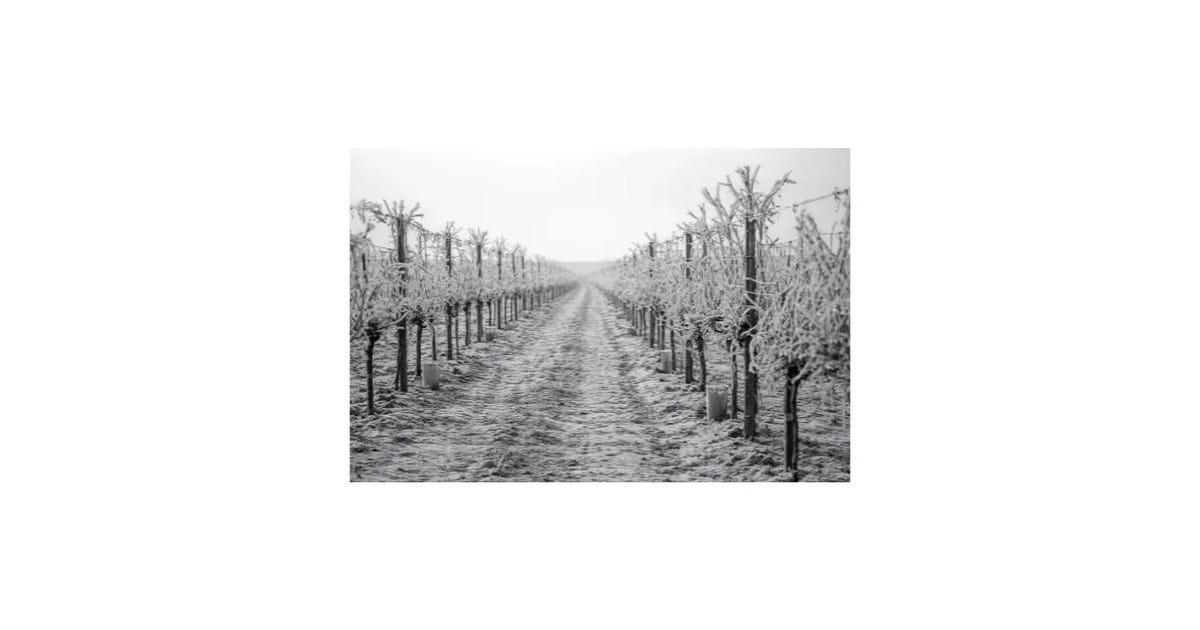
Spring frost has long been a familiar adversary in European vineyards. In recent decades, however, its frequency and unpredictability have increased, driven by earlier budbreak linked to climate warming. For winegrowers, the response is often immediate and pragmatic: protect the vines, limit yield loss, act fast. Cost and technical efficiency naturally dominate these decisions. What has remained largely unexplored, until recently, is the environmental price of these choices.
This is the gap addressed by the doctoral research of Vincent Baillet, conducted over three years within the USC Grappe ESA–Inrae in Angers. Rather than offering prescriptive conclusions, his work provides the profession with a structured, comparative framework to evaluate the environmental impacts of frost protection techniques—an additional lens through which vineyard strategies can be assessed.
Frost events and technical responses
Baillet’s research focuses primarily on radiative frost, the most common form encountered in spring. In these conditions, cold air settles near the ground, directly threatening buds at their most vulnerable stage. The study encompasses six major frost protection technologies, broken down into twenty-eight distinct practices: fixed and mobile wind machines, heating cables, radiative systems, heaters and candles, overhead sprinkling, and protective covers.
These practices were analysed in two contrasting French wine regions—Val de Loire and Champagne—allowing local climatic and topographical factors to be integrated. Slope, cold air drainage, and site exposure significantly influence both frost risk and the effectiveness of protective measures. Climate change adds another layer of complexity, increasing the likelihood of late frost episodes while simultaneously advancing vine phenology.
Life cycle analysis as a decision tool
The methodological core of the research lies in contextualised life cycle assessment (LCA). Applied to viticulture, this approach evaluates environmental impacts across the full lifespan of a practice: manufacturing of equipment, transport, installation, energy and fuel consumption during use, and, where relevant, disposal.
To allow meaningful comparison, impacts were calculated for the protection of one hectare of vines over one hour of frost, then extrapolated to a typical frost episode lasting eleven hours. The results highlight a consistent pattern: energy consumption—particularly fossil fuels used for heating—dominates environmental impact profiles. These impacts, Baillet notes, are difficult to offset, even when the protected yield is preserved.
The study also underlines the variability of technical effectiveness. While many systems are adapted to radiative frost, only sprinkling proves effective against advective frost, more typical of winter conditions. In practice, winegrowers frequently combine methods, further complicating environmental evaluation.
Economic logic versus environmental hierarchy
To test how these findings resonate in the field, Baillet organised participatory workshops with winegrowers. Participants were asked to rank frost protection practices according to their own decision criteria. The contrast with the LCA-based hierarchy was striking. Economic considerations came first, followed by organisational constraints. Environmental impact ranked lower, ahead only of social and societal factors.
This divergence does not reflect indifference, but urgency. Frost events demand rapid, reliable action. Environmental performance, while increasingly acknowledged, rarely determines immediate choices when a harvest is at stake.
Towards more nuanced modelling
Rather than positioning environmental assessment as a constraint, Baillet’s work proposes it as a complementary decision-making tool. Ongoing refinements aim to improve modelling accuracy, including more detailed treatment of combustion processes—whether paraffin, fuel oil, or vine prunings—as well as the integration of emerging indicators such as microplastic emissions from certain materials.
The research also underscores a sobering reality: environmental compensation for frost protection practices remains extremely difficult to achieve. This reinforces the need for informed arbitration rather than simplistic solutions.
Informing choices, not dictating them
In an era where viticulture must reconcile agronomic resilience with environmental responsibility, the value of this work lies in its clarity. By translating complex life cycle data into a comparative framework, it equips winegrowers with a broader understanding of the consequences embedded in their technical choices.
Cost and efficiency will continue to guide frost protection strategies. What Baillet’s methodology offers is the possibility to enrich those decisions—bringing environmental impact into the conversation, not as an abstract ideal, but as a measurable, contextualised reality within the vineyard.