
Edmond de Rothschild Heritage Unifies Its Bordeaux Technical Leadership as Fabrice Bandiera Takes Charge of Château Clarke
Fabrice Bandiera’s expanded Bordeaux brief signals a new phase of synergy, climate resilience and consumer focus
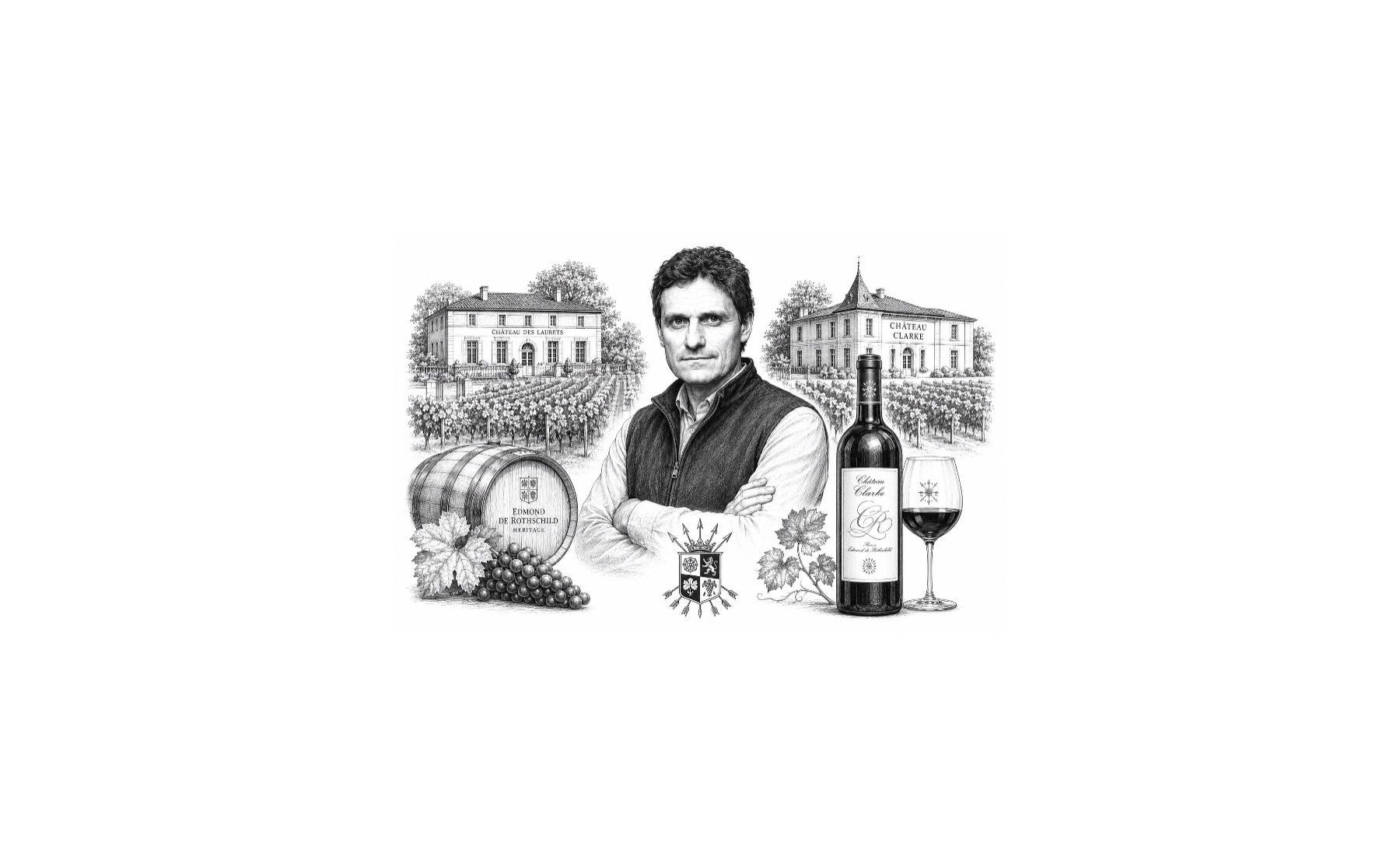
For Bordeaux’s historic estates, technical appointments are rarely just internal housekeeping. They can signal a shift in vineyard priorities, a recalibration of style, or a quiet response to market pressure. At Edmond de Rothschild Heritage, the elevation of Fabrice Bandiera to technical director of the group’s Bordeaux wine division is one of those moves.
Already at the helm of Château des Laurets, Bandiera will now also take charge of Château Clarke, the Médoc estate long associated with the Rothschild name. His new role places him over the viticultural and winemaking activities of both properties, bringing two distinct Bordeaux identities under one technical command.
The change follows the departure of Fabrice Darmaillacq, who leaves Château Clarke after more than nine years as technical director to become deputy director at Château Lagrange in Saint-Julien-Beychevelle. For Edmond de Rothschild Heritage, the succession is not simply a replacement. It is being framed as a broader Bordeaux project: one built around estate synergies, adaptation to consumer expectations, and the increasingly urgent technical questions posed by climate change.
Bandiera’s appointment comes at a moment when Bordeaux estates, especially those outside the most speculative first-growth orbit, are being forced to define their relevance more sharply. Collectors still prize history, terroir and name recognition, but the market has become more selective. Consumers are asking for wines that are not only age-worthy and classically framed, but also more immediately legible, balanced and responsive to changing drinking habits. Meanwhile, hotter vintages, water stress and shifting ripening windows are forcing technical teams to revisit decisions that once seemed settled.
In that context, Edmond de Rothschild Heritage’s decision to consolidate its Bordeaux technical direction looks strategic. Château Clarke and Château des Laurets do not occupy identical positions in Bordeaux’s hierarchy, but together they offer the group a broader platform: the Médoc on one side, Saint-Émilion satellite country on the other. The challenge now is to preserve the integrity of each estate while building enough shared technical culture to improve consistency, agility and market clarity.
Bandiera brings an unusually deep internal profile to the task. Originally from the Entre-deux-Mers and from a family of winegrowers based in Castelviel, he began his career in family-run properties before working with Vignobles Cazes and AXA Millésimes. He joined Château des Laurets in 1996 as a skilled vineyard worker, became technical director in 2002, and then managing director in 2018.
That trajectory matters. In an industry often eager to announce transformation through outside appointments, Bandiera represents continuity from the soil upward. His authority at Château des Laurets was not built through branding or boardroom distance, but through decades of vineyard-level familiarity. Edmond de Rothschild Heritage is now betting that this combination of practical experience, terroir knowledge and openness to innovation can be extended across its Bordeaux holdings.
The group has explicitly linked the appointment to a “transformative” project. The stated agenda includes adapting wines to new consumer expectations, evolving viticultural practices, reviewing plant material, and managing climate pressures linked to water and temperature. Those priorities are not cosmetic. They sit at the centre of Bordeaux’s next competitive phase.
For collectible wine, the word “adaptation” can be delicate. Change must not look like loss of identity. Yet the most resilient estates are increasingly those capable of making technical evolution appear seamless: finer extraction without abandoning structure, fresher profiles without forced austerity, more sustainable vineyard management without sacrificing yield discipline, and renewed plant material choices without diluting the estate signature.
At Château Clarke, that balance will be especially important. The estate’s historic resonance and Rothschild association give it visibility, but visibility alone does not guarantee collector momentum. In today’s Bordeaux market, buyers are attentive to execution. They want estates with clear direction, transparent investment and a style that answers both the cellar and the table. A unified technical lead may help sharpen that direction.
For Château des Laurets, the appointment reinforces Bandiera’s long association with the property while placing it in a more integrated Bordeaux framework. Rather than functioning as a separate estate with its own technical rhythm, it may now become part of a broader exchange of vineyard knowledge, cellar practice and strategic positioning. The word “synergies” can be overused in wine-group language, but here it points to a concrete operational question: what can two estates with different terroirs learn from one another without becoming stylistically interchangeable?
The answer will likely emerge in the vineyard first. Climate change is pushing Bordeaux properties to reconsider canopy management, soil work, rootstocks, clonal material, planting density and harvest timing. Water and temperature management are no longer peripheral sustainability topics; they are directly tied to wine style, quality and long-term estate value. A technical director overseeing multiple properties can compare responses across sites, standardise what works, and avoid repeating mistakes estate by estate.
There is also a market dimension. Edmond de Rothschild Heritage now counts 11 wine estates and brands across Bordeaux, Champagne and international regions, including Château Clarke, Château Malmaison, Château des Laurets, Château de Malengin, Champagne Barons de Rothschild, Amista, Flechas de los Andes, Macán, Rupert & Rothschild Vignerons, Rimapere and Akarua. In that portfolio, Bordeaux remains both a heritage anchor and a competitive proving ground. Strengthening the technical coherence of the Bordeaux pole may help the group speak more clearly to merchants, collectors and international buyers.
The appointment also reflects a wider truth about Bordeaux’s middle and upper-middle market. The region’s most famous names may still command global attention, but the estates that will gain ground are those able to demonstrate precision and purpose. Buyers are less patient with reputational drift. They reward properties where vineyard choices, winemaking style and commercial positioning appear aligned.
Bandiera’s new brief therefore extends beyond cellar management. It is about translating estate identity into market resilience. That means understanding what consumers now expect from Bordeaux: freshness without thinness, drinkability without simplicity, environmental credibility without marketing excess, and value without the impression of compromise. For historic estates, this is a demanding equation.
Arthur Lassale, deputy managing director of Edmond de Rothschild Heritage, has positioned the appointment as part of an ambitious project to adapt the wines not only to consumer expectations but also to the rapid changes affecting the terroirs themselves. That dual framing is important. It acknowledges that the pressure on Bordeaux is coming from both ends: the market is changing, and so is the vineyard.
For collectors, the immediate impact will not be visible overnight. Technical leadership changes reveal themselves over vintages, not press releases. The first indicators will be subtle: harvest decisions, extraction choices, oak integration, parcel selection, the handling of warm years, and the communication around each estate’s evolution. Over time, the question will be whether Château Clarke and Château des Laurets become more sharply defined, more consistent, and more compelling within their respective categories.
There is little doubt that Edmond de Rothschild Heritage wants a more coordinated Bordeaux story. By entrusting both Château Clarke and Château des Laurets to Fabrice Bandiera, the group is choosing an insider with long-term vineyard credibility rather than a disruptive outsider. That choice suggests evolution rather than rupture.
In a market that increasingly separates estates with a clear future from those merely trading on the past, that may be the point. Château Clarke and Château des Laurets are being asked to remain historic, but not static. Bandiera’s task is to make that transition visible in the glass.