

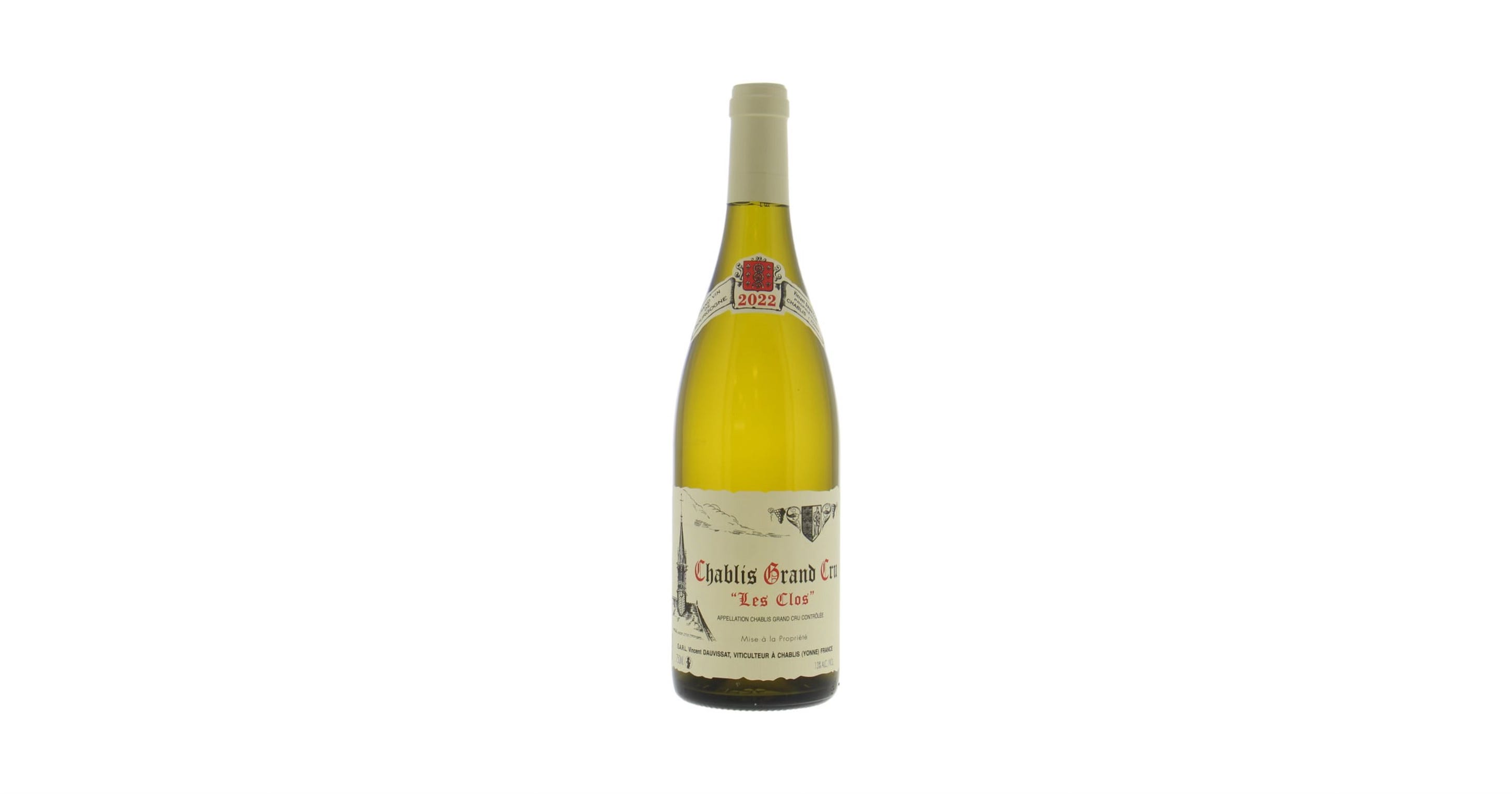
Domaine Vincent Dauvissat: Chablis Grand Cru 'Les Clos'
Terroir, time, and four generations of uncompromising craft behind Chablis's most revered white wine
Introduction: The Summit of Chablis
Within the hierarchy of French fine wine, few white wines occupy the rarefied position held by Domaine Vincent Dauvissat’s Chablis Grand Cru Les Clos. It is not merely one of the finest expressions of its appellation; it is among the most compelling arguments for Chardonnay as a grape capable of producing wines that rival the greatest expressions of any variety, in any region, across any era. To speak of Dauvissat’s Les Clos is to address questions that run to the core of what defines fine wine: the relationship between terroir and human decision-making, the tension between tradition and adaptation, and the capacity of a single vineyard, tended by a single family, to yield wines of extraordinary longevity and intellectual depth.
The appellation of Chablis Grand Cru, formally established by decree in 1938, encompasses approximately one hundred hectares distributed across seven named climats on a single southwest-facing hillside overlooking the town of Chablis and the Serein river. Of these seven—Bougros, Les Preuses, Vaudésir, Grenouilles, Valmur, Les Clos, and Blanchot—Les Clos is both the largest and, by broad critical consensus, the most esteemed. Its wines define a benchmark: they are the standard against which all other Chablis, and arguably all other unoaked or lightly oaked Chardonnay, must be measured.
Domaine Vincent Dauvissat’s custodianship of Les Clos is central to the vineyard’s modern reputation. Alongside Domaine François Raveneau, Dauvissat is universally regarded as Chablis’s greatest producer. The two domaines together form the twin pillars upon which the region’s claim to greatness rests. Where Raveneau’s wines tend toward a crystalline, almost ethereal finesse, Dauvissat’s interpretations—particularly of Les Clos—favour a broader, more muscular, and more architecturally complex expression. They are wines of immense concentration but also of tension, wines whose hallmark is a structural density that can take decades to fully unfold.
The domaine’s history begins in the 1920s, when Robert Dauvissat first began bottling his own production—an uncommon practice at the time, when most Chablis growers sold their fruit or wine to négociants. Robert’s son René, working from the 1950s onward, expanded the family’s holdings and cemented the domaine’s reputation for wines of exceptional quality. Vincent, René’s son, joined his father at the end of the 1970s and assumed full control in 1989. Under his stewardship, the domaine reached its current zenith. His adoption of biodynamic viticulture from 2002, his refusal to compromise on yield, his insistence on whole-cluster pressing and barrel ageing in a region where stainless steel had become dominant—all of these decisions have shaped the character of his Les Clos into one of the most distinctive and revered wines in France.
In 2013, Vincent’s children Ghislain and Étiennette joined the domaine, marking the transition to a fourth generation. Vincent technically retired at the beginning of 2020, though by all accounts he remains intimately involved in the vineyards and cellar. The continuity of this family’s vision—across nearly a century of viticulture, through phylloxera, frost, war, economic upheaval, and climatic change—is itself a narrative of unusual coherence in a region where many vineyards have changed hands repeatedly.
The cult status of Dauvissat’s Les Clos has intensified markedly since the early 2000s. A devoted following among France’s most esteemed restaurateurs has long limited the quantity available for export. On the secondary market, bottles now command prices that reflect the wine’s scarcity, its critical standing, and the broader inflation in fine Burgundy. The wine is regularly scored at the highest levels by critics across major publications—Vinous, The Wine Advocate, Burghound, Decanter, and others—and has been the subject of celebrated vertical tastings that have confirmed the extraordinary consistency and longevity of the domaine’s production across more than three decades.
To understand Dauvissat’s Les Clos fully, however, one must move beyond the language of scores and prices. This is a wine that exists at the intersection of geology, climate, viticulture, and winemaking philosophy. Its identity is inseparable from the Kimmeridgian marl on which it grows, from the particular parcels the family has tended across generations, and from a set of winemaking choices that are as much ethical as they are technical. What follows is an attempt to examine that identity in full.
Vineyard and Terroir
Les Clos: Location, Size, and Context
Les Clos is the largest of the seven Chablis Grand Cru climats, covering approximately 26 hectares (various sources cite figures between 24.75 and 27 hectares, reflecting minor boundary adjustments and measurement methods). It occupies the southeastern portion of the Grand Cru hillside, situated between Valmur to its north and Blanchot wrapping around the hill to the east. The vineyard rises sharply and uniformly from the valley floor—just east of the town of Chablis—up to the hilltop, at altitudes ranging from approximately 130 to 250 metres above sea level. The slope faces predominantly southwest, ensuring that the vines receive direct sunlight from midday through the late afternoon.
The name itself is historically significant. Archives indicate that vines existed on this site before 1267, and the term “Les Clos” refers to the stone walls that once enclosed the most prized vineyard parcels—a common practice among monastic landowners in mediaeval Burgundy to protect against erosion, weather, and theft. The monks of the region are widely credited with first recognising the exceptional quality of this particular hillside. These walls have long since disappeared, and the vineyard was devastated by phylloxera at the end of the nineteenth century, like the rest of the region. But the site’s prestige has endured for more than seven centuries.
Today, Les Clos is divided among approximately twenty-eight individual owners. Including négociant bottlings, there are considerably more than twenty-eight expressions of Les Clos available on the market in any given year, but only a handful command the attention that Dauvissat’s bottling receives.
Dauvissat’s Parcels Within Les Clos
Dauvissat’s holdings within Les Clos have varied over the years due to inheritance arrangements and replanting. The domaine’s vineyard area in Les Clos is cited at different points as 1.70 hectares (by bestofwines.com and other retailers) and approximately 1.0 hectare in more recent allocations (as listed by importers such as Alliance Wine for the 2023 vintage). The Vinous vertical tasting article from November 2019, based on detailed conversations with Vincent Dauvissat, described roughly a hectare of vines spread across multiple parcels in the middle and upper reaches of the slope. A 2017 Decanter note referenced seven parcels—four above the main path that traverses the vineyard and three below it—but noted that the volume had been reduced by replanting and inheritance considerations.
The parcels occupy different soil types and expositions within the climat. Some lie on white marl soil—essentially calcareous clay—high up on the hillside. Others sit on deeper marl in the middle of the slope. A third category, described by Dauvissat as easier to work, features darker soil with higher clay content and some underground moisture. This last type is more vulnerable to spring frost due to its humidity, though extreme frost events can affect the upper parcels as well. Despite this internal diversity, Dauvissat performs a single vinification for Les Clos, as the harvest from all parcels typically falls within a day or two.
Geological Context: Kimmeridgian Marl
The bedrock of the Chablis Grand Cru vineyards is Kimmeridgian limestone marl, a geological formation dating to approximately 150 million years ago, when a warm, shallow sea covered much of what is now northern France. The Kimmeridgian stage takes its name from the village of Kimmeridge in Dorset, England, where the formation was first identified. It consists of alternating layers of limestone and clay-rich marl deposited on the ancient seabed. This marl is characteristically soft, chalky, and rich in marine fossils—most famously the tiny comma-shaped oyster Exogyra virgula, but also ammonites and other organisms whose calcareous shells have been compressed into the matrix of the soil.
The Kimmeridgian soils of Les Clos are not homogeneous. Toward the top of the slope, the soil becomes stonier, with a higher proportion of limestone fragments and a thinner layer of clay loam over the bedrock. Toward the base, the soil is deeper, more clay-rich, and retains more moisture. This variation is widely believed to contribute to the particular tension in Les Clos wines—the combination of power (from the deeper, clay-rich lower parcels) and minerality (from the stonier upper sections).
Overlying the Kimmeridgian in some areas is the slightly younger Portlandian (now often termed Tithonian) limestone, which is harder, more brittle, and less rich in clay and fossils. The Portlandian formation predominantly underlies the Petit Chablis appellation on the plateaux above the Grand Cru slopes. The interplay between these two geological layers—Kimmeridgian on the mid-slopes, Portlandian above—shapes drainage patterns and root development throughout the Grand Cru hillside.
The significance of Kimmeridgian soil to Chablis is a matter of long-standing discussion. The Wine Tribunals of 1923 originally defined Chablis as wine grown on Kimmeridgian subsoil, though this reference was formally discontinued in 1976, reflecting the growing understanding that slope and orientation are of at least equal importance to soil type in determining wine quality. Geologist Jennifer Huggett has noted that identical geological conditions extend both northeast and southwest of the Grand Cru slope but are classified only as Premier Cru—suggesting that Kimmeridgian soil alone is not the sole determinant of grand cru status. It is, rather, the combination of soil, slope, exposure, and microclimate that defines the excellence of sites like Les Clos.
Exposure, Altitude, Microclimate, and Drainage
Les Clos’s southwest exposure is among its most defining features. In the semi-continental climate of Chablis—where the growing season is short, spring frosts are a perennial threat, and ripeness is hard-won—this orientation provides the vines with direct sunlight from midday through evening. The slope is relatively steep and notably uniform, making Les Clos one of the most homogeneous terroirs on the Grand Cru hill. This consistency translates into reliability: Les Clos tends to ripen more evenly and completely than some of the other Grand Cru climats, producing wines that are fuller-bodied and more powerful, yet tempered by the naturally high acidity conferred by the northern latitude and limestone soils.
The drainage characteristics of the site are also critical. The Kimmeridgian marl, while clay-rich enough to retain some moisture during dry spells, sits atop cracked limestone that allows excess water to percolate downward. This forces vine roots deep into the subsoil in search of water, a condition widely believed to enhance the mineral character and concentration of the resulting wine. The rapid drainage also means that waterlogging is rare, even in wet years, though the clay-rich lower parcels can suffer from excessive humidity in spring.
The microclimate of Chablis is significantly cooler than that of the Côte d’Or, located more than 100 kilometres to the southeast. The town of Chablis is, in fact, closer to the vineyards of Champagne than to those of Beaune. Spring frosts remain the most serious viticultural hazard; major frost events in 2016, 2017, and 2021 reduced yields dramatically across the region, with Dauvissat among the most affected producers. Climate change has introduced new variables: warmer summers have improved ripeness in historically marginal vintages, but have also brought increased risk of hailstorms, drought stress, and premature phenolic development.
Farming Philosophy
Vincent Dauvissat adopted biodynamic viticulture in 2002, applying its principles rigorously but without seeking official certification. The decision reflected his long-standing conviction that the health of the vine and the pure expression of terroir depend on working in harmony with natural cycles. Biodynamic preparations are used to enhance soil vitality, and synthetic herbicides and pesticides have been eliminated. Yields are strictly controlled, typically not exceeding 50 hectolitres per hectare for the Grands Crus—modest by the standards of the region. Pruning and ébourgeonnage are rigorous, and the vines are tended with the meticulous attention that the domaine’s small scale makes possible.
This approach carries real risk. Biodynamic viticulture in a frost-prone, semi-continental climate demands vigilance and flexibility. In difficult vintages—years of heavy rot pressure, repeated frost, or extreme weather—the domaine’s yields can fall well below their already conservative targets. The 2016 and 2017 vintages, marked by severe spring frosts and hailstorms, saw production reduced to a fraction of normal levels. But the philosophy is non-negotiable: as Vincent has said, the force of the terroir is the guiding principle.
Grape Composition and Viticultural Choices
Dauvissat’s Les Clos is produced exclusively from Chardonnay, as mandated by the Chablis Grand Cru appellation rules. There are no blending partners, no skin-contact experiments, no varietal diversions. The purity of the varietal expression is absolute.
The vines in the Les Clos parcels are old. At the time of the 2019 Vinous vertical tasting, Dauvissat described the average age as approximately fifty-five years, with many vines he characterised as “tiring.” The oldest plantings date from periods when massal selection—propagation from the domaine’s own best-performing vines—was standard practice. This genetic diversity, accumulated over decades of selection, is believed to contribute meaningfully to the complexity and depth of the wine. More recent replanting (a parcel was pulled up for eventual replanting, with a rest period of five or six years before new vines would go in) will introduce younger vines, but the domaine’s commitment to maintaining old-vine character means that the proportion of young-vine fruit in the blend has historically been negligible.
Yield control is fundamental to Dauvissat’s approach. Rigorous pruning, early bud removal, and the natural limitations imposed by old vines and biodynamic farming conspire to keep yields modest. In generous vintages, this restraint produces wines of remarkable concentration; in lean years, the small crop can be further diminished by frost or hail, making quantities unpredictably small. The domaine’s total annual production across all cuvees is estimated at approximately 70,000 to 80,000 bottles—a tiny figure by any measure, and of that, the Les Clos cuvee represents only a small fraction.
The viticultural calendar follows biodynamic rhythms. Treatments in the vineyard are limited to copper-based preparations and natural tisanes. The goal at every stage is to bring healthy, fully ripe fruit to the press—fruit that carries within it the authentic expression of the terroir, unobscured by chemical intervention.
Vinification and Élevage
Harvest and Pressing
Harvest at Dauvissat is conducted entirely by hand. The fruit is not destemmed; whole clusters are brought directly to the press. This practice, traditional in Chablis but increasingly rare among producers focused on efficiency, allows for a gentler extraction and contributes to the wine’s textural complexity. There is no fixed harvest order among the domaine’s various parcels. As Vincent explained in the 2019 Vinous interview, the harvest begins when conditions are right for each individual plot. In some years, Les Clos is the first vineyard harvested; in others, it is the last.
Pressing is slow, with whole clusters processed in a pneumatic press. A débourbage (natural gravity settling of solids) follows, typically lasting around twelve hours. This step removes the heaviest lees while retaining enough fine particulate matter to nourish the fermentation and contribute to textural richness.
Fermentation
Fermentation takes place predominantly in enamelled steel vats, with a small proportion of the must going into new oak barrels. When the grape skins are healthy, indigenous yeasts begin the fermentation naturally and promptly. Primary fermentation typically lasts between fifteen and twenty-one days. In vintages where rot has compromised the grape skins—and with them the natural yeast populations—Dauvissat does not hesitate to inoculate with neutral yeasts. He has been characteristically pragmatic about this, noting that the force of the terroir is stronger than that of the yeasts.
Malolactic fermentation occurs spontaneously, usually completing between January and March following the harvest, though the timing can vary. Only the natural cold of winter is used to precipitate tartrate crystals; there is no chilling or filtration for tartrate stability. This is a significant philosophical commitment: the wine arrives in bottle essentially unmanipulated, with its natural chemistry intact.
Oak and Élevage
Dauvissat is one of only a handful of estates in Chablis that continues to age all of its wines in oak barrels. In a region where stainless steel fermentation and ageing have become the overwhelming norm, this practice is both a declaration of traditionalism and a calculated stylistic choice. René Dauvissat articulated the rationale clearly: the synergy of air and wood adds character and helps soften the wine, and without oak, Chablis is too hard and too austere.
The barrels used are primarily six-to-eight-year-old pièces and the smaller 132-litre feuillettes traditional to Chablis, sourced from the forests of Nevers. The proportion of new oak for Les Clos is approximately twenty percent, though this figure fluctuates with circumstances. In vintages of dramatically reduced yields—such as 2016 and 2017, when frost damage was severe—Dauvissat purchased no new barrels at all. The use of predominantly neutral barrels ensures that the wood serves as a vessel for micro-oxygenation and textural development rather than as a flavouring agent. The goal is not to impart oak character but to allow the wine to breathe during its maturation, developing complexity and structure that stainless steel alone would not provide.
Élevage lasts between eight and eighteen months depending on the cuvee and the vintage. Les Clos, as the domaine’s most structured wine, typically spends the longer end of this range in barrel. Vincent avoids bâtonnage (lees stirring), convinced that the practice alters and obscures the expression of terroir. The wines are neither fined nor filtered before bottling. Sulphur additions are kept to a minimum: typically around twenty parts per million free and sixty-five to seventy total at bottling.
Bottling and Its Implications
The low-intervention bottling regime—no fining, no filtration, minimal sulphur—is directly connected to the wine’s ageing potential. Wines bottled with their full complement of fine lees, natural enzymes, and phenolic compounds tend to develop more slowly and with greater complexity than those subjected to aggressive clarification. The trade-off is a degree of bottle variation that more industrially processed wines do not exhibit. This is a feature, not a flaw, in the eyes of the serious collector: each bottle of Dauvissat Les Clos is, in a meaningful sense, alive and evolving.
The wines are sealed with wax capsules, a Dauvissat signature that adds a modest layer of protection against premature oxidation and contributes to the domaine’s distinctive visual identity.
Vintage-by-Vintage Analysis
The following analysis traces the trajectory of Dauvissat’s Les Clos through key vintages, drawing on published critical assessments, the 2019 Vinous vertical tasting covering 1983–2015, and subsequent vintage reviews. The aim is not to catalogue scores but to illuminate how the wine expresses time, context, and decision-making across decades of production.
The Foundational Decades: 1960s–1980s
Wine-Searcher listings indicate that vintages of Dauvissat Les Clos exist on the market dating as far back as 1962, 1969, 1970, and through the 1970s. These early bottlings, produced under Robert and then René Dauvissat, predate Vincent’s involvement and represent a period when the domaine’s production was smaller and its international reputation still developing. Bottles from this era are extraordinarily rare and almost never appear at auction. Those that have been tasted in recent years have generally shown remarkable persistence, confirming the inherent longevity of Les Clos fruit handled traditionally.
The 1983 vintage, the earliest included in the 2019 Vinous vertical, was described as still vital after more than thirty-five years. It demonstrated the capacity of well-stored Dauvissat Les Clos to age far beyond what most consumers expect of white Burgundy. The 1985, 1986, and 1988 vintages, all produced during the period when Vincent was working alongside René, have shown varying degrees of evolution: the 1988 is generally considered the strongest of the trio, reflecting a vintage of excellent balance across Chablis.
The 1990s: Growing Reputation
The 1990 vintage is widely regarded as one of the great benchmarks of the domaine’s history. A warm, generous year across Burgundy, 1990 produced a Les Clos of exceptional richness and concentration. Over three decades later, well-stored bottles continue to show remarkable depth, having passed through their initial opulence into a more complex, savoury register. The 1992 and 1993 vintages, by contrast, reflected the cooler and more challenging conditions of those years—leaner, more angular wines that matured more quickly but offered genuine Chablis character.
The 1995 and 1996 pair illustrate the classic warm-year/cool-year dynamic. The 1995 brought generous fruit and roundness, while the 1996—one of the most celebrated vintages in Chablis history—produced a Les Clos of extraordinary tension, acidity, and mineral intensity. The 1996 remains, by broad consensus, among the finest vintages Dauvissat has produced, a wine of steely power that continues to evolve. The 1997 and 1998, less heralded at the outset, have shown respectable development. The 1999, from a generous and ripe vintage, offered early charm but proved to have less structure for very long-term ageing than the 1996.
2000–2009: The Modern Era Begins
The 2000 vintage was correct and well-made but did not reach the heights of the surrounding years. The 2001, by contrast, was excellent—winning two stars in the Guide Hachette des Vins—and showed the kind of crystalline acidity and mineral depth that Les Clos produces in its finest iterations. The 2002, another benchmark year for Chablis, combined richness with precision and has aged superbly. The move to biodynamic viticulture, adopted that year, would begin to shape the wines’ character going forward.
The 2003 vintage, from an unprecedented heatwave, was atypical: broader, lower in acidity, and more overtly rich than the norm. It represented a departure from the classic Dauvissat profile and has evolved more quickly than cooler vintages. The 2004, a return to more classical conditions, produced a structured wine with better long-term potential. The 2005 was another notable success—rich, concentrated, and balanced—earning two stars in the Guide Hachette. The 2006 was a vintage of moderate ambition but solid craftsmanship.
The trio of 2007, 2008, and 2009 represents a remarkable run. The 2007, from a late-ripening, classically proportioned vintage, delivered elegant tension and fine mineral detail. The 2008, another vintage of exceptional purity and acidity, produced a Les Clos of bracing intensity that critics identified early as a wine with decades of life ahead. The 2009, warmer and more generous, offered a broader, more immediately appealing profile without sacrificing the underlying structure.
2010–2015: Consistency Under Pressure
The 2010 vintage is among the most universally acclaimed of the decade. An initially tight and reticent wine, it has gradually opened to reveal layers of complexity: notes of honeycomb, citrus oil, and oyster shell, with a saline, chiselled finish of immense length. The Burghound tasting note described it as textbook Les Clos with size, power, and explosive energy. The 2010 was produced from seven parcels of fifty-plus-year-old vines totalling 1.7 hectares, according to Farr Vintners’ records.
The 2011 offered more modest ambitions—a correct, well-crafted wine from a challenging vintage that lacked the concentration of its predecessor but remained true to the Les Clos identity. The 2012, by contrast, returned to form: a vintage of precision and energy that many critics compared favourably to the 2010, if slightly less monumental in scale. The 2013, from a late and cool season, produced a leaner style that emphasised the mineral and saline elements over fruit generosity.
The 2014 is widely considered one of the finest Dauvissat Les Clos of the modern era. A vintage of exceptional balance, it combined the concentration and depth of a warm year with the acidity and tension of a cool one. The wine possessed a rare structural completeness that prompted some critics to compare it to the legendary 1996. The 2015, marked by a hailstorm just before the anticipated harvest start, was nevertheless superb: exquisitely defined, with the most closed profile of the 2015 range at Dauvissat. Vincent himself said he would wait ten years before opening it. He also noted that neutral yeasts were added due to hail damage to grape skins.
2016–2023: Frost, Climate, and Generational Transition
The 2016 and 2017 vintages were defined by severe spring frosts that devastated yields across Chablis. Dauvissat’s production was among the most affected. No new barrels were purchased in either year. Despite the dramatically reduced volumes, the quality of the resulting wines was remarkably high. The 2017 Les Clos was described by one major critic as utterly mesmerizing, a wine of total seduction and rapturous beauty, scoring near-perfect marks from multiple publications. The frost-limited yields produced wines of extraordinary concentration that were, paradoxically, not out of the ordinary in their concentration profile—a testament to Dauvissat’s philosophical refusal to let reduced yields dictate an unnaturally concentrated style.
The 2018 vintage, warm and generous, produced a Les Clos of broad-shouldered richness. The 2019, another warm year, was similarly powerful. The 2020 was exceptional by nearly all critical measures—receiving scores at or near the highest marks from The Wine Advocate, Vinous, and others—combining the warmth of the vintage with a structural precision that elevated it above mere richness. The 2021, affected once again by severe frost, offered a more floral and citrus-inflected profile, taut and salty on the palate. The 2022, from a ripe year, was described as a tour de force: generous in structure, muscular, and more fruit-forward than Les Preuses, but retaining the tension and chalky extract expected of Les Clos. The 2023, still in its earliest stages of release, continues the domaine’s pattern of adapting its style to each vintage’s conditions while maintaining an unmistakable house identity.
Style, Identity, and Structural Sensory Profile
Dauvissat’s Les Clos possesses a stylistic identity that transcends individual vintages. Across decades of production, certain constants emerge that define the wine’s character and distinguish it from other producers’ bottlings of the same climat, and from the domaine’s own Les Preuses.
The defining structural feature is density. Dauvissat’s Les Clos is a wine of exceptional textural weight—not heaviness, but substance. It fills the palate with a viscous, almost oily concentration that is paradoxically paired with an acidity of penetrating sharpness. This tension between substance and cut is the wine’s signature. It is what makes Les Clos, in Dauvissat’s hands, not merely a powerful wine but an intelligent one: a wine that engages the palate at multiple levels simultaneously.
Compared to Les Preuses, the domaine’s other Grand Cru, Les Clos is consistently the more muscular, more overtly mineral, and more closed in its youth. Vincent himself has described Les Preuses as the opposite of Les Clos. Where Les Preuses tends toward a Zen-like harmony and understatement, Les Clos is more rambunctious, more demonstrative, more insistent. It demands patience. Young bottles can be impenetrable—tightly wound, mineral-dominated, almost austere. It is a wine that reveals itself on its own schedule.
In bottle, the evolution follows a characteristic arc. In its first three to five years, the wine presents a concentrated, often reductive profile: mineral, saline, marked by an almost chalky phenolic texture. Between five and ten years, the secondary characteristics begin to emerge—a broadening of texture, the development of honeyed and waxy notes, and the gradual integration of the subtle oak influence into the fabric of the wine. Between ten and twenty years, the tertiary phase introduces layers of complexity: iodine, tidal pool, mushroom, truffle, smoked almonds, and a distinctive lanolin quality that is almost unique to old Chablis from Kimmeridgian soils. The finest vintages can continue to develop for thirty years or more.
The saline quality of the wine—often described in terms of oyster shell, seawater, or iodine—is neither metaphor nor affectation. It is a measurable aspect of the wine’s chemical profile, likely connected to the high mineral content of the Kimmeridgian marl and the depth at which the vine roots access the subsoil. This salinity, combined with the wine’s elevated natural acidity, produces a finish that can seem to go on indefinitely: dry, stony, and palate-etching. It is the finish, more than any other single attribute, that distinguishes Dauvissat’s Les Clos from lesser expressions of the terroir.
Within the broader context of Chablis Grand Cru, Dauvissat’s Les Clos occupies the apex of a tradition-minded style. Producers like William Fèvre, Domaine Long-Depaquit, and Louis Moreau make fine Les Clos bottlings, but their winemaking philosophies—often involving more stainless steel, more modern temperature control, and different approaches to oak—yield wines that tend to be more immediately accessible and less demanding of cellaring. Dauvissat’s interpretation, like Raveneau’s, insists on a longer perspective: these are wines conceived for the cellar, designed to reward patience, and structured to outlast their more approachable counterparts.
Aging Potential and Cellaring
The ageing trajectory of Dauvissat’s Les Clos is among the most impressive of any white wine produced outside the oxidative traditions of the Jura, Madeira, or the great Rieslings of the Mosel. The 2019 Vinous vertical, which traced the wine back to 1983, confirmed that well-stored bottles retain vitality and continue to evolve positively over three decades or more. The oldest wines showed neither fatigue nor oxidation, only a deepening complexity and a gradual shift from primary fruit and mineral intensity toward tertiary richness.
Short-Term (1–5 Years)
In its first five years, Dauvissat’s Les Clos is typically closed and unyielding. The wine can be appreciated for its structural density and its sheer intensity of mineral character, but the nuances that define its greatness are locked away. Drinking the wine young is not objectionable, but it is, in a real sense, a waste: the investment of terroir, old vines, and meticulous winemaking has not yet been repaid. The domaine itself, and most serious critics, counsel a minimum of eight years of cellaring for Les Clos.
Medium-Term (5–15 Years)
This is the period during which Les Clos begins to open. The primary fruit notes broaden, secondary complexity develops, and the integration of acid, phenolics, and extract creates a wine of increasing harmony. Vintages of moderate structure (such as 2011 or 2013) may approach their optimal drinking window within this period. The great vintages (1996, 2002, 2010, 2014, 2020) will still be evolving and will reward further patience.
Long-Term (15–30+ Years)
The finest vintages of Dauvissat’s Les Clos enter their tertiary phase after fifteen to twenty years and can continue to develop for a decade or more beyond that. At this stage, the wine has transcended its youth: it is no longer merely a powerful Chablis but has become something genuinely rare—a white wine of intellectual complexity comparable to the finest aged Montrachet, Meursault-Perrières, or Haut-Brion Blanc. The 1983, tasted at thirty-six years of age, and the 1990, approaching thirty-five, have both confirmed this potential.
Storage Conditions
The wine demands impeccable storage: a constant temperature between 10 and 14 degrees Celsius, humidity of 70–80 percent, absence of vibration, and protection from light. The wax capsule provides a degree of insulation, but it is not a substitute for proper cellaring. Provenance is critical on the secondary market: bottles that have been poorly stored will not achieve the longevity that well-stored examples demonstrate. The difference between a professionally cellared 2002 and one that has spent time in variable conditions can be dramatic.
Market Value and Investment Perspective
Price Evolution
The market price of Dauvissat’s Les Clos has risen substantially over the past two decades, tracking the broader appreciation in fine Burgundy prices but also reflecting factors specific to the domaine. As of early 2026, the average price across vintages is approximately 448 USD per 750ml bottle on Wine-Searcher, making it the second-highest-priced wine produced from Chardonnay in the Chablis Grand Cru Les Clos climat. Individual vintages vary: recent strong vintages such as 2020 command higher premiums, while older vintages with established critical reputations can trade significantly above average depending on provenance and condition.
The price trajectory has been one of steady, sustained growth rather than speculative spikes. This stability is characteristic of wines whose demand is driven primarily by consumption rather than investment—the wine is bought to be drunk, and the market for it is sustained by serious collectors, sommeliers, and enthusiasts rather than by financial speculators.
Scarcity and Production
Production volumes are extremely small. The domaine’s total output across all cuvees is estimated at 70,000 to 80,000 bottles annually. Les Clos, from roughly one hectare of vines, represents a fraction of this total. In full-production vintages, the yield might amount to a few thousand bottles; in frost-affected years like 2016, 2017, or 2021, the figure can drop dramatically. A significant portion of the production is allocated directly to French restaurants and long-standing private clients, further limiting the quantity that reaches the open market.
Secondary Market Liquidity
Despite its rarity, Dauvissat Les Clos does appear with some regularity on auction platforms such as iDealWine, and through specialist merchants. The wine’s reputation and critical standing ensure a ready buyer pool, and well-provenanced bottles trade efficiently. However, the thin supply means that individual sales can exhibit price volatility, particularly for sought-after older vintages or frost-affected rarities.
Comparative Performance
Relative to comparable white Burgundy—the Grands Crus of Puligny-Montrachet and Chassagne-Montrachet, the top Meursault producers, or Raveneau’s own Les Clos—Dauvissat offers a value proposition that remains attractive, though the gap has narrowed significantly. The price of entry is high in absolute terms but moderate relative to top Côte d’Or whites, and the wine’s proven longevity means that the cost-per-year-of-drinkability compares favourably.
Risks
Collectors and investors should consider several risk factors. First, the generational transition—while the involvement of Ghislain and Étiennette appears seamless, any change in stewardship at a domaine of this nature introduces uncertainty. Second, climatic risk: the increasing frequency of spring frosts, hailstorms, and drought events in Chablis threatens both the consistency of production and the long-term viability of the current viticultural model. Third, the broader Burgundy market itself is subject to cyclical correction; the sustained price appreciation of the past two decades is not guaranteed to continue. Fourth, provenance and storage risk on the secondary market remains a perennial concern for white Burgundy. Analytical and descriptive assessment of these risks is essential for informed decision-making; none should be interpreted as speculative encouragement or discouragement.
Cultural and Gastronomic Significance
Dauvissat’s Les Clos occupies a distinctive position within French wine culture. It is not a wine of conspicuous display; unlike the trophy Burgundies of the Côte de Nuits—Romanée-Conti, La Tâche, Musigny—it does not carry the weight of aristocratic symbolism or the glamour of global celebrity collectors. Its prestige is quieter, more internal to the world of serious wine knowledge. To order Dauvissat Les Clos in a Parisian restaurant is to signal a particular kind of connoisseurship: an appreciation for Chablis not as a stepping stone to “greater” Burgundy but as a complete and autonomous expression of French terroir.
The domaine’s devoted following among France’s most esteemed restaurateurs is not accidental. Chablis—and Dauvissat’s Les Clos in particular—possesses a gastronomic versatility that few other wines can match. At the table, its high acidity, mineral intensity, and saline character make it an extraordinary partner for seafood in all its forms: raw oysters (the geological echo is almost too poetic), grilled fish, lobster, crab, and the refined shellfish preparations of classical French cuisine. In its youth, the wine functions as an electrifying counterpoint to rich, buttery preparations; with age, it develops the complexity to stand alongside more elaborate dishes—turbot in cream sauce, poultry with truffles, aged Comté.
The wine has featured in notable comparative tastings and retrospectives organised by publications including Vinous, Burghound, and Decanter. The 2019 Vinous vertical, spanning vintages from 1983 to 2015, was among the most comprehensive critical evaluations ever conducted of a single Chablis domaine’s production and helped to further cement Dauvissat’s Les Clos as one of the reference points against which all serious Chablis must be measured.
Within the broader narrative of French wine culture, Dauvissat’s Les Clos stands as an argument for terroir as the ultimate determinant of quality. It is a wine that cannot be replicated elsewhere—not in California, not in Australia, not in the Côte d’Or. Its identity is so deeply embedded in the particular combination of Kimmeridgian marl, northern exposure, old vines, and a family’s century-long commitment to a single vision that it resists all attempts at imitation. In an age of international Chardonnay and stylistic homogenisation, this singularity is itself a cultural achievement.
Conclusion
Domaine Vincent Dauvissat’s Chablis Grand Cru Les Clos is a wine that rewards every form of attention one can bring to it: the patient cellar, the careful decanting, the attentive palate, and the informed mind. It is, in the most literal sense, the product of deep time—geological time, in the Kimmeridgian marl that was laid down 150 million years ago; viticultural time, in the old vines that have been tended across four generations of a single family; and maturation time, in the decades over which the wine evolves in bottle.
Its significance extends beyond its own considerable merits as a drinking experience. Dauvissat’s Les Clos is a proof of concept: evidence that Chardonnay, grown in the right place and handled with sufficient respect, can produce wines of a complexity, longevity, and intellectual depth that rival anything in the world of fine wine. It demonstrates that Chablis—often relegated to a supporting role in the Burgundy narrative—can stand at the very summit of French viticulture.
For the collector, the wine offers proven ageing potential, relative value within the context of fine Burgundy, and a scarcity that ensures its desirability. For the professional, it is an essential reference point: a wine against which to calibrate one’s understanding of what Chablis can be. For the enthusiast, it is, quite simply, one of the great drinking experiences available in wine today—provided one has the patience, the storage, and the palate to meet it on its own terms.
The generational transition to Ghislain and Étiennette Dauvissat introduces a new chapter in the domaine’s history, one that will inevitably bring subtle shifts in approach and emphasis. What seems unlikely to change is the fundamental orientation that has defined the domaine since Robert Dauvissat first bottled his own production nearly a century ago: an uncompromising commitment to the terroir of Chablis, and the conviction that the best expression of that terroir comes from listening to the land more than from imposing one’s will upon it.