
Domaine Raveneau: Chablis Grand Cru Les Clos
A collector’s study of Chablis’ benchmark grand cru: site, élevage, vintages, cellar life, critical standing, and market gravity
Introduction
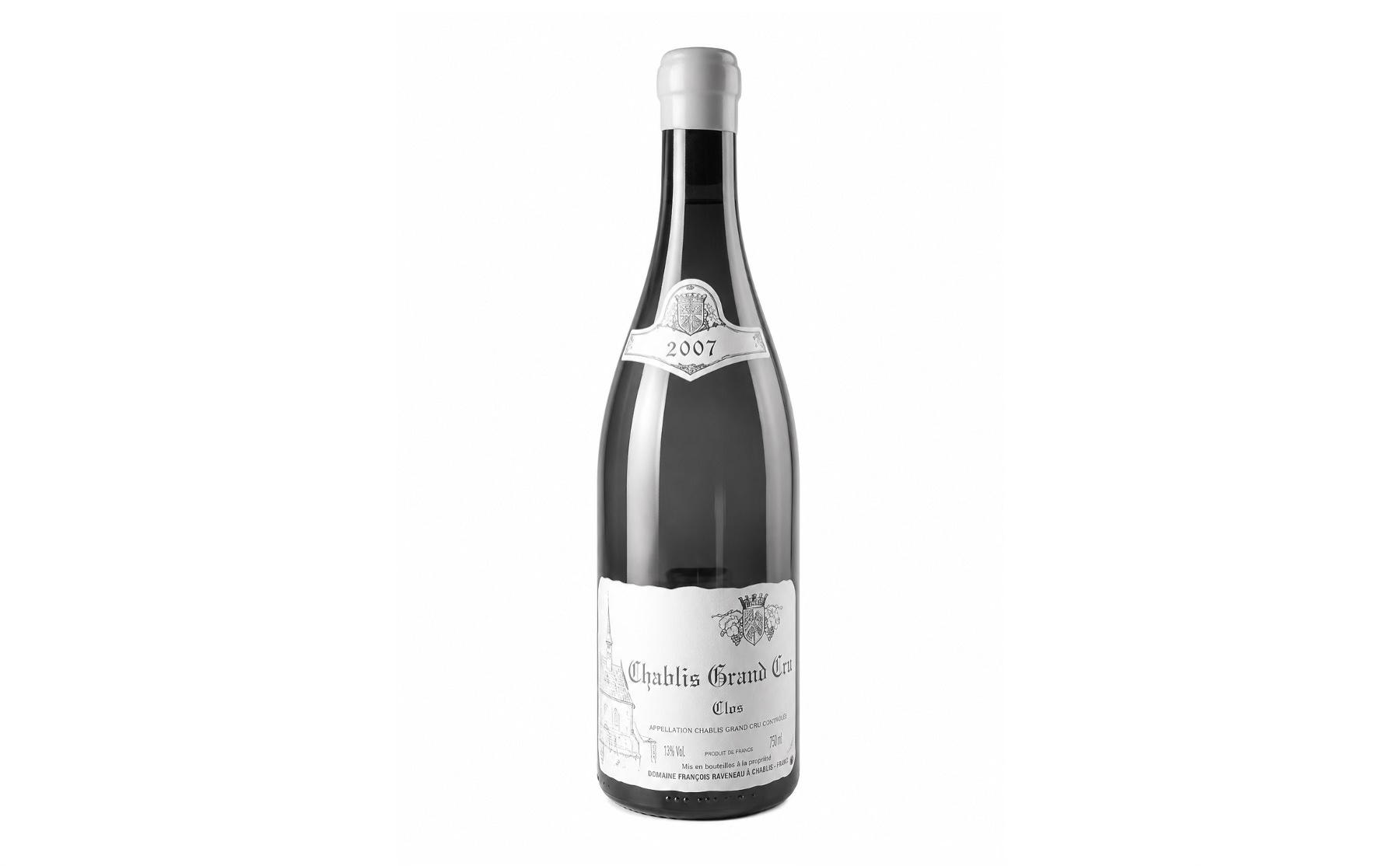
Domaine François Raveneau’s Chablis Grand Cru Les Clos belongs to the tiny group of white wines that function simultaneously as terroir benchmark, collector’s reference point, and secondary-market blue chip. Official Chablis materials describe Les Clos as the emblematic grand cru and a benchmark of the appellation, while Decanter has noted that many observers consider Raveneau’s Les Clos the domaine’s greatest wine. That prestige is now mirrored by price: Decanter reported a global average retail price for Raveneau’s current-vintage Les Clos of nearly £1,700 per bottle, roughly triple the level of a decade earlier.
For serious buyers, that status is not based on branding alone. Raveneau Les Clos sits at the intersection of three durable advantages: one of Chablis’ greatest climats, a resolutely traditional and low-intervention cellar culture, and a style that marries concentration with restraint rather than opulence with easy early charm. In a world where many elite Chardonnays are judged by amplitude and oak architecture, Raveneau’s claim to greatness rests instead on mineral authority, structural longevity, and a refusal to sacrifice site expression for seduction.
Estate and Producer Background
The domaine was established in 1948, when François Raveneau consolidated vineyard parcels he had acquired with holdings from his wife’s family. Kermit Lynch’s long-standing producer dossier records that François built the estate back at a time when some prime family parcels had already been sold off, and that his reputation rose quickly because his wines stood apart from increasingly uniform Chardonnay styles. Jean-Marie Raveneau joined in 1978; Bernard returned in 1995 when François retired. Recent producer materials indicate that the third generation is now actively in place: Isabelle Raveneau and Maxime Raveneau work at the helm, with Bernard and Jean-Marie still supporting the transition.
Scale is one source of the estate’s mystique. Kermit Lynch lists annual production at only 3,000 cases across the entire domaine, farmed from nearly eight hectares, with holdings concentrated in grand cru and premier cru sites. That rarity is structural rather than promotional. Raveneau’s Les Clos parcel is listed at 0.50 hectare, with an average vine age of about 45 years; across the estate, the center of gravity remains overwhelmingly in high-class Chablis sites rather than broad-volume appellations.
The house philosophy remains markedly conservative. On its official site, the domaine says all plots, from Petit Chablis to Grand Cru, receive the same care and attention to detail, and that cellar work is guided by minimal intervention. Kermit Lynch’s account of the estate speaks of an “old-fashioned” approach from vine to bottle, a characterization supported by the domaine’s continued reliance on hand harvesting, modestly sized older oak vessels, and long élevage rather than modern texture-building shortcuts.
Terroir Analysis
Les Clos is the largest of the seven Chablis grand cru climats, spanning 26 hectares on the grand cru hillside. The official Chablis website describes it as running from the top to the bottom of the slope with a southwest exposure, bathed in sun from noon through evening. That combination of steepness and exposure is central to the climat’s identity: it gives Les Clos more ripening authority, density, and breadth than many neighboring grands crus without stripping the wine of its Chablisien edge.
Raveneau’s own holding lies within this grand cru framework but remains minute: Decanter reports roughly 0.5 hectare, starting in the mid-slope and rising toward the top near the woods; the vines are planted across different levels of the climat, which is important because Les Clos is not geologically uniform. The official climat profile explains that the upper reaches are stonier and more calcareous, while lower portions are deeper and more clay-rich. Raveneau’s multi-level holding therefore captures both the stricter mineral edge of the higher ground and some of the deeper, more powerful register associated with the lower, clay-influenced sections.
At the appellation level, the official INAO dossier places Chablis Grand Cru on the right bank of the Serein, at approximately 135 to 215 meters in elevation, on calcareous soils derived from Kimmeridgian marls rich in Exogyra virgula fossil oysters. The Chablis BIVB materials make the same geological point and emphasize that these Upper Jurassic marls and limestones underpin the region’s identity. Climatically, the zone is semi-continental to oceanic-continental, with modest rainfall, cool average temperatures, and significant frost risk.
This is the key to Raveneau Les Clos stylistically. The southwest exposure and steep slope explain the wine’s power, dry extract, and ripe orchard-fruit core; the Kimmeridgian marl and calcareous drainage explain its chalky line, salt-toned finish, and longevity; the cool Chablis climate explains why the wine can remain fresh even after a decade or more in bottle. Official Chablis materials explicitly say that Les Clos can be reserved when young, needs at least three years to reveal itself, and still astonishes with freshness after ten years. Raveneau’s best bottles turn that climat description into a more exacting reality.
Viticulture, Winemaking, and Technical Composition
Raveneau’s viticulture and élevage are unusually transparent for such a cult estate. Kermit Lynch’s technical sheet states that the grapes are harvested by hand, pressed gently in a pneumatic press, settled, and racked to tank for fermentation. Alcoholic fermentation lasts about two weeks, followed by malolactic fermentation in tank, after which the wines are transferred to older oak barrels and feuillettes—mostly from Chassin—with only a very small percentage of new wood, for approximately 18 months of aging. The domaine’s official philosophy page aligns with this picture, stressing minimal intervention rather than technological manipulation.
That regimen matters. Tank fermentation protects precision and reductive tension in a cool climate; aging in seasoned oak and small-format Burgundian vessels broadens texture without imposing overt toast, vanilla, or sweetness. The result is a wine that can show smoke, spice, wax, and bread-like secondary complexity while still reading unmistakably as Chablis rather than generic barrel-fermented Chardonnay. Decanter’s notes on Raveneau’s recent vintages repeatedly stress power without showiness, purity without leanness, and an aftertaste marked by salinity and mineral savor.
Technically, Les Clos is straightforward but exacting. The wine is 100% Chardonnay; Raveneau’s Les Clos holding is 0.50 hectare with average vine age around 45 years. Under the Chablis Grand Cru regulations, the minimum natural alcohol is 11%, the standard yield ceiling is 54 hl/ha, wood chips are forbidden, continuous presses are forbidden, and the wines must be aged at least until 15 March of the year following harvest, with release from 31 March at the earliest. Recent published listings and critic comments place Raveneau’s actual bottled alcohol commonly around 12.5% to 13.0% in recent vintages.
The domaine’s public materials reviewed for this profile emphasize traditional farming, hand work, and minimal intervention rather than certification language. In other words, Raveneau’s identity is built less around organic or biodynamic signaling than around painstaking site stewardship and conservative cellar choices. For collectors, that is not a weakness; it is part of the estate’s long-standing refusal to market itself through fashion.
Vintage Report
Open-access, year-by-year critical vintage summaries are continuous from 1983 to 2024; older mature bottles are certainly documented—Jancis Robinson’s Raveneau versus Dauvissat tasting reached back to 1971—but standardized public Chablis/Burgundy white summaries become much thinner before the early 1980s. The chronology below therefore covers the full modern public record, followed by older benchmark years that remain relevant for mature-bottle collectors.
Recent vintages. 2024 is a tiny crop that Decanter describes as more mineral, structured, and punchy than 2023, albeit less substantial than 2022; 2023 was generous and ripe but retained lively, racy acidity; 2022 combined much-needed volume with strong quality, high acidity, and warm-year ripeness; 2021 was devastated by frost and produced minuscule quantities of classically taut, high-acid wines; 2020 was early, warm, and notably classic in profile, with concentration and crystalline acidity.
Mid-2010s to late-2010s. 2019 was small, hot, and concentrated, with better balance than 2018; 2018 was abundant, warm, and charmingly early but less textbook than the finest cooler years; 2017 suffered severe frost in Chablis, yet what remained could be excellent, with a notable balance of power and acidity; 2016 was cut by frost and hail, especially in Chablis, but the surviving wines were generally classical in shape; 2015 was warm and dry, then hit by hail in early September in Chablis, yielding richer, broader wines that are generally less precise than 2014.
Early-2010s. 2014 is one of the reference Chablis white vintages of the last two decades, with good acidity after a cool, damp summer and Decanter’s 4.5/5 regional assessment; 2013 was a short crop after a cold spring and erratic summer, demanding careful selection; 2012 was extremely low-yielding but surprisingly successful in quality, a triumph over frost, hail, poor flowering, and summer heat; 2011 was tricky, less ripe, and often needed chaptalisation, but balanced wines were made; 2010 was a high-acid classic, small and intense, with rot pressure around harvest making strict sorting essential.
The later 2000s. 2009 was healthy, warm, and generous, though less classically structured than the very best years; 2008 was difficult and low-yielding but offered a compelling mix of freshness and richness; 2007 was rainy and challenging, though late dry winds helped preserve white-wine quality; 2006 produced relatively fleshy, earlier-maturing whites after a poor summer and better September weather; 2005 yielded concentrated whites with notable longevity.
The earlier modern record. 2004 was angular and acid-driven; 2003 was the notorious heatwave year, often low in acidity; 2002 was rich yet balanced and a fine Chablis year; 2001 was highly grower-selective but unexpectedly successful in better cellars; 2000 was especially good in Chablis; 1999 was generous and crisp; 1998 was difficult; 1997 charming and earlier drinking; 1996 acid-led and sometimes severe; 1995 small and concentrated; 1994 more consistent than the reds; 1993 large but rain-affected; 1992 balanced and refined; 1991 dilute; 1990 ripe but mixed in Chablis; 1989 rich; 1988 lean; 1986 uneven; 1985 balanced; 1983 ripe but not entirely harmonious. Among older guidepost years in Decanter’s long white Burgundy guide, 1971 stands out as a very fine small vintage, 1969 as excellent and rich, and 1961 as very good and balanced.
Tasting Profile, Aging, and Food Pairing
Appearance and aromatics. At youth, official Chablis Grand Cru descriptors point to a crystalline green-gold color that evolves toward paler yellow with age. Raveneau’s critics amplify that template with more site-specific detail: recent notes reference pear, white peach, citrus zest, white flowers, smoke, spice, and saline mineral tones; with maturity, Chablis Grand Cru can move toward honey, nuts, almond, and a faint mushroom nuance. Jancis Robinson’s note on Raveneau 2011 points to a deeper mature gold and a mealy, juicy breadth, while mature-bottle commentary from Robert Parker on 2003 still emphasizes minerality, crispness, and freshness rather than tiring oxidation.
Palate and structure. The palate is dry, full but not heavy, driven by high acidity, and texturally layered rather than creamy. In 2020 Decanter described the wine as a “wall of concentration” with orchard fruit, white flowers, and a long savory mineral aftertaste, yet insisted that it was not showy. The 2021 note adds ripe peach, honey, citrus zest, and saline mineral persistence; the 2022 note emphasizes power and precision “chiselled” from the rock, cut by thrilling acidity. Put differently, Raveneau Les Clos is not a soft, buttery grand cru Chardonnay. It is a grand cru built on tension, extract, and finish.
Aging potential and drinking window. Official Chablis sources describe Grand Cru as a wine for 10 to 15 years, sometimes more, and Les Clos specifically as needing at least three years to begin to reveal itself. Raveneau’s recent critical windows run longer: Decanter gives the 2020 a 2024-2040 window and says the 2021 will last decades. Mature-bottle evidence supports that trajectory. Jancis Robinson’s note on 2002 found the wine still concentrated and somewhat locked up; Robert Parker found the hot-vintage 2003 still crisp and mineral with life left. In practical collector terms, lesser years can drink well after five to ten years, while top vintages merit patience and can reward 15 to 20 years or more. That last point is an inference from the official aging guidance and mature-bottle critical evidence.
Food pairing. The official Bourgogne pairing guide is unusually clear: Chablis Grand Cru belongs with lobster, crayfish, scampi, salmon, turbot, monkfish, sweetbreads in cream sauce, veal with morels, and foie gras. Charles Curtis MW also recounts choosing Raveneau Les Clos at table with oysters, lobster, and Dover sole. For fine dining, the logic is simple: young bottles flatter iodine-rich shellfish and pristine raw or lightly dressed seafood; bottles with several years of bottle age can handle beurre blanc, shellfish sauces, morel cream, and the sweet-savoury depth of veal or sweetbreads without losing their edge.
Critical Reception, Market Position, and Comparative Context
Critical reception is exactly what collectors would expect from a reference-point wine, but the shape of the praise matters as much as the score. Decanter awarded Raveneau Les Clos 98 points in 2020 and called it the wine of the vintage; 96 points in 2021, describing it as rich, regal, crystalline, and built to last decades; and 97 points in 2022, again naming it wine of the vintage. Decanter also flagged the 2018 Les Clos as the best wine in the Raveneau range that year, and the 2017 as one of the very best wines of its vintage, explicitly recommending cellaring rather than early drinking.
Other critics reinforce the same theme from different angles. Vinous reported that Raveneau’s 2022s were broadly unchanged from earlier “banded” scores, with Les Clos and Blanchot “tussling for supremacy,” and noted that 2023 had nearly double the yield of 2022 and correspondingly less concentration. Jancis Robinson’s note on the 2011 speaks of thickness, freshness, purity, and juiciness. Robert Parker, writing about mature bottles, found the 2003 Clos impressively mineral and crisp despite the extreme vintage. Wine Advocate also placed the 2014 Raveneau Les Clos among its Top 10 Chardonnays in Issue 226, a small but telling sign of the cuvée’s broader standing outside Chablis alone.
From a market perspective, the investment case rests first on scarcity, then on critical consistency, and only then on fashion. Raveneau’s entire estate produces only about 3,000 cases, while Les Clos itself comes from just 0.50 hectare. Decanter’s 2024 market analysis put the current-vintage global average retail price near £1,700 per bottle and estimated that prices had roughly tripled in a decade. At the broader market level, Liv-ex says Burgundy now dominates the white-wine trade and that white wine trade value has risen 650% since 2010; Decanter adds that, even after a pullback from 2022 highs, white Burgundy has still outperformed Burgundy reds since the start of 2022. Auction evidence from iDealwine shows that mature Raveneau Les Clos remains highly bankable in practice: the 2001 carried an auction estimate around €825 in 2025, while a bottle of 2011 sold at €730 hammer, €918.34 with commission.
The sensible caveat is liquidity. Specialist fine-wine advisers see Raveneau as an attractive investment proposition, but one with thinner liquidity than the grandest Côte d’Or comparables. That sounds right. Raveneau is no longer an inefficiency; it is now a recognized luxury asset inside a niche still smaller than Montrachet, DRC, or top Champagne. For investors, that means fewer forced sellers, a smaller transactional pool, and a greater need for pristine provenance.
Comparatively, Raveneau Les Clos sits at the top of an already crowded elite. Decanter’s 2021 assessment put Raveneau, Dauvissat, Droin, and Louis Michel among the top Les Clos wines of that difficult year. Dauvissat’s Les Clos is described as powerful and weighty, with stone fruit and a long saline finish, demanding about five years to show fully; Louis Michel’s is cleaner, cooler, and more restrained, a less showy expression; Droin’s is richer and more Côte d’Or-like in amplitude, with a meaningful oak component. William Fèvre’s Les Clos, from a much larger and higher-placed holding, tends toward a fresher, chalkier, more linear style, and at historically much lower average prices than cult Raveneau. What differentiates Raveneau is not simply that it is “better” in some abstract sense, but that it combines the climat’s native authority with an old-barrel élevage that deepens texture while keeping the wine paradoxically quiet, severe, and aristocratic in youth.
Seen globally, Raveneau Les Clos is unusual because it offers blue-chip white Burgundian collectibility in a register defined by marine salinity, gunflint tension, and Kimmeridgian authority rather than by the richer, broader profile often associated with Côte de Beaune grand cru Chardonnay. Decanter’s collector’s guide notes that Chablis generally has the lowest average prices in Burgundy’s grand cru white hierarchy, yet Raveneau has transcended that regional discount. The result is a wine that remains unmistakably Chablis but is bought, cellared, and discussed like one of the world’s great luxury whites. That is an inference supported by its market positioning and stylistic evidence.
Conclusion
Domaine François Raveneau Chablis Grand Cru Les Clos is not merely a famous bottle from a famous name. It is the most complete expression of what the Les Clos climat can do when old-fashioned élevage, tiny scale, and exacting farming meet one of Chablis’ most authoritative sites. In the appellation, it occupies the top echelon with Dauvissat and the finest examples from Droin, Louis Michel, and William Fèvre; in the wider world of Chardonnay, it is one of the very few wines that can credibly unite cult demand, profound longevity, and a rigorously site-driven identity. For collectors and investors alike, that combination is the whole point.