
Domaine Leroy: Romanée Saint-Vivant Grand Cru
Silken, biodynamic Romanée-Saint-Vivant from Vosne’s most exacting cult domaine
Introduction
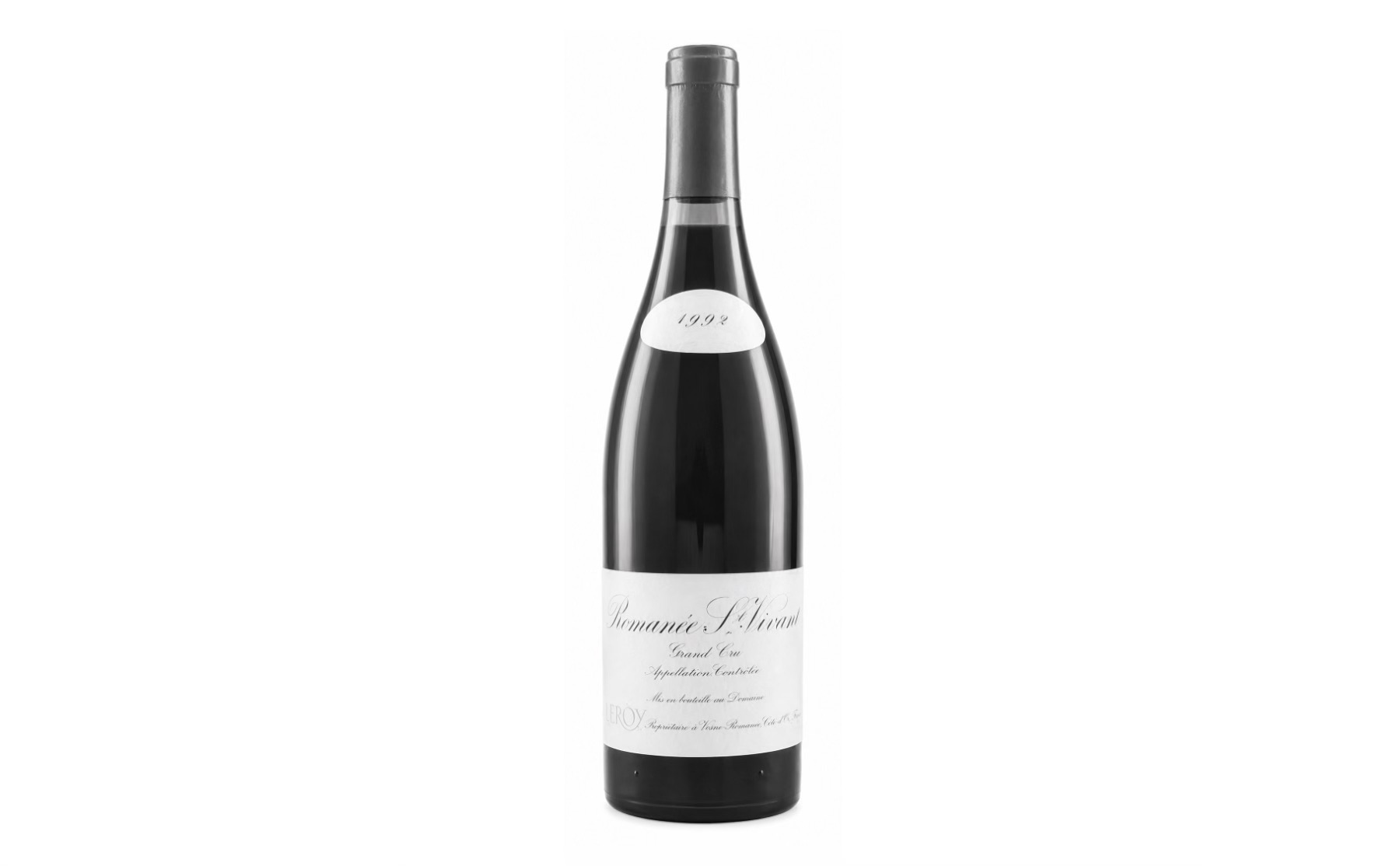
Domaine Leroy Romanée-Saint-Vivant Grand Cru sits in the highest echelon of Burgundy collecting: a Grand Cru Pinot Noir from Vosne-Romanée, produced by an estate whose name has become shorthand for rarity, uncompromising biodynamic viticulture, and microscopic supply. The Romanée-Saint-Vivant appellation itself covers only about 9.4 hectares, and Domaine Leroy farms just 0.9929 hectare, split across two parcels near Les Suchots. In practical terms, this is a wine that is scarce by appellation logic and rarer still by producer philosophy.
For serious collectors, its significance lies in an unusual conjunction: Romanée-Saint-Vivant’s naturally perfumed, silk-textured Grand Cru profile is allied to Leroy’s deliberately severe yields and biodynamic rigor. The result is not merely an expensive Burgundy, but a specific kind of icon—one that often marries RSV’s native grace to a degree of concentration and authority more often associated with sterner terroirs. That is why benchmark vintages have drawn perfect or near-perfect praise from The Wine Advocate and strong acclaim from Burghound, Vinous, Jancis Robinson, and Decanter.
Estate and Producer Background
The Leroy family story begins with Maison Leroy, founded in 1868 by François Leroy; the business passed through Joseph Leroy and then Henri Leroy, who joined Maison Leroy in 1919. Lalou Bize-Leroy inherited not only that commercial lineage but also one of Burgundy’s most forceful quality visions. Official Leroy history records that after 1988 she directed the construction of Domaine Leroy as a standalone estate expression, distinct from the family’s négociant activity.
That date matters. In 1988, Lalou Bize-Leroy converted the new domaine to biodynamics at a moment when such a choice was highly unconventional in Burgundy. Decanter notes that this was her first decision for the new estate, while the domaine’s own materials state that Lalou was among the first Burgundian growers to introduce biodynamic viticulture locally. The estate’s present reputation is inseparable from that choice.
In stature, Domaine Leroy now occupies a near-mythic position in the Côte d’Or. Jancis Robinson has written that the domaine wines regularly form one of the greatest groups of Burgundies she tastes from barrel, and Cult Wines noted that, as of 2021, seven of the twenty most expensive wines in the world were Leroy bottlings. Romanée-Saint-Vivant is therefore not an isolated trophy within the portfolio; it is one of the wines through which the estate’s wider reputation for exactitude and extremity is continuously reinforced.
Terroir, Viticulture and Winemaking
Romanée-Saint-Vivant is rooted in the heart of Vosne-Romanée, on a gentle east-facing slope that slightly dominates the plain. The official AOC text emphasizes that the site is sheltered from morning fog and spring frost while receiving generous sunlight; it also highlights argillaceous soils rich in iron oxides, a water-retentive top layer, and a limestone subsoil that ensures effective drainage. In Decanter’s more recent terroir comparison, Romanée-Saint-Vivant is described as relatively flat at roughly 247 to 265 meters in altitude, with gradients around 2% to 7%, and in some sectors soils approaching 90 centimeters in depth—deeper than the famously shallower soils of adjoining Richebourg.
Those facts are not academic. They explain why Romanée-Saint-Vivant, at its best, tends toward perfume, breadth without heaviness, and textural suppleness rather than the more immediate muscularity of Richebourg. The official appellation text explicitly links this environment to regular excellence, hydric equilibrium, and a particularly fine and elegant expression of Pinot Noir. Decanter likewise characterizes Romanée-Saint-Vivant as lighter, softer, and more elegant than Richebourg, with a greater marl-and-clay component in the soil.
Domaine Leroy’s holding is unusually important because it is both substantial and precisely placed. The domaine’s own site gives the holding as 0.9929 hectare across two plots near Les Suchots; Winehog identifies Leroy as the second-largest owner in the appellation and places the parcels just south of the road between Les Suchots and Romanée-Saint-Vivant. Collectors should read that as a meaningful positional advantage within an already privileged cru.
On farming, the published record is unusually clear. Official Leroy material for this wine states that biodynamic preparations 500 to 508 are used to stimulate microbial life in the clay and that vineyard interventions follow the lunar calendar; it also specifies voluntarily restricted yields of 20 to 25 hectoliters per hectare. The AOC itself requires dense planting at a minimum of 9,000 vines per hectare, forbids irrigation, and prohibits chemical weed control. The combination is decisive: Romanée-Saint-Vivant legally permits quality, but Leroy legislates intensity far beyond the appellation minimum.
The producer is less expansive in public about a parcel-specific cellar recipe than about the vine. What can be stated with confidence is that the AOC and the official appellation description both stress long élevage, and the wine’s recurrent critical profile—satiny tannins, aromatic lift, and strong site transparency—suggests a cellar discipline aimed at preserving perfume and structure rather than amplifying oak signature. For collectors, that is entirely consistent with the estate’s hierarchy of values: terroir first, concentration through farming, and élevage as a refining instrument rather than a stylistic overlay.
Vintage Chronicle
Public merchant and comparison databases document the domaine-era wine from 1988 onward and show current comparison entries through at least 2023. The most reliable non-speculative way to assess “all known vintages” is therefore to read the documented Domaine Leroy era through Burgundy’s authoritative red-vintage chronology.
In the foundational years, 1988 was tough and backward, rewarding patience; 1989 was nearly at the level of 1990 and produced real charmers; 1990 was a major success, rich and fragrant; 1991 yielded some excellent Côte de Nuits wines because the grapes had ripened before rain; 1992 was softer and meant for earlier drinking; and 1993 was underrated, with healthy, well-colored, fruity wines.
The middle nineteen-nineties were far less homogeneous. 1994 exposed Burgundy’s variability; 1995 produced reduced crops of initially austere wines that broadened in bottle; 1996 brought very high acidity, making some wines thrilling and others severe; 1997 yielded charming, early-drinking bottles; 1998 gave dark colors but often tough, solid wines; and 1999 was exceptional in both quality and quantity, with concentration, color, balance, and broad drinking appeal.
The turn-of-the-century sequence is especially instructive for Leroy collectors. 2000 was soft, easy, and more successful in the Côte de Nuits than the Côte de Beaune; 2001 required a gentle hand in the winery and was quite variable; 2002 was broadly good, dry enough in summer and charming early; 2003, the heatwave year, produced some monumental wines but also unusual, sometimes raisined Pinot; 2004 was large, relatively light, crisp, and best understood as an earlier-drinking vintage; and 2005 was outstanding, though many wines entered a long, chewy adolescence.
The later two-thousands again demanded discrimination. 2006 could be pure and expressive at best, austere at worst; 2007 was damp and selection-dependent; 2008 suffered from coulure, mildew, and hail before late September sunshine salvaged the crop, leaving high acidity as the hallmark; 2009 was warm, dry, and immediately seductive, with ripe tannins and lower acidity; 2010 returned to a high-acid norm but especially strong quality in the Côte de Nuits; and 2011 surprised positively despite an early season and summer rain.
The run from 2012 to 2017 forms the modern core of the wine’s reputation. 2012 was tiny, variable in yield, but far better than feared, often with soft tannins; 2013 was late, cold, and storm-lashed but ended with a small balanced crop; 2014 was redeemed by September and produced relatively light wines; 2015 was low-yielding, ample, and one of the truly great vintages of the period; 2016 was devastated by frost, hail, and mildew, yet top producers made excellent wines from tiny crops; and 2017 was generous, fruity, and comparatively soft-structured.
Most recently, 2018 combined heat with generous volumes and often blurred distinctions of level; 2019 was very warm and low-yielding, with concentration for medium- to long-term aging; 2020 delivered impeccable fruit quality from a warm, dry season and is widely regarded as built for long aging; 2021 was a season of frost, mildew, botrytis, and rain, saved by September sunshine and yielding light, elegant wines from minuscule crops; 2022 offered ripe, classical Pinot Noir in a good to excellent vintage; and 2023, the largest harvest in Burgundy’s history according to the BIVB, produced fruity, charming reds with slightly higher acidity than 2022 and little sign of heat stress.
Technical and Sensory Profile
Technical composition
Romanée-Saint-Vivant is legally reserved for still red wines from vineyards within the commune of Vosne-Romanée. Pinot Noir N is the principal variety; Chardonnay B, Pinot Blanc B, and Pinot Gris G are permitted only as accessory varieties in complanted parcels and together may not exceed 15% of any given parcel. The AOC sets a natural minimum alcohol of 11.5%, an authorized yield of 42 hectoliters per hectare and a rendement butoir of 49 hectoliters, while Leroy voluntarily works at only 20 to 25 hectoliters per hectare. For the collector, the important point is simple: this is Pinot Noir Grand Cru compressed by radical undercropping.
Tasting profile and aging curve
The official Romanée-Saint-Vivant profile describes dark ruby color that turns carmine with age, and aromas that may evoke red and black fruits, ripe or confit, alongside musk, leather, and humus with maturity. Modern benchmark notes from Dominique Leroy’s wine add a more precise contemporary lexicon: rose petal, blood orange, potpourri, bright berry fruit, cold stone, dark chocolate, Asian spice, and, in stronger years, a profound concentration carried by satiny tannins rather than brute force. On the palate, critics consistently stress completeness, multidimensionality, energy, and a long resonant finish.
The producer’s own page suggests an aging horizon of fifteen to twenty-five years, but both the AOC text and leading critics point beyond that in the best years. The appellation description speaks of a capacity to improve over several decades, while The Wine Advocate gives the 2015 a drinking window of 2025 to 2065 and the 2016 a window of 2026 to 2065. That range is persuasive: lesser or lighter years can be enjoyed earlier, but top vintages of Domaine Leroy Romanée-Saint-Vivant Grand Cru demand at least a decade in cellar and may reward half a century of patience.
Food pairing
At the table, this is a wine for noble textures and exact saucing rather than for sheer force. Roast Bresse pigeon, lacquered squab, saddle of venison with juniper, sweetbreads with morels, or hare prepared with restraint all make sense. That is partly classical Burgundy logic and partly inference from the wine’s own profile: aromatic lift, finesse, and long savory persistence call for dishes that echo depth without smothering perfume. The Bourgogne Wine Board’s pairing guidance for the region’s most distinguished, complex reds points in exactly this direction—braised, roasted, or sauce-based meats of high flavor but measured aggression.
Critical Reception and Comparative Context
The critical record is emphatic. William Kelley awarded the 2015 Domaine Leroy Romanée-Saint-Vivant Grand Cru 100 points and described it as one of Burgundy’s most magical wines of the vintage, with a projected window to 2065. The 2016 also received 100 points from Kelley, who called it a “magisterial achievement”; in a Wine Journal summary, it was included among the top five Côte d’Or wines of the report, all rated 99+ or higher. Burghound rated the 2015 at 97 in the domaine review and the 2016 at 93-96 from barrel. Vinous described Leroy’s 2015 collection as “absolutely stellar” and its 2014s as tense, brilliant wines of energy and translucence. Jancis Robinson’s producer archive lists the 2010 Romanée-St-Vivant among Domaine Leroy’s top three wines in her database, while Decanter’s retrospective notes describe the 2009 as perfumed and highly harmonious, and the 2007 as concentrated, elegant, and very fine.
For collectors comparing Romanée-Saint-Vivant bottlings, Domaine de la Romanée-Conti is the unavoidable benchmark because it farms 5.29 hectares of the cru. Decanter’s recent DRC notes portray that wine as deeper-colored, richer, and more overtly black-plum and savory in recent vintages. Hudelot-Noëllat’s recent RSV notes likewise lean toward blackberry, cassis, mulberry, and a notably firm mineral frame. Against those profiles, Domaine Leroy’s distinction is unusually clear: benchmark notes repeatedly return to rose petal, blood orange, potpourri, cold stone, and satiny structure. In other words, Leroy does not try to out-Richebourg Romanée-Saint-Vivant; it intensifies the cru’s perfume and silk without relinquishing depth.
That point matters beyond the appellation. What makes Domaine Leroy Romanée-Saint-Vivant Grand Cru distinctive even against the world’s top luxury wines is not only critical altitude but stylistic singularity. Many globally elite reds trade on mass, density, or overt monumentality. This wine can reach perfect-score territory while remaining recognizably RSV: floral, tensile, aristocratically scented, and texturally suspended. That is a rare combination.
Market Position and Investment Perspective
Scarcity is the foundation of the wine’s market behavior. At Leroy’s stated target yield of 20 to 25 hectoliters per hectare, a 0.9929-hectare holding implies a theoretical production of roughly 2,648 to 3,310 standard bottles before any losses to selection, lees, or format decisions. In reality, some vintages are far lower: Christie’s recorded the 2006 Romanée-Saint-Vivant from Domaine Leroy at a production of 1,506 bottles. This is why allocations are so tight and why market supply can feel almost anecdotal. Neal Martin’s commentary on the tiny 2012 rendement—just 9 hl/ha on average at the domaine—explicitly anticipated difficult allocation conversations.
Price behavior confirms blue-chip status. iDealwine notes that a bottle of the 1998 vintage sold for €1,500 in 2017, while the platform’s 2026 estimate for that same vintage is €3,478. Cult Wines’ current quoted market prices for 12x75cl cases show the magnitude of modern release-vintage value: £75,050 for 2005, £81,900 for 2012, £85,340 for 2013, £84,000 for 2014, and £168,260 for 2015. Cult Wines also noted that, as of 2021, seven of the world’s twenty most expensive wines were Leroy bottlings. Romanée-Saint-Vivant therefore belongs unambiguously to the fine-wine asset class, albeit one where provenance, bottle condition, and original-case integrity materially affect value.
For investors, the attraction is straightforward: minuscule supply, a producer with enduring brand power, and critical reception that reaches the top of the 100-point scale. The caution is equally straightforward: this is a market best navigated through impeccable provenance, serious storage, and disciplined buying. Auction descriptions for older bottles routinely scrutinize wax, seepage, fill levels, and label condition. At this level, the bottle is both wine and object.
Conclusion
Domaine Leroy Romanée-Saint-Vivant Grand Cru stands at a rare intersection of terroir nobility, producer extremity, and market significance. Romanée-Saint-Vivant gives it perfume, inner silk, and aristocratic length; Leroy contributes biodynamic rigor, severe yield control, and a refusal to compromise. The effect is a wine that can be both RSV in typicity and Leroy in intensity—a combination that explains its long critical record, its minute allocations, and its place in the highest tier of global fine-wine collecting. For the collector who values nuance as highly as prestige, it is not merely one of the greatest Romanée-Saint-Vivants. It is one of the purest demonstrations of what that Grand Cru can become when every variable is pushed toward concentration without sacrificing grace.