
Domaine Lafage Takes Over GICB: A New Chapter for Banyuls and Collioure
The Roussillon estate will steer the historic Collioure-Banyuls cooperative into a new phase as Terrasses Vermeilles.
Domaine Lafage Steps In to Secure a Cornerstone of the Côte Vermeille
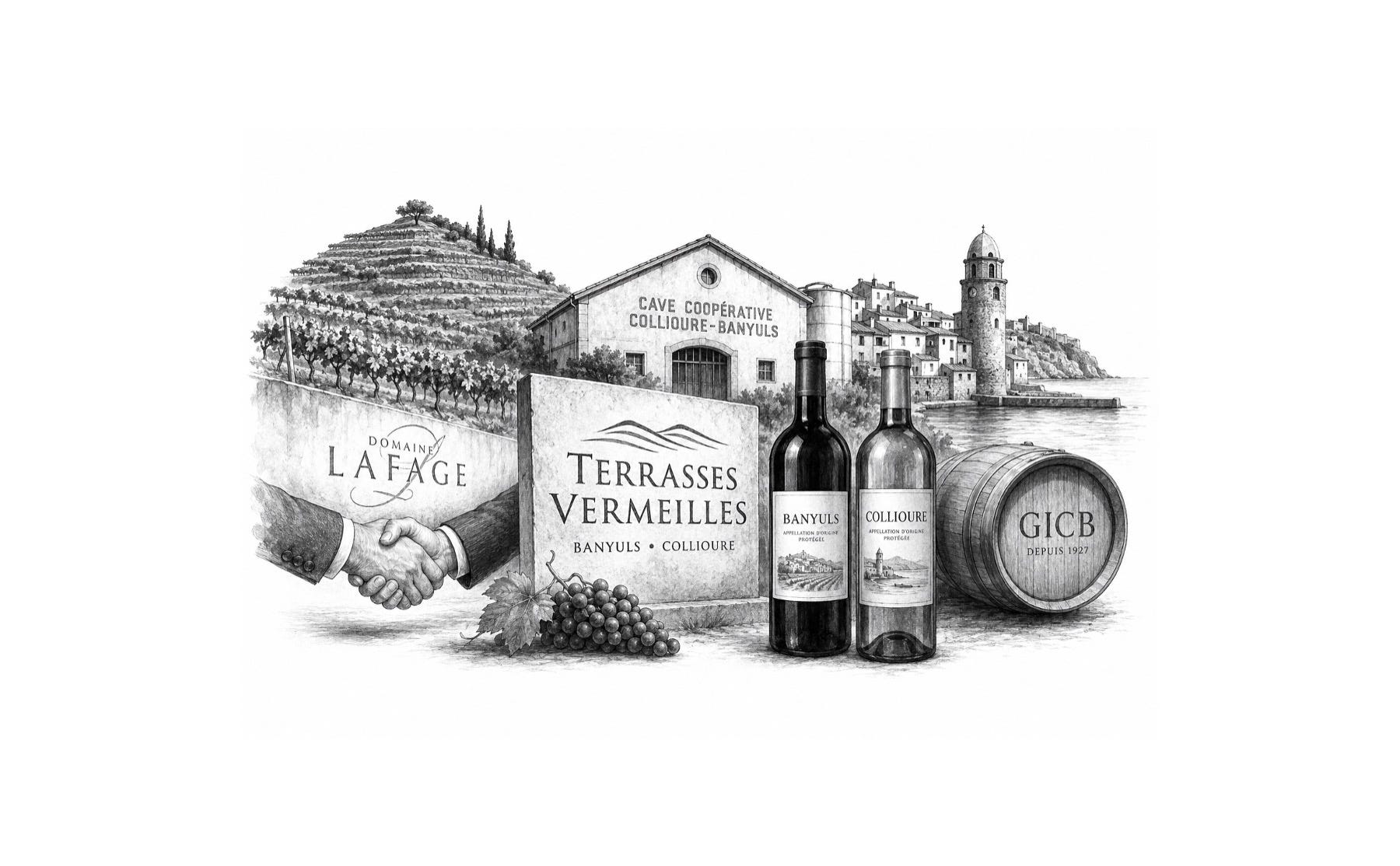
Domaine Lafage has been chosen to take over the activities of the Groupement Interproducteurs Collioure-Banyuls, better known as GICB, following a court decision announced on 24 July 2026. The cooperative, based in Banyuls-sur-Mer, will now operate under a new name: Terrasses Vermeilles.
For the wines of Banyuls and Collioure, the significance reaches well beyond a change of ownership. GICB is one of the largest and most influential structures on the Côte Vermeille, bringing together hundreds of growers whose steep, terraced vineyards form one of France’s most distinctive Mediterranean landscapes. The takeover offers those vineyards a measure of stability after months of financial uncertainty.
A Court-Approved Rescue After Years of Decline
The cooperative entered judicial restructuring on 12 March 2026 after requesting protection from its creditors. Its difficulties were substantial: debt had climbed to almost €20 million, while both production and sales had fallen sharply.
The long-term figures illustrate the scale of that contraction. GICB produced approximately 23,000 hectolitres in 2011 and recorded revenue of around €25 million. By 2025, production had dropped to roughly 10,000 hectolitres, while annual revenue had fallen to about €10 million.
Even so, the cooperative continued to market close to one million bottles a year. Its problem was therefore not an absence of wine, vineyards or recognised labels, but the growing difficulty of turning those assets into sufficient and sustainable value.
Why GICB Matters to Banyuls and Collioure
The Collioure-Banyuls cooperative represents close to 500 hectares of vines and accounts for an estimated 60% of the wine produced across the Côte Vermeille. Around 500 growers are connected to the organisation.
These figures make GICB more than a large local cellar. It is part of the economic framework that allows viticulture to continue on a coastline where vineyard work is unusually demanding. Many parcels are narrow, steep and difficult to mechanise. Maintaining them depends not only on the commitment of individual growers, but also on reliable facilities, routes to market and dependable payment for grapes.
That is especially important in Banyuls, where fortified wines have faced a difficult commercial environment, and in Collioure, where dry wines must compete in an increasingly crowded premium Mediterranean category. Without a viable collective structure, the loss would be measured not simply in bottles, but in abandoned terraces and reduced prospects for the next generation.
Domaine Lafage Places Growers at the Centre
The proposal presented by Domaine Lafage gives particular emphasis to the cooperative’s winegrowers. Its stated priorities include improving the value paid for grapes, shortening payment times and introducing exclusive supply agreements designed to provide the new organisation with a dependable annual harvest.
The approach addresses two closely related concerns. Growers need greater financial confidence if they are to continue cultivating labour-intensive vineyards, while Terrasses Vermeilles requires stable grape supplies if it is to rebuild its commercial position.
There is also a generational dimension. Better remuneration cannot by itself guarantee vineyard succession, but poor remuneration almost certainly discourages it. By making grape growing more economically credible, Domaine Lafage hopes to give younger growers a stronger reason to remain in—or return to—the appellations.
Domaine Lafage Brings Commercial Reach and Regional Experience
Based near Perpignan, Domaine Lafage manages around 300 hectares across five vineyard areas. Jean-Marc and Éliane Lafage have developed the estate around the varied terroirs of Roussillon, producing wines from the Mediterranean coast, the Agly Valley, the Aspres and higher-altitude sites further inland.
That geographical range has given the company experience in presenting Roussillon wines to markets far beyond the region. It is this commercial capability that may prove particularly valuable to Terrasses Vermeilles.
Cooperatives often possess considerable strengths in vineyard knowledge, production capacity and technical skill. Their weakness can lie elsewhere: building brands, protecting margins and finding enduring markets for large volumes. The new arrangement brings together the growers’ detailed understanding of the Côte Vermeille with Domaine Lafage’s broader experience in distribution and wine marketing.
An Initial Period of Observation
Despite the urgency surrounding the takeover, Domaine Lafage has indicated that it will not begin with immediate, sweeping changes. With the 2026 harvest already approaching, the first phase will be one of assessment.
That restraint is sensible. A cooperative of this size is an intricate organisation, linking growers, cellar teams, brands, stock, distribution networks and seasonal production schedules. Sudden disruption before harvest could create further uncertainty at precisely the moment when operational continuity matters most.
The new management will instead have to determine which activities remain effective, which require investment and where commercial strategy must change. The success of the project will depend on improving performance without weakening the collective knowledge that made GICB important in the first place.
Protecting Jobs and the Terres des Templiers Identity
Approximately four-fifths of the cooperative’s 135 employees are expected to remain under the takeover plan. This preserves a substantial body of local expertise, from cellar and vineyard operations to logistics, hospitality and sales.
Domaine Lafage has also committed to maintaining the historic production site, established brands and specialist knowledge associated with GICB. Among the most valuable of those assets is Terres des Templiers, a name closely linked with Banyuls and the identity of the cooperative.
Preserving such a brand does not mean leaving it untouched. Its future will depend on careful positioning, clear communication and disciplined pricing. But continuity matters. In a region where wine, place and history are unusually intertwined, abandoning familiar names could destroy recognition that would be difficult—and costly—to rebuild. (LinkedIn)
Terrasses Vermeilles Faces the Harder Work Ahead
The court decision removes an immediate threat, but it does not solve the deeper challenges facing Banyuls and Collioure. The decline in volumes and revenue occurred over many years, reflecting changing drinking habits, pressure on traditional fortified-wine categories and the costs of cultivating difficult terrain.
Terrasses Vermeilles will therefore need more than financial restructuring. It must find a credible balance between dry Collioure wines and sweet Banyuls, between established customers and new audiences, and between sufficient scale and the preservation of regional character.
The renamed organisation also has an opportunity to reconsider how these wines are explained. The Côte Vermeille possesses powerful advantages: dramatic schist terraces, a Mediterranean climate, distinctive grape varieties and a wine culture unlike that of any other French appellation. Yet exceptional landscapes do not market themselves. Their value must be communicated with precision, consistency and restraint.
For Domaine Lafage, the takeover represents a considerable expansion of responsibility. For the growers of Banyuls and Collioure, it offers the possibility of remaining part of a functioning collective rather than facing fragmentation. The real measure of success will not come with the legal transfer, but in the vintages ahead: in the price paid for grapes, the strength of the wines in the market and the number of terraces that remain under cultivation.