
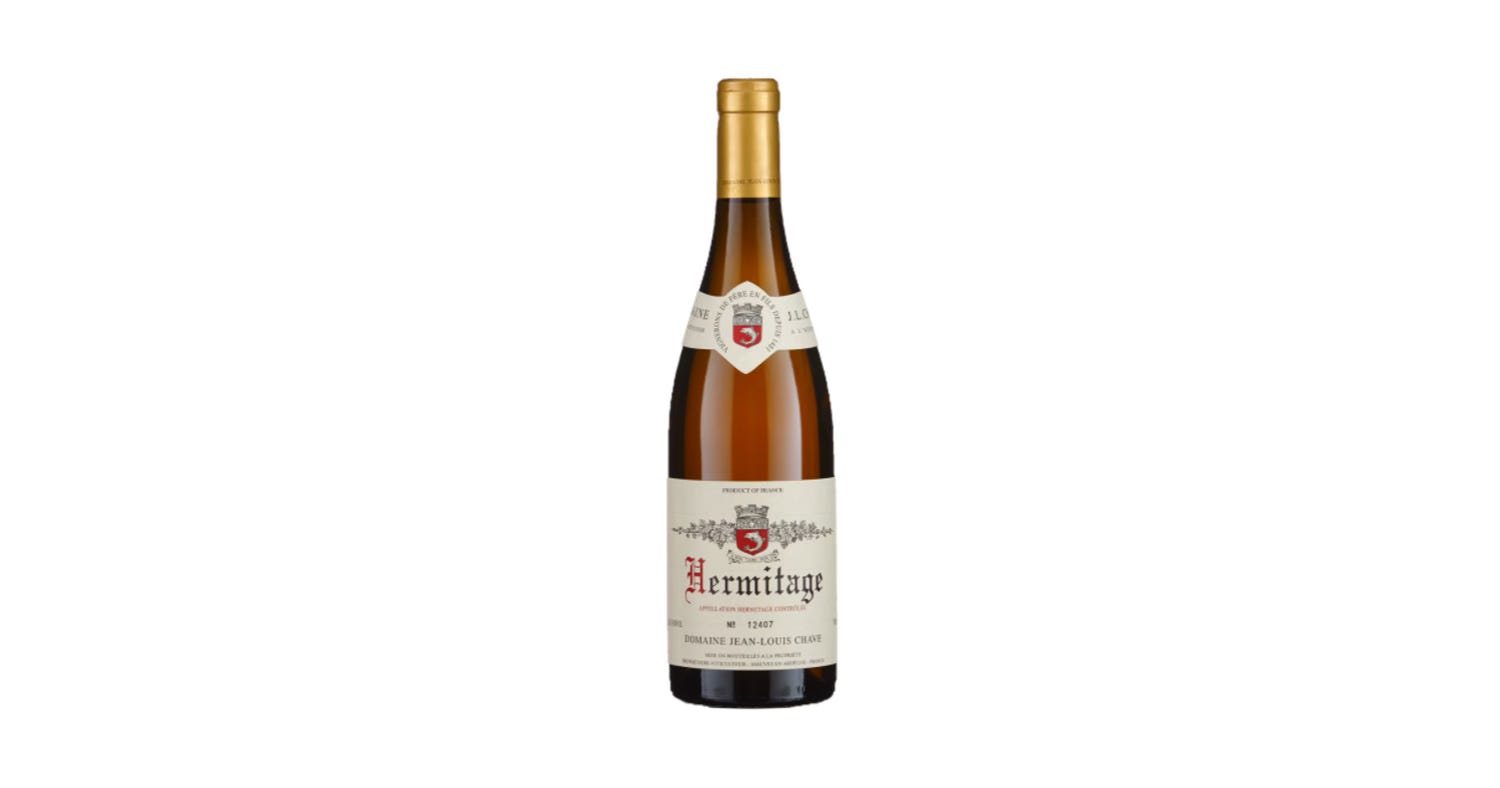
Domaine Jean-Louis Chave: Hermitage (Blanc)
Chave Hermitage Blanc: Historical Singularity, Structural Longevity, and the Case for Marsanne as One of the World's Great White Wines
Introduction
The Hermitage Blanc of Domaine Jean-Louis Chave is, by any serious measure, one of the most extraordinary white wines produced anywhere on earth. That it remains less universally discussed than the domaine’s celebrated rouge is an artefact of the market’s tendency to privilege red wines from the northern Rhône — not a reflection of any qualitative inferiority. Indeed, a persuasive case exists that the Chave blanc, in its greatest vintages, is the more intellectually complex and historically unusual of the two wines: a Marsanne-dominant assemblage from granite and loessic parcels on the hill of Hermitage, it defies nearly every expectation the wine world applies to aged white wine and offers an evolutionary arc of extraordinary length and singularity.
The appellation of Hermitage sits on the left bank of the Rhône at Tain-l’Hermitage in the Drôme department, its 136 classified hectares comprising some of the most ancient viticultural land in France. The hill of Hermitage itself is documented in Roman viticultural records; Pliny the Elder’s Natural History contains references to the wines of the Rhône corridor that some ampelographers have associated with the granite massif that now carries the Hermitage AOC. The Chave family’s own documented presence on the hill dates to 1481, making it one of the oldest continuously family-operated domaines in France — a distinction of substance rather than mere marketing, as it implies an unbroken chain of empirically accumulated knowledge about the behaviour of specific parcels across centuries of climatic and agricultural variation.
White wine production at Hermitage has always coexisted with red, but the white has historically occupied a more specific and perhaps more demanding niche within the appellation’s identity. Before phylloxera devastated the Rhône vineyards in the 1870s and 1880s, Hermitage Blanc was traded throughout Europe as a wine of exceptional longevity and distinction. Nineteenth-century négociant records, including those documented by Jancis Robinson in her Oxford Companion to Wine, indicate that Hermitage Blanc commanded premium prices relative to many first-growth Bordeaux blancs and was sought specifically for its capacity to develop in bottle over extraordinary timescales — thirty, forty, even fifty years. This reputation was not merely legendary: tasting notes from the late nineteenth and early twentieth centuries, cited in historical compilations such as André Simon’s Bibliotheca Vinaria, describe aged Hermitage Blanc in terms that correspond precisely to what serious collectors observe in mature Chave today.
The modern critical apparatus discovered the wine somewhat later than the rouge. Robert Parker’s identification of Chave Hermitage rouge as a world-class benchmark in the 1980s drove collector interest primarily toward the red; the white, though consistently praised in Parker’s Rhône Valley guide and the Wine Advocate, remained a secondary discovery for many buyers who came to the domaine through the red door. This sequencing has had a lasting effect on the market: the blanc is still meaningfully underpriced relative to the rouge on a quality-adjusted basis, a discrepancy that experienced collectors — those who have tasted the wine at full maturity — find consistently puzzling.
The critical turning point for the white wine’s international profile came in part through the advocacy of critics who had tasted old vintages with sufficient patience to witness its full developmental arc. Jancis Robinson, writing in multiple editions of the Oxford Companion to Wine and in her personal tasting notes, identified the Chave Hermitage Blanc as one of the world’s most age-worthy whites and specifically documented tastings of twenty-, thirty-, and forty-year-old examples that remained vital and extraordinary. Similarly, Wine Spectator’s coverage of great northern Rhône white wines from the late 1990s and early 2000s onward contributed to a growing collector awareness of the white’s unique position. The wine is now firmly established in the consciousness of serious white wine collectors, though its production volumes ensure that demand continues to exceed supply.
Within the broader narrative of French fine wine, the Chave Hermitage Blanc occupies a philosophically important position: it is one of very few white wines in France whose ageing capacity genuinely rivals the greatest Burgundy whites, yet whose character is so utterly distinct from Chardonnay as to represent an entirely separate evolutionary paradigm. The wine does not compete with Montrachet or Corton-Charlemagne; it exists alongside them as evidence that white wine greatness is not a single phenomenon but a plurality of expressions, each rooted in its own geology, variety, and human tradition.
The Chave Hermitage Blanc does not compete with Montrachet — it exists alongside it as evidence that white wine greatness is a plurality of expressions, each rooted in its own geology, variety, and human tradition. Its evolutionary arc is unique in the world of wine.
Vineyard and Terroir
The Hill of Hermitage: Geological Overview
The hill of Hermitage is a pre-Cambrian granite and gneiss massif that rises abruptly above the left bank of the Rhône to approximately 300 metres above sea level. Its southern and south-eastern faces are steep, in places almost vertical, and receive near-maximum solar irradiation throughout the growing season. The rock beneath the cultivated soils is among the oldest in the viticultural world: decomposed granite and gneiss of Hercynian origin, with varying overlays of transported loess, alluvial deposits, and ancient river terrace materials depending on altitude and sector. The INAO delimitation of AOC Hermitage encompasses 136 hectares, of which approximately 30 to 35 percent is planted to white varieties — primarily Marsanne, with smaller plots of Roussanne.
The geological variability of the hill is not uniform. On the steeper, western granite sections, soils are thin, free-draining, and extremely low in organic matter — a matrix that imposes profound natural vine stress and produces wines of great concentration and mineral tension. On the eastern and lower-altitude sectors, the granite sub-layer is overlain by deeper deposits of decomposed loess: a yellowy, siliceous material of aeolian origin that retains more moisture and produces a marginally richer, more textural wine character. The Chave domaine’s white wine parcels span this geological spectrum, which is fundamental to the assembled wine’s complexity: no single geological type could produce the combination of mineral tension, aromatic richness, and textural depth that the assemblage achieves.
White Wine Lieux-Dits: Parcel-by-Parcel Geography
Ermite (l’Hermite) — Situated near the summit of the hill, l’Hermite is the most elevated and geologically ancient of the domaine’s white wine parcels. Soils are extremely shallow over fractured pre-Cambrian granite and gneiss, with virtually no water retention capacity. Yields are the lowest of all white parcels; the vine stress is severe. The contribution of l’Hermite to the assemblage is correspondingly profound: a deep, saline mineral precision, a limestone-like tension that persists across decades of bottle ageing, and a structural austerity in youth that resolves, over fifteen to twenty-five years, into the most complex dimension of the assembled wine. This parcel is, in the view of many serious tasters, the spiritual heart of the Chave blanc’s identity.
L’Homme — Adjacent to l’Hermite on the upper hill, l’Homme occupies slightly lower ground with marginally deeper soils. The Marsanne from this parcel contributes freshness and structural acidity — qualities not immediately associated with the variety in popular conception but essential to the assemblage’s capacity for long development. L’Homme introduces a tension and vertical drive to the wine that balances the weight contributed by the lower-altitude parcels.
Rocoule — (Distinct from the red wine Roucoule.) Rocoule occupies a mid-altitude position on the hill, with deeper loessic soils over a granitic sub-layer. The contribution here is textural richness: a waxy, almost lanolin quality associated with mature Marsanne that gives the wine its extraordinary mid-palate weight. In hot years, Rocoule can produce fruit of such density that its inclusion in the assemblage risks heaviness; in cooler years, it provides the fleshy generosity that anchors the wine’s structure.
Maison Blanche — Located on the hill’s eastern exposure, Maison Blanche receives somewhat less direct afternoon sun than the south-facing sectors, resulting in a slightly later-ripening character and a wine of notable freshness relative to its alcohol level. The soils here include a higher proportion of calcaire — chalky limestone intrusions within the predominantly granitic matrix — which contributes a distinctive minerality and a slightly more angular structure than the pure-granite parcels deliver.
Chaillot — The Chaillot parcel contributes aromatic complexity and, in the view of some analysts, the most Roussanne-adjacent character in the assemblage, even where planted primarily with Marsanne. This may reflect the soil type — a mix of granitic and clay-limestone material — that encourages a more aromatic, herbally inflected fruit expression. In the context of the assembled wine, Chaillot provides the aromatic lift and spice that make the Chave blanc more immediately perfumed than a pure Rocoule or l’Homme expression would be.
Vine Age, Root Architecture, and Microclimate
The domaine’s white wine parcels include some of the oldest Marsanne vine material in the appellation. Certain plots, particularly in l’Hermite and Chaillot, contain individual plants of sixty to eighty years of age, with root systems that penetrate deeply into fractured granite bedrock. This root architecture is of fundamental practical importance in the context of the appellation’s increasingly warm and dry summers: vines rooted into fractured bedrock can access water reserves and trace mineral elements unavailable to younger, shallower-rooted plants. The old vines’ natural yield limitation — small berries, reduced cluster size, sporadic bud-break irregularity — contributes concentrated must without requiring aggressive green harvesting.
The hill’s microclimate for white wine production is distinct from that affecting red wine parcels in ways relevant to winemaking decisions. White varieties on the upper slopes benefit from the Mistral wind’s cooling effect during late summer — critical for retaining natural acidity as temperatures rise in August and September. The Rhône corridor amplifies this wind effect, creating a natural temperature moderation that partially offsets the radiative heat accumulation on the south-facing slopes. Below a certain altitude on the hill, this Mistral cooling is less effective, and ripening advances more rapidly — a distinction that Jean-Louis Chave manages through harvest timing on a parcel-by-parcel basis.
Drainage and Soil Structure
Drainage on the Hermitage hill is broadly excellent across the white wine parcels, reflecting the steep gradients and granitic substrate. In the upper sectors (l’Hermite, l’Homme), drainage is effectively instantaneous, with surface water running off immediately after rainfall and the shallow soils providing virtually no moisture storage. This condition, which would be considered a vine health risk on many other terroirs, is precisely what drives the root systems into the rock fissures where sub-surface water and mineral nutrients are accessible. In the mid-altitude parcels (Rocoule, Maison Blanche), the deeper soil profiles create a marginal buffer against drought stress, which in the context of warming vintages has become an increasingly valuable characteristic.
Farming Philosophy
The Chave domaine farms without organic or biodynamic certification but applies practices indistinguishable from organic viticulture in all substantive respects. Herbicides are not used; inter-row management relies on mechanical ploughing and hand hoeing on the steeper slopes where machinery cannot operate safely. Phytosanitary interventions are confined principally to copper and sulphur treatments permitted under organic regimes. Synthetic fertilisers are absent; organic compost is applied selectively to the most depleted plots. Cover cropping between vine rows in the gentler sectors contributes to soil biodiversity and naturally limits excessive vigour.
Jean-Louis Chave has consistently articulated a philosophy of non-dogmatic pragmatism: the goal is the best possible fruit from each parcel in each year, without the imposition of an ideological framework that might override the empirical evidence of what a specific parcel requires. In the context of white wine production, this translates into attentive management of the phenological stages most critical for Marsanne and Roussanne — budburst timing, flowering uniformity, and the final weeks of ripening when the balance of sugar, acidity, and phenolic maturity is most sensitive to temperature fluctuation.
Grape Composition and Viticultural Choices
Marsanne: The Dominant Variety
Marsanne constitutes the dominant component of the Chave Hermitage Blanc, typically between 70 and 85 percent of the assembled wine, though the precise ratio varies by vintage and parcel performance. The variety is deeply associated with the northern Rhône; Chapoutier’s ampelographical research and the work of Pierre Galet (Cépages et Vignobles de France, 1990) document Marsanne as a native variety whose genetic origins lie within the Rhône corridor, probably in the area around the Drôme and Ardèche departments. Its name is believed to derive from the commune of Marsanne in the Drôme.
The variety’s viticultural character poses specific management challenges. Marsanne is a vigorous, upright-growing variety with naturally large clusters and berries, prone to coulure (flower drop) and millerandage (irregular berry development) in cool, wet flowering conditions — a not infrequent occurrence in the northern Rhône spring. Its susceptibility to oxidation means that strict management of the must during pressing and the early stages of fermentation is essential. And its natural tendency toward phenolic richness and textural weight means that, without careful yield control and parcel selection, it can produce wines of impressive but ultimately one-dimensional concentration.
The Chave domaine’s approach to Marsanne management reflects decades of accumulated knowledge about its behaviour in each specific parcel. Canopy management — including shoot positioning and leaf removal — is calibrated to balance solar exposure against the risk of over-heating in warm years. Yield control through natural vine stress in the high-granite parcels, supplemented selectively by green harvesting in more productive lower sectors, maintains the concentration necessary for long development without reaching levels of dehydration that compromise acidity.
Roussanne: The Structural and Aromatic Complement
Roussanne constitutes the remaining 15 to 30 percent of the assemblage, varying by vintage according to the relative quality of each parcel’s fruit. It is the more aromatic, more acidic, and more structurally angular of the two varieties, and its role in the blend is essentially one of tension and lift: where Marsanne provides weight, texture, and longevity, Roussanne introduces a fresh, spiced aromatic dimension and the natural acidity that prevents the wine from seeming ponderous in youth.
Roussanne is notoriously difficult to cultivate. It is susceptible to powdery mildew, sensitive to drought, irregular in yield, and prone to oxidation during winemaking. Its massale selections at the Chave domaine — propagated from the best-performing old vines in the estate’s parcels — are argued to be more stable and complex than commercially available clones. Pierre Galet’s work on Rhône varieties documents the considerable diversity within the Roussanne population, and the domaine’s old massale material likely represents a genetically diverse population that contributes to the wine’s complexity through the natural heterogeneity of its ripening and chemical composition.
In cooler vintages, the proportion of Roussanne in the final assemblage may increase slightly, as its higher natural acidity and more linear structure complement the lean, precise Marsanne of cool years. In warmer vintages, Marsanne’s natural density and weight dominate the assemblage more completely, with Roussanne playing a refreshing but proportionally smaller role. This vintage-by-vintage adjustment of blend ratios is a fundamental aspect of the assemblage philosophy.
Clonal and Massale Selection
The domaine’s exclusive use of sélection massale — propagation from cuttings taken from carefully observed individual vines within the domaine’s own parcels — rather than certified ENTAV/INRA clones is a philosophical position with real qualitative implications. Certified clones for Marsanne and Roussanne, developed primarily for commercial viticulture, prioritise yield regularity and disease resistance; the genetic diversity of polygenomic massale selections is sacrificed for consistency. The Chave domaine’s old massale Marsanne populations contain considerable genetic variation between individual plants: variation in berry size, skin thickness, natural sugar accumulation, and phenolic profile. This diversity produces must of natural complexity — a spectrum of ripeness and chemical composition that no single-clone parcel can replicate — and is a direct contributor to the assembled wine’s structural and aromatic depth.
Yield Management
Average yields for the white wine parcels are typically in the range of 25 to 35 hectolitres per hectare, below the AOC maximum of 40 hl/ha and well below the levels common in commercially oriented Hermitage production. The natural yield limitation of old vines on thin granite soils provides the primary control mechanism; selective green harvesting is applied in more productive parcels and in years of exceptional vegetative vigour. The goal is concentrated but not dehydrated must: the distinction between natural concentration from low yields and the concentrated but unbalanced character of drought-stressed or over-cropped and then drastically thinned fruit is one that Jean-Louis Chave has frequently articulated as central to his quality philosophy.
Vinification and Élevage
Harvest Decisions and Timing
Harvest of the white wine parcels is conducted entirely by hand, with careful sorting both in the vineyard and at the winery. Given Marsanne’s sensitivity to oxidation, speed of handling from vine to press is treated as a priority: clusters are harvested into small containers and transported immediately to the cellar to minimise the time between picking and pressing. Parcels are harvested in sequence based on their individual ripening trajectories — typically the upper, cooler, slower-ripening parcels (l’Hermite, l’Homme) later than the lower, warmer, more precocious plots (Rocoule, Chaillot).
The harvest timing decision for white wine at Hermitage is among the most consequential in winemaking, and one that has grown progressively more complex as the growing seasons have warmed. The fundamental challenge is that Marsanne’s sugar accumulation tends to outpace its phenolic and aromatic maturity in warm years: harvesting at the technical maturity indicated by sugar concentration risks over-alcoholic, poorly structured wines; waiting for full phenolic and aromatic development risks unacceptably low natural acidity and the potential for botrytis or other rot development in humid conditions. Jean-Louis Chave’s track record in navigating this tension — consistently producing wines of excellent natural balance across warm and cool years alike — reflects both experience and the intrinsic quality of old-vine material in well-drained, high-altitude parcels that naturally moderate sugar accumulation.
Pressing and Must Handling
Grapes are pressed gently in a pneumatic press. The domaine’s pressing philosophy for white wine emphasises the extraction of clean, phenolically balanced free-run juice over the heavier, more tannic press fractions — a typical approach for fine white wine production. Press fractions are assessed individually and may be incorporated selectively into the assemblage based on quality, or excluded entirely from the finest lots.
Must settling (débourbage) follows pressing, with the juice clarified to a moderate level before fermentation. The degree of settling is calibrated carefully: over-clarification removes the fine lees that contribute to fermentation complexity; under-clarification risks off-flavour development from heavy solids. The settled must is transferred to barrel for fermentation without the addition of sulphur at levels that would inhibit indigenous yeast activity.
Fermentation
Fermentation is conducted exclusively with indigenous yeasts — the native Saccharomyces and non-Saccharomyces populations present on the fruit and in the cellar environment. This is a deliberate philosophical choice: indigenous fermentations are slower, less predictable, and occasionally problematic, but they produce wines of greater complexity and site-specificity than inoculated fermentations driven by commercial strains selected for predictability and speed. The fermentation of the Chave blanc typically begins three to five days after pressing and proceeds slowly, over four to six weeks, in 228-litre Burgundy barrels and larger 400 to 600-litre demi-muids.
The choice of vessel for fermentation — barrel and demi-muid rather than stainless steel tank — is fundamental to the wine’s character. Barrel fermentation allows gradual, micro-oxygenative integration of the wood influence from the earliest stages of fermentation, and the convective movement within the small vessel promotes natural bâtonnage (lees stirring) without mechanical intervention. The thermal mass of the cellar stone, combined with the small vessel volumes, naturally moderates fermentation temperature — typically between 16°C and 22°C — without mechanical refrigeration. This temperature range is considered optimal for the development of the complex aromatic and structural compounds that characterise the Chave blanc’s fermentation signature.
Oak and Vessel Régime
The oak régime for the Chave Hermitage Blanc is among the most carefully calibrated aspects of its production, and its philosophy is explicitly restrained. The proportion of new oak used is extremely low by international fine white wine standards — typically between five and ten percent of the total volume — with the remainder in one-, two-, and three-year-old barrels. The domaine’s principal coopers are from Burgundy (including François Frères), sourcing wood from forests whose tight grain is known for low-aromatic contribution relative to toast intensity. Toast levels are light to medium, specifically chosen to minimise toasted-wood or vanilla aromatic imprint on the wine.
The rationale for this extreme restraint in new oak use is not merely aesthetic but structural: the dense phenolic matrix and textural complexity of mature Marsanne-dominant wine is not served by additional wood character, which would mask rather than amplify the wine’s intrinsic mineral and textural evolution. The barrels and demi-muids serve as vessels for slow, controlled micro-oxygenation during élevage — providing the gradual oxidative development necessary for the wine’s long-term stability — without imposing a flavour signature of their own. This approach is consistent across the domaine’s history; older vintages of the Chave blanc show no excess oak influence even in the immediate post-fermentation period, confirming the efficacy of the philosophy.
Élevage, Lees Contact, and Bâtonnage
Following fermentation, the wine remains on its fine lees in barrel for a period of approximately eighteen to twenty-four months, depending on the vintage character and the quality of the lees themselves. Bâtonnage — the periodic stirring of the settled lees back into suspension — is practised selectively rather than on a fixed schedule. The purpose of lees contact is the gradual autolytic enrichment of the wine: the breakdown of yeast cell walls releases mannoproteins and other complex polysaccharides that add textural roundness, protect the wine against oxidation, and contribute to the extraordinary creamy, waxy character that mature Chave blanc displays. The timing and intensity of bâtonnage are calibrated to achieve these benefits without producing reductive off-flavours or excessive lees weight that would cloud the wine’s mineral precision.
Racking is conducted by gravity where possible, typically twice during the élevage period, using gentle transfer to minimise oxidative shock. Sulphur additions during élevage are modest and targeted: the domaine’s philosophy of low sulphur management for its white wine reflects both confidence in the wine’s natural stability (derived from its high dry extract and polysaccharide content) and a commitment to the kind of reductive freshness that long élevage on fine lees can provide.
Assemblage and Bottling
The assemblage of individual parcel lots into the final Hermitage Blanc is conducted after the completion of malolactic fermentation — which in the Chave blanc is typically partial, preserving a portion of the natural malic acid for structural freshness rather than converting it entirely to the softer lactic acid. The decision on assemblage is made empirically, through repeated tasting of individual lots, with Jean-Louis Chave’s judgement on the proportions driven by the goal of the most complete and balanced expression of the vintage rather than adherence to a fixed formula.
Bottling follows fining with bentonite or another appropriate agent to ensure protein stability — necessary for a Marsanne-dominant wine given the variety’s natural tendency toward proteinaceous haze in warm conditions. Filtration is applied selectively, in vintages where microbiological stability requires it; in clean, healthy vintages, the wine may be bottled with minimal or no filtration. The decision represents a careful balance between the risk of bottle re-fermentation or refermentation from residual yeasts and the potential aromatic loss that filtration inevitably imposes.
Vintage-by-Vintage Analysis
The following analysis covers the Chave Hermitage Blanc across the key vintages of the modern era, from the years that first established the wine’s international reputation through to the most recent releases. The arc of each vintage is treated as a narrative of climatic context, winemaking decision, structural character, and ageing trajectory, with specific reference to critical reception and comparative standing within the domaine’s own history. Critical observations are referenced analytically; the goal is understanding, not score compilation.
1978 — The Proving Ground
The 1978 vintage is the most historically significant Chave Hermitage Blanc in the modern critical record, because it was the wine most frequently cited by the analysts who built the domaine’s international reputation. A late, cool growing season in the northern Rhône produced whites of formidable structure and natural acidity. The Chave 1978 blanc, tasted at thirty-plus years by Jancis Robinson and several other credible critics, was described as remarkable in its vitality: still rich, still mineral, with the peculiar waxy-but-vivid character of old Marsanne at its peak. It serves as the empirical foundation for the claim that great Hermitage Blanc rivals the world’s most age-worthy dry whites. Any bottle from this vintage carrying impeccable provenance is a museum object of the first order.
1979 — Elegant and Early
The 1979, like the rouge of the same year, was a gentler, more open-structured expression than 1978 — accessible relatively early by Chave blanc standards, with more immediate aromatic appeal but less long-term structural ambition. It has been documented in reputable tastings as having reached and passed its peak; bottles encountered today may still show historical interest but are unlikely to be at their best.
1983 — Structured and Long-Lived
A dry, warm year producing wines of concentrated structure and austere mineral character in youth. The Chave 1983 blanc was famously closed for over a decade and has since emerged as one of the most celebrated white Hermitage expressions of the decade: dense, mineral, with extraordinary length and the characteristic Marsanne evolution from waxy and ponderous to complex and transparent. Still drinking well when accessed from ideal provenance.
1985 — Harmony, Richness, Grace
A warm but well-balanced year produced the 1985 Chave blanc in a register that represents the domaine’s ideal: rich texture combined with sufficient acidity and mineral precision to sustain decades of development. This vintage is frequently cited alongside 1978 as the dual benchmark for understanding the Chave blanc’s potential. At nearly forty years of age, specimens from excellent provenance remain extraordinary — complex, dense, and still evolving.
1989 — Opulence and Weight
The extraordinary warmth of 1989 produced a Chave blanc of dramatic density and textural weight. It was arguably the most immediately approachable of the great Gérard-era whites — rich to the point of near-decadence in its prime, with the waxy, honeyed development of mature Marsanne unusually prominent even at ten years of age. The trade-off: less linear mineral precision than 1978 or 1985, and a somewhat faster evolutionary trajectory. Now at its plateau of full maturity, it is a wine of great hedonistic impact rather than the austere intellectual complexity of the finest cooler-year expressions.
1990 — The Apex of the Gérard Era
The 1990 Chave Hermitage Blanc is, alongside the rouge of the same vintage, one of the most historically significant expressions of the domaine. A second consecutive extraordinary warm year produced white wine fruit of even greater concentration than 1989 — yet 1990 has proven structurally superior, showing better acid retention and more classical mineral development with age. Parker and multiple other serious critics identified it as among the greatest white wines of the Rhône Valley on release and subsequent reassessment. At thirty-plus years of age, the 1990 remains in an extended plateau of breathtaking complexity: the evolution of aged Marsanne — from the closed, flinty reduction of youth through a middle phase of beeswax and dried flowers to the extraordinary mineral transparency of full maturity — is documented here in its most complete form. Bottles of the 1990 blanc now represent some of the most historically significant white wine available on the secondary market from any French appellation.
1991 — Jean-Louis’s White Debut
The 1991 vintage, Jean-Louis Chave’s first as primary winemaker, produced a Hermitage Blanc of genuine quality in a challenging year. The spring frosts and irregular ripening that marked 1991 in the northern Rhône required exceptional parcel-by-parcel selectivity; the resulting white is leaner and more mineral than the preceding warm-year expressions, with a structural precision that makes it an interesting counterpoint to 1989 and 1990. Now fully mature, it is a wine of historical as much as current drinking interest.
1995 — The Overlooked Masterpiece
The 1995 Chave blanc is one of the most consistently undervalued vintages in the domaine’s history. A classically structured year — firm acidity, good concentration, mineral precision — produced a wine that was austere and almost inexpressive in its first decade, leading some critics to underestimate its long-term trajectory. At approaching thirty years of age, it has developed into a wine of exceptional depth and the characteristic mineral-over-wax complexity that distinguishes the domaine’s finest expressions. It represents outstanding value in the context of the domaine’s history and is an important argument for patience in the cellaring of Hermitage Blanc.
1996 — Cool Precision
The 1996 blanc reflects the cooler vintage character with unusual clarity: higher natural acidity than the warm years, lighter textural weight, and a mineral, almost piercing freshness that has made it a connoisseur’s favourite even if it lacks the sheer density of 1990 or 1998. Now in its mature drinking phase, it is a wine of elegant restraint — intellectually compelling, with a cool, flint-and-lemon precision rarely seen in Marsanne-dominant wines.
1998 — Structural Complexity and Power
After two lighter years, 1998 re-established the domaine’s peak register for white wine. Concentrated, deeply structured, and long-lived, the 1998 blanc is now within its extended drinking window — generous and complex, with the mineral-over-waxy tertiary evolution fully deployed. It represents the transition vintage between the Gérard and Jean-Louis eras in stylistic terms, showing the precision and mineral focus that Jean-Louis would emphasise while retaining the density of the domaine’s classical approach.
1999 — Accessible and Consistent
A generous vintage producing well-made, reliable Hermitage Blanc of good concentration but without the structural depth of the great years. The 1999 is now fully mature and represents a pleasant if not profound drinking experience.
2000 — Outstanding Quality, Incomplete Recognition
The 2000 vintage produced a Chave blanc of considerable depth and balance that has been somewhat overshadowed in collectors’ consciousness by the Bordeaux-driven attention the year received. A warm summer with well-timed rains produced concentrated fruit with good natural acidity; the resulting wine is structured, mineral, and developing beautifully. Now entering its extended prime, the 2000 Chave blanc represents a serious medium-to-long-term cellaring proposition for those who locate clean provenance examples.
2001 — Serious, Slow-Developing
One of the consistently underrated vintages of the decade for Hermitage Blanc. A classically structured year — firm tannin-like phenolics from the granite parcels, good natural acidity, concentrated rather than lavish fruit — produced a wine that closed down tightly in its first decade and is only now revealing its depth. Collectors who acquired the 2001 and have maintained it in ideal conditions will find a wine of exceptional complexity and length. An important argument for patience and provenance care.
2003 — Extreme Year, Atypical Character
The 2003 heatwave was more damaging to white wine quality at Hermitage than to red, given the greater sensitivity of white varieties to the loss of natural acidity under extreme heat. The Chave 2003 blanc is the domaine’s most controversial white: rich, dense, and almost exotic in its oily, golden intensity, but with an accelerated evolutionary trajectory and lower structural acidity than is typical of the domaine’s finest expressions. Jean-Louis Chave’s decision to harvest early in specific parcels — accepting slightly elevated acidity and less than full phenolic maturity — preserved more freshness than many appellation peers achieved. The wine has matured faster than the classic years and is now largely within its current drinking window; further cellaring offers diminishing returns. It is fascinating as an historical document of an extreme year, but does not rank among the domaine’s great white expressions.
2004 — Classical Recovery
A cool, classically structured year following the drama of 2003 produced a Chave blanc of notable precision and structural integrity. More linear and mineral than the warm years, with excellent natural acidity, it has developed slowly and is now entering a rewarding phase that recalls the structural profile of the 1996. Long cellaring potential remains.
2005 — Balanced Power
The 2005 vintage is widely regarded as among the three or four finest in the domaine’s modern white wine history. A near-ideal growing season — warm without excess, well-distributed rainfall, long and cool final ripening period — produced Marsanne and Roussanne of exceptional concentration combined with excellent natural acidity. The Chave 2005 blanc currently sits within its early drinking window while clearly retaining the structural density for long further development. The combination of concentration and freshness is the hallmark of the great balanced years; the 2005 sits beside 1985 and 1990 as one of the most complete expressions of the domaine’s white wine ideal. Collectors with proper cellaring should resist premature consumption.
2006 — Elegant Restraint
A moderate, well-balanced vintage producing a Chave blanc of notable elegance and finesse. Less densely concentrated than the 2005, but with exceptional aromatic precision — the Roussanne component particularly prominent — and a freshness that has sustained through nearly twenty years of development. Now in a compelling mature phase, showing the cool-mineral character of the cool-year style at its most intellectually interesting.
2007 — Early Approachability
A warm vintage producing generous, accessible Hermitage Blanc of good quality but limited structural depth for extended cellaring. The 2007 was appealing at ten years of age and is now at or past its best. A pleasant if not intellectually demanding expression of the domaine in a moderate year.
2008 — Sleeper Vintage
The 2008 vintage is the Hermitage Blanc equivalent of the rouge’s much-cited underrated status: a cool, late year producing wines of firm structure and penetrating mineral precision that were initially dismissed as ‘too lean’ but have blossomed dramatically with fifteen-plus years of bottle age. The Chave 2008 blanc is now a wine of extraordinary tension and mineral depth, with the reductive, almost petrol-like complexity — characteristic of well-aged Marsanne from high-granite parcels — fully deployed. An important collector’s discovery, still underpriced relative to its quality.
2009 — Magnificent Concentration
The 2009 blanc mirrors the outstanding vintage quality of the rouge: a warm growing season with better acid retention than 2003 or 2007 produced Marsanne and Roussanne of exceptional concentration and aromatic depth. The wine is currently rich, opulent, and developing with impressive trajectory. Its combination of density — the textural weight of old-vine Marsanne at its most extreme — with genuinely good structural acidity suggests a cellaring trajectory comparable to the 1989 and 1990: long, generous, and building toward extraordinary complexity in the 2030s and beyond.
2010 — A White Wine of Historical Significance
The 2010 Chave Hermitage Blanc is one of the most important white wines produced in France in the twenty-first century. The growing season’s combination of warmth, density, and precision — which produced the celebrated rouge — was equally extraordinary for white wine. The blanc shows a concentration of almost baroque density combined with an acidic precision that recalls the great cool-year expressions: the structural paradox of the greatest Hermitage Blanc vintages, where power and precision exist simultaneously rather than in opposition. It is currently in a very early developmental phase, tightly wound and resistant to easy assessment; serious collectors should not approach this wine before 2028 to 2030 at the earliest, and ideally reserve it for the 2030s and 2040s. It has every structural indicator of a wine with a fifty-year arc — the equal of 1978 and 1990 in historical terms.
2011 — Creditable in Difficulty
An irregular, challenging vintage produced a Chave 2011 blanc of honest quality — concentration adequate, structure sound — without the structural ambition of the flanking great years. Now in a pleasant drinking phase, without exceptional long-term cellaring potential.
2012 — Classical Structure, Long Future
A classically structured year — firm natural acidity, good concentration, no vintage drama — produced a Chave blanc of excellent proportions and a long cellaring trajectory. Currently tight and somewhat closed, in the style of the 2001 and 2008 in their early years; the structural indicators suggest a wine of considerable future interest. A sleeper vintage for the patient collector.
2013 — Lean and Mineral
A cool year producing the most mineral and structurally austere Chave blanc of the decade. High natural acidity, modest textural weight, and a penetrating mineral precision make the 2013 an excellent food wine in the medium term and a long-term development candidate for those who value the cool-year mineral style above warm-year density.
2014 — Balanced and Reliable
A moderate vintage of good quality without exceptional structural ambition. The Chave 2014 blanc is a well-assembled, pleasant expression of the domaine’s consistent baseline quality, now in a rewarding drinking phase.
2015 — Heat and Extraction: Managed Complexity
The warmest northern Rhône vintage since 2003 produced a Chave blanc of powerful concentration and overt textural richness. Jean-Louis Chave’s early harvest decisions in the l’Hermite and l’Homme parcels preserved more natural acidity than the vintage conditions alone would have provided. The result is more structurally complete than the 2003: opulent, deeply concentrated, with a golden, waxy textural character already pronounced at ten years of age. The 2015 will develop more rapidly than the structural great years but with greater grace than the 2003. Its long-term trajectory is a fascinating open question.
2016 — Exceptional Precision: A New Benchmark
The 2016 Chave Hermitage Blanc is rapidly establishing itself among the greatest expressions of the modern Jean-Louis era. A moderate growing season with outstanding natural acidity produced a wine of remarkable freshness and mineral definition — more angular and linear than 2015, more concentrated than 2013 or 2008, and combining the structural characteristics of a great cool year with the density of a warm one. Currently in its early developmental phase, the 2016 blanc shows every indicator of a fifty-year wine in the tradition of 1978 and 2010. Collectors who acquired this vintage at release should resist opening it for at least another decade.
2017 — Drought and Old-Vine Resilience
The severe 2017 drought tested the old vines’ root systems, and the Chave domaine’s deep-rooted l’Hermite and l’Homme parcels provided better results than many appellation peers. The resulting blanc is concentrated — in the manner of drought years, where dehydration naturally reduces volume — with a slightly more exotic, rich character than the domaine’s classical style. Good structural depth, early-to-mid drinking trajectory.
2018 — Warm Generosity, Well-Balanced
A warm, generous vintage produced Chave blanc of considerable hedonistic appeal: rich, textural, and already approachable at six to eight years of age. The wine follows the 2015 rather than the 2016 in its structural register — opulent and satisfying rather than tense and mineral — with a medium-to-long cellaring trajectory that will depend on whether the acid framework proves sufficient for extended development.
2019 — Concentrated and Precise
The second consecutive warm-to-hot vintage, 2019 produced a Chave blanc of impressive concentration with better acid balance than the warmth alone might suggest — a result of Jean-Louis Chave’s increasingly refined warm-vintage harvesting protocols. Currently developing well in the early phase; structured for a medium-to-long development arc.
2020 — Extreme Conditions, Careful Navigation
The most extreme growing season recorded in the northern Rhône to the time of harvest produced a Chave blanc that reflects the domaine’s increasing mastery of warm-vintage white wine production. Early picking from the highest parcels, rigorous selection at sorting, and attentive fermentation management produced a wine of impressive balance given the vintage’s extraordinary warmth. Whether the 2020 will ultimately age in the manner of the 2015 (structurally sound over the medium term) or approach the faster-maturing 2003 trajectory remains an open question. Early assessments are cautiously positive.
2021 — Return to Classical Form
The spring frosts of 2021 reduced yields across the appellation significantly, and the resulting wines from the surviving vines are concentrated, precise, and profoundly mineral — reflecting a cool growing season and exceptional natural acidity. The Chave 2021 blanc is among the most classically structured expressions of the Jean-Louis era, drawing direct comparison with 1996, 2008, and 2016 in its linear, mineral austerity and long cellaring potential. Currently tight and closed; this is a wine for the patient collector who can commit to a minimum of ten to fifteen years before opening.
2022 — Heat Again, Adaptation Refined
Another heatwave vintage required the full toolkit of warm-year white wine production that Jean-Louis Chave has developed across the preceding two decades. Early selective harvest from the high-altitude parcels, careful sorting, and rapid pressing minimised the impact of the extreme temperatures on the must’s natural acidity. Initial assessments describe a wine of good balance for the vintage conditions — concentrated, textural, and notably fresher than the appellation average — though full evaluation requires further bottle development.
Style, Identity, and Structural Sensory Profile
The House Signature Across Vintages
The stylistic signature of the Chave Hermitage Blanc is best understood not as a fixed aromatic profile — the variety and the vintage vary too substantially for any fixed descriptor to hold across decades — but as a structural identity: a combination of textural density, mineral tension, and evolutionary ambition that persists even when the aromatic and flavour expression changes dramatically between warm and cool years. At all stages of its development, the wine is characterised by an unusual internal coherence: the textural weight of aged Marsanne balanced against a granite-derived mineral tension that prevents heaviness; the aromatic evolution from closed reduction to extraordinary tertiary complexity; and a finish of remarkable length that exceeds the expectations its variety and appellation conventionally generate.
Three structural phases characterise the wine’s evolution, regardless of vintage character. In the first phase — typically years one through eight to ten — the wine is dense, somewhat closed, and resistant to easy assessment. The aroma is dominated by fresh fruit, floral lift (from the Roussanne component), and a stony, flinty reduction that can be mistaken for a fault by those unfamiliar with the wine’s developmental pattern. The palate shows the full weight of the Marsanne dry extract — dense, almost oily in the warmest years — with an underlying mineral acidity that sustains the structure without announcing itself.
In the second phase — years ten to twenty-five in the great vintages — the wine opens progressively, the reductive character giving way to extraordinary aromatic complexity: beeswax, dried flowers (acacia, lime blossom), white truffle, almond paste, lanolin, and a mineral salinity that recalls certain aged Chenin Blanc or Riesling without resembling either. The textural weight remains but becomes more integrated, the density that seemed ponderous in youth now appearing as the structural foundation of the wine’s aromatic complexity. The finish elongates dramatically from the first phase, acquiring the saline persistence that characterises the world’s finest dry whites.
In the third phase — beyond twenty-five years in the greatest vintages — the wine achieves what might be called mineral transparency: the fruit and oak components recede entirely, the textural weight is absorbed into a near-infinite complexity, and the wine’s identity resolves into the purest expression of the l’Hermite and l’Homme parcels’ granite geology. Tasters who have experienced the 1978 or 1985 in this phase describe something that is less a recognisable white wine than a profound mineral statement — simultaneously lighter and deeper than any description of its individual components would suggest. This phase has no direct parallel in any other French white wine appellation.
Beyond twenty-five years, the greatest Chave blanc vintages achieve what might be called mineral transparency: the fruit recedes entirely, and the wine resolves into the purest expression of l’Hermite’s granite geology. There is no direct parallel for this phase in any other French white wine appellation.
Comparative Identity: Hermitage Blanc Among the World’s Great Whites
The most useful comparative reference for understanding the Chave Hermitage Blanc is not another northern Rhône producer, but the structural parallels it draws with aged Chenin Blanc from Savennières (particularly Domaine aux Moines or Coulée de Serrant), aged Riesling from Alsace’s grand crus, and — in purely structural terms — certain aged Burgundy Chardonnays. In each case, the parallel is structural rather than varietal: the combination of high dry extract, mineral tension, and extraordinary evolutionary longevity creates a family resemblance across styles that differ fundamentally in variety, vinification, and appellation philosophy.
Within Hermitage itself, the nearest comparator is Chapoutier’s single-parcel white wines — particularly l’Ermite and Chante-Alouette (the latter a more commercially oriented expression). Chapoutier’s single-parcel approach under Michel Chapoutier’s biodynamic regime produces wines of comparable concentration and mineral intensity from the same parcels the Chave family also farms. The stylistic differences are real but subtle: Chapoutier’s whites tend toward a more overtly oxidative élevage character, with less reductive freshness in youth; the Chave is more tightly wound early, opening more slowly but ultimately achieving greater complexity. Paul Jaboulet Aîné’s Chevalier de Sterimberg remains a serious reference from the appellation but has not consistently matched the quality of the Chave or Chapoutier single-parcel expressions in recent decades. Marc Sorrel’s Hermitage Blanc Blanc is a fine, accessible expression but smaller in scale and earlier-maturing.
The White’s Relationship to the Red: Complementary Not Competitive
Within the domaine’s own range, the blanc and rouge exist as genuinely separate expressions of the same philosophy rather than a primary and secondary wine. The blanc requires greater patience from the collector — its first phase of closure is longer and more opaque than the rouge’s equivalent period — but its eventual complexity and the singularity of its evolved character may, for the most experienced drinkers, represent the more unusual and profound experience. Many serious collectors who have encountered both wines at full maturity argue that the blanc is the more intellectually extraordinary object: its paradox of textural mass and mineral transparency has no equivalent in the world’s great red wine tradition.
Aging Potential and Cellaring
The Case for Extreme Patience
The Chave Hermitage Blanc presents a fundamental challenge to most collectors’ habitual approach to white wine: it is not designed for early consumption, and the penalty for premature consumption of a great vintage is more severe than for almost any other dry white. A bottle of the 2010 Chave blanc opened today — at fifteen years of age — will show impressive concentration and the beginning of its developmental arc, but it will not begin to approach its full potential before 2030 to 2035. A bottle opened at five years of age is, effectively, a wasted bottle: the wine will be closed, heavy, and resistant, offering no more than a structural impression of its eventual self.
The empirical evidence for this extraordinary patience requirement is well-documented. The most authoritative tastings of old Chave blanc — conducted by Jancis Robinson, Parker, Neal Martin, and other credible critics at twenty-five, thirty, and forty years of age — consistently describe wines of vivid, still-developing complexity rather than faded relics. The 1978, tasted at thirty-five years by Robinson, was described as remarkable. The 1985, encountered by multiple critics at twenty-five years, was identified as still building. This empirical record is the most compelling argument for long-term cellaring of the great vintages.
Cellaring Frameworks by Vintage Category
For practical cellar management, the Chave blanc vintages can be classified into three broad categories. Lighter, cooler years (1996, 2004, 2008, 2013, 2021) are accessible from ten to twelve years of age and offer a drinking window of ten to twenty years, with their linear mineral character providing genuine pleasure without the long-term complexity of the great vintages. Middle-register years (1999, 2000, 2006, 2014, 2018) are at their best between twelve and twenty-five years, with a broader, more textural profile that develops early and holds well. The great vintages (1978, 1985, 1989, 1990, 1995, 1998, 2005, 2009, 2010, 2012, 2016) require a minimum of fifteen years before serious assessment and reach their fullest development between twenty-five and forty-five years post-harvest, with the very greatest examples showing continuing vitality beyond fifty years.
The Awkward Phase: Navigating Closure
One of the most documented and unusual aspects of the Chave blanc’s development is its ‘awkward phase’ — a period, typically between years six and twelve in most vintages and lasting up to fifteen years in the greatest structured examples, during which the wine shuts down. The aromatic expression becomes muted and reduced; the palate shows the textural weight of the Marsanne without its counterbalancing complexity; the wine can seem ungenerous and almost disagreeable. This phase has confused critics and collectors who have encountered the wine without prior knowledge of its developmental pattern. Purchasing the wine and consuming it during this phase is not a valid assessment of its quality; it is the equivalent of opening a first-growth Bordeaux at four years of age. The closure will resolve.
Storage Requirements and Provenance
Ideal storage for Chave Hermitage Blanc is identical to standard fine wine requirements: constant temperature between 12°C and 14°C, humidity between 65 and 80 percent, absence of light and vibration. The wine’s sensitivity to temperature fluctuation is, if anything, greater than for the rouge: the high dry extract of Marsanne makes the wine more viscous and slower to exchange gases through the cork, but a history of heat exposure accelerates the oxidative evolution dramatically and permanently shortens the developmental arc. Bottles acquired on the secondary market should be assessed critically for signs of heat damage: ullage above the base of the neck, browning of the colour, or any visible leakage around the capsule are serious warning signs.
Market Value and Investment Perspective
Historical Price Evolution
The secondary market for Chave Hermitage Blanc has historically been undervalued relative to both the rouge and to comparable white wine benchmarks from Burgundy and Alsace. This structural undervaluation has persisted despite the wine’s documented quality because of two factors: the market’s general preference for red wine in the fine wine collecting context, and the wine’s extreme youth-inaccessibility, which discourages buyers who have not tasted it at full maturity from understanding its potential.
In the 1980s and 1990s, the blanc traded at a significant discount to the rouge. Through the 2000s, as critical awareness of its age-worthiness grew, this discount narrowed; today, the blanc in great vintages trades at roughly 50 to 70 percent of the equivalent rouge’s secondary market value, a ratio that most experienced collectors regard as representing outstanding value on a quality-adjusted basis. Great vintages of the blanc (1985, 1990, 2005, 2009, 2010) currently trade in the range of $300 to $900 per bottle depending on vintage, provenance, and auction context — substantially below equivalent Montrachet, Le Mesnil Blanc de Blancs, or aged Alsace Grand Cru Riesling of comparable critical standing.
Production Volumes and Structural Scarcity
Total annual production of Chave Hermitage Blanc is among the smallest of any serious white wine appellation benchmark: approximately 1,500 to 2,500 cases (18,000 to 30,000 bottles) in a normal vintage, with significant reductions in frost, drought, or disease years. The 2021 frost vintage, which reduced yields substantially across the appellation, will have produced a fraction of normal volume. This scarcity is structural and permanent; the domaine cannot increase production without compromising the quality or expanding into parcels it does not own.
Secondary Market Dynamics
Secondary market liquidity for the blanc is more modest than for the rouge — reflecting both smaller production volumes and a smaller active collector base — but is growing as white wine collecting expands internationally. Major auction houses (Acker, Sotheby’s, Christie’s, Hart Davis Hart, iDealwine) regularly include the wine in their fine wine sales; great vintages with documented provenance achieve strong results. The relative illiquidity of the wine — fewer bottles available at any given time — means price discovery can be uneven: a single prestigious auction with strong bidder competition can produce results that significantly exceed the wine’s trailing average, while thinner sales may underprice it.
For serious collectors, the blanc’s undervaluation relative to comparable white wine benchmarks represents a meaningful qualitative opportunity. A collection built on Chave Hermitage Blanc from great vintages at current market prices could reasonably be expected to appreciate as market awareness of the wine’s maturity potential grows — though any such projection carries the inherent uncertainty of a thin, specialist market.
Analytical Risks
The risks applicable to the blanc parallel and in some respects exceed those of the rouge. Climate change is the most significant structural challenge: the acidity preservation that is essential to the wine’s extraordinary longevity is under increasing pressure from warming temperatures. The domaine’s warm-vintage toolkit — early harvesting from high-altitude parcels, rigorous parcel-level selection — has been effective to date, but the question of whether a blanc from a 2040 harvest can achieve the fifty-year developmental trajectory of the 1978 or 1990 cannot be answered with certainty.
Additionally, the wine’s extreme patience requirement introduces a specific investor risk: bottles of great vintages acquired for long-term cellaring must be held for decades before realising their full potential or appreciated value. The opportunity cost of capital tied in ten to forty years of cellaring is a real consideration that pure quality analysis tends to underweight.
Cultural and Gastronomic Significance
Historical Prestige and Cultural Continuity
The historical prestige of Hermitage Blanc, and of the Chave family’s expression in particular, is embedded in the deepest strata of French gastronomic culture. Before phylloxera, the wine was one of the most expensive and admired whites in Europe, sought for the specific character of aged Marsanne that no other appellation could replicate. André Jullien’s Topographie de tous les vignobles connus (first edition 1816) places Hermitage Blanc at the summit of French white wine quality in the pre-classification era, alongside the dry whites of the Loire and the finest Burgundies — a judgment that historical tasting evidence from the nineteenth century broadly supports.
The wine’s pre-eminence in the nineteenth century was not merely domestic: British merchants, particularly those with strong Lyon connections, regularly imported aged Hermitage Blanc for the English market, where its golden, nutty, deeply complex character attracted the kind of collector attention now reserved for aged Burgundy. The collapse of this trade following phylloxera and the subsequent dominance of Bordeaux and Burgundy in the international fine wine market effectively erased Hermitage Blanc from the collective memory of non-French collectors for most of the twentieth century — a cultural amnesia from which it is only gradually recovering.
Presence on Celebrated Wine Lists
The Chave Hermitage Blanc appears on the wine lists of the most distinguished French restaurants, where its gastronomic provenance — specifically its deep connection to the Rhône valley’s culinary tradition — gives it a cultural legitimacy that imported alternatives cannot match. The great tables of Lyon, Vienne, and Valence have historically featured aged Hermitage Blanc as the paradigmatic white wine for the region’s sophisticated cuisine. The wine appears at multiple Michelin three-star establishments across France, as well as on selected lists in New York, London, Tokyo, and other international centres of fine dining — though its scarcity and the limited availability of back vintages makes by-the-glass service rare.
Gastronomic Relevance Across the Developmental Arc
The gastronomic applications of the Chave Hermitage Blanc are profoundly stage-dependent. In youth and early development (years one through eight), the wine’s density and weight suit preparations of considerable richness and protein content: lobster bisque with cream, turbot rôti with a Dijon mustard crust and beurre blanc, freshwater crayfish gratin, veal blanquette, scallops with winter truffle. The wine’s textural weight meets the fat content of these preparations without being overwhelmed; the underlying mineral acidity cuts through richness and refreshes the palate.
In the middle phase (years ten to twenty-five), as the wine’s aromatic complexity develops and its textural weight integrates more fully, it becomes the ideal accompaniment to the great Lyonnaise preparations that represent its natural gastronomic home: quenelles de brochet (pike dumplings with Nantua sauce), poulet en croûte de sel, sweetbreads with morel mushrooms, aged Comté or Beaufort at full maturity, and freshwater fish preparations of every kind. The wine’s combination of richness and mineral precision at this stage is unmatched by any other white wine style as an accompaniment to the classic Rhône valley table.
At full maturity — twenty-five to fifty years in the greatest vintages — the Chave blanc transcends conventional food pairing considerations. It is a meditation rather than a match; it merits, like the greatest aged red wines, the simplicity of a single ingredient of honest quality: a mature Comté, a piece of aged Cantal, or simply bread and complete attention. The wine at this stage does not need food to amplify it; food needs to step back and allow the wine’s extraordinary evolved complexity to speak without interruption.
Conclusion
Domaine Jean-Louis Chave Hermitage Blanc is an object of genuine historical singularity in the world of white wine. It combines the age-worthiness of the greatest Rieslings, the textural complexity of aged Chenin Blanc, and a mineral transparency in full maturity that has no direct equivalent in any other appellation — all while deriving from a variety (Marsanne) that is seldom identified as the source of profound, long-lived white wine. Its existence is a standing refutation of the assumption that white wine greatness is the exclusive province of Chardonnay, Riesling, or Chenin.
The case for acquiring and cellaring this wine with patience is among the most compelling in the world of fine wine. Its production volume is genuinely small, its scarcity structural, and its relative undervaluation — against comparable white wine benchmarks from Burgundy and Alsace — a persistent anomaly that serious collectors are slowly correcting. Its proven longevity, documented across decades of authoritative tastings, removes the speculative element from claims about its long-term development: the evidence is already in the glass, in the form of 1978s and 1985s and 1990s that remain vivid at forty years of age.
The risks — climate change above all, but also the succession question and the inherent unpredictability of a thin, specialist secondary market — are real and should not be dismissed. A responsible analytical assessment of the wine’s future cannot simply extrapolate from its extraordinary past without acknowledging that the growing season conditions which produced the 1978 or 1990 are no longer reliably reproducible. Jean-Louis Chave and, in due course, his successors at the domaine will face an increasingly difficult challenge in preserving the wine’s essential structural identity in a warming climate.
What is not at risk is the historical record. The Chave Hermitage Blanc from the great vintages of the past five decades is already established as one of the permanent monuments of the French wine tradition: a wine that demands patience, rewards knowledge, and ultimately delivers an experience of mineral complexity and evolutionary depth for which the language of wine criticism has never fully found adequate words.
The Chave Hermitage Blanc demands patience, rewards knowledge, and ultimately delivers an experience of mineral complexity and evolutionary depth for which the language of wine criticism has never fully found adequate words. It is, at its finest, not merely a white wine but an argument for what white wine can be.