

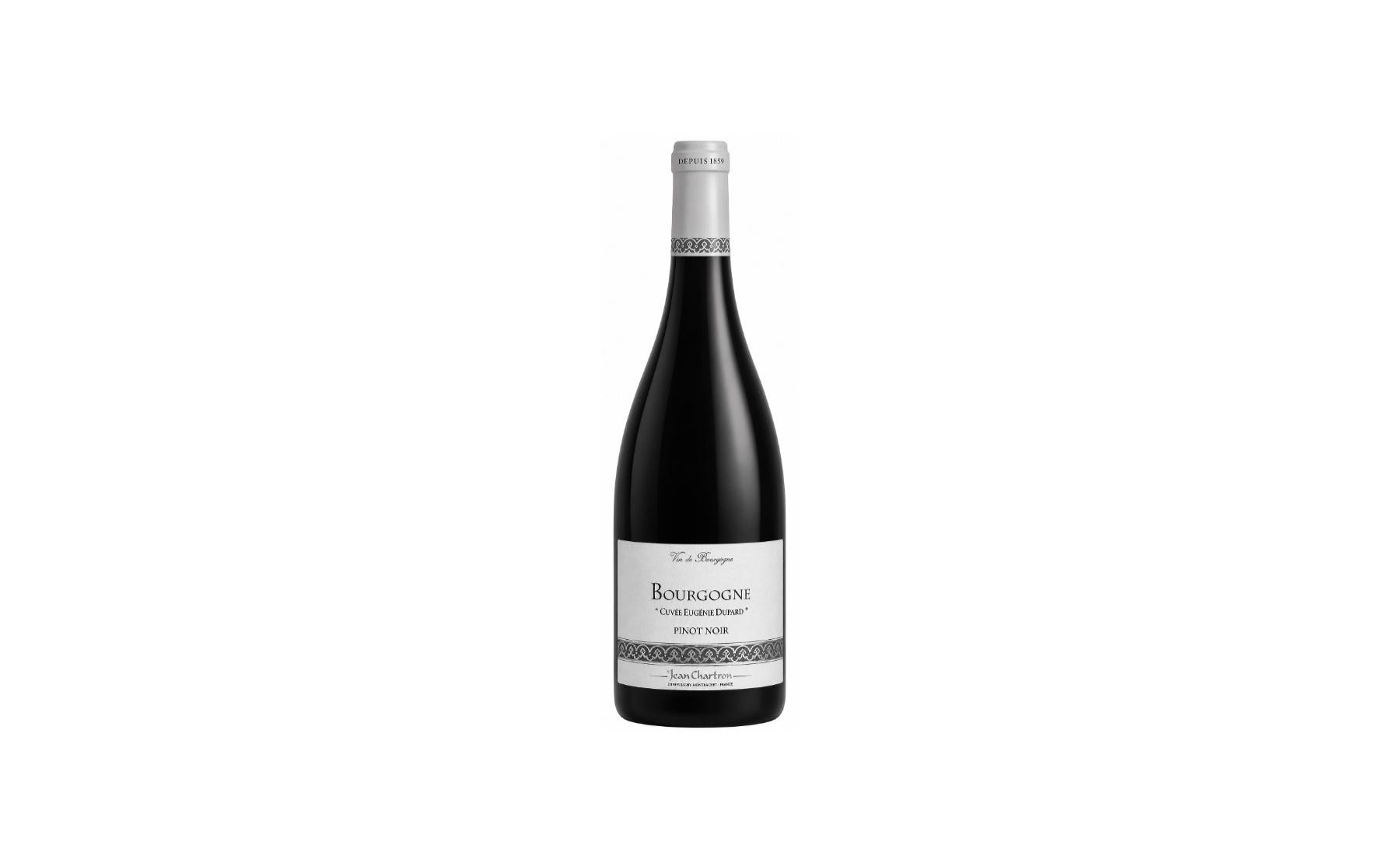
From an estate internationally associated with the great white wines of Puligny-Montrachet comes a comparatively modest red Burgundy with an unusually personal history. Named after a woman central to the Chartron family’s nineteenth-century heritage, Cuvée Eugénie Dupard combines traditional Pinot Noir vinification, measured oak ageing and an accessible drinking style. Its appeal lies less in classification or investment potential than in the opportunity to experience an established Côte de Beaune domaine through a different expression of Burgundy.
A red Burgundy with a remarkable family history
The identity of Domaine Jean Chartron is closely associated with Chardonnay, the limestone vineyards of Puligny-Montrachet and some of the Côte de Beaune’s most celebrated white-wine appellations. Bourgogne Pinot Noir Cuvée Eugénie Dupard occupies a rather different position within the estate.
It is a regional-appellation red Burgundy, produced from Pinot Noir and intended to offer the freshness, delicacy and aromatic precision that make the variety so distinctive. Yet its name connects the wine directly to the origins of one of Puligny’s longstanding winegrowing families.
The domaine was founded in 1859 by Jean-Édouard Dupard, a cooper whose descendants would become closely involved in the development of Puligny-Montrachet. His daughter, Eugénie Dupard, married Jean-Edmond Chartron, bringing vineyards into the marriage as her dowry. That union established the relationship between the Dupard and Chartron families from which the present domaine descends.
The family’s influence extended beyond viticulture. While serving as mayor of Puligny in 1873, Jean-Édouard Dupard initiated the municipal resolution seeking permission to add Montrachet, the village’s most prestigious vineyard name, to that of the commune.
The association between family, village and vineyard was subsequently reinforced by several generations of Chartron mayors.
Today, the fifth generation is represented by Jean-Michel Chartron and his sister Anne-Laure. Jean-Michel oversees vinification, while Anne-Laure and the vineyard team manage the estate’s vines.
Their domaine extends across approximately 14.5 hectares in Puligny-Montrachet and neighbouring communes, encompassing regional, Village, Premier Cru and Grand Cru appellations.
Within this portfolio, Eugénie Dupard is neither a flagship wine nor a classified vineyard bottling. Its significance is more intimate: a regional Pinot Noir bearing the name of a woman who helped establish the family’s winegrowing inheritance.
It is an example of how Burgundy’s history can be preserved not only through famous climats and prestigious classifications, but also through the names attached to comparatively everyday wines.
Bourgogne appellation: Prestige begins with the producer
Bourgogne Pinot Noir Cuvée Eugénie Dupard is classified under the regional Bourgogne appellation rather than a Village, Premier Cru or Grand Cru designation.
The distinction matters.
Burgundy’s appellation hierarchy places considerable emphasis on geographical specificity. Village wines are associated with recognised communes, while Premiers Crus and Grands Crus identify more narrowly delimited vineyards with established historical reputations.
Regional Bourgogne occupies the broader foundation of this hierarchy.
For consumers, this generally means less emphasis on a particular classified vineyard and greater importance attached to the grower, grape selection, vintage and winemaking.
Cuvée Eugénie Dupard should therefore not be confused with a red Puligny-Montrachet Premier Cru, even though it comes from a domaine possessing prestigious vineyards in the village.
Its appeal lies partly in that separation between the classification of the wine and the reputation of its producer.
Domaine Jean Chartron is particularly associated with white Burgundy, including important holdings in Puligny-Montrachet and its surrounding appellations. The estate nevertheless maintains a smaller red-wine range, including the unusual Puligny-Montrachet Premier Cru Clos du Cailleret.
Eugénie Dupard offers a substantially more accessible introduction to this less familiar side of the domaine.
The estate also identifies the wine under the alternative designation Vieilles Vignes. However, the precise age of the vines used for the cuvée is not consistently specified in its principal public technical information.
The designation should therefore be understood as part of the wine’s commercial identity rather than as evidence of a particular vine age.
There is another important distinction for collectors. The name Cuvée Eugénie Dupard has also appeared on a white Bourgogne Chardonnay from Jean Chartron. Consequently, the cuvée name alone does not establish which wine is being offered.
Colour, grape variety, appellation wording and vintage must be verified when comparing older bottles, merchant listings or critical reviews.
Clay-limestone terroir and the character of Pinot Noir
The producer describes the soil associated with Bourgogne Pinot Noir Cuvée Eugénie Dupard as clay and limestone.
This geological combination is familiar across Burgundy but remains important to understanding the balance the wine seeks to achieve.
Limestone-rich soils can provide favourable drainage, while clay influences water retention and the availability of moisture during the growing season. The interaction between these components, alongside soil depth, exposure, rainfall and vineyard management, helps shape the conditions under which Pinot Noir ripens.
For a grape variety as sensitive to growing conditions as Pinot Noir, small differences in water supply and ripening speed can influence aromatic development, acidity and tannin maturity.
Merchant descriptions associate Eugénie Dupard with vineyards around Puligny-Montrachet, although the estate’s principal public specification does not establish an exact vineyard, lieu-dit or fixed parcel selection.
Nor does it provide a complete technical account of the cuvée’s vineyard area, individual exposures, planting density or annual yields.
The wine should consequently not be presented as a single-vineyard expression or monopole.
What can be established more securely is the domaine’s broader approach to viticulture.
Jean Chartron places considerable emphasis on attentive soil management, pruning that respects the movement of sap through the vine, careful canopy work and manual harvesting.
The estate’s general red-wine protocol also allows for sorting in the vineyard when vintage conditions make additional selection necessary.
Its environmental approach has been described by specialist merchants and wine publications as organic in practice, although formal organic certification for this cuvée has not been established. The distinction between cultivation methods and certified status remains important.
In stylistic terms, the objective appears to be balanced ripeness rather than maximum extraction.
Eugénie Dupard is not intended to reproduce the concentration of a powerful Premier Cru from the Côte de Nuits. Its defining qualities are more closely associated with fruit clarity, freshness, approachable tannin and a relatively supple texture.
These characteristics reflect both the flexibility of the regional Bourgogne appellation and the domaine’s preference for precise, controlled vinification.
Traditional winemaking and a measured influence of oak
The cellar treatment of Cuvée Eugénie Dupard is more clearly documented than its individual vineyard origins.
Pinot Noir is fermented in open wooden vats before undergoing approximately twelve months of maturation in oak barrels.
The ageing regime is specific: 25% new oak and 75% barrels between one and five years old.
This combination is significant for a regional Bourgogne.
New oak can contribute aromatic complexity, subtle spice and additional structure, while previously used barrels allow maturation without the same intensity of fresh wood character.
At a proportion of one-quarter new barrels, the intention is evidently not to dominate Pinot Noir’s natural perfume, but to provide sufficient structure and integration during élevage.
The domaine’s wider red-wine protocol provides further insight into its philosophy.
Following manual harvesting, red-wine fermentation generally takes place in open wooden vats under controlled temperatures. The estate describes typical cuvaisons lasting approximately twelve to fifteen days, with pigeage and remontage used to manage extraction.
These techniques serve different but complementary purposes. Pigeage, or punching down the cap, encourages contact between juice and grape skins. Remontage, or pumping over, circulates fermenting juice over the cap.
Both help determine the extraction of colour, tannin and aromatic compounds.
The precise balance between them can vary according to the characteristics of the harvest.
A commercial description of the 2024 Eugénie Dupard refers to a longer, approximately three-week cuvaison using remontage. This should be treated as a vintage-specific account rather than as confirmation that the same method applies every year.
After fermentation, the wine undergoes barrel maturation, with the producer specifying twelve months on fine lees for this cuvée.
Fine-lees contact can contribute texture and integration, allowing the wine to develop without relying solely on oak for a sense of substance.
The domaine’s general practice for red wines includes light fining and bottling without filtration, although not every technical parameter is separately confirmed for every Eugénie Dupard vintage.
The resulting approach is recognisably Burgundian: controlled extraction, relatively restrained maturation and an emphasis on preserving Pinot Noir’s balance.
It is particularly appropriate for a regional wine whose principal attraction is finesse rather than sheer concentration.
Red fruit, freshness and supple tannins
Cuvée Eugénie Dupard is best understood as a fruit-led, relatively accessible expression of Pinot Noir.
Its aromatic character is built around red berries, with darker-fruit accents providing additional depth.
The producer’s description of the 2022 vintage emphasises crushed strawberry and blackcurrant, together with a plum-coloured appearance and fresh, textured tannins.
Commercial tasting descriptions of the 2024 identify cherry and wild strawberry, accompanied by subtle clove, floral nuances, earthy undertones and suggestions of undergrowth.
These observations indicate a recognisable stylistic relationship between vintages, although differences in weather and ripeness naturally influence the final expression.
In youth, the wine’s most attractive characteristics are likely to be its immediate fruit, freshness and delicately structured palate.
Strawberry, raspberry and cherry provide the principal aromatic framework. Blackcurrant may introduce a darker note, while subtle spice and woodland impressions add complexity without necessarily implying substantial bottle development.
The body is best characterised as light to medium rather than powerful.
Tannins are generally described as fine, supple and integrated. Acidity contributes freshness and definition, preventing the fruit from becoming heavy.
The oak regime may introduce delicate spice and additional texture, although prominent toasted or vanilla-driven character is not central to the documented style.
The 2024 appears particularly focused on aromatic delicacy, with floral detail and fresh red fruit playing an important role.
The 2022 provides a useful contrasting reference, showing a slightly more generous fruit profile while retaining the freshness considered fundamental to the cuvée.
With bottle age, the youthful berry character can be expected to soften, potentially revealing more savoury impressions of dried flowers, woodland and gentle spice.
Such evolution should not, however, be confused with the profound tertiary complexity associated with mature Grand Cru Pinot Noir.
Eugénie Dupard’s attraction lies in proportion: sufficient fruit and structure to remain interesting, but without the need for extended cellaring before the wine becomes pleasurable.
Understanding the recent vintages
Vintage conditions are particularly relevant to regional Bourgogne, where the relationship between ripeness, freshness and tannin maturity can vary considerably from one growing season to another.
For Eugénie Dupard, the differences between 2022, 2023, 2024 and 2025 provide a useful perspective on the wine’s development.
2022: Generosity with freshness
The 2022 vintage offers one of the clearest published references for the wine’s intended character.
The producer describes an appealing balance of strawberry, blackcurrant and fresh tannins, presenting the wine as immediately enjoyable rather than demanding prolonged maturation.
More broadly, the domaine regarded 2022 as a charming vintage combining generous fruit with good freshness.
For current drinking, it is an especially relevant choice.
Jean Chartron’s technical guidance recommends a drinking period from 2024 to 2028, making sound bottles of the 2022 suitable for opening now.
2023: Abundance and ripe fruit
The 2023 growing season brought a comparatively generous harvest across the domaine, although warm conditions and periods of disease pressure required attentive vineyard management.
The estate’s vintage commentary records challenges involving mildew, powdery mildew and later botrytis, making selection important.
The wider vintage suggests the possibility of approachable, relatively generous fruit, but the precise balance of the finished Eugénie Dupard should be assessed independently rather than inferred from regional conditions alone.
For consumers, 2023 remains an interesting comparison with the fresher stylistic expectations surrounding 2024.
2024: Precision after a difficult season
The 2024 vintage was considerably more challenging.
According to the estate, spring rainfall reached approximately 87% above the seasonal average, creating significant pressure from mildew. Difficult growing conditions affected yields and required continued vineyard attention.
Despite these challenges, Jean Chartron reported encouraging aromatic maturity and delicate tannins in its red wines.
For Eugénie Dupard specifically, the 2024 has been commercially described in terms of ripe cherry, wild strawberry, restrained spice, floral character and a fresh, finely textured palate.
These characteristics suggest a vintage in which delicacy and freshness may prove more important than density.
For Burgundy enthusiasts who favour elegant Pinot Noir over richer, more extracted expressions, 2024 is consequently of particular interest.
2025: Concentration moderated by freshness
The 2025 season followed a different pattern.
After a cold winter and uneven flowering, heatwaves during June and August increased ripening pressure. Millerandage contributed to smaller-than-expected yields, while rainfall toward the end of August helped maintain acidity.
The domaine’s general vintage assessment emphasises concentration, healthy fruit and a promising balance between richness and freshness.
Early commercial descriptions of the 2025 Eugénie Dupard highlight raspberry, morello cherry and redcurrant, with supple tannins.
However, these early impressions should not be treated as the equivalent of an established record of mature bottled wine.
With the vintage offered en primeur during 2026, its longer-term performance remains to be demonstrated.
Taken together, these four vintages illustrate the cuvée’s central stylistic objective: to preserve drinkability while allowing differences in seasonal conditions to emerge.
For immediate enjoyment, 2022 offers the clearest producer-supported reference. For a fresher, more delicate expression, 2024 is particularly interesting. The eventual standing of 2025 will depend on how its concentration and acidity integrate after maturation.
Cellaring potential: A Burgundy to enjoy within its natural horizon
Not every serious Burgundy needs a decade or more in the cellar.
Indeed, one of the attractions of a carefully made regional Pinot Noir is the opportunity to enjoy its fruit and texture relatively early.
Cuvée Eugénie Dupard belongs to this category.
The producer’s recommended drinking window for the 2022 extends from 2024 to 2028, indicating a relatively moderate ageing horizon.
For recent vintages, a broad expectation of approximately three to seven years from harvest appears reasonable, depending on vintage conditions, bottle storage and individual preference. This is an editorial estimate rather than a producer guarantee for every year.
Young bottles are likely to be most expressive in their red-fruit character. With a few additional years, acidity and tannin may become more integrated, while subtle savoury notes begin to appear.
The wine does not have the documented mature-vintage history needed to support confident claims of routine fifteen- or twenty-year longevity.
This is a meaningful distinction for collectors.
Extended bottle ageing introduces increasing uncertainty. Cork condition, storage history, transport exposure and vintage variation become more influential as the wine moves beyond its intended drinking period.
Consequently, Eugénie Dupard should generally be purchased with a view to near- or medium-term enjoyment rather than indefinite storage.
Its ageing potential is sufficient to make small vertical collections interesting, but its principal purpose remains drinking.
Market positioning: The appeal of accessible Burgundy
The fine-wine market has become increasingly associated with scarcity, vineyard prestige and international demand.
In Burgundy, the most sought-after producers and appellations can command prices far beyond the reach of many otherwise knowledgeable enthusiasts.
Cuvée Eugénie Dupard occupies a more approachable commercial position.
French retail offers observed in early November 2026 placed recent vintages around €28–€30 per 75cl bottle.
The 2024 was listed at approximately €28–€29.20, while retail observations for the 2023 were close to €29.40.
The 2022 was also offered by a French specialist merchant at approximately €28.
In the United Kingdom, a six-bottle offer for the 2024 corresponded to approximately £29.67 per bottle, including duty and VAT.
These prices are indicative advertised retail offers rather than completed transactions. Differences in taxation, distribution and merchant margins also mean that international prices should not be compared without qualification.
The 2025 vintage was offered en primeur at approximately €28–€29 per bottle through French and Belgian merchants, with delivery scheduled later.
At these levels, the cuvée competes within the market for well-made regional Burgundy rather than prestigious classified Pinot Noir.
Its pricing reflects several identifiable advantages: an established family producer, traditional vinification, a meaningful oak-ageing programme and a connection with one of Burgundy’s most recognisable white-wine villages.
What it does not offer is the vineyard classification or documented scarcity associated with Burgundy’s most expensive collectible wines.
Annual production figures for the red cuvée are not securely established, and commercial availability across several European markets suggests ordinary specialist distribution rather than an exceptionally restricted allocation system.
The value proposition is therefore principally qualitative.
For enthusiasts wishing to explore the wines of Jean Chartron without purchasing a classified white Burgundy, Eugénie Dupard provides a comparatively inexpensive entry point.
Collectability and the limits of investment appeal
The distinction between an interesting wine to collect and a wine suitable for financial investment is fundamental.
Bourgogne Pinot Noir Cuvée Eugénie Dupard has several qualities that may appeal to collectors.
Its name preserves a direct connection with nineteenth-century family history. Its producer possesses an established reputation in the Côte de Beaune. Its recurring production allows enthusiasts to compare vintages, while its modest price makes a small vertical relatively achievable.
However, the evidence for an active secondary market is limited.
No representative pattern of completed auction transactions for the red cuvée has been established through the principal international wine-auction houses, and there is no substantial, reliably documented history of trading through Liv-ex.
Nor is there a consistent published sequence of major critic scores for the red bottling sufficient to demonstrate score-driven collector demand.
This does not mean the wine lacks quality or desirability. It means that its reputation operates largely outside the mechanisms that support prices for internationally traded investment wines.
For perspective, the wider Burgundy fine-wine market experienced some improvement during 2026. At the end of October, the Liv-ex Burgundy 150 index was approximately 2.1% higher year-to-date, although still around 6.3% below its level five years earlier.
Such figures illustrate the volatility of the wider fine-wine market, but they are not a valuation measure for Eugénie Dupard. The index tracks a substantially different group of wines with established secondary-market activity.
For a regional Pinot Noir retailing around €30, transaction costs present another significant obstacle to financial investment.
Auction commissions, shipping, professional storage, insurance and potential tax liabilities can quickly consume any modest appreciation.
There is also no reliable evidence that the cuvée benefits from a substantial premium for large formats, original packaging or exceptionally old vintages.
Its strongest collecting audience is therefore likely to consist of Domaine Chartron enthusiasts, Burgundy specialists and drinkers interested in comparing the influence of vintage on an accessible regional Pinot Noir.
A collector assembling a small selection of 2022, 2023 and 2024 bottles could explore meaningful stylistic differences without committing the capital associated with a vertical of classified Burgundy.
For investors seeking liquidity, measurable historical returns and an established resale market, the wine presents a much less convincing proposition.
Scarcity alone is not sufficient to create financial value, particularly when the scale of production and depth of demand are uncertain.
Provenance and the importance of correct identification
At its relatively modest market price, Eugénie Dupard is not an obvious target for the sophisticated counterfeiting associated with Burgundy’s most valuable bottles.
No well-established history of counterfeiting involving this specific red cuvée has been documented.
The more immediate practical issue is identification.
Both red Pinot Noir and white Chardonnay have appeared under the Cuvée Eugénie Dupard name. Historical listings may also use alternative designations, including Vieilles Vignes.
Buyers should therefore confirm that a bottle is indeed the red Bourgogne Pinot Noir rather than relying solely on the cuvée name.
Older merchant descriptions and critical references require particular care. A review or score associated with Eugénie Dupard should not automatically be attributed to the Pinot Noir unless the wine’s colour and identity are explicit.
For bottles acquired with some age, ordinary provenance considerations remain important.
Storage temperature, exposure to heat, fill level, seepage, cork condition and transport history can all affect the likelihood that a wine has developed as intended.
Because Eugénie Dupard is generally suited to relatively early drinking, there is little reason to pay a substantial premium for an older bottle without excellent provenance.
For this wine, freshness and condition are likely to be more valuable than age alone.
Serving and food pairing
Cuvée Eugénie Dupard benefits from service that preserves its aromatic delicacy.
The producer recommends a serving temperature of 13–15°C for the 2022 vintage, a useful reference for the cuvée’s general style.
This is slightly cooler than the temperature at which many red wines are served, but appropriate for a fresh, relatively light Pinot Noir.
Excessive warmth can make alcohol more apparent and diminish the precision of delicate red-fruit aromas.
Young bottles generally do not require prolonged decanting.
Opening the wine approximately twenty to thirty minutes before service should be sufficient in many circumstances. Brief aeration may help a particularly closed bottle, but extended exposure is unlikely to be necessary.
Older bottles should be opened carefully and assessed before decanting. Where sediment is present, a gentle transfer may be preferable to vigorous aeration.
A generous Burgundy glass will allow the wine’s fruit and subtle floral aromas to develop.
At the table, its moderate tannin, fresh acidity and relatively delicate structure make it especially compatible with poultry, veal and mushroom-based dishes.
Bresse chicken with a light jus and morels is a particularly attractive pairing. The poultry provides sufficient flavour and texture without overwhelming the wine, while the mushrooms complement its potential earthy nuances.
Roast quail or pigeon can also work well, particularly when accompanied by restrained reductions rather than heavily concentrated sauces.
Duck breast served pink, with herbs and a modestly savoury accompaniment, provides another appealing combination. The wine’s acidity refreshes the palate, while its red-fruit character complements the meat.
For a vegetarian pairing, a mushroom-and-herb pithivier or a tart of roasted seasonal vegetables offers the necessary aromatic compatibility without excessive richness.
The producer’s own food guidance also favours charcuterie and white meats, reinforcing the wine’s versatile, convivial character.
Cheese pairings should follow similar principles.
Comté or Gruyère provides nutty complexity without the pungency that might dominate the wine. Strong washed-rind cheeses or aggressively spiced dishes are generally less suitable.
With bottles showing modest bottle development, carefully prepared truffle or woodland-mushroom dishes may become especially appealing.
The guiding principle is restraint. Eugénie Dupard performs best alongside food that complements its finesse rather than demanding a level of concentration it is not designed to provide.
How it compares with other Burgundy Pinot Noirs
The most meaningful comparisons for Eugénie Dupard are regional Bourgogne Pinot Noirs from established Côte de Beaune growers.
These wines often offer an attractive balance between producer reputation, traditional vinification and relative affordability.
Against less ambitious regional Burgundy, Jean Chartron’s cuvée benefits from a clearly documented oak-ageing programme, manual harvesting within the domaine’s red-wine practice and the experience of a longstanding family producer.
Its historical identity adds another dimension, although family heritage is not itself a guarantee of superior wine quality.
Bourgogne Côte d’Or reds provide one relevant point of comparison, especially when sourced from producers with a comparable commitment to restrained extraction and freshness.
Bourgogne Hautes-Côtes de Beaune Pinot Noir offers another stylistic alternative. Depending on site and vintage, these wines may emphasise freshness and lighter structure, although individual producer differences remain decisive.
Village wines from appellations such as Savigny-lès-Beaune, Monthélie or Santenay represent a further step in geographical specificity.
They may offer more explicitly identifiable terroir and, in suitable vintages, additional ageing potential. The trade-off is often a higher entry price, although Burgundy pricing is influenced by producer reputation as much as appellation hierarchy.
Within Domaine Jean Chartron itself, the red Puligny-Montrachet Premier Cru Clos du Cailleret provides a particularly instructive contrast.
Clos du Cailleret belongs to a much more prestigious classification and represents a specifically identified vineyard. Eugénie Dupard instead offers the more accessible regional expression of Pinot Noir.
The two should not be regarded as direct competitors.
What distinguishes Eugénie Dupard is the combination of a respected Puligny producer, family-historical identity and an approachable regional price.
It is a wine through which enthusiasts can explore a lesser-known aspect of an established domaine without the financial commitment associated with Burgundy’s classified vineyards.
Gallico Vinum Verdict
Domaine Jean Chartron’s Bourgogne Pinot Noir Cuvée Eugénie Dupard occupies an attractive position within the world of accessible Burgundy.
Its significance is not based on an exceptional classification, a celebrated single vineyard or an established international auction reputation.
Instead, it brings together an unusually direct connection with the history of Puligny-Montrachet, a respected family estate, traditional Pinot Noir vinification and a style built around freshness, supple tannins and early drinking pleasure.
The wine’s strengths are tangible. Its production methods are well documented, its aromatic character is consistent with the elegance expected of regional Bourgogne Pinot Noir, and its retail price remains approachable relative to much of the Côte de Beaune’s classified production.
Its limitations are equally important. The precise vineyard origins and production volumes are not fully disclosed, its long-term ageing performance is not extensively documented, and the secondary market offers little evidence of sustained collector liquidity.
For enthusiasts, the cuvée represents a worthwhile introduction to Domaine Jean Chartron’s red-wine production and a particularly appealing choice for relaxed, food-oriented drinking.
For collectors, it offers historical interest and the possibility of assembling an affordable vertical across recent vintages.
For investors, its modest price and uncertain resale market make meaningful financial appreciation difficult to establish as a credible purchasing rationale.
Gallico Vinum regards Cuvée Eugénie Dupard primarily as a wine of drinking value rather than investment ambition. Its distinction rests on the quality of the experience it offers at a comparatively modest price, supported by the history of a family whose contribution to Puligny-Montrachet extends far beyond this individual bottling.
It is a reminder that Burgundy’s appeal is not confined to its most expensive or famous vineyards. Sometimes the most rewarding bottles are those that offer an honest expression of their grape, a connection with their producer and the simple pleasure of being opened at the right moment.